
Throughout human history, the evolution of residential architecture has been inextricably linked to our mastery of artificial illumination. Long before the invention of the modern electrical grid, the physical layout, ceiling height, and even the wall colors of a home were entirely dictated by how light was generated and dispersed. As an experienced lighting designer, I frequently look back at the historical timeline of interior illumination to draw profound inspiration for contemporary spaces. Understanding how lighting fixtures evolved from primitive survival tools into the ultimate expressions of artistic luxury allows us to make more intentional, educated design choices for our own homes today. This extraordinary journey from the flickering open flame to the highly intelligent light-emitting diode is a fascinating exploration of human ingenuity, engineering, and aesthetic ambition.

The Age Of Open Flames And Crystal Brilliance
For centuries, the absolute primary source of interior light was the open flame, fueled by animal fats, crude oils, and eventually beeswax or tallow. Because open flames continuously produce smoke, consume oxygen, and require constant vertical ventilation, early lighting fixtures were strictly utilitarian and often dangerous. However, as medieval castles slowly gave way to the opulent palaces of the Renaissance, the social necessity to illuminate massive dining halls birthed the most iconic fixture in interior design history: the hanging chandelier.
Early wooden and iron ceiling hoops eventually evolved into extravagant, multi-tiered brass structures. By the early 18th century, European glassmakers began incorporating faceted lead crystal drops into these metal frames. This was not merely a decorative choice; it was a highly functional, scientific engineering solution. The precisely cut crystal prisms refracted and magnified the dim, flickering light of dozens of expensive candles, drastically increasing the overall ambient brightness of the room. Today, the fixtures found in our premium Chandeliers collection still borrow heavily from these historical silhouettes, offering that exact same sense of timeless grandeur and focal-point drama without the inherent fire hazard.
The Industrial Revolution And Gas Lighting
As the world hurtled into the 19th century, the rapid expansion of the Industrial Revolution brought about the first major infrastructural shift in illumination: coal gas. Gas lighting burned significantly brighter and more consistently than candles, and it could be piped directly into affluent homes and municipal city streets. This era introduced the world to ornate, fixed wall sconces and highly robust exterior glass enclosures.

Because exterior gas flames still needed strict protection from wind, rain, and snow, metalworkers crafted heavy-duty brass and cast-iron housings equipped with thick, tempered glass panes. These rugged, deeply weather-resistant designs established the core visual DNA for the traditional Outdoor Lanterns that continue to grace the front porches and garden patios of American homes today.
Despite its brightness, gas lighting was notoriously problematic. It produced toxic fumes, rapidly blackened ornate plaster ceilings with heavy soot, and consumed massive amounts of oxygen in closed rooms, setting the stage for a desperate global need for a cleaner, safer alternative.
The Electric Paradigm Shift
The commercialization of the incandescent electric bulb in the late 19th century completely shattered the established rules of interior design. Electricity meant absolutely no open flames, zero toxic smoke, and the elimination of the requirement for vertical ventilation space. For the first time in human history, light fixtures could be safely turned upside down, completely enclosed in delicate glass globes, and mounted directly against plaster materials.
This newfound electrical freedom directly gave rise to low-profile Flush Mount Ceiling Lights, which allowed residential architects to design modern rooms with significantly lower ceilings and much cleaner, uninterrupted visual sightlines.
The electric era also birthed incredibly distinct aesthetic design movements, shifting rapidly from the ornate, organic floral motifs of Art Nouveau to the streamlined, geometric precision of the Mid-Century Modern period. During the mid-20th century, lighting was no longer viewed just as a pragmatic way to see in the dark; it became a defining, sculptural element of a room's architectural identity.

Technical Data: Tracking Luminous Efficacy
To truly comprehend the magnitude of our engineering progress, industry professionals look at a metric called luminous efficacy, measured in lumens per watt (lm/W). This metric defines exactly how much visible light is produced relative to the energy consumed. The exponential growth seen in the chart below illustrates why modern lighting focuses so heavily on advanced technological integration:
| Historical Era | Primary Technology | Luminous Efficacy | Architectural Impact |
|---|---|---|---|
| 18th Century | Beeswax Candles | 0.1 - 0.3 lm/W | High ceilings required for heat dissipation; large reflective fixtures needed. |
| 19th Century | Coal Gas Lighting | 1.0 - 2.0 lm/W | Fixed wall piping introduced; glass enclosures developed for safety. |
| Early 20th Century | Incandescent Bulb | 10 - 15 lm/W | Flush mounting invented; downward-facing lighting became possible. |
| Modern Era (Today) | Solid-State LED | 90 - 150+ lm/W | Miniaturization of fixtures; integration into smart home systems. |
The Digital Frontier: LEDs And Sustainable Autonomy
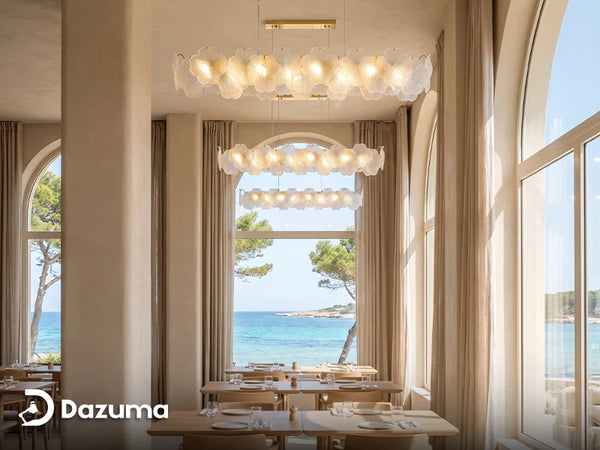
Today, we are living through the most significant leap in lighting technology since the invention of the electric bulb: the global transition to solid-state digital illumination. Light Emitting Diodes (LEDs) generate light by passing electrons through specialized semiconductors rather than burning fragile metal filaments, resulting in unprecedented energy efficiency, zero heat generation, and decade-long lifespans. Because LEDs are practically microscopic, they have entirely decoupled fixture design from the physical volume constraints of a traditional glass bulb. As a result, our curated Modern Chandeliers can now take the breathtaking shapes of floating halos, ultra-thin minimalist geometric lines, and complex organic curves that were physically impossible to construct just twenty years ago.

Furthermore, the incredibly low power consumption of modern LEDs has utterly revolutionized exterior landscaping architecture. By combining highly efficient diodes with advanced photovoltaic solar panels and high-capacity lithium battery cells, the industry has achieved true electrical autonomy.
When you explore cutting-edge solutions like Outdoor Solar Lights, you are looking at the modern peak of this evolutionary timeline. These highly advanced fixtures completely eliminate the need for destructive yard trenching and expensive hardwiring. They represent the ultimate culmination of our lighting journey: capturing the raw power of the sun during the day to autonomously illuminate our pathways at night, seamlessly merging environmental sustainability with effortless elegance.
Embrace The Next Generation Of Illumination
From the historical romance of grand crystal centerpieces to the wire-free autonomy of smart solar landscapes, lighting continues to fundamentally shape how we experience our homes. Elevate your interior and exterior spaces by exploring our diverse catalog, where historical craftsmanship perfectly meets next-generation LED technology.
Explore The Complete Lighting Collection