



2 PCS Black Outdoor Wall Light European Vintage Three-Light

DESCRIPTION
Description:
This black outdoor wall light combines a black iron frame with clear glass panels in a classic European-inspired design. A large curved arm rises above the lantern and is accented with decorative scrollwork, giving the fixture a distinctive architectural character. The compact multi-sided glass enclosure keeps the overall silhouette balanced while allowing the three internal light sources to remain visible and spread light naturally around the fixture. Measuring approximately 26.8 inches high, this larger wall light has enough presence for villa exteriors, garden entrances, brick walls, gates, and other substantial outdoor surfaces. It uses three E12 sockets, allowing compatible bulbs to be selected according to the desired lighting effect. The iron and glass construction reinforces its traditional lantern appearance, while the IP44 rating provides protection against light splashes. For outdoor use, it is best suited to covered entrances, porches, walls beneath eaves, and other sheltered locations.
Highlights:
26.8-Inch Tall Design: This black outdoor wall light creates noticeable presence on larger exterior walls and entrances.
Three E12 Sockets: Provides a layered three-light arrangement for decorative illumination.
Large Curved Iron Arm: Adds distinctive European scrollwork and architectural character.
Clear Glass Panels: Keep the lantern visually open while spreading light naturally.
IP44 Outdoor Protection: Best suited for porches and sheltered exterior installations.
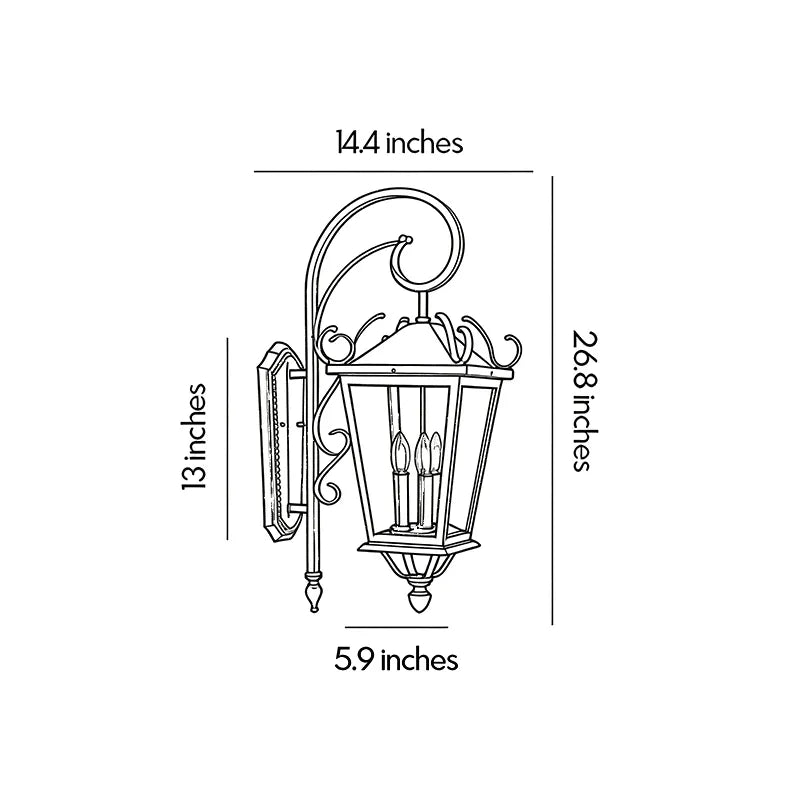
WEIGHTS & DIMENSIONS
| Size: Hight 26.8 inches | |
| Weight: | 8.60lb |
| Size: | 14.37'' Width x 9.06'' Depth x 26.77'' Height |
DETAILS
| Product Type: | Outdoor Wall Sconces |
| Power Supply: | Hardwired |
| Voltage: | 110V |
| Style: | European |
| Bulb Base: | E12*3 |
| Finish: | Black |
| Material: | Iron |
| Shade Color: | Clear |
| Shade Material: | Glass |
| Bulb Included: | No |
| Control Type: | Wall Switch |
| Mounting Type: | Wall Mount |
| Ingress Protection: | IP44 |
| Indoor/Outdoor: | Outdoor |
| Product Care: | Turn Off the Power,Wipe Clean with Dry Cloth |
DEAL
Buy More Save More!
For purchases of 10 or more of the above items, please Contact Us for special offers.
Shipping & Delivery
Shipping & Delivery
Free Shipping
Dazuma offers free standard shipping on orders over $49. For orders under $49, a flat shipping fee of $9.99 will apply.
Processing Time
We start processing your order as soon as it is placed. You will receive an email confirmation upon placing your order. Please review your order details carefully for accuracy. Processing times are as follows:
- Standard Products: 7–10 business days.
- Custom or Bulk Orders: 10–35 business days.
- Peak Periods or Holidays: Processing times may extend during high-order volumes.
Shipping Methods & Delivery Times
Dazuma provides the following shipping options to suit your needs:
Standard Shipping
- Estimated Delivery Time: 15–25 business days.
- Cost: Free for orders over $49; $9.99 flat rate for orders under $49.
Expedited Shipping
- Estimated Delivery Time: 7–10 business days.
- Cost: Additional fees apply; calculated at checkout.
Note: Delivery times may vary depending on your location and carrier logistics.
Shipping Costs
Shipping costs are calculated based on:
- The shipping method you select.
- The weight and dimensions of your order.
- The delivery destination.
The total shipping cost will be displayed at checkout before completing your purchase.
Order Tracking
Once your order ships, you will receive an email that includes:
- A tracking number.
- A link to track your package.
- The carrier’s information (e.g., UPS, FedEx, DHL).
You can also track your order via our website on the Order Tracking page.
Shipping Delays
We strive to deliver your order on time; however, delays may occur due to:
- Inventory availability or processing capacity.
- High order volumes during peak seasons.
- Unforeseen circumstances such as natural disasters or strikes.
- Customs clearance issues or carrier delays.
If a significant delay occurs, we will notify you promptly. For urgent assistance, please contact Dazuma Customer Service.
Lost or Damaged Packages
Lost Packages
- If your package is not delivered within 15 business days of the expected delivery date, please contact us.
- We will work with the carrier to locate your package or provide a replacement/refund.
Damaged Packages
- If your package arrives damaged, please contact us within 48 hours of delivery.
- Provide photos or videos of the damaged item and packaging to expedite the resolution process.
Ownership & Authorized Online Operations
Dazuma is a lighting brand owned by DUSTERONE SARL, 44 Rue Beaurepaire, 49100 Angers, France.
Dazuma.us is an authorized online retail channel for Dazuma-branded products. HONGKONG GAOXUNBOO TECHNOLOGY CO., LIMITED is authorized by DUSTERONE SARL to support global e-commerce operations, including online store management, order processing, customer-service coordination, payment support, and logistics coordination for Dazuma.us.
Authorized U.S. Return & Exchange Receiving Facility
For approved returns and exchanges only:
Recipient: MH022 Address: 21 Central Ct STE #7, Leominster, MA 01453, United States
Please contact Dazuma Customer Support before sending any return or exchange shipment. Packages sent without prior authorization, missing order information, or sent to the wrong facility may be delayed, refused, or returned to sender.
Additional Information
- International Shipping: Available to select locations.
- Non-Serviceable Addresses: We cannot deliver to Alaska, Hawaii, P.O. Boxes, APO/FPO addresses, or restricted areas.
- Customs and Duties: All customs fees, import taxes, and duties are included in the shipping cost.
- Installation & Assembly: Dazuma does not provide on-site installation, assembly, indoor placement, or labor services.
- Non-Refundable Shipping Charges: Please note that shipping charges are non-refundable.
Return & Refunds
Return & Refunds
At Dazuma, we are committed to enhancing your home with thoughtfully designed lighting and home décor. While every order is rigorously inspected by our QA team before shipping, we understand that a return or refund may occasionally be necessary. This policy outlines the process for returns, refunds, and exchanges to ensure a seamless experience.
1. Order Cancellation Policy
Cancellation Before Shipping: You may cancel your order for a full refund at any time before the product has been shipped. Please contact us immediately at [email protected] to process your request.
Cancellation After Shipping: Once an order has been transferred to the carrier and is in transit, it cannot be canceled or modified. If you no longer wish to keep the item, please refer to our return policy after receiving the package.
Customized Orders: Once production of a custom or specialty order (non-stock sizes/designs) has begun, the order cannot be canceled or modified.
2. Return Window & Eligibility
Geographical Restriction: We only offer return and exchange services for orders delivered within the United States. We do not accept returns or exchanges from countries or regions outside the USA.
30-Day Strict Deadline: We offer a 30-day return window from the date of delivery. You must initiate your return request within this period. No returns or refund requests will be accepted after 30 days of receipt.
Condition Requirement: To be eligible for a return, items must be in their original condition: unused, unassembled, undamaged, and in their original packaging (unopened). All original tags, instructions, and inserts must be included.
3. Non-Returnable Products
The following items are strictly non-returnable and non-refundable:
Orders from outside the USA.
Customized or personalized items (unless there is a confirmed quality defect).
Items that have been assembled, used, or altered.
Clearance items, "Open Box" items, or final sale items.
Gift cards.
4. Return Shipping Costs
Quality Issues (Defective/Damaged/Mis-shipped): Dazuma will be responsible for the return shipping costs for orders that are defective, damaged, or mis-shipped. Please report such issues within 48 hours of delivery.If it is a quality issue, please contact [email protected] and provide photos/videos.
Non-Quality Issues (Change of Mind): For returns due to personal preference (e.g., style, size, or color), the customer is responsible for all round-trip shipping costs, including the original shipping cost paid by Dazuma and the return shipping fee.
5. How to Initiate a Return (USA Orders Only)
Contact Us: Email [email protected] with your order number and reason for return.
Approval: Once approved, you will receive the correct return address. Do not send items back without prior authorization.
Packaging: Securely package the item and include a note with your order number and product ID inside the box.
Tracking: Use a trackable shipping method. Dazuma is not responsible for lost or undelivered return packages.
6. Refund Process
Inspection: Once we receive and inspect your return, we will notify you of the approval or rejection.
Approved Refunds: Refunds will be issued to your original payment method within 5–10 business days.
7. Damaged or Defective Products
Visible Damage: If damage is visible upon delivery, please reject the shipment and contact us immediately.
Concealed Damage: If you discover damage after opening, you must contact us within 48 hours of delivery. Provide photos of the damaged item and all original packaging.
Dazuma will work with you to provide a replacement or refund, based on your preference.
8. 2-Year Quality Support & Warranty
We are committed to the longevity of your Dazuma lighting. To ensure your space remains perfectly lit, we provide a 2-year support framework for all fixtures:
Within 1 Year of Delivery: Should any functional issues or manufacturing defects arise (such as driver or LED failure), Dazuma will provide the necessary replacement components or a new unit at no additional cost to you.
Year 2 Support: For items entering their second year of use, our commitment continues through our Extended Loyalty Program. If a component requires replacement after the first 12 months, we offer exclusive, high-value discounts on replacement parts or new units to ensure your Dazuma collection remains in top condition.
How it works: If you have questions about your product's performance, simply reach out to [email protected]. Our technical team will review the details (please include your order number and any relevant photos) and provide the most efficient resolution for your specific case.
We strive to make returns, refunds, and exchanges simple and stress-free. For assistance, please contact Dazuma Customer Service.
9.The terms need to be explained:
If the return is caused by the consumer, consumer should be responsible for the shipping fee. The specific fee should be based on the express company you choose.
If due to our reasons, the goods received are damaged or not correct, and the consumer is not required to bear the shipping fee for this reason.
Authorized U.S. Return & Exchange Receiving Facility
For approved returns and exchanges only:
Recipient: MH022 Address: 21 Central Ct STE #7, Leominster, MA 01453, United States
Please contact Dazuma Customer Support before sending any return or exchange shipment. Packages sent without prior authorization, missing order information, or sent to the wrong facility may be delayed, refused, or returned to sender.
Ownership & Authorized Online Operations
Dazuma is a lighting brand owned by DUSTERONE SARL, 44 Rue Beaurepaire, 49100 Angers, France.
Dazuma.us is an authorized online retail channel for Dazuma-branded products. HONGKONG GAOXUNBOO TECHNOLOGY CO., LIMITED is authorized by DUSTERONE SARL to support global e-commerce operations, including online store management, order processing, customer-service coordination, payment support, and logistics coordination for Dazuma.us.
FAQ
FAQ
FAQs you need! Get instant answers to everything you want to know right here. Your questions answered in one convenient place.
Ordering & Payments
What Types of Credit Card Payments Do You Accept?
Dazuma accepts Visa, MasterCard, American Express, Discover, Diners Club, JCB, and UnionPay credit cards. Here is a list of Valid Payment Methods
What Should I Do If My Payment Method Is Declined at Checkout?
If your payment is declined, it may be due to factors such as incorrect billing details, insufficient funds, or fraud protection measures by your card issuer. Start by reviewing your card information for accuracy. If the issue persists, please contact Dazuma Customer Service for assistance.
How Will I Know My Order Has Been Received?
After placing your order, a confirmation page will display your transaction details. You can print this for your records. Additionally, a confirmation email will be sent to the email address provided. When your order ships, you’ll receive further emails with tracking information.
How Can I View an Order I’ve Placed?
Log into your Dazuma account and navigate to your Orders. If you’re unable to locate your order, please contact Dazuma Customer Service for help linking the order to your account.
Can I Change or Cancel My Order?
Once Dazuma receive your order, we begin processing it right away, so changes or cancellations may not always be possible. Additionally, orders cannot be modified online after they’ve been placed.
However, we understand that situations may arise where you’d like to request a change or cancellation. If this happens, please contact Dazuma Customer Service as soon as possible. We will do our best to accommodate your request.
If your order has already shipped before the cancellation or change is confirmed, you can return the item in accordance with our Return Policy. Please note that certain items, especially non-returnable ones, cannot be canceled.
Are Installation or Labor Costs Included in the Prices?
No, Dazuma is not responsible for installation or labor costs related to handling, storing, installing, or uninstalling items purchased from us.
Shipping & Delivery
Is Free Shipping Available?
Yes, Dazuma offers free standard shipping on orders over $49. Expedited delivery options are available at an additional cost.
How Much Does Shipping Cost?
Shipping costs are determined by the delivery location, the item's size and weight, and the selected shipping method. Exact fees will be calculated and shown during checkout. Additional surcharges may apply for deliveries to remote areas.
Are Customs Taxes Covered?
Dazuma covers all customs taxes for your orders. Whether you’re shopping locally or internationally, you can enjoy a seamless experience without worrying about unexpected customs fees.
How Long Will It Take for My Order to Arrive?
Delivery time includes both processing and shipping times:
1. Processing Time:
• Standard products: 7–10 business days.
• Custom or bulk orders: 10–35 business days.
• Processing may take longer during holidays or peak periods.
2. Shipping Time:
• Varies by location and shipping method.
• Expedited shipping: 7–10 business days (estimated).
• Standard shipping: 15–25 business days (estimated).
Delays may occur due to inventory availability, processing capacity, or unexpected events like strikes or natural disasters. If there are any delays, we will notify you promptly. For more details, visit Dazuma Shipping Info.
Why Didn’t I Receive an Email About My Order Delivery?
Once your order is dispatched, you’ll receive a tracking number via email within 1–2 business days. Please ensure your email address is accurate and check your spam folder if you don’t see the email.
How Can I Track My Package?
Visit the “Order Tracking” section on our website once your tracking number is updated by the courier. Note: Tracking updates may take time due to international shipping and customs clearance processes. Contact Dazuma Customer Service for help if you encounter any issues.
Can I Modify My Shipping Address?
You can contact Dazuma Customer Service to update your shipping address before the package ships. After shipment, address changes will not be possible.
Returns & Refunds
What Should I Do If I Receive a Damaged Item?
If your item arrives damaged, please follow these steps:
- Document the Damage: Take clear photos or videos of the damaged item, its packaging, and the shipping label.
- Contact Us: Email us at [email protected] with your order number and the photos attached.
- Resolution: After reviewing your case, we will arrange a refund or replacement at no additional cost.
How Do I Return a Product?
You can return eligible items within 30 days of delivery. Follow these steps to initiate a return:
1. Contact Customer Service: Reach out to Dazuma Customer Service to confirm the return address.
2. Package the Item: Retain all packaging materials and shipping notes. Securely pack the item and include a note with the following details:
- Order number
- Product ID or name and quantity
- A brief description of the issue with the product
3. Arrange Pickup: Make the package available for pickup as instructed.
4. Provide Tracking Information: Share the tracking number and a copy of the shipping receipt with Dazuma.
For more details, review our Return Policy.
How Is My Refund Calculated for Returns?
If you decide to return a returnable item because you’ve changed your mind, we will issue a partial refund. This refund will cover the cost of the item minus the original shipping fees. Additionally, you will be responsible for the return shipping costs.If the return is due to an item being damaged, defective, or incorrect, we will provide a full refund or a replacement at no charge. For further details, please refer to our
When Will I Receive My Refund?
Refunds are typically processed within one week after we receive and inspect the item. However, due to shipping, inspection, and banking processes, it may take up to 30 days for the refund to appear on your card.
Warranty & Support
Do Your Products Come With a Warranty?
Yes, Dazuma proudly stands behind the quality of our products. We offer a One-Year Warranty that covers defects in materials or workmanship. If you discover such a defect within one year of purchase, we will repair or, at our discretion, replace the product at no additional charge.Please note:
• The warranty does not cover defects, breakage, or malfunctions caused by mishandling or improper use of the product.
• Light bulbs included with the product are not covered under this warranty.
Who Should I Contact If I Have a Complaint?
Your satisfaction is our priority. Please contact Dazuma Customer Service via phone, live chat, or email, and we’ll do our best to resolve your concerns promptly.
Account Management
How Can I Update My Email Address?
Currently, email addresses cannot be updated. If you have no pending orders, contact Dazuma Customer Service to delete your account and create a new one with the updated email.
How Can I Update My Shipping Address?
Visit the “Profile-Address” section in My Account to add, update, or delete shipping addresses.
How Do I Unsubscribe From Emails?
Click the unsubscribe link at the bottom of any email and follow the instructions.
Promotions & Discounts
How Do Your Coupon Promotions Work?
To use a Dazuma coupon code, simply enter it during checkout. Once applied, your cart will reflect the discount associated with the code.Please keep in mind:
• They cannot be applied to special orders or previous purchases.
• Coupons cannot be combined with other discounts or markdown pricing.
• Each coupon is limited to one use per customer and is non-transferable.
• Coupons cannot be redeemed for cash or gift certificates.
Do You Offer Gift Cards?
Yes, Dazuma Gift Cards are available on our website and can be redeemed at checkout.
Custom Orders & Bulk Purchases
Can I Customize a Product?
While most items are sold as-is, we’re happy to explore customization options for bulk or special orders. Contact Dazuma Customer Service to discuss your requirements.
Do You Offer Discounts for Bulk Orders?
Yes, Dazuma offers special discounts for bulk purchases through our Trade Professionals Program, designed for qualified trade professionals such as designers, architects, and contractors.Key benefits include:
• Exclusive discounts on large orders.
• Personalized support from a dedicated trade account manager.
• Free and straightforward enrollment via our website.
If you need a quotation for a substantial purchase, our trade account managers are ready to assist. Contact Dazuma Customer Service and start saving on your next project!
Share this product


THE DAZUMA STANDARD

AUTHENTIC MATERIALS
Genuine natural silk, solid brass, and artisan glass.

QUALITY ASSURANCE
Rigorous 7-stage inspection for every fixture.

EXPERT SUPPORT
Provide online chat and email support services 24/7.

BESPOKE SOLUTIONS
Tailored dimensions and finishes for your specific needs.

7,000+ DESIGNS
Curated collections featuring the latest architectural trends.
Browse our selection of premium lighting, thoughtfully organized by the rooms they illuminate.


Discover our diverse aesthetics. Find the design language that speaks to your unique home décor.


Every material tells a story. From the cool touch of Stone to the warmth of Rattan, find the perfect finish to define your interior narrative.


Explore lighting optimized for specific zones—including indoor sanctuaries and outdoor landscapes.


Professional lighting support for residential and commercial projects, with project pricing, customization, and technical guidance from concept to installation.


Why a Black Outdoor Wall Light Works So Well on Brick and Traditional Exteriors
A black outdoor wall light is a strong choice when an exterior needs both a visible architectural accent and useful light near an entry. The fixture shown here combines a tall lantern-shaped body, a curved scroll bracket, a rectangular wall plate, and clear-looking side panels. Against warm brick, the dark silhouette stands out in daylight while the illuminated center creates a welcoming marker after sunset. That contrast makes the fixture especially effective beside front doors, covered porches, garage entries, and garden-facing walls.
The design has more decorative presence than a simple box-shaped sconce. A large arched support rises above the lantern and curls inward, while smaller scroll details fill the space between the bracket and fixture. The lantern itself appears vertically tapered, with a broad roof-like cap and a narrower lower frame. A pointed detail beneath the body adds another visual stop, so the fixture reads as a complete composition rather than a light source attached to a plain mounting plate.
That combination of straight framing and curved ornament works naturally with brick façades, traditional trim, dark window frames, iron-style railings, and substantial entry doors. If you are planning several exterior fixtures at once, compare the broader outdoor wall lighting collection before deciding where a decorative lantern should be used and where a quieter wall fixture would be more appropriate. Giving the most detailed light to the main entrance often creates a clearer hierarchy than repeating the same ornate fixture around every elevation.
The photo suggests two candle-like illuminated forms inside the lantern and transparent-looking panels around them, but those visible details should not be used to confirm the actual bulb base, number of replaceable lamps, wattage, voltage, lumen output, or glass type. The image also cannot establish the body material, finish treatment, weather rating, dimming compatibility, or electrical certification. Check the product specifications before ordering, especially if the installation will be directly exposed to rain or severe weather.
For homeowners specifically looking for a dark exterior fixture, the black outdoor wall lights collection provides a useful comparison point. This particular design is best understood as a decorative lantern-style option: it brings black contrast to the wall, but its open framework keeps it from reading as a large solid block on brick or masonry.
What Makes This Black Outdoor Wall Light Visually Distinctive?
The most distinctive feature is the relationship between the lantern and its oversized curved bracket. The support rises well above the fixture, creating a tall overall silhouette, while smaller scrolls repeat the same curved language around the lantern. This gives the black outdoor wall light a traditional, almost carriage-lantern character without relying on an extremely bulky body. The clear-looking panels preserve visual openness, allowing the illuminated interior and the brick wall behind the fixture to remain part of the composition.
The lantern body appears slightly wider near the top and narrower toward the bottom. Dark vertical frame members define the panels, and a broad cap extends beyond the glazing-like surfaces. At night, the warm-looking interior light becomes the focus while the black frame turns into a crisp outline. During the day, the opposite happens: the bracket, roof, and scrollwork become the main visual features. That day-to-night change is important for an exterior fixture because it remains part of the architecture even when it is not illuminated.
On brick, the finish contrast is especially effective. Warm red, brown, or tan masonry contains many small tonal variations, so a clean black outline can help organize the wall visually. The lantern also casts shadows across the textured surface, which can make the mounting area feel more dimensional at dusk. On pale stucco or stone, the same fixture would create an even stronger graphic contrast. On very dark siding, however, much of the frame may visually recede, leaving the glowing interior as the dominant feature.
The design is most compatible with traditional, transitional, European-inspired, Mediterranean, French-country, and classic suburban architecture. It can also be used on a newer home when the exterior includes brick, arched forms, substantial trim, or black metal details. If the lantern silhouette is the main reason you like this fixture, compare it with other outdoor wall lanterns to judge how much ornament, projection, and visual weight your façade can comfortably support.
Where Should You Install a Black Outdoor Wall Light?
The best location is a wall where the fixture can help define an arrival point without interfering with doors, walkways, trim, or nearby seating. Beside a front door is the most obvious choice, but a decorative wall lantern can also work on a covered porch, garage-side entry, courtyard wall, patio doorway, or garden-facing elevation. The key is to provide enough blank wall around the curved bracket so the full silhouette is visible rather than squeezed between architectural details.
Front entry on a brick home: The image demonstrates one of the strongest applications. A black lantern mounted against brick creates a clear nighttime destination and visually connects with dark window frames, railings, roof details, or door hardware. On a centered doorway with equal wall space, a pair can create formal symmetry. On an asymmetrical entry, a single fixture may feel more natural and prevent the façade from becoming crowded.
Covered porch: A wall-mounted lantern can add light closer to eye level while an overhead porch fixture handles broader ambient illumination. Use the sconce near the primary door or at the outer edge of a seating arrangement, but avoid placing the brightest part directly beside a chair. If your project centers on a porch rather than an exposed façade, browsing outdoor porch lighting can help you compare wall-mounted, ceiling-mounted, and hanging solutions before choosing the final combination.
Courtyard or patio entrance: On a sheltered courtyard wall, the scroll bracket can soften a large area of brick or stucco and give the doorway a more finished appearance. If several doors repeat along the same wall, align fixtures with the architecture rather than spacing them mechanically. A lantern at every opening can be effective on a formal façade, but too many ornate brackets in a small courtyard may create visual clutter.
Boutique hotel or restaurant: A row of decorative black wall lanterns can help establish an arrival sequence at a hospitality entrance, covered terrace, courtyard passage, or restaurant exterior. In a commercial project, however, visual consistency is only one requirement. Maintenance access, mounting height, electrical specifications, required lighting levels, weather exposure, and local code conditions should be reviewed as part of the project specification rather than inferred from residential photography.
How High and How Large Should an Outdoor Wall Lantern Be?
Size and mounting height should be determined by the door, wall width, ceiling clearance, viewing distance, and the fixture's complete dimensions. A tall lantern with an arched bracket needs more vertical room than a compact rectangular sconce, so the electrical box position alone does not tell you where the finished light will sit. Before ordering, compare the listed overall height and projection with the available wall area, then make a full-size paper template and view it from the driveway or sidewalk.
For an entry light, the fixture should feel visually connected to the door rather than floating near the eave or sitting so low that the lantern becomes an obstacle. Many exterior sconces are mounted with their center around eye level or somewhat above, but that is only a starting point. A fixture with ornament above and below the wall plate may need adjustment so the top scroll clears the soffit while the lower point remains safely above shoulders, furniture, and circulation.
Professional sizing tip: measure the entire wall zone, not just the distance from the junction box to the door trim. Note the clear width between the door casing and the nearest corner, window, column, downspout, or architectural molding. Then compare those measurements with the fixture's full width and projection. This prevents a common mistake: choosing a lantern that technically fits the electrical box but visually overlaps nearby trim.
Professional placement tip: check the fixture from several viewing distances. Stand at the curb, driveway, front walk, and doorway. A lantern that looks substantial from three feet away can appear undersized from the street, especially on a two-story brick façade. Conversely, an oversized bracket can dominate a small porch when viewed close up. A cardboard mockup is one of the simplest ways to judge scale before drilling or moving an electrical box.
Projection matters as much as height. The curved bracket and lantern body shown here extend away from the wall, so narrow walkways deserve extra attention. Measure the clear path after accounting for the actual projection. On a tight side entrance, a flatter fixture from a broader wall sconces collection may be more practical than an ornate lantern that reaches into circulation.
How Should a Black Outdoor Wall Light Be Layered With Other Exterior Lighting?
A decorative black outdoor wall light should usually serve as one layer in the exterior lighting plan rather than the only source around the home. Use the lantern to identify the entrance and provide localized ambient light, then let path lights, step lights, ceiling fixtures, or landscape lighting handle circulation and broader coverage. This creates a more comfortable nighttime scene than trying to make one wall fixture bright enough to illuminate the porch, walkway, driveway, and landscaping at once.
At a front entry, the lantern can make the door and surrounding brick easy to recognize while lower-level fixtures guide visitors from the driveway or gate. If there are steps, dedicated step lighting can improve tread visibility without requiring an overly bright wall light. On a covered porch, a ceiling or hanging fixture can provide general illumination while the wall lantern adds decorative emphasis at the door.
Color temperature should feel coordinated across fixtures visible in the same scene. Warm white light is commonly used around brick, stone, wood doors, and traditional lanterns because it often complements those materials, but the exact color temperature in this image cannot be verified. Camera exposure and editing can make a source appear warmer than it really is. Check the listed specification and compare it with existing porch, path, and garage lighting before ordering.
Brightness also needs hierarchy. The front door should be easy to locate, but the lantern does not necessarily need to be the brightest fixture on the property. Excessive contrast between a brilliant wall light and a dark walkway can make the surrounding area feel less comfortable. In a large exterior plan, start with the functions each area needs and then choose fixtures accordingly. The broader outdoor lighting collection can help you compare wall, path, landscape, and other exterior fixture types within one plan.
If controls matter, verify them rather than assuming they are included. The image cannot confirm a motion sensor, dusk-to-dawn photocell, timer, smart control, or dimming capability. Some homeowners prefer a low steady light during evening hours and brighter output only when needed, but that strategy depends on compatible lamps, controls, wiring, and fixture specifications. Confirm those details before building the lighting plan around them.
Is This Black Outdoor Wall Light Right for Your Home?
This black outdoor wall light is best for homeowners who want the exterior fixture to contribute visible architectural character, especially on brick, pale stone, stucco, or other textured walls. Its lantern shape, arched bracket, and scrollwork suit traditional and transitional entrances more naturally than extremely minimalist façades. It is less suitable when wall space is tight, the walkway is narrow, or the project requires weather, electrical, material, or control specifications that have not yet been verified.
This style is likely a good fit if:
- Your front entry has enough vertical wall space for the full arched bracket and lantern body.
- You want a black wall-mounted fixture that contrasts clearly with brick, stone, stucco, or light siding.
- Your exterior includes traditional, European-inspired, Mediterranean, transitional, or classic details.
- You already use black window frames, railings, gates, door hardware, or other dark architectural accents.
- You want the fixture to remain decorative during daylight instead of disappearing into the façade.
Consider another fixture type if:
- Your available wall section is too narrow for the actual overall width or projection.
- The bracket would conflict with shutters, columns, molding, gutters, or a low porch ceiling.
- You prefer a simple contemporary fixture with little or no ornament.
- Your site requires a specific weather rating, finish durability, voltage, or certification that is not confirmed.
- You need broad task or security illumination rather than a decorative entry light.
Before ordering, measure the available wall width, distance to door trim, height to the soffit or porch ceiling, and the clear walking space in front of the proposed location. Then confirm the listed overall dimensions, projection, wall plate size, material, finish, light source, voltage, output, color temperature, weather rating, dimming or control compatibility, and care instructions. If the existing electrical box is poorly positioned, moving it may require professional electrical work and masonry or siding repair.
Frequently Asked Questions
What style of house works best with a black outdoor wall light like this?
This lantern-style fixture is especially compatible with traditional, transitional, European-inspired, Mediterranean, French-country, and classic suburban homes because its curved bracket and scroll details echo decorative ironwork and older carriage-lantern forms. Brick is a particularly strong backdrop because the black frame creates contrast against the warm, textured masonry. It can also work on stucco or stone façades. On a highly minimalist home, the ornate silhouette will read as an intentional contrast rather than a seamless continuation of the architecture, so consider the door, windows, railings, and trim together.
Should I install one black outdoor wall light or a matching pair?
A pair works well when a centered doorway has similar wall space on both sides and the architecture is deliberately symmetrical. Matching lanterns can frame the entrance and create a formal arrival point. A single fixture is often better for an asymmetrical door, a narrow porch, or an entry where one side is interrupted by a window, column, downspout, or other feature. Because this design has a large decorative bracket, two fixtures require more wall area than two compact sconces. Measure both sides independently before ordering a pair.
How large should an outdoor wall lantern be beside a front door?
There is no single ideal dimension because door height, wall width, ceiling clearance, viewing distance, and architectural scale all affect the result. The important point with this fixture is to measure the complete silhouette, including the arched support and lower ornament, rather than judging only the lantern chamber. Use the listed overall height, width, and projection to make a full-size paper or cardboard template. Tape it beside the door and view it from the sidewalk or driveway. This gives a more reliable sense of proportion than a close-up product image.
Can this black outdoor wall light be installed on an uncovered brick wall?
Only if the product specifications confirm that it is suitable for the actual exposure level. An uncovered brick wall may receive direct rain, wind-driven moisture, sun, freezing conditions, or high humidity depending on the climate. The image shows the fixture outdoors, but it does not establish an official wet-location or damp-location rating. Check the listed environmental rating, material, finish-care instructions, mounting requirements, and electrical specifications before installation. If the home is coastal or exposed to severe weather, finish durability and corrosion resistance deserve particular attention.
Will a black wall light look too heavy on brick?
Usually the dark contrast is one of the reasons the combination works. Brick contains many small changes in color and texture, while a black lantern creates a clean outline that helps define the entry. The transparent-looking panels reduce the visual mass of the body, and the open scrollwork allows the brick to remain visible behind the bracket. Scale still matters: a very large lantern can dominate a narrow wall section, while a small fixture may disappear on a broad two-story façade. Use the listed dimensions and view a mockup from the street before deciding.
What color temperature works best for a traditional black outdoor wall light?
Warm white light is often selected for traditional exterior lanterns because it tends to complement brick, stone, wood doors, landscaping, and other warm-toned materials. However, the most important factor is consistency with nearby fixtures. If the porch ceiling light, path lights, and garage sconces are visible at the same time, large differences in color temperature can make the exterior feel disconnected. The photo appears warm, but photography cannot confirm the actual specification. Check the listed color temperature and coordinate it with the other lighting in the same view.
Does a decorative black outdoor wall light provide enough light for a front entry?
It may provide useful ambient and entry lighting, but the actual result depends on lumen output, diffuser or panel design, mounting height, wall reflectance, and the size of the porch. A decorative wall lantern should not automatically be expected to illuminate an entire driveway, staircase, or large patio. Use dedicated path, step, or landscape lighting where circulation needs more even coverage. Review the product's listed output and think of the lantern as one part of a layered exterior lighting plan rather than the only source around the entrance.
What should I check before ordering this black outdoor wall light?
Measure the wall width, door-trim clearance, soffit or ceiling height, and walking space in front of the proposed location. Then confirm the fixture's listed overall height, width, projection, wall plate dimensions, material, finish, light source, voltage, brightness, color temperature, weather rating, dimming or control compatibility, and care requirements. On brick, also verify that the existing electrical box and mounting surface are suitable for the new plate. Because the bracket extends above and away from the lantern, total clearance matters more than the apparent size of the illuminated body alone.


