



Deck Lights for Steps Modern Minimalist Embedded Outdoor Step Lights
Features

DESCRIPTION
Description:
This deck lights for steps features an aluminum alloy body paired with an acrylic panel, available in black/white dual colors and two sizes: 200cm and 120cm. It offers dual color temperatures of 3000K and 4000K, as well as two modes: switch type and sensor type, totaling 24 combinations. The power consumption for the 200cm and 120cm sizes is 3W and 12W respectively, with a color rendering index of 90 and an IP65 protection rating. It uses Osram LED light sources and has a downward illumination angle of 45 degrees, providing a safe and intelligent lighting solution for step spaces.
Highlights:
Two mode options: This deck lights for steps switch type (always on when powered) and sensor type (light control + human presence detection), suitable for different usage scenarios.
Smart sensing system: 120-degree detection angle and 3-meter detection range, automatically turns off 15 seconds after person leaves.
High-quality light source configuration: Equipped with Osram LED chips, high color rendering index of RA90, producing true and natural light.
Dual color temperature options: Offers 3000K warm yellow light and 4000K warm white light, meeting various needs.
Precise optical design: 45-degree downward illumination angle, avoiding glare and ensuring safety.
You may also like: Copper sconce indoor
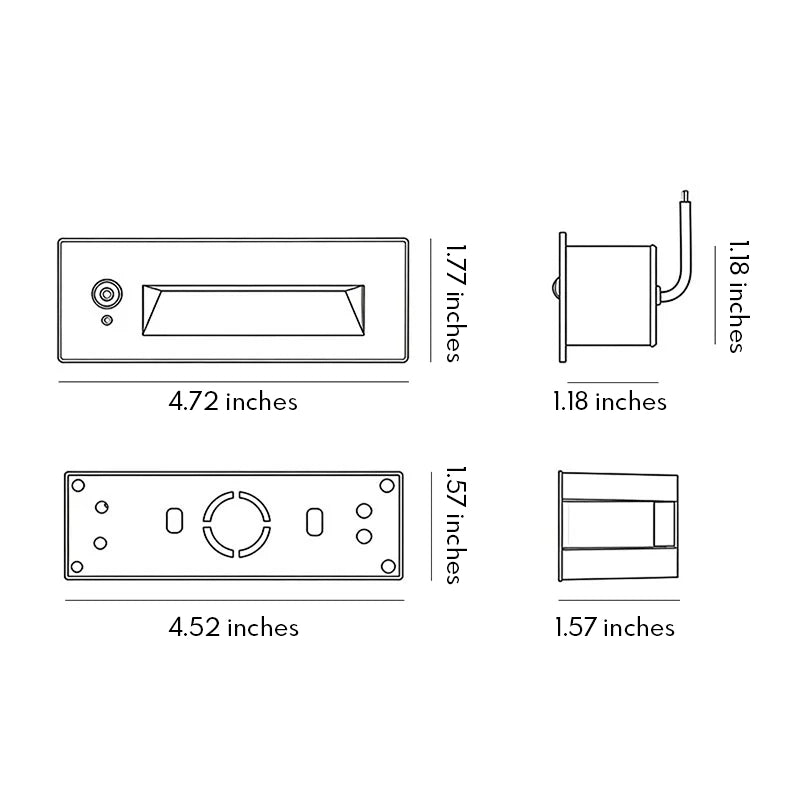
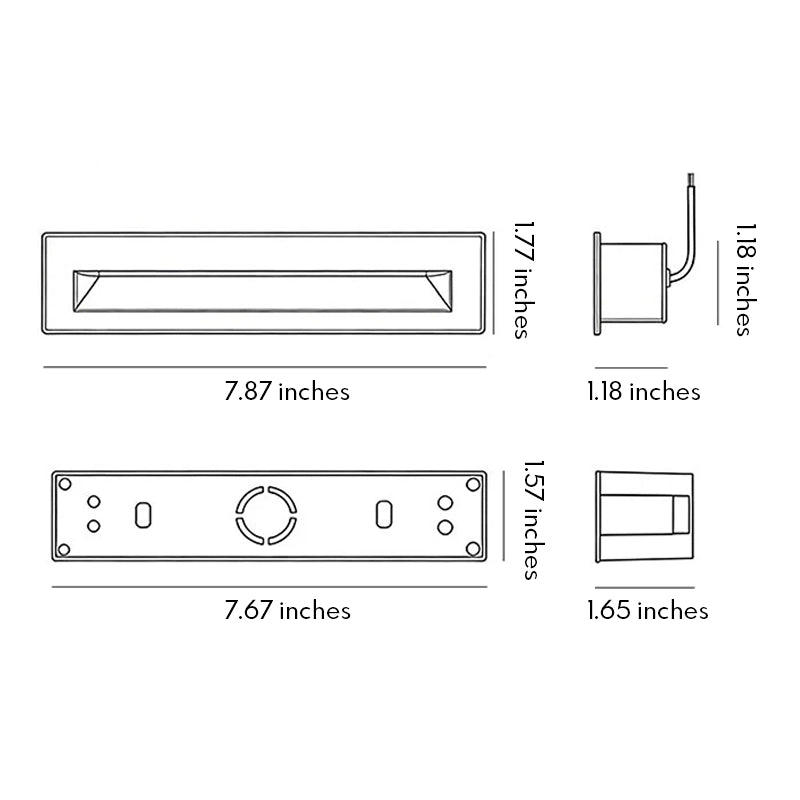
WEIGHTS & DIMENSIONS
| Size: 4.7" * 1.8" | |
| Weight: | 1.65lb |
| Size: | 1.77'' Width x 4.72'' Depth x 1.18'' Height |
| Size: 7.9" * 1.8" | |
| Weight: | 2.20lb |
| Size: | 1.77'' Width x 7.87'' Depth x 1.18'' Height |
| Size: 7.9" * 1.8" | |
| Weight: | 1.65lb |
| Size: | 1.77'' Width x 4.72'' Depth x 1.18'' Height |
DETAILS
| Product Type: | Step & Deck Lights |
| Product Name: | Deck lights for steps |
| Power Supply: | Hardwired |
| Voltage: | 85-265V |
| Material: | Aluminum Alloy |
| Shade Material: | Acrylic |
| Shade Color: | White |
| Control Type: | Wall Switch |
| Style: | Modern |
| Mounting Type: | Flush Mounted Mount |
| Light Source: | LED Integrated |
| Color Temperature Dimming: | No |
| Brightness Dimming: | No |
| Color Rendering Index (CRI): | Ra>90 |
| Indoor/Outdoor: | Outdoor |
| Product Care: | Turn Off the Power,Wipe Clean with Dry Cloth |
| Finish: | Black,Gray,White |
| Color Temperature: | Neutral (4000K),Warm White (3000K) |
| Power: | 3W,5W |
NOTE
1 in = 2.54 cm; 1 cm = 0.39 in
* Should you require any further information about our products and services, feel free to Contact Us.
Shipping & Delivery
Shipping & Delivery
Free Shipping
Dazuma offers free standard shipping on orders over $49. For orders under $49, a flat shipping fee of $9.99 will apply.
Processing Time
We start processing your order as soon as it is placed. You will receive an email confirmation upon placing your order. Please review your order details carefully for accuracy. Processing times are as follows:
- Standard Products: 7–10 business days.
- Custom or Bulk Orders: 10–35 business days.
- Peak Periods or Holidays: Processing times may extend during high-order volumes.
Shipping Methods & Delivery Times
Dazuma provides the following shipping options to suit your needs:
Standard Shipping
- Estimated Delivery Time: 15–25 business days.
- Cost: Free for orders over $49; $9.99 flat rate for orders under $49.
Expedited Shipping
- Estimated Delivery Time: 7–10 business days.
- Cost: Additional fees apply; calculated at checkout.
Note: Delivery times may vary depending on your location and carrier logistics.
Shipping Costs
Shipping costs are calculated based on:
- The shipping method you select.
- The weight and dimensions of your order.
- The delivery destination.
The total shipping cost will be displayed at checkout before completing your purchase.
Order Tracking
Once your order ships, you will receive an email that includes:
- A tracking number.
- A link to track your package.
- The carrier’s information (e.g., UPS, FedEx, DHL).
You can also track your order via our website on the Order Tracking page.
Shipping Delays
We strive to deliver your order on time; however, delays may occur due to:
- Inventory availability or processing capacity.
- High order volumes during peak seasons.
- Unforeseen circumstances such as natural disasters or strikes.
- Customs clearance issues or carrier delays.
If a significant delay occurs, we will notify you promptly. For urgent assistance, please contact Dazuma Customer Service.
Lost or Damaged Packages
Lost Packages
- If your package is not delivered within 15 business days of the expected delivery date, please contact us.
- We will work with the carrier to locate your package or provide a replacement/refund.
Damaged Packages
- If your package arrives damaged, please contact us within 48 hours of delivery.
- Provide photos or videos of the damaged item and packaging to expedite the resolution process.
Ownership & Authorized Online Operations
Dazuma is a lighting brand owned by DUSTERONE SARL, 44 Rue Beaurepaire, 49100 Angers, France.
Dazuma.us is an authorized online retail channel for Dazuma-branded products. HONGKONG GAOXUNBOO TECHNOLOGY CO., LIMITED is authorized by DUSTERONE SARL to support global e-commerce operations, including online store management, order processing, customer-service coordination, payment support, and logistics coordination for Dazuma.us.
Authorized U.S. Return & Exchange Receiving Facility
For approved returns and exchanges only:
Recipient: MH022 Address: 21 Central Ct STE #7, Leominster, MA 01453, United States
Please contact Dazuma Customer Support before sending any return or exchange shipment. Packages sent without prior authorization, missing order information, or sent to the wrong facility may be delayed, refused, or returned to sender.
Additional Information
- International Shipping: Available to select locations.
- Non-Serviceable Addresses: We cannot deliver to Alaska, Hawaii, P.O. Boxes, APO/FPO addresses, or restricted areas.
- Customs and Duties: All customs fees, import taxes, and duties are included in the shipping cost.
- Installation & Assembly: Dazuma does not provide on-site installation, assembly, indoor placement, or labor services.
- Non-Refundable Shipping Charges: Please note that shipping charges are non-refundable.
Return & Refunds
Return & Refunds
At Dazuma, we are committed to enhancing your home with thoughtfully designed lighting and home décor. While every order is rigorously inspected by our QA team before shipping, we understand that a return or refund may occasionally be necessary. This policy outlines the process for returns, refunds, and exchanges to ensure a seamless experience.
1. Order Cancellation Policy
Cancellation Before Shipping: You may cancel your order for a full refund at any time before the product has been shipped. Please contact us immediately at [email protected] to process your request.
Cancellation After Shipping: Once an order has been transferred to the carrier and is in transit, it cannot be canceled or modified. If you no longer wish to keep the item, please refer to our return policy after receiving the package.
Customized Orders: Once production of a custom or specialty order (non-stock sizes/designs) has begun, the order cannot be canceled or modified.
2. Return Window & Eligibility
Geographical Restriction: We only offer return and exchange services for orders delivered within the United States. We do not accept returns or exchanges from countries or regions outside the USA.
30-Day Strict Deadline: We offer a 30-day return window from the date of delivery. You must initiate your return request within this period. No returns or refund requests will be accepted after 30 days of receipt.
Condition Requirement: To be eligible for a return, items must be in their original condition: unused, unassembled, undamaged, and in their original packaging (unopened). All original tags, instructions, and inserts must be included.
3. Non-Returnable Products
The following items are strictly non-returnable and non-refundable:
Orders from outside the USA.
Customized or personalized items (unless there is a confirmed quality defect).
Items that have been assembled, used, or altered.
Clearance items, "Open Box" items, or final sale items.
Gift cards.
4. Return Shipping Costs
Quality Issues (Defective/Damaged/Mis-shipped): Dazuma will be responsible for the return shipping costs for orders that are defective, damaged, or mis-shipped. Please report such issues within 48 hours of delivery.If it is a quality issue, please contact [email protected] and provide photos/videos.
Non-Quality Issues (Change of Mind): For returns due to personal preference (e.g., style, size, or color), the customer is responsible for all round-trip shipping costs, including the original shipping cost paid by Dazuma and the return shipping fee.
5. How to Initiate a Return (USA Orders Only)
Contact Us: Email [email protected] with your order number and reason for return.
Approval: Once approved, you will receive the correct return address. Do not send items back without prior authorization.
Packaging: Securely package the item and include a note with your order number and product ID inside the box.
Tracking: Use a trackable shipping method. Dazuma is not responsible for lost or undelivered return packages.
6. Refund Process
Inspection: Once we receive and inspect your return, we will notify you of the approval or rejection.
Approved Refunds: Refunds will be issued to your original payment method within 5–10 business days.
7. Damaged or Defective Products
Visible Damage: If damage is visible upon delivery, please reject the shipment and contact us immediately.
Concealed Damage: If you discover damage after opening, you must contact us within 48 hours of delivery. Provide photos of the damaged item and all original packaging.
Dazuma will work with you to provide a replacement or refund, based on your preference.
8. 2-Year Quality Support & Warranty
We are committed to the longevity of your Dazuma lighting. To ensure your space remains perfectly lit, we provide a 2-year support framework for all fixtures:
Within 1 Year of Delivery: Should any functional issues or manufacturing defects arise (such as driver or LED failure), Dazuma will provide the necessary replacement components or a new unit at no additional cost to you.
Year 2 Support: For items entering their second year of use, our commitment continues through our Extended Loyalty Program. If a component requires replacement after the first 12 months, we offer exclusive, high-value discounts on replacement parts or new units to ensure your Dazuma collection remains in top condition.
How it works: If you have questions about your product's performance, simply reach out to [email protected]. Our technical team will review the details (please include your order number and any relevant photos) and provide the most efficient resolution for your specific case.
We strive to make returns, refunds, and exchanges simple and stress-free. For assistance, please contact Dazuma Customer Service.
9.The terms need to be explained:
If the return is caused by the consumer, consumer should be responsible for the shipping fee. The specific fee should be based on the express company you choose.
If due to our reasons, the goods received are damaged or not correct, and the consumer is not required to bear the shipping fee for this reason.
Authorized U.S. Return & Exchange Receiving Facility
For approved returns and exchanges only:
Recipient: MH022 Address: 21 Central Ct STE #7, Leominster, MA 01453, United States
Please contact Dazuma Customer Support before sending any return or exchange shipment. Packages sent without prior authorization, missing order information, or sent to the wrong facility may be delayed, refused, or returned to sender.
Ownership & Authorized Online Operations
Dazuma is a lighting brand owned by DUSTERONE SARL, 44 Rue Beaurepaire, 49100 Angers, France.
Dazuma.us is an authorized online retail channel for Dazuma-branded products. HONGKONG GAOXUNBOO TECHNOLOGY CO., LIMITED is authorized by DUSTERONE SARL to support global e-commerce operations, including online store management, order processing, customer-service coordination, payment support, and logistics coordination for Dazuma.us.
FAQ
FAQ
FAQs you need! Get instant answers to everything you want to know right here. Your questions answered in one convenient place.
Ordering & Payments
What Types of Credit Card Payments Do You Accept?
Dazuma accepts Visa, MasterCard, American Express, Discover, Diners Club, JCB, and UnionPay credit cards. Here is a list of Valid Payment Methods
What Should I Do If My Payment Method Is Declined at Checkout?
If your payment is declined, it may be due to factors such as incorrect billing details, insufficient funds, or fraud protection measures by your card issuer. Start by reviewing your card information for accuracy. If the issue persists, please contact Dazuma Customer Service for assistance.
How Will I Know My Order Has Been Received?
After placing your order, a confirmation page will display your transaction details. You can print this for your records. Additionally, a confirmation email will be sent to the email address provided. When your order ships, you’ll receive further emails with tracking information.
How Can I View an Order I’ve Placed?
Log into your Dazuma account and navigate to your Orders. If you’re unable to locate your order, please contact Dazuma Customer Service for help linking the order to your account.
Can I Change or Cancel My Order?
Once Dazuma receive your order, we begin processing it right away, so changes or cancellations may not always be possible. Additionally, orders cannot be modified online after they’ve been placed.
However, we understand that situations may arise where you’d like to request a change or cancellation. If this happens, please contact Dazuma Customer Service as soon as possible. We will do our best to accommodate your request.
If your order has already shipped before the cancellation or change is confirmed, you can return the item in accordance with our Return Policy. Please note that certain items, especially non-returnable ones, cannot be canceled.
Are Installation or Labor Costs Included in the Prices?
No, Dazuma is not responsible for installation or labor costs related to handling, storing, installing, or uninstalling items purchased from us.
Shipping & Delivery
Is Free Shipping Available?
Yes, Dazuma offers free standard shipping on orders over $49. Expedited delivery options are available at an additional cost.
How Much Does Shipping Cost?
Shipping costs are determined by the delivery location, the item's size and weight, and the selected shipping method. Exact fees will be calculated and shown during checkout. Additional surcharges may apply for deliveries to remote areas.
Are Customs Taxes Covered?
Dazuma covers all customs taxes for your orders. Whether you’re shopping locally or internationally, you can enjoy a seamless experience without worrying about unexpected customs fees.
How Long Will It Take for My Order to Arrive?
Delivery time includes both processing and shipping times:
1. Processing Time:
• Standard products: 7–10 business days.
• Custom or bulk orders: 10–35 business days.
• Processing may take longer during holidays or peak periods.
2. Shipping Time:
• Varies by location and shipping method.
• Expedited shipping: 7–10 business days (estimated).
• Standard shipping: 15–25 business days (estimated).
Delays may occur due to inventory availability, processing capacity, or unexpected events like strikes or natural disasters. If there are any delays, we will notify you promptly. For more details, visit Dazuma Shipping Info.
Why Didn’t I Receive an Email About My Order Delivery?
Once your order is dispatched, you’ll receive a tracking number via email within 1–2 business days. Please ensure your email address is accurate and check your spam folder if you don’t see the email.
How Can I Track My Package?
Visit the “Order Tracking” section on our website once your tracking number is updated by the courier. Note: Tracking updates may take time due to international shipping and customs clearance processes. Contact Dazuma Customer Service for help if you encounter any issues.
Can I Modify My Shipping Address?
You can contact Dazuma Customer Service to update your shipping address before the package ships. After shipment, address changes will not be possible.
Returns & Refunds
What Should I Do If I Receive a Damaged Item?
If your item arrives damaged, please follow these steps:
- Document the Damage: Take clear photos or videos of the damaged item, its packaging, and the shipping label.
- Contact Us: Email us at [email protected] with your order number and the photos attached.
- Resolution: After reviewing your case, we will arrange a refund or replacement at no additional cost.
How Do I Return a Product?
You can return eligible items within 30 days of delivery. Follow these steps to initiate a return:
1. Contact Customer Service: Reach out to Dazuma Customer Service to confirm the return address.
2. Package the Item: Retain all packaging materials and shipping notes. Securely pack the item and include a note with the following details:
- Order number
- Product ID or name and quantity
- A brief description of the issue with the product
3. Arrange Pickup: Make the package available for pickup as instructed.
4. Provide Tracking Information: Share the tracking number and a copy of the shipping receipt with Dazuma.
For more details, review our Return Policy.
How Is My Refund Calculated for Returns?
If you decide to return a returnable item because you’ve changed your mind, we will issue a partial refund. This refund will cover the cost of the item minus the original shipping fees. Additionally, you will be responsible for the return shipping costs.If the return is due to an item being damaged, defective, or incorrect, we will provide a full refund or a replacement at no charge. For further details, please refer to our
When Will I Receive My Refund?
Refunds are typically processed within one week after we receive and inspect the item. However, due to shipping, inspection, and banking processes, it may take up to 30 days for the refund to appear on your card.
Warranty & Support
Do Your Products Come With a Warranty?
Yes, Dazuma proudly stands behind the quality of our products. We offer a One-Year Warranty that covers defects in materials or workmanship. If you discover such a defect within one year of purchase, we will repair or, at our discretion, replace the product at no additional charge.Please note:
• The warranty does not cover defects, breakage, or malfunctions caused by mishandling or improper use of the product.
• Light bulbs included with the product are not covered under this warranty.
Who Should I Contact If I Have a Complaint?
Your satisfaction is our priority. Please contact Dazuma Customer Service via phone, live chat, or email, and we’ll do our best to resolve your concerns promptly.
Account Management
How Can I Update My Email Address?
Currently, email addresses cannot be updated. If you have no pending orders, contact Dazuma Customer Service to delete your account and create a new one with the updated email.
How Can I Update My Shipping Address?
Visit the “Profile-Address” section in My Account to add, update, or delete shipping addresses.
How Do I Unsubscribe From Emails?
Click the unsubscribe link at the bottom of any email and follow the instructions.
Promotions & Discounts
How Do Your Coupon Promotions Work?
To use a Dazuma coupon code, simply enter it during checkout. Once applied, your cart will reflect the discount associated with the code.Please keep in mind:
• They cannot be applied to special orders or previous purchases.
• Coupons cannot be combined with other discounts or markdown pricing.
• Each coupon is limited to one use per customer and is non-transferable.
• Coupons cannot be redeemed for cash or gift certificates.
Do You Offer Gift Cards?
Yes, Dazuma Gift Cards are available on our website and can be redeemed at checkout.
Custom Orders & Bulk Purchases
Can I Customize a Product?
While most items are sold as-is, we’re happy to explore customization options for bulk or special orders. Contact Dazuma Customer Service to discuss your requirements.
Do You Offer Discounts for Bulk Orders?
Yes, Dazuma offers special discounts for bulk purchases through our Trade Professionals Program, designed for qualified trade professionals such as designers, architects, and contractors.Key benefits include:
• Exclusive discounts on large orders.
• Personalized support from a dedicated trade account manager.
• Free and straightforward enrollment via our website.
If you need a quotation for a substantial purchase, our trade account managers are ready to assist. Contact Dazuma Customer Service and start saving on your next project!
Share this product


THE DAZUMA STANDARD

AUTHENTIC MATERIALS
Genuine natural silk, solid brass, and artisan glass.

QUALITY ASSURANCE
Rigorous 7-stage inspection for every fixture.

EXPERT SUPPORT
Provide online chat and email support services 24/7.

BESPOKE SOLUTIONS
Tailored dimensions and finishes for your specific needs.

7,000+ DESIGNS
Curated collections featuring the latest architectural trends.
Browse our selection of premium lighting, thoughtfully organized by the rooms they illuminate.


Discover our diverse aesthetics. Find the design language that speaks to your unique home décor.


Every material tells a story. From the cool touch of Stone to the warmth of Rattan, find the perfect finish to define your interior narrative.


Explore lighting optimized for specific zones—including indoor sanctuaries and outdoor landscapes.


Professional lighting support for residential and commercial projects, with project pricing, customization, and technical guidance from concept to installation.


Deck lights for steps solve a very specific outdoor lighting problem: they put light close to the walking surface without adding a tall fixture to the stairway. In the visible design, each light has a compact horizontal rectangular face with a dark border and a narrow warm-looking illuminated opening. Installed low on stair risers or adjacent walls, the fixtures create repeated pools of light that make each change in elevation easier to read after dark.
This low-profile approach is especially useful when the architecture is meant to stay visually clean. The images show the lights working with pale masonry-style stairs, dark contemporary steps, garden walls, and a residential entry. Because the fixture body remains visually secondary, attention stays on the stair geometry, planting, and building facade. The exact housing material, dimensions, wattage, voltage, color temperature, outdoor rating, and installation cavity cannot be confirmed from the images, so those specifications should be checked before ordering.
Searches for recessed stair riser lights, modern outdoor stair lighting, or deck lighting for stairs often reflect this same planning goal, even though the mounting system and electrical requirements can differ considerably from one product to another.
What Makes These Deck Lights for Steps Different?
These deck lights for steps are defined by a small horizontal profile, low mounting position, and controlled-looking light close to the walking surface. Rather than projecting above the deck like a post light, the fixture sits against or within a vertical surface. That makes the design particularly compatible with modern stairs, restrained landscapes, and entrances where visual clutter should remain low.
The rectangular proportion matters. A long, narrow opening visually follows the horizontal line of a stair tread, while the dark frame creates a crisp contrast against light-colored risers. On a dark wall or black step, the bezel can recede more strongly and allow the illuminated slot to become the dominant element. This makes the fixture easier to repeat without turning every stair into a decorative focal point.
Based on the visible examples, the light appears concentrated downward and outward near the mounting surface rather than broadly illuminating an entire yard. That is appropriate for outdoor stair riser lights because the useful target is usually the tread edge, landing, or immediate walking zone. It also reduces the need to direct a brighter source toward a person climbing the stairs. Actual beam shape and output still depend on the internal optics, so product photometrics or listed beam information should be reviewed when consistent illumination is critical.
For a coordinated exterior, these fixtures can become the low-level layer beneath taller modern path lights. The two fixture types should not compete for brightness. The step lights can define elevation changes, while path lighting can help establish the approach through planting beds or along a longer walkway.
Where Do Recessed Deck Step Lights Work Best?
Recessed deck step lights work best where a stair or nearby wall offers a clear vertical mounting surface and the walking route needs quiet, low-level guidance. They are especially useful at exterior entries, deck stairs, patio transitions, garden steps, and hospitality walkways. The strongest applications use repeated placement to clarify a route rather than relying on one isolated light to illuminate the entire stair.
Residential entries and backyard stairs. The first and fourth images show why this format works well near a house. Small lights can follow a broad run of steps without adding posts to the edges, leaving railings, planters, and door sightlines relatively open. At an entry, they can be paired with outdoor porch lighting so the porch fixture identifies the door while the step lights address the elevation change below it.
Garden and landscape transitions. A low wall beside gravel, planting beds, or terraces is another useful mounting location. The close-up image shows a rectangular fixture installed at the base of a textured wall, allowing light to reach the ground rather than washing the entire facade. Where the walking route continues beyond the stairs, conventional path lights can extend guidance through the landscape. Keep the visual rhythm related, but do not assume every fixture needs identical spacing.
Restaurants, boutique hotels, and outdoor lounges. Commercial outdoor stairs benefit from lighting that is visually calm when guests are seated nearby. A compact step light can support navigation without introducing a tall source directly into a dining or lounge sightline. For a hospitality project, however, decorative appearance is only one requirement. The design team should verify required illumination, accessibility and egress criteria, outdoor/environmental ratings, service access, and applicable local codes rather than treating product imagery as evidence of compliance.
New construction and renovation projects. Recessed-looking fixtures deserve early coordination. If the selected model requires a housing or cutout, the installer needs the actual rough-in dimensions before finishes are completed. That matters for concrete, masonry, composite cladding, and framed walls because the method of creating a cavity is different in each assembly. A custom home or multi-unit project should standardize mounting height, orientation, circuiting, and finish coordination before many units are installed.
How Should You Space Deck Step Lights Without Creating Glare?
Space deck step lights according to the stair geometry and the fixture's real light distribution, not a universal every-step rule. Start by identifying tread edges, landings, turns, and changes in width, then place enough low-level light to make those transitions visually continuous. A mockup at night is more reliable than choosing spacing from a daytime rendering or copying another staircase with different dimensions.
For a straight run, repetition should feel deliberate. Lights centered on selected risers can create a formal rhythm, while fixtures placed near the side of a broad stair can feel quieter and may be easier to coordinate with railings. The images show both ideas: some installations put the light directly into the riser face, while others align a sequence along a side wall. Neither method is automatically better; the right choice depends on the stair width, construction, sightlines, and beam pattern.
A useful professional lighting tip is to check the fixture from both directions of travel. Stand at the bottom and look upward, then stand at the top and look down. A source that appears comfortable from one direction can be conspicuous from the other if the illuminated opening is directly visible. Low mounting and a downward-directed beam can help, but the actual optical cutoff must be confirmed from the selected fixture.
Do not confuse regular spacing with good visibility. A landing may need more attention than a long uniform run, and a corner can create shadows that are not obvious on a plan. Adjacent landscape elements also affect perception: pale stone may reflect more light than a dark tread, while dense planting can absorb it. If the route continues onto a garden path, compare the step-light rhythm with nearby path fixtures instead of designing the two systems independently.
How Should Step Lighting Fit Into a Layered Outdoor Lighting Plan?
Step lighting should usually be one layer of an outdoor lighting plan rather than the only exterior light source. Use the fixtures to reveal tread edges and changes in level, then let other fixture types address entrances, longer paths, walls, planting, and gathering areas. Separating these jobs makes it easier to control glare and avoids forcing small stair lights to provide more coverage than they were designed for.
For example, well lights can be considered when a project needs point-source illumination from the ground, while step lights are better positioned to keep illumination close to a stair or vertical mounting plane. The two categories are not interchangeable. Ground-recessed lighting has different drainage, aiming, load, and maintenance considerations, so it should be specified for its intended installation environment.
If the design goal is a continuous line of light under an edge rather than individual pools, outdoor LED strip lights offer a different visual strategy. Strip lighting can trace a long run or underside detail, whereas small rectangular step lights create punctuation and rhythm. Before choosing between them, compare access for replacement, channel or housing requirements, power supply location, drainage, and how the installation will look during daylight when the light is off.
Wall illumination is another separate layer. A textured masonry wall may benefit from wall wash lighting when the goal is to reveal a larger architectural surface. Step lights should not be expected to produce that same broad effect. Keeping functional stair guidance and decorative facade lighting on distinct circuits or control zones can also make the exterior easier to tune for different evening conditions, provided the chosen electrical system supports that approach.
For residential and hospitality environments, warm white light is often selected because it feels comfortable beside wood tones, stone-look surfaces, planting, and warm architectural finishes. Many designers begin around 2700K to 3000K as a general planning range, but that is not a specification for the pictured product. Confirm its available color temperature and compare it with adjacent exterior fixtures to avoid an accidental mix of noticeably different whites.
What Should You Confirm Before Installing Outdoor Stair Riser Lights?
Before installing outdoor stair riser lights, confirm the fixture dimensions, cutout or mounting method, input voltage, driver or transformer requirements, environmental rating, wiring access, and service procedure. Also measure the riser or wall where each light will sit. These details determine whether a compact-looking fixture can actually be integrated cleanly into the stair construction without conflicts behind the finished surface.
Measure more than the faceplate. Record the visible riser height and width, but also determine how much depth is available behind the mounting surface. A small front plate does not guarantee a shallow housing. On an existing stair, investigate what is behind the finish before cutting. On new construction, obtain the manufacturer's rough-in drawing early enough for the electrical and hardscape teams to coordinate openings and conduits.
Verify outdoor suitability for the exact location. The images show exterior use, but they do not establish an IP rating, wet-location listing, corrosion resistance, or a specific water-management method. Stairs may receive rain, irrigation spray, snowmelt, cleaning water, or runoff. Confirm the manufacturer's listed environmental suitability and follow the required sealing and drainage details. A fixture intended only for a protected area should not be treated as suitable for a fully exposed step.
Plan the electrical system as a system. If you want low-voltage deck step lights, check that the selected model actually uses the intended voltage and confirm transformer capacity, cable runs, voltage drop considerations, and compatible controls. If it is line voltage or uses a separate driver, the installation approach changes. Do not infer electrical architecture from the fixture's small size. A qualified installer can coordinate wiring and local requirements once the real specification sheet is available.
Think about maintenance before closing the wall. Outdoor stair fixtures collect dust, splash residue, insects, and landscape debris. Ask how the face or light source is accessed, whether the housing must remain reachable, and which cleaning products are appropriate for the listed finish. On a large project, serviceability can matter as much as initial appearance because dozens of fixtures may need to remain visually consistent over time.
Are These Modern Deck Stair Lights Right for Your Project?
This style is a strong choice for projects that want discreet, low-level stair illumination and a clean contemporary appearance. It is especially well suited to broad exterior steps, deck transitions, garden walls, and entries where tall fixtures would interrupt the architecture. It is less appropriate when the project needs one fixture to provide broad area lighting or when the wall cannot accommodate the required installation method.
The visual design is particularly convincing against simple surfaces. A dark rectangular frame creates definition on pale concrete- or stone-look stairs, while it can nearly disappear against darker cladding. The warm-looking illuminated slot then becomes the visual cue. For a minimalist landscape, that restraint can be more useful than a decorative lantern because the lighting supports the architecture instead of adding another object at each stair edge.
Before ordering, measure the number of risers, each riser face, landing dimensions, wall thickness or available cavity, and the distance to planned electrical equipment. Decide whether you want lights on every riser, selected risers, or a side wall only after reviewing the actual beam and output. Also note the surrounding materials and other light sources so the finish and apparent color of light can be coordinated.
These fixtures should not be chosen from appearance alone for a safety-sensitive route. Confirm the product's outdoor suitability, electrical requirements, installation instructions, and documented performance, then check the project against applicable local requirements. If more general exterior illumination is also needed, build the stair lights into a broader outdoor lighting plan rather than increasing step-light brightness until the small fixtures are doing jobs they were not intended to do.
Frequently Asked Questions About Deck Lights for Steps
How many deck lights do I need for a flight of steps?
There is no reliable one-light-per-step rule because stair width, tread and riser proportions, surface reflectance, fixture output, beam spread, and ambient light all change the result. Begin with the key transitions: the first and last step, landings, turns, and any change in width. Then use the selected fixture's photometric information or a nighttime mockup to fill dark gaps. A consistent visual rhythm matters, but safe visibility and comfortable glare control should guide the final quantity throughout the entire stair run.
Where should deck step lights be installed on the stair?
They can be installed in a riser face or on a side wall, depending on the fixture's listed mounting method and the stair construction. Riser placement visually connects the light to each tread, while side-wall placement can reduce the number of openings made directly in the stairs. In either case, keep the illuminated opening low enough to address the walking surface without sitting where it will be easily kicked or struck. Always follow the manufacturer's required mounting orientation and clearances.
Do deck lights for steps need a waterproof or wet-location rating?
Outdoor step lights need an environmental rating appropriate to their real exposure, but the required classification depends on the installation and local rules. An uncovered stair can experience direct rain and runoff; a protected porch stair may face less direct water but can still experience moisture and cleaning. Do not assume the pictured product has a particular IP or wet-location rating. Review the product specification, installation instructions, sealing details, and applicable electrical requirements before using it in an exposed exterior location.
What color temperature is best for outdoor step lighting?
Warm white light is a common design choice for residential decks, gardens, hospitality patios, and stone- or wood-toned architecture because it creates a softer nighttime appearance. Designers often start around 2700K to 3000K when coordinating comfortable exterior lighting, then adjust for the surrounding finishes and existing fixtures. This is a design guideline, not a confirmed setting for the pictured light. Check the available color temperature and keep neighboring sources reasonably consistent unless an intentional contrast is part of the plan.
Can recessed step lights be installed in concrete or masonry stairs?
Potentially, but compatibility depends on the exact housing, rough-in method, wiring access, drainage strategy, and manufacturer's installation instructions. Concrete and masonry make late changes difficult, so recessed stair lighting is best coordinated before pouring, setting block, or applying the final finish whenever possible. For an existing stair, an installer should verify what can be cut safely and how wiring will reach the fixture. Never use the visible faceplate dimensions alone to determine whether a model fits the available construction depth.
Are individual step lights better than outdoor LED strip lighting?
Neither is universally better; they create different visual effects and require different detailing. Individual rectangular step lights produce separated pools of light and a clear repeated rhythm, which can suit modern risers and side walls. Strip lighting creates a continuous line that can emphasize the underside of a tread or a long edge. Compare daylight appearance, glare, access for service, channel or housing needs, electrical components, and outdoor ratings. The simpler-looking finished effect is not always the simpler installation method.
Can deck stair lights provide enough light without other fixtures?
They may provide useful local illumination, but you should not assume small step lights can handle every outdoor lighting task. Their job is usually to help reveal changes in level near the stairs. Entrances, paths, gathering areas, gates, and landscape features may need additional sources with different distribution. Plan these layers together and verify actual output from the chosen fixture. Where circulation continues away from the stairs, separate path or area lighting can prevent an abrupt drop in nighttime visibility.
What should I measure before ordering recessed deck step lights?
Measure the riser or wall face, available depth behind it, stair width, number of risers, landing dimensions, proposed mounting height, and the distance between planned fixture locations. Also identify where wiring, drivers, transformers, junction points, and controls can be serviced if the selected system requires them. Then compare those measurements with the manufacturer's faceplate, cutout, housing, and clearance dimensions. For renovations, verify hidden construction before creating openings; for new work, coordinate rough-ins before the final stair or wall finish is installed.


