



Floor Spotlights Low Voltage Copper Outdoor Waterproof COB Light

DESCRIPTION
Description:
This floor spotlights features a compact cylindrical design with an antique copper body and clear glass lens, creating a refined vintage look for gardens and landscape spaces. The built-in 6W COB warm light source runs on DC24V low voltage and provides focused illumination for trees, shrubs, walls, and architectural details. The adjustable lamp head allows flexible aiming, while the focusable design helps control the beam spread for different lighting distances and applications. Made from copper and glass, the fixture offers an IP65 waterproof rating for reliable outdoor use. It is ideal for tree lighting, garden accents, landscape features, courtyards, and ground-stake installations.
Highlights:
Copper Construction: This floor spotlights antique copper finish adds a refined landscape appearance.
6W COB Warm Lighting: Provides focused and comfortable accent illumination.
DC24V Low Voltage: Suitable for low-voltage outdoor landscape lighting systems.
Adjustable and Focusable: Allows flexible beam direction and light spread control.
IP65 Weather Protection: Suitable for gardens, trees, courtyards, and outdoor landscapes.
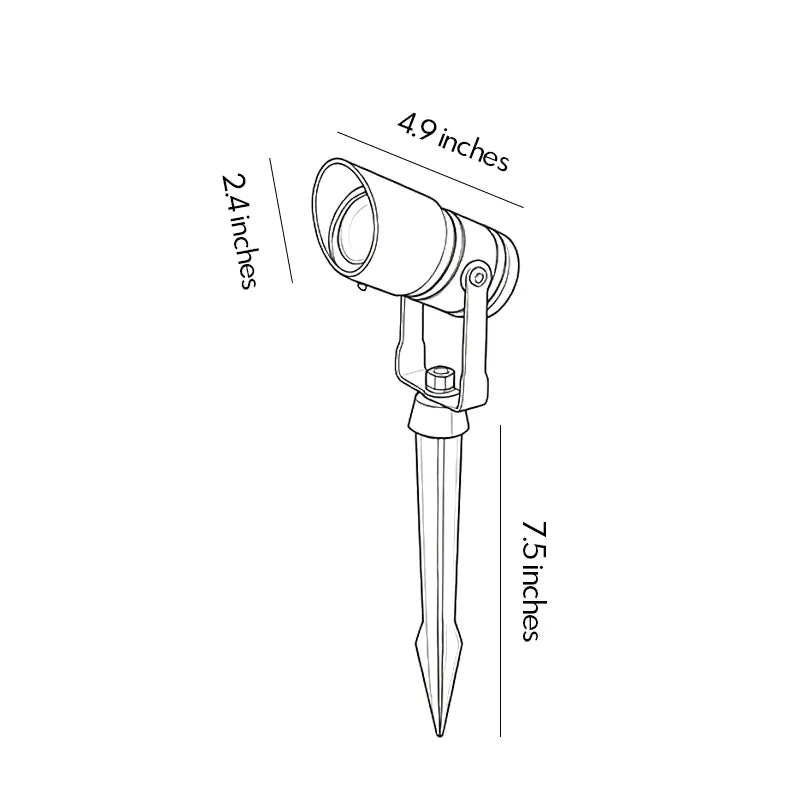
WEIGHTS & DIMENSIONS
| Color Temperature: Warm White (3000K) | |
| Weight: | 8.82lb |
| Size: | 2.36'' Width x 2.36'' Depth x 4.72'' Height |
DETAILS
| Product Type: | Spotlights |
| Power Supply: | Hardwired |
| Power: | 6W |
| Voltage: | DC24V (Need to Be Used with Transformer) |
| Style: | Modern |
| Light Source: | COB |
| Color Temperature: | Warm White (3000K) |
| Material: | Copper |
| Finish: | Copper |
| Shade Color: | Clear |
| Shade Material: | Glass |
| Control Type: | Wall Switch |
| Ingress Protection: | IP65 |
| Indoor/Outdoor: | Outdoor |
| Product Care: | Turn Off the Power,Wipe Clean with Dry Cloth |
| Note: | Transformer Not Included |
DEAL
Buy More Save More!
For purchases of 10 or more of the above items, please Contact Us for special offers.
Shipping & Delivery
Shipping & Delivery
Free Shipping
Dazuma offers free standard shipping on orders over $49. For orders under $49, a flat shipping fee of $9.99 will apply.
Processing Time
We start processing your order as soon as it is placed. You will receive an email confirmation upon placing your order. Please review your order details carefully for accuracy. Processing times are as follows:
- Standard Products: 7–10 business days.
- Custom or Bulk Orders: 10–35 business days.
- Peak Periods or Holidays: Processing times may extend during high-order volumes.
Shipping Methods & Delivery Times
Dazuma provides the following shipping options to suit your needs:
Standard Shipping
- Estimated Delivery Time: 15–25 business days.
- Cost: Free for orders over $49; $9.99 flat rate for orders under $49.
Expedited Shipping
- Estimated Delivery Time: 7–10 business days.
- Cost: Additional fees apply; calculated at checkout.
Note: Delivery times may vary depending on your location and carrier logistics.
Shipping Costs
Shipping costs are calculated based on:
- The shipping method you select.
- The weight and dimensions of your order.
- The delivery destination.
The total shipping cost will be displayed at checkout before completing your purchase.
Order Tracking
Once your order ships, you will receive an email that includes:
- A tracking number.
- A link to track your package.
- The carrier’s information (e.g., UPS, FedEx, DHL).
You can also track your order via our website on the Order Tracking page.
Shipping Delays
We strive to deliver your order on time; however, delays may occur due to:
- Inventory availability or processing capacity.
- High order volumes during peak seasons.
- Unforeseen circumstances such as natural disasters or strikes.
- Customs clearance issues or carrier delays.
If a significant delay occurs, we will notify you promptly. For urgent assistance, please contact Dazuma Customer Service.
Lost or Damaged Packages
Lost Packages
- If your package is not delivered within 15 business days of the expected delivery date, please contact us.
- We will work with the carrier to locate your package or provide a replacement/refund.
Damaged Packages
- If your package arrives damaged, please contact us within 48 hours of delivery.
- Provide photos or videos of the damaged item and packaging to expedite the resolution process.
Ownership & Authorized Online Operations
Dazuma is a lighting brand owned by DUSTERONE SARL, 44 Rue Beaurepaire, 49100 Angers, France.
Dazuma.us is an authorized online retail channel for Dazuma-branded products. HONGKONG GAOXUNBOO TECHNOLOGY CO., LIMITED is authorized by DUSTERONE SARL to support global e-commerce operations, including online store management, order processing, customer-service coordination, payment support, and logistics coordination for Dazuma.us.
Authorized U.S. Return & Exchange Receiving Facility
For approved returns and exchanges only:
Recipient: MH022 Address: 21 Central Ct STE #7, Leominster, MA 01453, United States
Please contact Dazuma Customer Support before sending any return or exchange shipment. Packages sent without prior authorization, missing order information, or sent to the wrong facility may be delayed, refused, or returned to sender.
Additional Information
- International Shipping: Available to select locations.
- Non-Serviceable Addresses: We cannot deliver to Alaska, Hawaii, P.O. Boxes, APO/FPO addresses, or restricted areas.
- Customs and Duties: All customs fees, import taxes, and duties are included in the shipping cost.
- Installation & Assembly: Dazuma does not provide on-site installation, assembly, indoor placement, or labor services.
- Non-Refundable Shipping Charges: Please note that shipping charges are non-refundable.
Return & Refunds
Return & Refunds
At Dazuma, we are committed to enhancing your home with thoughtfully designed lighting and home décor. While every order is rigorously inspected by our QA team before shipping, we understand that a return or refund may occasionally be necessary. This policy outlines the process for returns, refunds, and exchanges to ensure a seamless experience.
1. Order Cancellation Policy
Cancellation Before Shipping: You may cancel your order for a full refund at any time before the product has been shipped. Please contact us immediately at [email protected] to process your request.
Cancellation After Shipping: Once an order has been transferred to the carrier and is in transit, it cannot be canceled or modified. If you no longer wish to keep the item, please refer to our return policy after receiving the package.
Customized Orders: Once production of a custom or specialty order (non-stock sizes/designs) has begun, the order cannot be canceled or modified.
2. Return Window & Eligibility
Geographical Restriction: We only offer return and exchange services for orders delivered within the United States. We do not accept returns or exchanges from countries or regions outside the USA.
30-Day Strict Deadline: We offer a 30-day return window from the date of delivery. You must initiate your return request within this period. No returns or refund requests will be accepted after 30 days of receipt.
Condition Requirement: To be eligible for a return, items must be in their original condition: unused, unassembled, undamaged, and in their original packaging (unopened). All original tags, instructions, and inserts must be included.
3. Non-Returnable Products
The following items are strictly non-returnable and non-refundable:
Orders from outside the USA.
Customized or personalized items (unless there is a confirmed quality defect).
Items that have been assembled, used, or altered.
Clearance items, "Open Box" items, or final sale items.
Gift cards.
4. Return Shipping Costs
Quality Issues (Defective/Damaged/Mis-shipped): Dazuma will be responsible for the return shipping costs for orders that are defective, damaged, or mis-shipped. Please report such issues within 48 hours of delivery.If it is a quality issue, please contact [email protected] and provide photos/videos.
Non-Quality Issues (Change of Mind): For returns due to personal preference (e.g., style, size, or color), the customer is responsible for all round-trip shipping costs, including the original shipping cost paid by Dazuma and the return shipping fee.
5. How to Initiate a Return (USA Orders Only)
Contact Us: Email [email protected] with your order number and reason for return.
Approval: Once approved, you will receive the correct return address. Do not send items back without prior authorization.
Packaging: Securely package the item and include a note with your order number and product ID inside the box.
Tracking: Use a trackable shipping method. Dazuma is not responsible for lost or undelivered return packages.
6. Refund Process
Inspection: Once we receive and inspect your return, we will notify you of the approval or rejection.
Approved Refunds: Refunds will be issued to your original payment method within 5–10 business days.
7. Damaged or Defective Products
Visible Damage: If damage is visible upon delivery, please reject the shipment and contact us immediately.
Concealed Damage: If you discover damage after opening, you must contact us within 48 hours of delivery. Provide photos of the damaged item and all original packaging.
Dazuma will work with you to provide a replacement or refund, based on your preference.
8. 2-Year Quality Support & Warranty
We are committed to the longevity of your Dazuma lighting. To ensure your space remains perfectly lit, we provide a 2-year support framework for all fixtures:
Within 1 Year of Delivery: Should any functional issues or manufacturing defects arise (such as driver or LED failure), Dazuma will provide the necessary replacement components or a new unit at no additional cost to you.
Year 2 Support: For items entering their second year of use, our commitment continues through our Extended Loyalty Program. If a component requires replacement after the first 12 months, we offer exclusive, high-value discounts on replacement parts or new units to ensure your Dazuma collection remains in top condition.
How it works: If you have questions about your product's performance, simply reach out to [email protected]. Our technical team will review the details (please include your order number and any relevant photos) and provide the most efficient resolution for your specific case.
We strive to make returns, refunds, and exchanges simple and stress-free. For assistance, please contact Dazuma Customer Service.
9.The terms need to be explained:
If the return is caused by the consumer, consumer should be responsible for the shipping fee. The specific fee should be based on the express company you choose.
If due to our reasons, the goods received are damaged or not correct, and the consumer is not required to bear the shipping fee for this reason.
Authorized U.S. Return & Exchange Receiving Facility
For approved returns and exchanges only:
Recipient: MH022 Address: 21 Central Ct STE #7, Leominster, MA 01453, United States
Please contact Dazuma Customer Support before sending any return or exchange shipment. Packages sent without prior authorization, missing order information, or sent to the wrong facility may be delayed, refused, or returned to sender.
Ownership & Authorized Online Operations
Dazuma is a lighting brand owned by DUSTERONE SARL, 44 Rue Beaurepaire, 49100 Angers, France.
Dazuma.us is an authorized online retail channel for Dazuma-branded products. HONGKONG GAOXUNBOO TECHNOLOGY CO., LIMITED is authorized by DUSTERONE SARL to support global e-commerce operations, including online store management, order processing, customer-service coordination, payment support, and logistics coordination for Dazuma.us.
FAQ
FAQ
FAQs you need! Get instant answers to everything you want to know right here. Your questions answered in one convenient place.
Ordering & Payments
What Types of Credit Card Payments Do You Accept?
Dazuma accepts Visa, MasterCard, American Express, Discover, Diners Club, JCB, and UnionPay credit cards. Here is a list of Valid Payment Methods
What Should I Do If My Payment Method Is Declined at Checkout?
If your payment is declined, it may be due to factors such as incorrect billing details, insufficient funds, or fraud protection measures by your card issuer. Start by reviewing your card information for accuracy. If the issue persists, please contact Dazuma Customer Service for assistance.
How Will I Know My Order Has Been Received?
After placing your order, a confirmation page will display your transaction details. You can print this for your records. Additionally, a confirmation email will be sent to the email address provided. When your order ships, you’ll receive further emails with tracking information.
How Can I View an Order I’ve Placed?
Log into your Dazuma account and navigate to your Orders. If you’re unable to locate your order, please contact Dazuma Customer Service for help linking the order to your account.
Can I Change or Cancel My Order?
Once Dazuma receive your order, we begin processing it right away, so changes or cancellations may not always be possible. Additionally, orders cannot be modified online after they’ve been placed.
However, we understand that situations may arise where you’d like to request a change or cancellation. If this happens, please contact Dazuma Customer Service as soon as possible. We will do our best to accommodate your request.
If your order has already shipped before the cancellation or change is confirmed, you can return the item in accordance with our Return Policy. Please note that certain items, especially non-returnable ones, cannot be canceled.
Are Installation or Labor Costs Included in the Prices?
No, Dazuma is not responsible for installation or labor costs related to handling, storing, installing, or uninstalling items purchased from us.
Shipping & Delivery
Is Free Shipping Available?
Yes, Dazuma offers free standard shipping on orders over $49. Expedited delivery options are available at an additional cost.
How Much Does Shipping Cost?
Shipping costs are determined by the delivery location, the item's size and weight, and the selected shipping method. Exact fees will be calculated and shown during checkout. Additional surcharges may apply for deliveries to remote areas.
Are Customs Taxes Covered?
Dazuma covers all customs taxes for your orders. Whether you’re shopping locally or internationally, you can enjoy a seamless experience without worrying about unexpected customs fees.
How Long Will It Take for My Order to Arrive?
Delivery time includes both processing and shipping times:
1. Processing Time:
• Standard products: 7–10 business days.
• Custom or bulk orders: 10–35 business days.
• Processing may take longer during holidays or peak periods.
2. Shipping Time:
• Varies by location and shipping method.
• Expedited shipping: 7–10 business days (estimated).
• Standard shipping: 15–25 business days (estimated).
Delays may occur due to inventory availability, processing capacity, or unexpected events like strikes or natural disasters. If there are any delays, we will notify you promptly. For more details, visit Dazuma Shipping Info.
Why Didn’t I Receive an Email About My Order Delivery?
Once your order is dispatched, you’ll receive a tracking number via email within 1–2 business days. Please ensure your email address is accurate and check your spam folder if you don’t see the email.
How Can I Track My Package?
Visit the “Order Tracking” section on our website once your tracking number is updated by the courier. Note: Tracking updates may take time due to international shipping and customs clearance processes. Contact Dazuma Customer Service for help if you encounter any issues.
Can I Modify My Shipping Address?
You can contact Dazuma Customer Service to update your shipping address before the package ships. After shipment, address changes will not be possible.
Returns & Refunds
What Should I Do If I Receive a Damaged Item?
If your item arrives damaged, please follow these steps:
- Document the Damage: Take clear photos or videos of the damaged item, its packaging, and the shipping label.
- Contact Us: Email us at [email protected] with your order number and the photos attached.
- Resolution: After reviewing your case, we will arrange a refund or replacement at no additional cost.
How Do I Return a Product?
You can return eligible items within 30 days of delivery. Follow these steps to initiate a return:
1. Contact Customer Service: Reach out to Dazuma Customer Service to confirm the return address.
2. Package the Item: Retain all packaging materials and shipping notes. Securely pack the item and include a note with the following details:
- Order number
- Product ID or name and quantity
- A brief description of the issue with the product
3. Arrange Pickup: Make the package available for pickup as instructed.
4. Provide Tracking Information: Share the tracking number and a copy of the shipping receipt with Dazuma.
For more details, review our Return Policy.
How Is My Refund Calculated for Returns?
If you decide to return a returnable item because you’ve changed your mind, we will issue a partial refund. This refund will cover the cost of the item minus the original shipping fees. Additionally, you will be responsible for the return shipping costs.If the return is due to an item being damaged, defective, or incorrect, we will provide a full refund or a replacement at no charge. For further details, please refer to our
When Will I Receive My Refund?
Refunds are typically processed within one week after we receive and inspect the item. However, due to shipping, inspection, and banking processes, it may take up to 30 days for the refund to appear on your card.
Warranty & Support
Do Your Products Come With a Warranty?
Yes, Dazuma proudly stands behind the quality of our products. We offer a One-Year Warranty that covers defects in materials or workmanship. If you discover such a defect within one year of purchase, we will repair or, at our discretion, replace the product at no additional charge.Please note:
• The warranty does not cover defects, breakage, or malfunctions caused by mishandling or improper use of the product.
• Light bulbs included with the product are not covered under this warranty.
Who Should I Contact If I Have a Complaint?
Your satisfaction is our priority. Please contact Dazuma Customer Service via phone, live chat, or email, and we’ll do our best to resolve your concerns promptly.
Account Management
How Can I Update My Email Address?
Currently, email addresses cannot be updated. If you have no pending orders, contact Dazuma Customer Service to delete your account and create a new one with the updated email.
How Can I Update My Shipping Address?
Visit the “Profile-Address” section in My Account to add, update, or delete shipping addresses.
How Do I Unsubscribe From Emails?
Click the unsubscribe link at the bottom of any email and follow the instructions.
Promotions & Discounts
How Do Your Coupon Promotions Work?
To use a Dazuma coupon code, simply enter it during checkout. Once applied, your cart will reflect the discount associated with the code.Please keep in mind:
• They cannot be applied to special orders or previous purchases.
• Coupons cannot be combined with other discounts or markdown pricing.
• Each coupon is limited to one use per customer and is non-transferable.
• Coupons cannot be redeemed for cash or gift certificates.
Do You Offer Gift Cards?
Yes, Dazuma Gift Cards are available on our website and can be redeemed at checkout.
Custom Orders & Bulk Purchases
Can I Customize a Product?
While most items are sold as-is, we’re happy to explore customization options for bulk or special orders. Contact Dazuma Customer Service to discuss your requirements.
Do You Offer Discounts for Bulk Orders?
Yes, Dazuma offers special discounts for bulk purchases through our Trade Professionals Program, designed for qualified trade professionals such as designers, architects, and contractors.Key benefits include:
• Exclusive discounts on large orders.
• Personalized support from a dedicated trade account manager.
• Free and straightforward enrollment via our website.
If you need a quotation for a substantial purchase, our trade account managers are ready to assist. Contact Dazuma Customer Service and start saving on your next project!
Share this product


THE DAZUMA STANDARD

AUTHENTIC MATERIALS
Genuine natural silk, solid brass, and artisan glass.

QUALITY ASSURANCE
Rigorous 7-stage inspection for every fixture.

EXPERT SUPPORT
Provide online chat and email support services 24/7.

BESPOKE SOLUTIONS
Tailored dimensions and finishes for your specific needs.

7,000+ DESIGNS
Curated collections featuring the latest architectural trends.
Browse our selection of premium lighting, thoughtfully organized by the rooms they illuminate.


Discover our diverse aesthetics. Find the design language that speaks to your unique home décor.


Every material tells a story. From the cool touch of Stone to the warmth of Rattan, find the perfect finish to define your interior narrative.


Explore lighting optimized for specific zones—including indoor sanctuaries and outdoor landscapes.


Professional lighting support for residential and commercial projects, with project pricing, customization, and technical guidance from concept to installation.


Floor Spotlights That Bring a Tree Into the Evening Scene
Floor spotlights let a garden feature remain visible after the rest of the landscape fades into darkness. This compact fixture has a smooth, cylindrical head in a warm metallic tone and a visible side pivot that lets the head point upward. In the image, light reaches the trunk and lower leaves of a small tree from a position near the ground. The result emphasizes the tree's shape, with the surrounding stone and planting kept comparatively dark.
Why a Low Position Changes the Look of a Tree
A spotlight set near the base of a tree reveals the trunk first and then catches selected leaves and branches above it. That creates a different evening view from the flat daylight view of the same planting. With this fixture, the adjustable-looking head allows the beam to be aimed along the trunk or across the canopy, subject to the actual adjustment range. Distance and angle determine whether the tree looks sculptural or washed out.
Browse outdoor spotlights when comparing narrow and broad light distributions. The suitable option depends on the size of the subject, the viewing distance, and verified product optics.
Where Should a Floor Spotlight Be Placed?
Start with the principal view of the tree, then place the spotlight where its beam reaches the trunk without shining into a person's eyes. Moving it slightly away from the base often allows more of the canopy to catch light, while a closer position can make bark texture more pronounced. The ideal distance depends on beam spread, tree shape, and nearby obstructions; test the proposed spot after dark.
Aim From an Oblique Angle
Aiming from one side can bring out the depth between branches. A light pointed straight up the trunk may create an overly bright central stripe, especially on pale bark. Begin with a modest angle and rotate the head in small increments while standing at the patio, window, or gate from which the tree will usually be seen.
Keep the Fixture Out of the Walking Line
Place the head and any support beyond paths, mowing edges, and regular gardening access. The pictured fixture sits near rocks and planting, which can screen it in daylight. Allow enough open space for aiming and cleaning so growing foliage does not swallow the light or deflect the beam.
Watch the View Beyond the Tree
A beam that passes through sparse branches may continue toward a neighbor's window or an upper-floor room. Check the view from the other side of the planting. Aim the head so the tree intercepts the useful light, and adjust its position as pruning or seasonal leaf cover changes.
One Beam, Two Beams, or a Different Fixture?
A single spotlight gives a small tree a clear direction of light and usually creates the strongest contrast. Two can reveal more of a broad canopy, but they need separate aiming to avoid flattening the trunk. Very large trees may require a wider plan with multiple fixtures and verified output. The pictured compact head should be chosen according to its published beam and performance details.
Lighting tip: begin with one fixture during a nighttime test. Move it around the tree before adding another. Photographs of lit gardens can make every leaf appear uniformly bright, but a real garden often looks richer when some branches remain in shadow. Retain enough contrast to show form.
For an installation intended to disappear into paving or soil, compare well lights. A directional surface-mounted spotlight is more visible but can offer a different aiming position, depending on its mounting method.
Other Useful Garden Subjects
Although the image shows a tree, a directional floor spotlight can also emphasize a sculptural shrub, textured wall, boulder grouping, or architectural column. It works best when the subject has a shape worth revealing and there is a controlled place for the light to sit. In a courtyard restaurant or hotel garden, a few well-chosen accents can anchor the nighttime view from dining areas or guest rooms.
- Small residential tree: aim through the trunk into selected lower branches without flooding the full yard.
- Rock garden: skim light across a surface to show texture and avoid placing the head where water collects.
- Entry column: use the adjustable head to emphasize vertical material, checking that the beam does not reach windows.
- Hospitality landscape: repeat accent points selectively, with paths and steps lit separately to meet the project's needs.
- Landscape renovation: coordinate cable routing and fixture locations before new planting or hardscape is installed.
When a broad area needs general illumination rather than a selected feature, the distribution of flood lights may be more relevant. Compare the purpose of the beam before choosing a fixture type.
Glare, Color Appearance, and Nighttime Balance
Because the head points upward, glare is a key placement concern. A person standing across the yard may see directly into the bright opening if the fixture sits outside the tree's silhouette. Keep the beam intercepted by trunk or foliage where possible, and test it from windows, outdoor chairs, and the approach path. An adjustable joint is useful only when the final angle is deliberately checked.
Lighting tip: view the scene after interior lights are switched off. A spotlight that looks subtle from a brightly lit room may become the strongest point in a dark garden. Reduce intensity if compatible controls are available, or refine the aim so the lit tree draws attention rather than the fixture itself.
The warm-looking light in the image complements the fixture's metallic tone and the green-yellow leaves. The exact color temperature is not established by the photo. If the garden also includes path or wall lighting, compare the stated color appearance of all fixtures so the tree does not look disconnected from the rest of the landscape.
What to Check Before Ordering This Spotlight
This style suits a buyer who wants to aim light at a specific tree or garden feature and has a discreet place near the ground for the head and its wiring. It is less suitable where the fixture would sit directly in a walkway, under dense foliage, or where the subject cannot intercept the beam. Confirm dimensions, beam angle, output, power requirements, mounting method, environmental rating, and finish before purchase.
Sketch the subject, the planned fixture position, and the direction of the beam. Note irrigation spray, drainage, mowing, and access for pruning. For a wired installation, plan how the visible cable will be routed and protected according to the manufacturer's instructions and local requirements. Have a qualified installer review electrical connections as appropriate.
Frequently Asked Questions
These answers address the placement decisions raised by the pictured adjustable-looking floor spotlight. Technical capabilities must be confirmed for the selected version.
Can I aim the light higher as the tree grows?
A side pivot is visible on the fixture, suggesting an aimable head, but the permitted adjustment range should be verified. Leave access to the pivot so the beam can be reviewed as branches change. You may eventually need to move the fixture or add another source for a much larger canopy.
How far should the spotlight sit from the trunk?
There is no universal distance. A close position tends to emphasize bark and lower branches; moving farther away can illuminate more of the canopy if the beam spread allows it. Test the location after dark from the principal viewing point and check that the fixture remains outside normal foot traffic.
Will one spotlight illuminate the whole tree?
It may emphasize only one side or a portion of the foliage, which can be desirable for depth. Whole-tree coverage depends on size, beam angle, output, and distance. For a wide or mature tree, a lighting plan may call for multiple carefully aimed sources.
Can it be placed in an exposed garden bed?
Check the product's stated environmental rating and installation instructions for the exact exposure. Review drainage and irrigation around the mounting area as well. The image shows a landscaped setting but does not verify performance in standing water or every weather condition.
Is the fixture solid brass or copper?
The cylindrical head has a warm metallic appearance, but a photograph does not confirm its composition. Consult the material and finish specifications for the selected version, especially if a particular aging behavior or cleaning method is important.
How do I avoid shining into a window?
Stand at the window after dark while another person adjusts the light. Move or tilt the head until the tree catches the intended beam without a direct view of the bright opening. Repeat the check when leaves fall or after significant pruning, since gaps in the canopy can change where light travels.


