



Lantern wall sconce retro LED die-cast aluminum glass lamp
Features


DESCRIPTION
Description:
This lantern wall sconce features a die-cast aluminum body and glass lampshade, available in two classic colors: black and bronze. It offers two power supply options: solar-powered or hard-wired. The solar panel can be fully charged with 6 hours of direct sunlight and provides up to 20 hours of illumination. With an IP55 protection rating, it is suitable for outdoor environments. The hard-wired model is compatible with the universal E27 bulb base, offering convenient and intelligent retro lighting for areas such as porches and courtyard walls.
Highlights:
Two Power Supply Options: This lantern wall sconce solar model automatically charges, while the hard-wired model provides stable output, allowing selection based on needs.
Efficient Solar Endurance: 6 hours of fast charging supports 20 hours of lighting, with built-in battery protection for safety and durability.
Dual Retro Colors: Black offers modern simplicity, and bronze exudes classic nostalgia, adapting to various architectural styles.
Durable Lamp Body Material: The die-cast aluminum body is designed to be corrosion-resistant and rust-proof, with efficient heat dissipation for long-lasting use.
Light-Transmitting Lampshade Design: The glass lampshade boasts excellent light transmittance, delivering uniform, soft, and comfortable illumination.
Explore More: Black outdoor wall light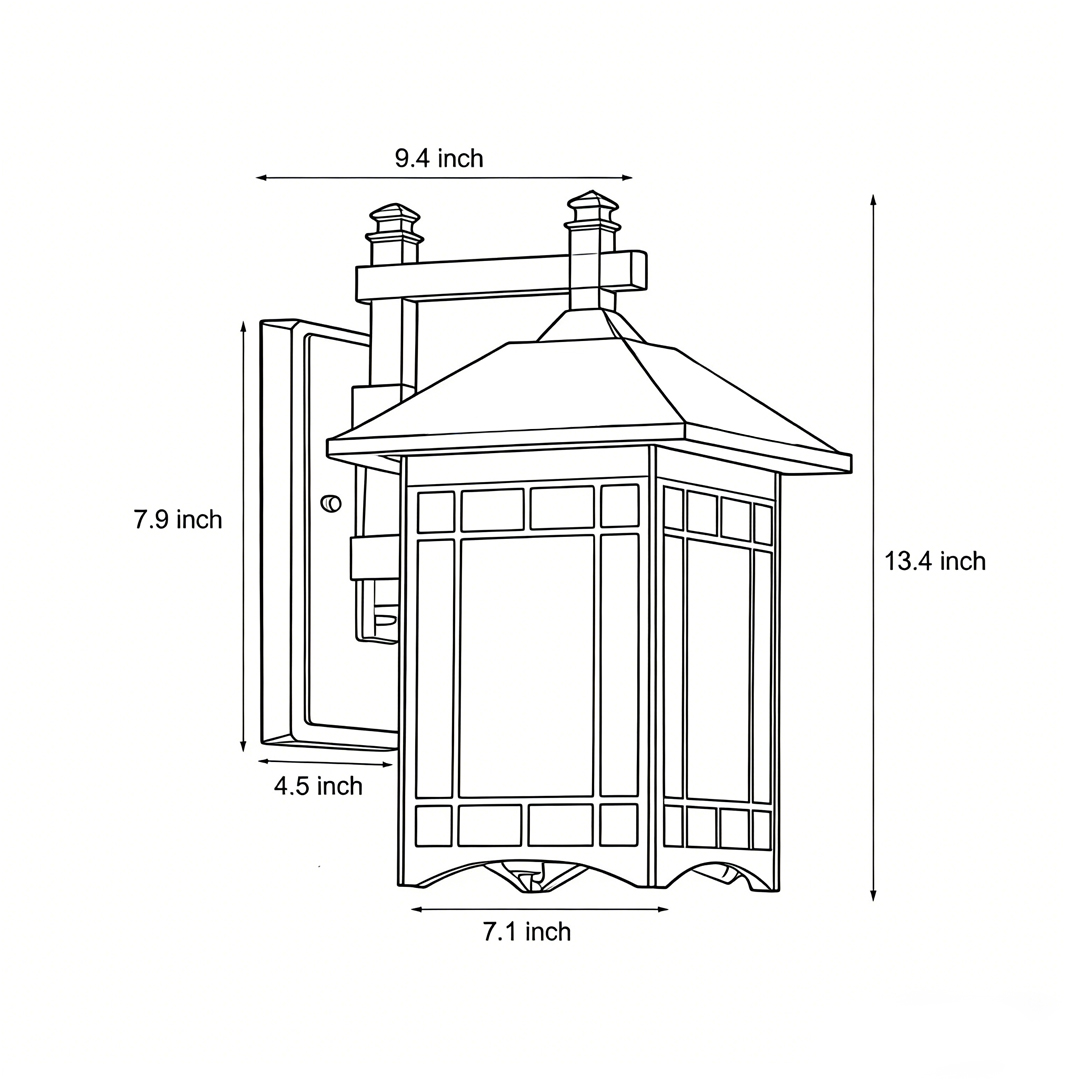
WEIGHTS & DIMENSIONS
| Power Supply: Solar | |
| Weight: | 4.25lb |
| Size: | 7.09'' Width x 9.45'' Depth x 13.39'' Height |
| Power Supply: Hardwired | |
| Weight: | 3.92lb |
| Size: | 7.09'' Width x 9.45'' Depth x 13.39'' Height |
DETAILS
| Product Type: | Outdoor Wall Sconces |
| Product Name: | Lantern wall sconce |
| Voltage: | 110V |
| Lumens: | 70LM/W |
| Material: | Die-cast Aluminum |
| Shade Color: | White |
| Shade Material: | Glass |
| Bulb Base: | E27 |
| Bulb Included: | Yes |
| Color Temperature: | Warm White (3000K) |
| Waterproof: | IP55 |
| Style: | Retro |
| Mounting Type: | Wall Mount |
| Applicable Scene: | Garden |
| Control Type: | Remote Control Switch,Wall Switch |
| Light Source: | LED Bulbs,LED Integrated |
| Finish: | Black,Bronze,Copper |
| Indoor/Outdoor: | Outdoor |
| Product Care: | Turn Off the Power,Wipe Clean with Dry Cloth |
| Power Supply: | Solar |
| Working Time: | 10H |
| Charging Time: | 5-6H |
| Power: | 6W,12W |
| Battery Capacity: | 2200MAH |
NOTE
1 in = 2.54 cm; 1 cm = 0.39 in
* Should you require any further information about our products and services, feel free to Contact Us.
Shipping & Delivery
Shipping & Delivery
Free Shipping
Dazuma offers free standard shipping on orders over $49. For orders under $49, a flat shipping fee of $9.99 will apply.
Processing Time
We start processing your order as soon as it is placed. You will receive an email confirmation upon placing your order. Please review your order details carefully for accuracy. Processing times are as follows:
- Standard Products: 7–10 business days.
- Custom or Bulk Orders: 10–35 business days.
- Peak Periods or Holidays: Processing times may extend during high-order volumes.
Shipping Methods & Delivery Times
Dazuma provides the following shipping options to suit your needs:
Standard Shipping
- Estimated Delivery Time: 15–25 business days.
- Cost: Free for orders over $49; $9.99 flat rate for orders under $49.
Expedited Shipping
- Estimated Delivery Time: 7–10 business days.
- Cost: Additional fees apply; calculated at checkout.
Note: Delivery times may vary depending on your location and carrier logistics.
Shipping Costs
Shipping costs are calculated based on:
- The shipping method you select.
- The weight and dimensions of your order.
- The delivery destination.
The total shipping cost will be displayed at checkout before completing your purchase.
Order Tracking
Once your order ships, you will receive an email that includes:
- A tracking number.
- A link to track your package.
- The carrier’s information (e.g., UPS, FedEx, DHL).
You can also track your order via our website on the Order Tracking page.
Shipping Delays
We strive to deliver your order on time; however, delays may occur due to:
- Inventory availability or processing capacity.
- High order volumes during peak seasons.
- Unforeseen circumstances such as natural disasters or strikes.
- Customs clearance issues or carrier delays.
If a significant delay occurs, we will notify you promptly. For urgent assistance, please contact Dazuma Customer Service.
Lost or Damaged Packages
Lost Packages
- If your package is not delivered within 15 business days of the expected delivery date, please contact us.
- We will work with the carrier to locate your package or provide a replacement/refund.
Damaged Packages
- If your package arrives damaged, please contact us within 48 hours of delivery.
- Provide photos or videos of the damaged item and packaging to expedite the resolution process.
Ownership & Authorized Online Operations
Dazuma is a lighting brand owned by DUSTERONE SARL, 44 Rue Beaurepaire, 49100 Angers, France.
Dazuma.us is an authorized online retail channel for Dazuma-branded products. HONGKONG GAOXUNBOO TECHNOLOGY CO., LIMITED is authorized by DUSTERONE SARL to support global e-commerce operations, including online store management, order processing, customer-service coordination, payment support, and logistics coordination for Dazuma.us.
Authorized U.S. Return & Exchange Receiving Facility
For approved returns and exchanges only:
Recipient: MH022 Address: 21 Central Ct STE #7, Leominster, MA 01453, United States
Please contact Dazuma Customer Support before sending any return or exchange shipment. Packages sent without prior authorization, missing order information, or sent to the wrong facility may be delayed, refused, or returned to sender.
Additional Information
- International Shipping: Available to select locations.
- Non-Serviceable Addresses: We cannot deliver to Alaska, Hawaii, P.O. Boxes, APO/FPO addresses, or restricted areas.
- Customs and Duties: All customs fees, import taxes, and duties are included in the shipping cost.
- Installation & Assembly: Dazuma does not provide on-site installation, assembly, indoor placement, or labor services.
- Non-Refundable Shipping Charges: Please note that shipping charges are non-refundable.
Return & Refunds
Return & Refunds
At Dazuma, we are committed to enhancing your home with thoughtfully designed lighting and home décor. While every order is rigorously inspected by our QA team before shipping, we understand that a return or refund may occasionally be necessary. This policy outlines the process for returns, refunds, and exchanges to ensure a seamless experience.
1. Order Cancellation Policy
Cancellation Before Shipping: You may cancel your order for a full refund at any time before the product has been shipped. Please contact us immediately at [email protected] to process your request.
Cancellation After Shipping: Once an order has been transferred to the carrier and is in transit, it cannot be canceled or modified. If you no longer wish to keep the item, please refer to our return policy after receiving the package.
Customized Orders: Once production of a custom or specialty order (non-stock sizes/designs) has begun, the order cannot be canceled or modified.
2. Return Window & Eligibility
Geographical Restriction: We only offer return and exchange services for orders delivered within the United States. We do not accept returns or exchanges from countries or regions outside the USA.
30-Day Strict Deadline: We offer a 30-day return window from the date of delivery. You must initiate your return request within this period. No returns or refund requests will be accepted after 30 days of receipt.
Condition Requirement: To be eligible for a return, items must be in their original condition: unused, unassembled, undamaged, and in their original packaging (unopened). All original tags, instructions, and inserts must be included.
3. Non-Returnable Products
The following items are strictly non-returnable and non-refundable:
Orders from outside the USA.
Customized or personalized items (unless there is a confirmed quality defect).
Items that have been assembled, used, or altered.
Clearance items, "Open Box" items, or final sale items.
Gift cards.
4. Return Shipping Costs
Quality Issues (Defective/Damaged/Mis-shipped): Dazuma will be responsible for the return shipping costs for orders that are defective, damaged, or mis-shipped. Please report such issues within 48 hours of delivery.If it is a quality issue, please contact [email protected] and provide photos/videos.
Non-Quality Issues (Change of Mind): For returns due to personal preference (e.g., style, size, or color), the customer is responsible for all round-trip shipping costs, including the original shipping cost paid by Dazuma and the return shipping fee.
5. How to Initiate a Return (USA Orders Only)
Contact Us: Email [email protected] with your order number and reason for return.
Approval: Once approved, you will receive the correct return address. Do not send items back without prior authorization.
Packaging: Securely package the item and include a note with your order number and product ID inside the box.
Tracking: Use a trackable shipping method. Dazuma is not responsible for lost or undelivered return packages.
6. Refund Process
Inspection: Once we receive and inspect your return, we will notify you of the approval or rejection.
Approved Refunds: Refunds will be issued to your original payment method within 5–10 business days.
7. Damaged or Defective Products
Visible Damage: If damage is visible upon delivery, please reject the shipment and contact us immediately.
Concealed Damage: If you discover damage after opening, you must contact us within 48 hours of delivery. Provide photos of the damaged item and all original packaging.
Dazuma will work with you to provide a replacement or refund, based on your preference.
8. 2-Year Quality Support & Warranty
We are committed to the longevity of your Dazuma lighting. To ensure your space remains perfectly lit, we provide a 2-year support framework for all fixtures:
Within 1 Year of Delivery: Should any functional issues or manufacturing defects arise (such as driver or LED failure), Dazuma will provide the necessary replacement components or a new unit at no additional cost to you.
Year 2 Support: For items entering their second year of use, our commitment continues through our Extended Loyalty Program. If a component requires replacement after the first 12 months, we offer exclusive, high-value discounts on replacement parts or new units to ensure your Dazuma collection remains in top condition.
How it works: If you have questions about your product's performance, simply reach out to [email protected]. Our technical team will review the details (please include your order number and any relevant photos) and provide the most efficient resolution for your specific case.
We strive to make returns, refunds, and exchanges simple and stress-free. For assistance, please contact Dazuma Customer Service.
9.The terms need to be explained:
If the return is caused by the consumer, consumer should be responsible for the shipping fee. The specific fee should be based on the express company you choose.
If due to our reasons, the goods received are damaged or not correct, and the consumer is not required to bear the shipping fee for this reason.
Authorized U.S. Return & Exchange Receiving Facility
For approved returns and exchanges only:
Recipient: MH022 Address: 21 Central Ct STE #7, Leominster, MA 01453, United States
Please contact Dazuma Customer Support before sending any return or exchange shipment. Packages sent without prior authorization, missing order information, or sent to the wrong facility may be delayed, refused, or returned to sender.
Ownership & Authorized Online Operations
Dazuma is a lighting brand owned by DUSTERONE SARL, 44 Rue Beaurepaire, 49100 Angers, France.
Dazuma.us is an authorized online retail channel for Dazuma-branded products. HONGKONG GAOXUNBOO TECHNOLOGY CO., LIMITED is authorized by DUSTERONE SARL to support global e-commerce operations, including online store management, order processing, customer-service coordination, payment support, and logistics coordination for Dazuma.us.
FAQ
FAQ
FAQs you need! Get instant answers to everything you want to know right here. Your questions answered in one convenient place.
Ordering & Payments
What Types of Credit Card Payments Do You Accept?
Dazuma accepts Visa, MasterCard, American Express, Discover, Diners Club, JCB, and UnionPay credit cards. Here is a list of Valid Payment Methods
What Should I Do If My Payment Method Is Declined at Checkout?
If your payment is declined, it may be due to factors such as incorrect billing details, insufficient funds, or fraud protection measures by your card issuer. Start by reviewing your card information for accuracy. If the issue persists, please contact Dazuma Customer Service for assistance.
How Will I Know My Order Has Been Received?
After placing your order, a confirmation page will display your transaction details. You can print this for your records. Additionally, a confirmation email will be sent to the email address provided. When your order ships, you’ll receive further emails with tracking information.
How Can I View an Order I’ve Placed?
Log into your Dazuma account and navigate to your Orders. If you’re unable to locate your order, please contact Dazuma Customer Service for help linking the order to your account.
Can I Change or Cancel My Order?
Once Dazuma receive your order, we begin processing it right away, so changes or cancellations may not always be possible. Additionally, orders cannot be modified online after they’ve been placed.
However, we understand that situations may arise where you’d like to request a change or cancellation. If this happens, please contact Dazuma Customer Service as soon as possible. We will do our best to accommodate your request.
If your order has already shipped before the cancellation or change is confirmed, you can return the item in accordance with our Return Policy. Please note that certain items, especially non-returnable ones, cannot be canceled.
Are Installation or Labor Costs Included in the Prices?
No, Dazuma is not responsible for installation or labor costs related to handling, storing, installing, or uninstalling items purchased from us.
Shipping & Delivery
Is Free Shipping Available?
Yes, Dazuma offers free standard shipping on orders over $49. Expedited delivery options are available at an additional cost.
How Much Does Shipping Cost?
Shipping costs are determined by the delivery location, the item's size and weight, and the selected shipping method. Exact fees will be calculated and shown during checkout. Additional surcharges may apply for deliveries to remote areas.
Are Customs Taxes Covered?
Dazuma covers all customs taxes for your orders. Whether you’re shopping locally or internationally, you can enjoy a seamless experience without worrying about unexpected customs fees.
How Long Will It Take for My Order to Arrive?
Delivery time includes both processing and shipping times:
1. Processing Time:
• Standard products: 7–10 business days.
• Custom or bulk orders: 10–35 business days.
• Processing may take longer during holidays or peak periods.
2. Shipping Time:
• Varies by location and shipping method.
• Expedited shipping: 7–10 business days (estimated).
• Standard shipping: 15–25 business days (estimated).
Delays may occur due to inventory availability, processing capacity, or unexpected events like strikes or natural disasters. If there are any delays, we will notify you promptly. For more details, visit Dazuma Shipping Info.
Why Didn’t I Receive an Email About My Order Delivery?
Once your order is dispatched, you’ll receive a tracking number via email within 1–2 business days. Please ensure your email address is accurate and check your spam folder if you don’t see the email.
How Can I Track My Package?
Visit the “Order Tracking” section on our website once your tracking number is updated by the courier. Note: Tracking updates may take time due to international shipping and customs clearance processes. Contact Dazuma Customer Service for help if you encounter any issues.
Can I Modify My Shipping Address?
You can contact Dazuma Customer Service to update your shipping address before the package ships. After shipment, address changes will not be possible.
Returns & Refunds
What Should I Do If I Receive a Damaged Item?
If your item arrives damaged, please follow these steps:
- Document the Damage: Take clear photos or videos of the damaged item, its packaging, and the shipping label.
- Contact Us: Email us at [email protected] with your order number and the photos attached.
- Resolution: After reviewing your case, we will arrange a refund or replacement at no additional cost.
How Do I Return a Product?
You can return eligible items within 30 days of delivery. Follow these steps to initiate a return:
1. Contact Customer Service: Reach out to Dazuma Customer Service to confirm the return address.
2. Package the Item: Retain all packaging materials and shipping notes. Securely pack the item and include a note with the following details:
- Order number
- Product ID or name and quantity
- A brief description of the issue with the product
3. Arrange Pickup: Make the package available for pickup as instructed.
4. Provide Tracking Information: Share the tracking number and a copy of the shipping receipt with Dazuma.
For more details, review our Return Policy.
How Is My Refund Calculated for Returns?
If you decide to return a returnable item because you’ve changed your mind, we will issue a partial refund. This refund will cover the cost of the item minus the original shipping fees. Additionally, you will be responsible for the return shipping costs.If the return is due to an item being damaged, defective, or incorrect, we will provide a full refund or a replacement at no charge. For further details, please refer to our
When Will I Receive My Refund?
Refunds are typically processed within one week after we receive and inspect the item. However, due to shipping, inspection, and banking processes, it may take up to 30 days for the refund to appear on your card.
Warranty & Support
Do Your Products Come With a Warranty?
Yes, Dazuma proudly stands behind the quality of our products. We offer a One-Year Warranty that covers defects in materials or workmanship. If you discover such a defect within one year of purchase, we will repair or, at our discretion, replace the product at no additional charge.Please note:
• The warranty does not cover defects, breakage, or malfunctions caused by mishandling or improper use of the product.
• Light bulbs included with the product are not covered under this warranty.
Who Should I Contact If I Have a Complaint?
Your satisfaction is our priority. Please contact Dazuma Customer Service via phone, live chat, or email, and we’ll do our best to resolve your concerns promptly.
Account Management
How Can I Update My Email Address?
Currently, email addresses cannot be updated. If you have no pending orders, contact Dazuma Customer Service to delete your account and create a new one with the updated email.
How Can I Update My Shipping Address?
Visit the “Profile-Address” section in My Account to add, update, or delete shipping addresses.
How Do I Unsubscribe From Emails?
Click the unsubscribe link at the bottom of any email and follow the instructions.
Promotions & Discounts
How Do Your Coupon Promotions Work?
To use a Dazuma coupon code, simply enter it during checkout. Once applied, your cart will reflect the discount associated with the code.Please keep in mind:
• They cannot be applied to special orders or previous purchases.
• Coupons cannot be combined with other discounts or markdown pricing.
• Each coupon is limited to one use per customer and is non-transferable.
• Coupons cannot be redeemed for cash or gift certificates.
Do You Offer Gift Cards?
Yes, Dazuma Gift Cards are available on our website and can be redeemed at checkout.
Custom Orders & Bulk Purchases
Can I Customize a Product?
While most items are sold as-is, we’re happy to explore customization options for bulk or special orders. Contact Dazuma Customer Service to discuss your requirements.
Do You Offer Discounts for Bulk Orders?
Yes, Dazuma offers special discounts for bulk purchases through our Trade Professionals Program, designed for qualified trade professionals such as designers, architects, and contractors.Key benefits include:
• Exclusive discounts on large orders.
• Personalized support from a dedicated trade account manager.
• Free and straightforward enrollment via our website.
If you need a quotation for a substantial purchase, our trade account managers are ready to assist. Contact Dazuma Customer Service and start saving on your next project!
Share this product


THE DAZUMA STANDARD

AUTHENTIC MATERIALS
Genuine natural silk, solid brass, and artisan glass.

QUALITY ASSURANCE
Rigorous 7-stage inspection for every fixture.

EXPERT SUPPORT
Provide online chat and email support services 24/7.

BESPOKE SOLUTIONS
Tailored dimensions and finishes for your specific needs.

7,000+ DESIGNS
Curated collections featuring the latest architectural trends.
Browse our selection of premium lighting, thoughtfully organized by the rooms they illuminate.


Discover our diverse aesthetics. Find the design language that speaks to your unique home décor.


Every material tells a story. From the cool touch of Stone to the warmth of Rattan, find the perfect finish to define your interior narrative.


Explore lighting optimized for specific zones—including indoor sanctuaries and outdoor landscapes.


Professional lighting support for residential and commercial projects, with project pricing, customization, and technical guidance from concept to installation.


Why a Lantern Wall Sconce Works So Well at a Covered Entry
A lantern wall sconce works especially well when an exterior needs a defined architectural light without the bulk of a large hanging fixture. The design shown here has a compact rectangular lantern body, dark metal-like framing, pale diffused-looking panels, a shallow roof-like top, and a structured wall bracket. Its balanced proportions make it suitable beside front doors, under covered porches, along sheltered walkways, and near courtyard entrances where the fixture should remain decorative during the day as well as after dark.
The most noticeable feature is the lantern’s framed geometry. Vertical and horizontal dark lines divide the pale panels into a clean grid, while the upper section projects slightly outward like a small architectural roof. That combination gives the fixture a tailored, almost pavilion-like silhouette rather than the tapered carriage-lantern form seen on many traditional exterior sconces. It feels decorative but controlled, which helps it work on both transitional and more contemporary façades.
The pale panels also change the character of the light. Instead of leaving the bulb completely exposed, the enclosure appears to soften or obscure the source behind a milky surface. This can make the sconce look calmer from close range and can reduce the visual contrast between the lamp and the surrounding wall. Actual diffusion, glare control, lumen output, and beam spread still need to be confirmed in the product specifications rather than inferred from photography.
The black or very dark frame creates strong contrast against light stucco and pale exterior walls, as shown in both images. In daylight, the fixture reads almost like decorative metalwork attached to the façade. When illuminated, the pale panels become brighter and the grid remains visible around them. This day-to-night contrast is useful at an entrance because the fixture contributes to the architecture even when it is switched off.
If you are comparing this design with other exterior wall-mounted fixtures, the outdoor wall lighting collection is the most relevant starting point. For a closer comparison of lantern-shaped bodies and wall brackets, browse outdoor wall lanterns.
The images support the visible dark frame, pale panel surfaces, rectangular lantern body, projecting wall bracket, and exterior installation beside residential doors. They do not confirm the actual metal, panel material, dimensions, weight, wattage, lumen output, bulb base, color temperature, voltage, dimming compatibility, environmental rating, or installation hardware. Check those details before ordering, especially if the fixture will be mounted in an exposed location.
What Makes This Lantern Wall Sconce Visually Distinctive?
This lantern wall sconce stands out because the enclosure is more architectural than decorative in the usual carriage-lantern sense. The body is almost rectangular, with straight black framing and pale infill panels rather than curved glass or ornate scrollwork. A compact top cap and bracket system give the fixture enough detail to feel intentional, while the overall silhouette remains simple enough for cleaner exterior designs.
The front and side panels appear divided into repeated rectangular sections. That grid structure gives the lantern a strong rhythm and makes the fixture readable from several angles. On a plain stucco wall, those lines introduce detail without requiring additional trim. On a more elaborate façade with columns, molding, or stone, the sconce can remain visually calm because the decoration comes from proportion and framing rather than from heavy ornament.
The roof-like upper section is another useful design feature. It projects slightly beyond the lantern body and visually caps the grid below. This creates a small amount of shadow and gives the fixture a layered profile from the side. The top does not appear excessively deep, so the lantern remains compact while still referencing the form of a traditional exterior lantern.
The bracket system also contributes to the character. In the images, the lantern projects away from the wall rather than sitting completely flush. The dark vertical backplate and upper support create a clear connection between the fixture and the architecture. This projection gives the lantern more depth, but it also means the full distance from wall to outer edge should be confirmed before installation in a narrow passage.
The visible dark finish makes the fixture easy to coordinate with black-framed windows, railings, house numbers, door hardware, and other exterior metal details. Homeowners who want to compare similar dark fixtures can review black outdoor wall lights. The exact finish does not need to match every nearby metal perfectly; a related dark tone is often enough to create a cohesive exterior palette.
The pale panel treatment is what keeps the lantern from feeling too severe. A fully clear black lantern would expose the bulb and create stronger visual contrast, while these lighter-looking panels make the body read as a glowing volume. That softer appearance can suit residential entrances where the fixture is seen from only a few feet away.
Where Does This Style of Outdoor Lantern Work Best?
This style of outdoor lantern works best on exterior walls with enough open space for the rectangular body and bracket to remain visually clear. Strong locations include covered front entries, side doors, courtyard walls, patio entrances, and sheltered walkways. It is particularly effective where the architecture uses light stucco, stone, cream siding, or dark window frames, because the black grid can stand out without making the wall feel visually heavy.
Front entrance: A single fixture can work beside an asymmetrical door, while a matching pair can frame a centered entrance when both sides provide enough width. The rectangular body is especially useful beside tall doors because it creates a clear vertical accent without becoming overly wide. If the entry already uses dark door hardware or a black frame, the lantern can repeat that finish and make the composition feel more intentional.
Covered porch: This sconce can provide decorative light at wall level while leaving the ceiling available for a fan, hanging fixture, or exposed beam detail. The pale panels may also feel more visually comfortable near seating than a completely exposed bulb. The outdoor porch lighting collection can help you compare wall-mounted lanterns with ceiling and hanging options for the same porch.
Courtyard or patio door: On a sheltered wall, the compact lantern can identify the transition between indoor and outdoor space after dark. The rectangular grid works well with stucco, stone, masonry, and simple architectural openings. If furniture is positioned nearby, verify the fixture’s projection so chairs, umbrellas, or door swings do not interfere with the body.
Side entrance or breezeway: A smaller lantern wall sconce can make a secondary entrance feel more finished without using a large decorative fixture. Because these areas are often narrower than the main porch, projection becomes especially important. Measure the path people take through the space and confirm the outermost depth of the lantern before installation.
Boutique hotel or restaurant exterior: Repeated lantern sconces can create rhythm along courtyard walls, covered walkways, or guest entrances. The grid-like design can support both traditional and contemporary hospitality interiors without feeling overly residential. Commercial projects should verify output, maintenance access, environmental rating, voltage, installation hardware, and local code requirements before specifying multiple units.
Custom-home or renovation project: The fixture can bridge a traditional building envelope with more updated exterior details. For example, a stucco home may retain classic proportions while adding black-framed doors and simplified landscaping. A lantern with straight framing and pale panels can connect those elements without leaning too far toward either modern minimalism or ornate historic styling.
How High and How Large Should a Lantern Wall Sconce Be?
The right size and mounting height depend on the doorway, wall width, fixture projection, and normal viewing distance. A lantern wall sconce should look substantial enough to relate to the entrance but should not crowd door trim, columns, soffits, or windows. Before ordering, compare the listed overall dimensions with the wall and make a full-size paper template so you can judge the proportion from the driveway and front walk.
Do not evaluate only the illuminated panel section. The top cap, bracket, and backplate all contribute to the finished silhouette. A fixture that looks compact in a close-up product image may occupy more height and depth once installed. Use the manufacturer’s overall height, width, and projection when determining whether the sconce will clear nearby architectural elements.
Professional sizing tip: tape a full-size cardboard or paper outline beside the door and view it from at least two normal approach points. A fixture that feels large from arm’s length can look undersized on a two-story façade. Conversely, a wide or deeply projecting lantern may overwhelm a narrow porch even if it technically fits on the wall.
Professional projection tip: measure outward from the finished wall surface to the front edge of the lantern. In a narrow passage, projection can matter more than width because people naturally walk close to the wall. Check door swings, furniture, railings, and steps before finalizing the mounting position.
For a symmetrical pair, matching heights usually create the cleanest result when the doorway and wall sections are equal. If one side is interrupted by a window, column, or downspout, a single well-scaled lantern can look more intentional than forcing two fixtures into unequal spaces.
Wall construction should also be considered. Smooth stucco and flat masonry create a straightforward visual mounting surface, while rough stone or deeply textured walls may require additional preparation behind the backplate. The images show the fixture sitting flush against relatively smooth exterior surfaces, but the exact mounting method is not visible.
If your exterior is more minimalist and the grid detail feels too decorative, compare options from the modern outdoor wall lighting collection. A cleaner box or cylinder may suit a highly contemporary façade better, while this lantern works well when the architecture benefits from a visible framed enclosure.
How Should a Lantern Sconce Be Layered With Other Exterior Lighting?
A lantern sconce should usually serve as one layer of the exterior lighting plan rather than provide every type of illumination around the entrance. Use it to define the doorway and create ambient light near the wall, then add path, step, ceiling, or landscape fixtures where people need more targeted visibility. This keeps the lantern comfortable in brightness and creates a smoother transition from the driveway or garden to the door.
At a front entry, the wall lantern can help illuminate the immediate door area while path lights guide visitors from the sidewalk or driveway. If the porch is deep, an overhead fixture may add general brightness farther from the wall. This division of tasks is more effective than expecting one sconce to illuminate the entire entrance zone evenly.
The pale panels shown here may soften the light compared with a fully clear lantern, but actual glare and brightness cannot be judged from the image alone. A diffused-looking enclosure can still feel bright when mounted close to eye level. Check the listed lumen output, diffuser construction, and recommended light source before deciding how bright the surrounding fixtures should be.
Color temperature should also be coordinated. Warm white light often works naturally with stucco, stone, wood doors, and traditional lantern forms, while neutral white can create a cleaner architectural effect. The photographs show a warm-looking result in one scene, but camera settings can alter perceived color. Use the product specifications to coordinate the lantern with nearby path and porch lights.
Automatic controls may be useful, but they should never be assumed from appearance. If motion activation is a priority, compare fixtures in the motion sensor wall lights collection. A decorative lantern can be visually suitable for an entry without including any sensor or photocell functionality.
Likewise, if you want the fixture to operate automatically after sunset, verify whether dusk-to-dawn control is built in or compatible with the planned electrical system. The appearance of a traditional or contemporary lantern does not indicate how it is controlled. Treat styling and operating features as separate purchasing decisions.
Is This Lantern Wall Sconce Right for Your Exterior?
This lantern wall sconce is best suited to homeowners and designers who want a compact black-framed exterior light with pale panels, clean grid detailing, and a structured architectural silhouette. It works especially well on stucco, stone, siding, and transitional façades where a completely modern box light would feel too plain but a highly ornate carriage lantern would feel too decorative.
This style is likely a strong fit if:
- You want a framed lantern silhouette beside a front or side door.
- Your exterior uses pale stucco, stone, cream siding, or dark architectural accents.
- You prefer a diffused-looking enclosure over fully exposed bulbs.
- You want the fixture to remain decorative during the day.
- You plan to combine the sconce with path, ceiling, or landscape lighting.
Consider another fixture type if:
- Your wall is too narrow for the full lantern body and bracket.
- The walkway is too tight for the fixture’s actual projection.
- You want a completely transparent enclosure with a visible decorative bulb.
- Your location requires a specific environmental rating that is not confirmed.
- You need a particular dimmer, sensor, voltage, or smart-control feature that is not listed.
Before ordering, measure the available wall height and width, the distance to door trim, soffit clearance, and the walking space in front of the fixture. Then confirm the product’s actual height, width, projection, backplate dimensions, weight, material, finish, panel construction, light-source requirements, wattage, lumen output, color temperature, voltage, dimming compatibility, environmental rating, and installation method.
Also compare the fixture with the scale of the door and surrounding architecture rather than only with the wall immediately behind it. A small lantern can disappear beside a tall double door or substantial stone column, while an oversized fixture can dominate a compact entry. The goal is to make the sconce look proportionate before relying on the nighttime glow to carry the design.
The strongest reason to choose this design is its balance between decorative structure and visual restraint. The dark grid gives the fixture character, while the pale enclosure keeps the overall body from feeling heavy. When the proportions and placement are right, the lantern can feel like part of the architecture rather than an accessory added afterward.
Frequently Asked Questions
Is a lantern wall sconce a good choice beside a front door?
Yes. A lantern wall sconce is one of the most practical exterior fixtures beside a front door because it places light close to the entrance while adding visible architectural detail. The rectangular grid design shown here can work especially well on stucco, stone, or siding. A single fixture suits an asymmetrical doorway, while a pair can frame a centered entry if both sides have enough wall width and projection clearance.
How high should a lantern wall sconce be mounted?
There is no single mounting height that works for every home. The correct position depends on door height, fixture dimensions, bracket location, and normal eye level. Start by placing the fixture around eye level or somewhat above it, then adjust so the top clears trim and the bottom remains safely above contact. A full-size paper template is more reliable than following one generic measurement for every entry.
How large should an outdoor wall lantern be?
Choose size by comparing the fixture with the door, wall width, porch depth, and viewing distance. The lantern should look substantial enough to remain visible from the approach without crowding nearby trim. Mark the listed dimensions on the wall before ordering and view the outline from the driveway or sidewalk. The complete fixture height and projection matter more than the size of the illuminated panel area alone.
Do pale or frosted-looking lantern panels reduce glare?
They may soften the direct view of the light source, but actual glare control depends on the panel material, opacity, lumen output, lamp position, and mounting height. The images show pale diffused-looking surfaces, yet photography cannot reveal how bright the fixture feels at eye level. Check the product specifications and, if possible, evaluate detailed product images before relying on the panels to provide low-glare illumination.
What color temperature works best for a lantern wall sconce?
Warm white light often complements stucco, stone, wood doors, and traditional or transitional lantern forms, while neutral white can feel cleaner on more contemporary exteriors. The lifestyle images appear warm, but camera exposure does not confirm the actual Kelvin rating. The best result usually comes from keeping the wall lantern, porch light, and path lighting within a reasonably consistent color-temperature range.
Can this lantern be installed on an uncovered exterior wall?
Only if the product specifications confirm that the fixture is rated for the level of exposure at that location. An uncovered wall can receive direct rain, wind-driven moisture, strong sunlight, and temperature changes. The images show exterior installation, but they do not establish a specific damp- or wet-location rating. Review the environmental rating, finish-care guidance, electrical requirements, and mounting instructions before installation.
Does one lantern wall sconce provide enough light for a whole porch?
It may provide useful illumination near the door, but actual coverage depends on lumen output, porch depth, wall color, mounting height, and surrounding surfaces. One decorative wall lantern should not automatically be expected to illuminate steps, a walkway, and the entire covered area evenly. Use ceiling, path, or step lighting where additional visibility is needed and treat the wall sconce as one layer of the overall exterior plan.
What should I check before buying a lantern wall sconce?
Confirm the overall height, width, projection, backplate dimensions, weight, actual material, finish, panel construction, bulb base or integrated light source, wattage, lumen output, color temperature, voltage, dimming compatibility, control options, environmental rating, and installation requirements. Also measure the wall space around the door, soffit clearance, and walking path. Because the bracket projects the lantern away from the façade, total depth is just as important as height and width.


