



Scalloped Wall Sconce Vintage Marble Creative Bedside Lamp

DESCRIPTION
Description:
This scalloped wall sconce features a distinctive fan-shaped silhouette with a white marble shade and a clean metal base. The design feels calm and refined, blending vintage character with a subtle Italian light-luxury look. Natural marble texture gives the fixture a softer, more decorative presence, and when illuminated, the warm LED light passes gently through the stone to create a layered glow across the wall. Instead of looking like a standard wall lamp, it works more like a decorative wall accent that also provides comfortable ambient lighting. Available in small and large sizes, it can be chosen according to different wall proportions and installation areas. It works especially well on living room feature walls, beside a bed, in entryways, hallways, and studies where soft mood lighting is preferred.
Highlights:
Fan-Shaped Design: Creates a sculptural wall accent with a distinctive silhouette.
White Marble Shade: Diffuses the light softly and shows subtle natural texture.
Two Size Options: This scalloped wall sconce available in small and large sizes for different spaces.
Marble and Metal Combination: Blends refined stone texture with clean structure.
Warm LED Lighting: Ideal for bedrooms, living rooms, entryways, and hallways.
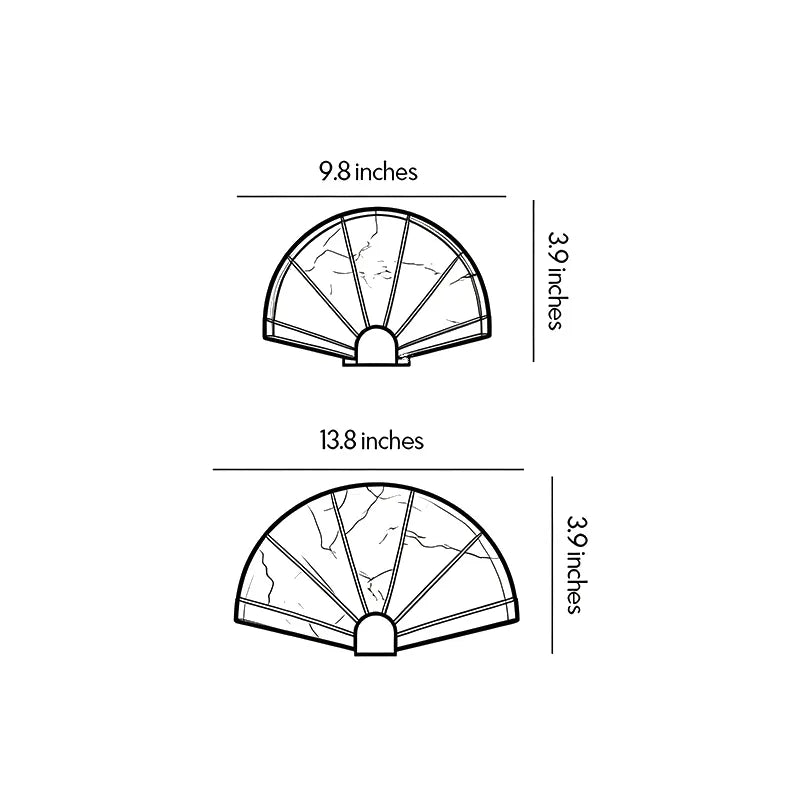
WEIGHTS & DIMENSIONS
| Specification: Small | |
| Weight: | 4.41lb |
| Size: | 6.30'' Width x 9.84'' Depth x 3.94'' Height |
| Specification: Large | |
| Weight: | 5.51lb |
| Size: | 8.66'' Width x 13.78'' Depth x 3.94'' Height |
DETAILS
| Product Type: | Diffused Light Wall Sconces |
| Power Supply: | Hardwired |
| Power: | 9W |
| Voltage: | 110V |
| Style: | Vintage |
| Light Source: | LED |
| Color Temperature: | Warm White (3000K) |
| Finish: | White |
| Material: | Marble + Hardware |
| Control Type: | Wall Switch |
| Mounting Type: | Wall Mount |
| Indoor/Outdoor: | Indoor |
| Product Care: | Turn Off the Power,Wipe Clean with Dry Cloth |
DEAL
Buy More Save More!
For purchases of 10 or more of the above items, please Contact Us for special offers.
Shipping & Delivery
Shipping & Delivery
Free Shipping
Dazuma offers free standard shipping on orders over $49. For orders under $49, a flat shipping fee of $9.99 will apply.
Processing Time
We start processing your order as soon as it is placed. You will receive an email confirmation upon placing your order. Please review your order details carefully for accuracy. Processing times are as follows:
- Standard Products: 7–10 business days.
- Custom or Bulk Orders: 10–35 business days.
- Peak Periods or Holidays: Processing times may extend during high-order volumes.
Shipping Methods & Delivery Times
Dazuma provides the following shipping options to suit your needs:
Standard Shipping
- Estimated Delivery Time: 15–25 business days.
- Cost: Free for orders over $49; $9.99 flat rate for orders under $49.
Expedited Shipping
- Estimated Delivery Time: 7–10 business days.
- Cost: Additional fees apply; calculated at checkout.
Note: Delivery times may vary depending on your location and carrier logistics.
Shipping Costs
Shipping costs are calculated based on:
- The shipping method you select.
- The weight and dimensions of your order.
- The delivery destination.
The total shipping cost will be displayed at checkout before completing your purchase.
Order Tracking
Once your order ships, you will receive an email that includes:
- A tracking number.
- A link to track your package.
- The carrier’s information (e.g., UPS, FedEx, DHL).
You can also track your order via our website on the Order Tracking page.
Shipping Delays
We strive to deliver your order on time; however, delays may occur due to:
- Inventory availability or processing capacity.
- High order volumes during peak seasons.
- Unforeseen circumstances such as natural disasters or strikes.
- Customs clearance issues or carrier delays.
If a significant delay occurs, we will notify you promptly. For urgent assistance, please contact Dazuma Customer Service.
Lost or Damaged Packages
Lost Packages
- If your package is not delivered within 15 business days of the expected delivery date, please contact us.
- We will work with the carrier to locate your package or provide a replacement/refund.
Damaged Packages
- If your package arrives damaged, please contact us within 48 hours of delivery.
- Provide photos or videos of the damaged item and packaging to expedite the resolution process.
Ownership & Authorized Online Operations
Dazuma is a lighting brand owned by DUSTERONE SARL, 44 Rue Beaurepaire, 49100 Angers, France.
Dazuma.us is an authorized online retail channel for Dazuma-branded products. HONGKONG GAOXUNBOO TECHNOLOGY CO., LIMITED is authorized by DUSTERONE SARL to support global e-commerce operations, including online store management, order processing, customer-service coordination, payment support, and logistics coordination for Dazuma.us.
Authorized U.S. Return & Exchange Receiving Facility
For approved returns and exchanges only:
Recipient: MH022 Address: 21 Central Ct STE #7, Leominster, MA 01453, United States
Please contact Dazuma Customer Support before sending any return or exchange shipment. Packages sent without prior authorization, missing order information, or sent to the wrong facility may be delayed, refused, or returned to sender.
Additional Information
- International Shipping: Available to select locations.
- Non-Serviceable Addresses: We cannot deliver to Alaska, Hawaii, P.O. Boxes, APO/FPO addresses, or restricted areas.
- Customs and Duties: All customs fees, import taxes, and duties are included in the shipping cost.
- Installation & Assembly: Dazuma does not provide on-site installation, assembly, indoor placement, or labor services.
- Non-Refundable Shipping Charges: Please note that shipping charges are non-refundable.
Return & Refunds
Return & Refunds
At Dazuma, we are committed to enhancing your home with thoughtfully designed lighting and home décor. While every order is rigorously inspected by our QA team before shipping, we understand that a return or refund may occasionally be necessary. This policy outlines the process for returns, refunds, and exchanges to ensure a seamless experience.
1. Order Cancellation Policy
Cancellation Before Shipping: You may cancel your order for a full refund at any time before the product has been shipped. Please contact us immediately at [email protected] to process your request.
Cancellation After Shipping: Once an order has been transferred to the carrier and is in transit, it cannot be canceled or modified. If you no longer wish to keep the item, please refer to our return policy after receiving the package.
Customized Orders: Once production of a custom or specialty order (non-stock sizes/designs) has begun, the order cannot be canceled or modified.
2. Return Window & Eligibility
Geographical Restriction: We only offer return and exchange services for orders delivered within the United States. We do not accept returns or exchanges from countries or regions outside the USA.
30-Day Strict Deadline: We offer a 30-day return window from the date of delivery. You must initiate your return request within this period. No returns or refund requests will be accepted after 30 days of receipt.
Condition Requirement: To be eligible for a return, items must be in their original condition: unused, unassembled, undamaged, and in their original packaging (unopened). All original tags, instructions, and inserts must be included.
3. Non-Returnable Products
The following items are strictly non-returnable and non-refundable:
Orders from outside the USA.
Customized or personalized items (unless there is a confirmed quality defect).
Items that have been assembled, used, or altered.
Clearance items, "Open Box" items, or final sale items.
Gift cards.
4. Return Shipping Costs
Quality Issues (Defective/Damaged/Mis-shipped): Dazuma will be responsible for the return shipping costs for orders that are defective, damaged, or mis-shipped. Please report such issues within 48 hours of delivery.If it is a quality issue, please contact [email protected] and provide photos/videos.
Non-Quality Issues (Change of Mind): For returns due to personal preference (e.g., style, size, or color), the customer is responsible for all round-trip shipping costs, including the original shipping cost paid by Dazuma and the return shipping fee.
5. How to Initiate a Return (USA Orders Only)
Contact Us: Email [email protected] with your order number and reason for return.
Approval: Once approved, you will receive the correct return address. Do not send items back without prior authorization.
Packaging: Securely package the item and include a note with your order number and product ID inside the box.
Tracking: Use a trackable shipping method. Dazuma is not responsible for lost or undelivered return packages.
6. Refund Process
Inspection: Once we receive and inspect your return, we will notify you of the approval or rejection.
Approved Refunds: Refunds will be issued to your original payment method within 5–10 business days.
7. Damaged or Defective Products
Visible Damage: If damage is visible upon delivery, please reject the shipment and contact us immediately.
Concealed Damage: If you discover damage after opening, you must contact us within 48 hours of delivery. Provide photos of the damaged item and all original packaging.
Dazuma will work with you to provide a replacement or refund, based on your preference.
8. 2-Year Quality Support & Warranty
We are committed to the longevity of your Dazuma lighting. To ensure your space remains perfectly lit, we provide a 2-year support framework for all fixtures:
Within 1 Year of Delivery: Should any functional issues or manufacturing defects arise (such as driver or LED failure), Dazuma will provide the necessary replacement components or a new unit at no additional cost to you.
Year 2 Support: For items entering their second year of use, our commitment continues through our Extended Loyalty Program. If a component requires replacement after the first 12 months, we offer exclusive, high-value discounts on replacement parts or new units to ensure your Dazuma collection remains in top condition.
How it works: If you have questions about your product's performance, simply reach out to [email protected]. Our technical team will review the details (please include your order number and any relevant photos) and provide the most efficient resolution for your specific case.
We strive to make returns, refunds, and exchanges simple and stress-free. For assistance, please contact Dazuma Customer Service.
9.The terms need to be explained:
If the return is caused by the consumer, consumer should be responsible for the shipping fee. The specific fee should be based on the express company you choose.
If due to our reasons, the goods received are damaged or not correct, and the consumer is not required to bear the shipping fee for this reason.
Authorized U.S. Return & Exchange Receiving Facility
For approved returns and exchanges only:
Recipient: MH022 Address: 21 Central Ct STE #7, Leominster, MA 01453, United States
Please contact Dazuma Customer Support before sending any return or exchange shipment. Packages sent without prior authorization, missing order information, or sent to the wrong facility may be delayed, refused, or returned to sender.
Ownership & Authorized Online Operations
Dazuma is a lighting brand owned by DUSTERONE SARL, 44 Rue Beaurepaire, 49100 Angers, France.
Dazuma.us is an authorized online retail channel for Dazuma-branded products. HONGKONG GAOXUNBOO TECHNOLOGY CO., LIMITED is authorized by DUSTERONE SARL to support global e-commerce operations, including online store management, order processing, customer-service coordination, payment support, and logistics coordination for Dazuma.us.
FAQ
FAQ
FAQs you need! Get instant answers to everything you want to know right here. Your questions answered in one convenient place.
Ordering & Payments
What Types of Credit Card Payments Do You Accept?
Dazuma accepts Visa, MasterCard, American Express, Discover, Diners Club, JCB, and UnionPay credit cards. Here is a list of Valid Payment Methods
What Should I Do If My Payment Method Is Declined at Checkout?
If your payment is declined, it may be due to factors such as incorrect billing details, insufficient funds, or fraud protection measures by your card issuer. Start by reviewing your card information for accuracy. If the issue persists, please contact Dazuma Customer Service for assistance.
How Will I Know My Order Has Been Received?
After placing your order, a confirmation page will display your transaction details. You can print this for your records. Additionally, a confirmation email will be sent to the email address provided. When your order ships, you’ll receive further emails with tracking information.
How Can I View an Order I’ve Placed?
Log into your Dazuma account and navigate to your Orders. If you’re unable to locate your order, please contact Dazuma Customer Service for help linking the order to your account.
Can I Change or Cancel My Order?
Once Dazuma receive your order, we begin processing it right away, so changes or cancellations may not always be possible. Additionally, orders cannot be modified online after they’ve been placed.
However, we understand that situations may arise where you’d like to request a change or cancellation. If this happens, please contact Dazuma Customer Service as soon as possible. We will do our best to accommodate your request.
If your order has already shipped before the cancellation or change is confirmed, you can return the item in accordance with our Return Policy. Please note that certain items, especially non-returnable ones, cannot be canceled.
Are Installation or Labor Costs Included in the Prices?
No, Dazuma is not responsible for installation or labor costs related to handling, storing, installing, or uninstalling items purchased from us.
Shipping & Delivery
Is Free Shipping Available?
Yes, Dazuma offers free standard shipping on orders over $49. Expedited delivery options are available at an additional cost.
How Much Does Shipping Cost?
Shipping costs are determined by the delivery location, the item's size and weight, and the selected shipping method. Exact fees will be calculated and shown during checkout. Additional surcharges may apply for deliveries to remote areas.
Are Customs Taxes Covered?
Dazuma covers all customs taxes for your orders. Whether you’re shopping locally or internationally, you can enjoy a seamless experience without worrying about unexpected customs fees.
How Long Will It Take for My Order to Arrive?
Delivery time includes both processing and shipping times:
1. Processing Time:
• Standard products: 7–10 business days.
• Custom or bulk orders: 10–35 business days.
• Processing may take longer during holidays or peak periods.
2. Shipping Time:
• Varies by location and shipping method.
• Expedited shipping: 7–10 business days (estimated).
• Standard shipping: 15–25 business days (estimated).
Delays may occur due to inventory availability, processing capacity, or unexpected events like strikes or natural disasters. If there are any delays, we will notify you promptly. For more details, visit Dazuma Shipping Info.
Why Didn’t I Receive an Email About My Order Delivery?
Once your order is dispatched, you’ll receive a tracking number via email within 1–2 business days. Please ensure your email address is accurate and check your spam folder if you don’t see the email.
How Can I Track My Package?
Visit the “Order Tracking” section on our website once your tracking number is updated by the courier. Note: Tracking updates may take time due to international shipping and customs clearance processes. Contact Dazuma Customer Service for help if you encounter any issues.
Can I Modify My Shipping Address?
You can contact Dazuma Customer Service to update your shipping address before the package ships. After shipment, address changes will not be possible.
Returns & Refunds
What Should I Do If I Receive a Damaged Item?
If your item arrives damaged, please follow these steps:
- Document the Damage: Take clear photos or videos of the damaged item, its packaging, and the shipping label.
- Contact Us: Email us at [email protected] with your order number and the photos attached.
- Resolution: After reviewing your case, we will arrange a refund or replacement at no additional cost.
How Do I Return a Product?
You can return eligible items within 30 days of delivery. Follow these steps to initiate a return:
1. Contact Customer Service: Reach out to Dazuma Customer Service to confirm the return address.
2. Package the Item: Retain all packaging materials and shipping notes. Securely pack the item and include a note with the following details:
- Order number
- Product ID or name and quantity
- A brief description of the issue with the product
3. Arrange Pickup: Make the package available for pickup as instructed.
4. Provide Tracking Information: Share the tracking number and a copy of the shipping receipt with Dazuma.
For more details, review our Return Policy.
How Is My Refund Calculated for Returns?
If you decide to return a returnable item because you’ve changed your mind, we will issue a partial refund. This refund will cover the cost of the item minus the original shipping fees. Additionally, you will be responsible for the return shipping costs.If the return is due to an item being damaged, defective, or incorrect, we will provide a full refund or a replacement at no charge. For further details, please refer to our
When Will I Receive My Refund?
Refunds are typically processed within one week after we receive and inspect the item. However, due to shipping, inspection, and banking processes, it may take up to 30 days for the refund to appear on your card.
Warranty & Support
Do Your Products Come With a Warranty?
Yes, Dazuma proudly stands behind the quality of our products. We offer a One-Year Warranty that covers defects in materials or workmanship. If you discover such a defect within one year of purchase, we will repair or, at our discretion, replace the product at no additional charge.Please note:
• The warranty does not cover defects, breakage, or malfunctions caused by mishandling or improper use of the product.
• Light bulbs included with the product are not covered under this warranty.
Who Should I Contact If I Have a Complaint?
Your satisfaction is our priority. Please contact Dazuma Customer Service via phone, live chat, or email, and we’ll do our best to resolve your concerns promptly.
Account Management
How Can I Update My Email Address?
Currently, email addresses cannot be updated. If you have no pending orders, contact Dazuma Customer Service to delete your account and create a new one with the updated email.
How Can I Update My Shipping Address?
Visit the “Profile-Address” section in My Account to add, update, or delete shipping addresses.
How Do I Unsubscribe From Emails?
Click the unsubscribe link at the bottom of any email and follow the instructions.
Promotions & Discounts
How Do Your Coupon Promotions Work?
To use a Dazuma coupon code, simply enter it during checkout. Once applied, your cart will reflect the discount associated with the code.Please keep in mind:
• They cannot be applied to special orders or previous purchases.
• Coupons cannot be combined with other discounts or markdown pricing.
• Each coupon is limited to one use per customer and is non-transferable.
• Coupons cannot be redeemed for cash or gift certificates.
Do You Offer Gift Cards?
Yes, Dazuma Gift Cards are available on our website and can be redeemed at checkout.
Custom Orders & Bulk Purchases
Can I Customize a Product?
While most items are sold as-is, we’re happy to explore customization options for bulk or special orders. Contact Dazuma Customer Service to discuss your requirements.
Do You Offer Discounts for Bulk Orders?
Yes, Dazuma offers special discounts for bulk purchases through our Trade Professionals Program, designed for qualified trade professionals such as designers, architects, and contractors.Key benefits include:
• Exclusive discounts on large orders.
• Personalized support from a dedicated trade account manager.
• Free and straightforward enrollment via our website.
If you need a quotation for a substantial purchase, our trade account managers are ready to assist. Contact Dazuma Customer Service and start saving on your next project!
Share this product


THE DAZUMA STANDARD

AUTHENTIC MATERIALS
Genuine natural silk, solid brass, and artisan glass.

QUALITY ASSURANCE
Rigorous 7-stage inspection for every fixture.

EXPERT SUPPORT
Provide online chat and email support services 24/7.

BESPOKE SOLUTIONS
Tailored dimensions and finishes for your specific needs.

7,000+ DESIGNS
Curated collections featuring the latest architectural trends.
Browse our selection of premium lighting, thoughtfully organized by the rooms they illuminate.


Discover our diverse aesthetics. Find the design language that speaks to your unique home décor.


Every material tells a story. From the cool touch of Stone to the warmth of Rattan, find the perfect finish to define your interior narrative.


Explore lighting optimized for specific zones—including indoor sanctuaries and outdoor landscapes.


Professional lighting support for residential and commercial projects, with project pricing, customization, and technical guidance from concept to installation.


A scalloped wall sconce can turn a relatively small section of wall into a decorative lighting feature, and this design does so with a broad fan-shaped silhouette rather than a conventional globe, cone, or fabric shade. Based on the visible design, the fixture uses a pale translucent-looking upper panel divided into radiating sections, with a compact dark center support at the bottom. Warm light appears to spread through the segmented surface and onto the wall behind it, giving the sconce a softly layered, almost shell-like appearance.
The visual effect is decorative without being overly ornate. The upper portion forms a wide half-circle with gently scalloped or fan-like geometry, while the lower mounting element keeps the center visually grounded. That combination makes the fixture especially suitable for interiors where the wall light should feel like part of the décor rather than disappear into the background. Exact dimensions, material, light source, output, color temperature, dimming, and electrical specifications cannot be confirmed from the image and should be checked before ordering.
What Makes This Scalloped Wall Sconce Visually Distinctive?
This scalloped wall sconce stands out because the visible shade spreads horizontally like an open fan while the supporting hardware remains compact. The radiating segments create a clear decorative rhythm, and the warm light emphasizes the spaces and surface variation between them. Compared with a simple cylinder or globe, this shape has more visual movement and can function almost like a small illuminated wall sculpture.
The broad upper profile is the most noticeable feature. Rather than forming a full circle, the fixture appears to use a half-round or fan-shaped shade that rises above the central mounting point. The top edge is gently curved, while the lower edge tapers toward the center. This creates a strong visual relationship with shell forms, folding fans, and Art Deco-inspired geometry without requiring the room to follow one specific historical style.
The segmented surface also matters. Several wedge-like sections appear to radiate outward from the lower center, creating visible lines that become more pronounced when the fixture is illuminated. This gives the pale surface more depth than one continuous translucent panel. Because the actual construction is unknown, the safest description is a segmented translucent-looking or stone-like shade rather than assuming glass, alabaster, resin, shell, or another material.
The dark center support provides useful contrast. In the image, the mounting element sits at the lowest central point of the fan and appears much smaller than the illuminated upper section. That visual weighting helps the shade seem broader and lighter, almost as if the luminous fan is opening upward from a small base.
For shoppers comparing different wall sconces, this design offers a very different proportion from tall vertical sconces or compact round fixtures. It is relatively wide for its height, which makes it especially useful above or beside furniture where horizontal emphasis feels more appropriate than a narrow upright light.
Where Does a Scalloped Wall Sconce Work Best?
A scalloped wall sconce works best where the wall needs a decorative focal point and the fixture can be viewed from the front rather than squeezed into a very narrow bay. This design is particularly well suited to living rooms, bedrooms, studies, dining rooms, entry areas, reading corners, and boutique hospitality interiors. Its broad fan shape can visually balance tall furniture and straight architectural lines while adding a softer source of light.
Living room: A scalloped wall sconce for living room use can work beside a sofa, above a side table, near a fireplace, or on a wall next to a large bookcase. The image shows the fixture beside a tall dark shelving unit, which demonstrates how the wide pale shade can soften the strong vertical geometry of dark wood furniture.
If the seating area also needs stronger reading illumination, use the sconce as the atmospheric layer and let a floor lamp provide task light near the chair or sofa. Decorative wall lighting usually feels more comfortable when it is not expected to provide all of the room’s practical illumination.
Study or home office: The fan-shaped wall light can be especially effective in a study with bookcases, writing furniture, or traditional wood cabinetry. Its warm glow can soften the harder edges of shelving and desk surfaces while the scalloped form adds visual interest without taking up desk space. If the room is used for reading or detailed work, supplement the sconce with a more focused designer table lamp or another task source.
Bedroom: A scalloped wall light for bedroom use can sit beside a headboard, above a low nightstand, or on a secondary wall near a reading chair. The wide profile works especially well when the bed or furniture below it is relatively low and horizontal. Before using it as a bedside reading source, confirm the actual lumen output, projection, switching method, and whether the light reaches the reading area rather than remaining mostly decorative.
Dining room: In a dining room, the fixture can work on a sideboard wall or in a pair around artwork or a mirror. The fan-like silhouette feels decorative enough to contribute to the evening atmosphere without requiring a large wall sculpture. If the dining table already has a strong ceiling focal point, a vintage chandelier or other chandelier should remain visually dominant while the wall sconces support the perimeter.
Entry or stair landing: A single fan-shaped wall sconce can create a memorable arrival point above a console or at a landing where the wall needs one decorative element. Because the fixture spreads horizontally, check that nearby door trim, wall panels, or artwork leave enough clear space for the full shape to be read.
Boutique hotel or restaurant: In a hospitality setting, a scalloped wall sconce can add character to guest rooms, lounge walls, reception niches, corridors, or intimate dining areas. Repeating the same broad fan motif can create a recognizable design language. For commercial projects, confirm electrical ratings, maintenance access, replacement needs, finish durability, and long-term product availability before specifying several units.
How Should You Position a Fan-Shaped Wall Sconce?
A fan-shaped wall sconce should be positioned according to the full width of the shade, not only the center of the wall box. Because this design spreads horizontally, the surrounding wall space matters as much as mounting height. A full-size paper template based on the listed dimensions is one of the easiest ways to judge scale and make sure the fixture does not crowd artwork, trim, shelving, or furniture.
Start by measuring the total available width. Mark the outer left and right edges of the fixture as well as the highest point of the curved top. This helps reveal whether the wall has enough breathing room for the entire fan shape. A fixture that appears compact in a product photo can feel much wider once installed at eye level.
Above a side table or console, center the fixture according to the furniture composition rather than the nearest wall edge. The lower mounting point can sit visually close to the furniture, but the broad shade should still have enough empty wall around it to feel balanced. If the room includes wall molding, check whether the fan shape fits comfortably within one panel or architectural bay.
Beside a bed, pay attention to both width and seated eye level. A wide glowing shade mounted too close to the pillow can feel brighter or larger than expected. The correct position depends on headboard width, mattress height, fixture projection, and actual output. If the sconce is used in a pair, measure both sides from the bed centerline and keep the outer clearance consistent.
Near a bookcase, tall cabinet, or doorway, the horizontal silhouette can create useful contrast with strong vertical lines. However, avoid letting the outer edge of the shade visually touch the furniture. Even a few inches of blank wall can make the fixture feel more intentional and prevent the composition from looking crowded.
- Professional tip: Make a full-width paper template before installation. With a scalloped or fan-shaped light, width is often the dimension homeowners underestimate most.
- Professional tip: View the mock-up from across the room and from the side. A broad wall light can look balanced straight on but project more than expected into a narrow circulation zone.
For new construction or renovation projects, coordinate the junction box before paneling, wallpaper, built-ins, or decorative wall finishes are complete. Precise positioning matters when the fixture has such a recognizable silhouette, especially if it needs to align with shelving, trim, or a matched pair.
What Kind of Light Effect Can a Scalloped Shade Create?
A scalloped or segmented shade can create a softer, more dimensional glow than a completely smooth flat diffuser because each section catches and transmits light slightly differently. In the image, the warm illumination appears strongest near the center and then spreads outward across the fan-shaped surface. That layered effect is especially useful for ambient and decorative lighting rather than highly focused task illumination.
The visible segmentation gives the light a radial quality. Instead of one uniform luminous panel, the shade appears divided into several sections that fan outward from the center. When the fixture is on, those lines become part of the visual effect and can make the wall light feel more crafted and architectural.
The warm halo behind the fixture also contributes to the room. On a neutral wall, the glow softens the outline of the shade and makes the fan shape appear slightly larger. On a darker wall, the illuminated silhouette may become more dramatic. On a heavily patterned wall, some of the subtle segmentation and halo could be harder to see.
Color temperature will change how the fixture reads. A warmer light can enhance the cream or ivory appearance of the shade and work well with dark wood, bronze, beige, linen, and other warm materials. A cooler light may make the shade feel crisper and more contemporary. Since photography and screen settings can shift the perceived warmth, use the listed color temperature rather than the image alone when coordinating the room.
The shade also appears to conceal the light source from direct frontal view. This can make a decorative wall sconce more comfortable near eye level because the viewer sees an illuminated surface rather than a bare bright point. The actual glare control depends on shade opacity, source position, output, and construction, so the product specifications remain important.
For the broader room plan, pair the sconce with ceiling lights for general illumination and portable lamps for tasks. In a living room, for example, the scalloped wall light can provide atmosphere while ceiling and floor lighting handle higher-output needs. This keeps the decorative effect soft rather than forcing the fixture to do every job.
Which Interior Styles Pair Well With a Scalloped Wall Sconce?
A scalloped wall sconce pairs well with modern vintage, transitional, Art Deco-inspired, contemporary classic, Asian-inspired, eclectic, and boutique-hotel-style interiors. The fan-shaped geometry gives the fixture decorative character, while the pale surface and compact mount keep the overall form relatively clean. It works especially well with dark wood, warm neutrals, black accents, brass-toned details, plaster-like walls, and rooms that mix soft decorative forms with strong architectural lines.
In a modern vintage living room, the sconce can sit beside dark wood cabinetry, a leather or upholstered chair, and simple framed art. The fan form adds historical flavor without requiring the rest of the room to be a literal period recreation. One decorative light can provide enough reference to vintage design while the furniture remains current.
In a study or library, the fixture can complement built-in bookcases and writing furniture because its warm glow and broad shape offset the vertical repetition of shelves. The image demonstrates this relationship particularly well. A dark cabinet gives the pale fan shape stronger contrast, while the light softens the overall wall composition.
In an Art Deco-inspired room, the radiating geometry can relate naturally to fan motifs, sunburst details, stepped forms, polished accents, and symmetrical furniture arrangements. The fixture does not need to be historically Art Deco to work in that environment. The connection comes from geometry, repetition, and the controlled decorative silhouette.
If the room also needs a ceiling focal point, choose a fixture that shares one or two cues rather than copying the fan shape. A modern chandelier can provide cleaner geometry at ceiling level while the scalloped sconce handles the decorative wall plane. This kind of contrast often feels more collected than selecting a perfectly matched lighting set.
Is This Scalloped Wall Sconce Right for Your Space?
This scalloped wall sconce is best suited to rooms that need a broad decorative accent and a warm ambient layer rather than a narrow task light. It is a strong candidate for living rooms, studies, bedrooms, dining rooms, entries, and hospitality interiors where the wall has enough clear width for the fan-shaped silhouette. It may be less suitable for very narrow wall bays, crowded gallery walls, or spaces that require strong directional light from the sconce alone.
Choose it if you want lighting to act like décor. The fan-shaped segmented surface remains noticeable even when the fixture is off, so it can replace some of the visual role normally assigned to wall art or decorative objects.
Choose it if your room has strong vertical furniture. Tall bookcases, cabinets, paneled walls, or narrow architectural lines can benefit from the horizontal counterbalance of a scalloped half-circle light.
Think carefully about wall width. The fixture’s main visual dimension is horizontal. A narrow wall beside a door or mirror may not provide enough negative space, even if the electrical box itself fits easily.
Check projection in circulation areas. The front view does not reveal the exact depth. Hallways, stair landings, and locations near door swings need enough clearance that the fixture does not feel intrusive.
Do not assume the shade material from the photograph. The surface appears pale, translucent, segmented, and stone-like in places, but the actual material must come from the product specifications. That information affects weight, cleaning, durability, installation, and light transmission.
Plan task lighting separately. If you need strong reading or desk illumination, use the scalloped sconce for atmosphere and pair it with a dedicated source. A table lamp can provide focused light while preserving the decorative role of the wall fixture.
- Good fit for: living rooms, studies, bedrooms, dining rooms, entries, boutique hotels, restaurant lounges, and design-led renovation projects.
- Potentially less suitable for: narrow wall bays, highly patterned walls, crowded gallery arrangements, or spaces requiring concentrated task light from the wall alone.
- Measure before ordering: total shade width, overall height, wall projection, distance to furniture or trim, intended mounting height, and junction-box position.
- Verify in the specifications: exact dimensions, shade material, finish, light source, output, color temperature, dimming, voltage, mounting details, certifications, and included hardware.
Frequently Asked Questions
Is a scalloped wall sconce suitable for a living room?
Yes. A scalloped wall sconce can work especially well in a living room where the wall needs a decorative focal point and softer eye-level illumination. This fan-shaped design can sit beside a sofa, bookcase, console, or fireplace and provide more visual interest than a basic cylinder. It works best as part of a layered lighting plan, with ceiling or floor lighting handling broader or task-oriented needs.
Can this sconce work in a study or home office?
Yes. The broad fan shape works particularly well beside tall shelving or bookcases because it creates horizontal contrast against strong vertical furniture lines. For reading, writing, or detailed desk work, however, use a dedicated task lamp as well unless the product specifications confirm enough output for that purpose.
What material is the scalloped shade made from?
The photograph does not provide enough information to confirm the material. The shade looks pale, translucent, segmented, and slightly stone-like, but it could be made from several different materials. Check the product specifications for the actual construction before ordering. Material affects weight, cleaning, durability, installation, and how evenly the warm light passes through the shade.
How high should a fan-shaped wall sconce be mounted?
There is no universal mounting height because the correct position depends on fixture width, furniture height, ceiling height, and normal eye level. With a wide scalloped sconce, the full fan shape matters more than the wall box alone. Create a full-size paper template and test it above or beside the intended furniture before finalizing the junction-box location.
Will this wall sconce provide enough light for reading?
That cannot be determined from the image alone. The visible effect appears warm and ambient, with the segmented surface distributing light across the shade and wall. Reading comfort depends on lumen output, source position, mounting height, and how much light reaches the page. If reading is important, review the specifications and plan a separate task source if necessary.
Can I use two scalloped wall sconces as a pair?
Yes. A pair can work well around a mirror, artwork, sideboard, fireplace, or bed if the wall has enough horizontal space. Because the fan shape is broad, leave generous clearance between the sconces and the central object. Measure both fixtures from a shared centerline so their width, height, and distance from nearby trim feel deliberately balanced.
Does this style work in a modern interior?
Yes. Although the fan-like geometry has a vintage and Art Deco-inspired character, the pale shade and compact center mount are clean enough for contemporary rooms. Use the sconce as one decorative accent against a simple wall and pair it with modern furniture, dark wood, restrained metal finishes, or neutral upholstery. The contrast between expressive lighting and quieter furnishings can feel current rather than themed.
Is professional installation recommended?
For a hardwired decorative wall fixture, professional installation is generally a sensible choice, especially when the sconce is relatively wide or must align precisely with cabinetry, wall panels, artwork, or a matched fixture on the opposite side. Follow the manufacturer’s instructions and confirm fixture weight, wall support, junction-box compatibility, electrical requirements, mounting hardware, and any dimming or driver requirements before installation.


