



Contemporary Ceiling Fans with LED Lights Brown Blade Light

DESCRIPTION
Description:
This contemporary ceiling fans with led lights black finish with a brown blade design creates a warm and refined appearance, providing both comfortable airflow and decorative appeal. Equipped with LED lighting, it features tri-color changing modes, allowing adjustment between warm light, natural light, and white light according to different occasions such as dining, relaxing, and reading. The acrylic diffuser softens the light output, creating comfortable and even illumination. Constructed with hardware, ABS, and acrylic materials, the fan light offers a stable and lightweight structure. With an IP44 protection rating, it is suitable for semi-outdoor environments such as balconies and gazebos. The downrod length is 4.7in+7.9in and is adjustable for flexible installation.
Highlights:
Retro Straight Blade Design: Creates a clean and stylish decorative look.
Large Fan Structure: This contemporary ceiling fans with led lights ideal for living rooms, patios, and leisure areas.
Tri-Color LED Lighting: Warm / natural / white light modes.
Hardware + ABS + Acrylic Construction: Durable structure with soft light diffusion.
Adjustable Downrod Design: 4.7in+7.9in adjustable length for flexible installation.
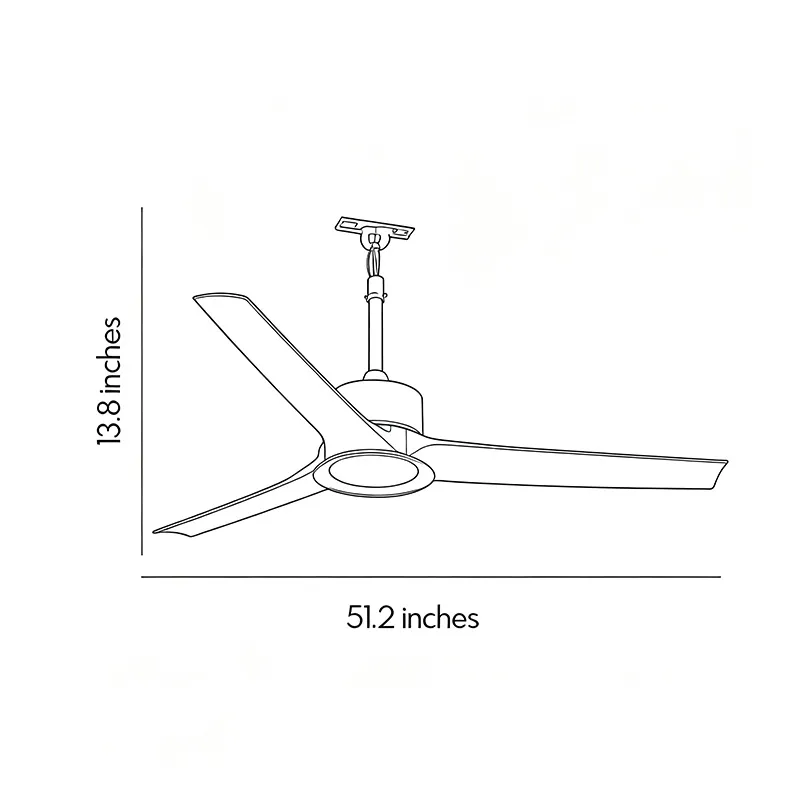
WEIGHTS & DIMENSIONS
| Color: Black and Brown | |
| Weight: | 8.82lb |
| Size: | 51.18'' Width x 51.18'' Depth x 13.78'' Height |
DETAILS
| Product Type: | Ceiling Fans with Lights |
| Power Supply: | Hardwired |
| Voltage: | 110V |
| Power: | 18W |
| Style: | Modern |
| Light Source: | LED |
| Color Temperature: | 3-Color Temperature (3000K/4500K/6000K) |
| Material: | Hardware |
| Finish: | Black |
| Shade Material: | Acrylic |
| Shade Color: | White |
| Blades Material: | ABS |
| Blades Color: | Brown |
| Control Type: | Remote Control Switch |
| Mounting Type: | Ceiling Mount |
| Number of Blades: | 3 |
| Ingress Protection: | IP44 |
| Indoor/Outdoor: | Indoor |
| Product Care: | Turn Off the Power,Wipe Clean with Dry Cloth |
NOTE
1 in = 2.54 cm; 1 cm = 0.39 in
* Should you require any further information about our products and services, feel free to Contact Us.
Shipping & Delivery
Shipping & Delivery
Free Shipping
Dazuma offers free standard shipping on orders over $49. For orders under $49, a flat shipping fee of $9.99 will apply.
Processing Time
We start processing your order as soon as it is placed. You will receive an email confirmation upon placing your order. Please review your order details carefully for accuracy. Processing times are as follows:
- Standard Products: 7–10 business days.
- Custom or Bulk Orders: 10–35 business days.
- Peak Periods or Holidays: Processing times may extend during high-order volumes.
Shipping Methods & Delivery Times
Dazuma provides the following shipping options to suit your needs:
Standard Shipping
- Estimated Delivery Time: 15–25 business days.
- Cost: Free for orders over $49; $9.99 flat rate for orders under $49.
Expedited Shipping
- Estimated Delivery Time: 7–10 business days.
- Cost: Additional fees apply; calculated at checkout.
Note: Delivery times may vary depending on your location and carrier logistics.
Shipping Costs
Shipping costs are calculated based on:
- The shipping method you select.
- The weight and dimensions of your order.
- The delivery destination.
The total shipping cost will be displayed at checkout before completing your purchase.
Order Tracking
Once your order ships, you will receive an email that includes:
- A tracking number.
- A link to track your package.
- The carrier’s information (e.g., UPS, FedEx, DHL).
You can also track your order via our website on the Order Tracking page.
Shipping Delays
We strive to deliver your order on time; however, delays may occur due to:
- Inventory availability or processing capacity.
- High order volumes during peak seasons.
- Unforeseen circumstances such as natural disasters or strikes.
- Customs clearance issues or carrier delays.
If a significant delay occurs, we will notify you promptly. For urgent assistance, please contact Dazuma Customer Service.
Lost or Damaged Packages
Lost Packages
- If your package is not delivered within 15 business days of the expected delivery date, please contact us.
- We will work with the carrier to locate your package or provide a replacement/refund.
Damaged Packages
- If your package arrives damaged, please contact us within 48 hours of delivery.
- Provide photos or videos of the damaged item and packaging to expedite the resolution process.
Ownership & Authorized Online Operations
Dazuma is a lighting brand owned by DUSTERONE SARL, 44 Rue Beaurepaire, 49100 Angers, France.
Dazuma.us is an authorized online retail channel for Dazuma-branded products. HONGKONG GAOXUNBOO TECHNOLOGY CO., LIMITED is authorized by DUSTERONE SARL to support global e-commerce operations, including online store management, order processing, customer-service coordination, payment support, and logistics coordination for Dazuma.us.
Authorized U.S. Return & Exchange Receiving Facility
For approved returns and exchanges only:
Recipient: MH022 Address: 21 Central Ct STE #7, Leominster, MA 01453, United States
Please contact Dazuma Customer Support before sending any return or exchange shipment. Packages sent without prior authorization, missing order information, or sent to the wrong facility may be delayed, refused, or returned to sender.
Additional Information
- International Shipping: Available to select locations.
- Non-Serviceable Addresses: We cannot deliver to Alaska, Hawaii, P.O. Boxes, APO/FPO addresses, or restricted areas.
- Customs and Duties: All customs fees, import taxes, and duties are included in the shipping cost.
- Installation & Assembly: Dazuma does not provide on-site installation, assembly, indoor placement, or labor services.
- Non-Refundable Shipping Charges: Please note that shipping charges are non-refundable.
Return & Refunds
Return & Refunds
At Dazuma, we are committed to enhancing your home with thoughtfully designed lighting and home décor. While every order is rigorously inspected by our QA team before shipping, we understand that a return or refund may occasionally be necessary. This policy outlines the process for returns, refunds, and exchanges to ensure a seamless experience.
1. Order Cancellation Policy
Cancellation Before Shipping: You may cancel your order for a full refund at any time before the product has been shipped. Please contact us immediately at [email protected] to process your request.
Cancellation After Shipping: Once an order has been transferred to the carrier and is in transit, it cannot be canceled or modified. If you no longer wish to keep the item, please refer to our return policy after receiving the package.
Customized Orders: Once production of a custom or specialty order (non-stock sizes/designs) has begun, the order cannot be canceled or modified.
2. Return Window & Eligibility
Geographical Restriction: We only offer return and exchange services for orders delivered within the United States. We do not accept returns or exchanges from countries or regions outside the USA.
30-Day Strict Deadline: We offer a 30-day return window from the date of delivery. You must initiate your return request within this period. No returns or refund requests will be accepted after 30 days of receipt.
Condition Requirement: To be eligible for a return, items must be in their original condition: unused, unassembled, undamaged, and in their original packaging (unopened). All original tags, instructions, and inserts must be included.
3. Non-Returnable Products
The following items are strictly non-returnable and non-refundable:
Orders from outside the USA.
Customized or personalized items (unless there is a confirmed quality defect).
Items that have been assembled, used, or altered.
Clearance items, "Open Box" items, or final sale items.
Gift cards.
4. Return Shipping Costs
Quality Issues (Defective/Damaged/Mis-shipped): Dazuma will be responsible for the return shipping costs for orders that are defective, damaged, or mis-shipped. Please report such issues within 48 hours of delivery.If it is a quality issue, please contact [email protected] and provide photos/videos.
Non-Quality Issues (Change of Mind): For returns due to personal preference (e.g., style, size, or color), the customer is responsible for all round-trip shipping costs, including the original shipping cost paid by Dazuma and the return shipping fee.
5. How to Initiate a Return (USA Orders Only)
Contact Us: Email [email protected] with your order number and reason for return.
Approval: Once approved, you will receive the correct return address. Do not send items back without prior authorization.
Packaging: Securely package the item and include a note with your order number and product ID inside the box.
Tracking: Use a trackable shipping method. Dazuma is not responsible for lost or undelivered return packages.
6. Refund Process
Inspection: Once we receive and inspect your return, we will notify you of the approval or rejection.
Approved Refunds: Refunds will be issued to your original payment method within 5–10 business days.
7. Damaged or Defective Products
Visible Damage: If damage is visible upon delivery, please reject the shipment and contact us immediately.
Concealed Damage: If you discover damage after opening, you must contact us within 48 hours of delivery. Provide photos of the damaged item and all original packaging.
Dazuma will work with you to provide a replacement or refund, based on your preference.
8. 2-Year Quality Support & Warranty
We are committed to the longevity of your Dazuma lighting. To ensure your space remains perfectly lit, we provide a 2-year support framework for all fixtures:
Within 1 Year of Delivery: Should any functional issues or manufacturing defects arise (such as driver or LED failure), Dazuma will provide the necessary replacement components or a new unit at no additional cost to you.
Year 2 Support: For items entering their second year of use, our commitment continues through our Extended Loyalty Program. If a component requires replacement after the first 12 months, we offer exclusive, high-value discounts on replacement parts or new units to ensure your Dazuma collection remains in top condition.
How it works: If you have questions about your product's performance, simply reach out to [email protected]. Our technical team will review the details (please include your order number and any relevant photos) and provide the most efficient resolution for your specific case.
We strive to make returns, refunds, and exchanges simple and stress-free. For assistance, please contact Dazuma Customer Service.
9.The terms need to be explained:
If the return is caused by the consumer, consumer should be responsible for the shipping fee. The specific fee should be based on the express company you choose.
If due to our reasons, the goods received are damaged or not correct, and the consumer is not required to bear the shipping fee for this reason.
Authorized U.S. Return & Exchange Receiving Facility
For approved returns and exchanges only:
Recipient: MH022 Address: 21 Central Ct STE #7, Leominster, MA 01453, United States
Please contact Dazuma Customer Support before sending any return or exchange shipment. Packages sent without prior authorization, missing order information, or sent to the wrong facility may be delayed, refused, or returned to sender.
Ownership & Authorized Online Operations
Dazuma is a lighting brand owned by DUSTERONE SARL, 44 Rue Beaurepaire, 49100 Angers, France.
Dazuma.us is an authorized online retail channel for Dazuma-branded products. HONGKONG GAOXUNBOO TECHNOLOGY CO., LIMITED is authorized by DUSTERONE SARL to support global e-commerce operations, including online store management, order processing, customer-service coordination, payment support, and logistics coordination for Dazuma.us.
FAQ
FAQ
FAQs you need! Get instant answers to everything you want to know right here. Your questions answered in one convenient place.
Ordering & Payments
What Types of Credit Card Payments Do You Accept?
Dazuma accepts Visa, MasterCard, American Express, Discover, Diners Club, JCB, and UnionPay credit cards. Here is a list of Valid Payment Methods
What Should I Do If My Payment Method Is Declined at Checkout?
If your payment is declined, it may be due to factors such as incorrect billing details, insufficient funds, or fraud protection measures by your card issuer. Start by reviewing your card information for accuracy. If the issue persists, please contact Dazuma Customer Service for assistance.
How Will I Know My Order Has Been Received?
After placing your order, a confirmation page will display your transaction details. You can print this for your records. Additionally, a confirmation email will be sent to the email address provided. When your order ships, you’ll receive further emails with tracking information.
How Can I View an Order I’ve Placed?
Log into your Dazuma account and navigate to your Orders. If you’re unable to locate your order, please contact Dazuma Customer Service for help linking the order to your account.
Can I Change or Cancel My Order?
Once Dazuma receive your order, we begin processing it right away, so changes or cancellations may not always be possible. Additionally, orders cannot be modified online after they’ve been placed.
However, we understand that situations may arise where you’d like to request a change or cancellation. If this happens, please contact Dazuma Customer Service as soon as possible. We will do our best to accommodate your request.
If your order has already shipped before the cancellation or change is confirmed, you can return the item in accordance with our Return Policy. Please note that certain items, especially non-returnable ones, cannot be canceled.
Are Installation or Labor Costs Included in the Prices?
No, Dazuma is not responsible for installation or labor costs related to handling, storing, installing, or uninstalling items purchased from us.
Shipping & Delivery
Is Free Shipping Available?
Yes, Dazuma offers free standard shipping on orders over $49. Expedited delivery options are available at an additional cost.
How Much Does Shipping Cost?
Shipping costs are determined by the delivery location, the item's size and weight, and the selected shipping method. Exact fees will be calculated and shown during checkout. Additional surcharges may apply for deliveries to remote areas.
Are Customs Taxes Covered?
Dazuma covers all customs taxes for your orders. Whether you’re shopping locally or internationally, you can enjoy a seamless experience without worrying about unexpected customs fees.
How Long Will It Take for My Order to Arrive?
Delivery time includes both processing and shipping times:
1. Processing Time:
• Standard products: 7–10 business days.
• Custom or bulk orders: 10–35 business days.
• Processing may take longer during holidays or peak periods.
2. Shipping Time:
• Varies by location and shipping method.
• Expedited shipping: 7–10 business days (estimated).
• Standard shipping: 15–25 business days (estimated).
Delays may occur due to inventory availability, processing capacity, or unexpected events like strikes or natural disasters. If there are any delays, we will notify you promptly. For more details, visit Dazuma Shipping Info.
Why Didn’t I Receive an Email About My Order Delivery?
Once your order is dispatched, you’ll receive a tracking number via email within 1–2 business days. Please ensure your email address is accurate and check your spam folder if you don’t see the email.
How Can I Track My Package?
Visit the “Order Tracking” section on our website once your tracking number is updated by the courier. Note: Tracking updates may take time due to international shipping and customs clearance processes. Contact Dazuma Customer Service for help if you encounter any issues.
Can I Modify My Shipping Address?
You can contact Dazuma Customer Service to update your shipping address before the package ships. After shipment, address changes will not be possible.
Returns & Refunds
What Should I Do If I Receive a Damaged Item?
If your item arrives damaged, please follow these steps:
- Document the Damage: Take clear photos or videos of the damaged item, its packaging, and the shipping label.
- Contact Us: Email us at [email protected] with your order number and the photos attached.
- Resolution: After reviewing your case, we will arrange a refund or replacement at no additional cost.
How Do I Return a Product?
You can return eligible items within 30 days of delivery. Follow these steps to initiate a return:
1. Contact Customer Service: Reach out to Dazuma Customer Service to confirm the return address.
2. Package the Item: Retain all packaging materials and shipping notes. Securely pack the item and include a note with the following details:
- Order number
- Product ID or name and quantity
- A brief description of the issue with the product
3. Arrange Pickup: Make the package available for pickup as instructed.
4. Provide Tracking Information: Share the tracking number and a copy of the shipping receipt with Dazuma.
For more details, review our Return Policy.
How Is My Refund Calculated for Returns?
If you decide to return a returnable item because you’ve changed your mind, we will issue a partial refund. This refund will cover the cost of the item minus the original shipping fees. Additionally, you will be responsible for the return shipping costs.If the return is due to an item being damaged, defective, or incorrect, we will provide a full refund or a replacement at no charge. For further details, please refer to our
When Will I Receive My Refund?
Refunds are typically processed within one week after we receive and inspect the item. However, due to shipping, inspection, and banking processes, it may take up to 30 days for the refund to appear on your card.
Warranty & Support
Do Your Products Come With a Warranty?
Yes, Dazuma proudly stands behind the quality of our products. We offer a One-Year Warranty that covers defects in materials or workmanship. If you discover such a defect within one year of purchase, we will repair or, at our discretion, replace the product at no additional charge.Please note:
• The warranty does not cover defects, breakage, or malfunctions caused by mishandling or improper use of the product.
• Light bulbs included with the product are not covered under this warranty.
Who Should I Contact If I Have a Complaint?
Your satisfaction is our priority. Please contact Dazuma Customer Service via phone, live chat, or email, and we’ll do our best to resolve your concerns promptly.
Account Management
How Can I Update My Email Address?
Currently, email addresses cannot be updated. If you have no pending orders, contact Dazuma Customer Service to delete your account and create a new one with the updated email.
How Can I Update My Shipping Address?
Visit the “Profile-Address” section in My Account to add, update, or delete shipping addresses.
How Do I Unsubscribe From Emails?
Click the unsubscribe link at the bottom of any email and follow the instructions.
Promotions & Discounts
How Do Your Coupon Promotions Work?
To use a Dazuma coupon code, simply enter it during checkout. Once applied, your cart will reflect the discount associated with the code.Please keep in mind:
• They cannot be applied to special orders or previous purchases.
• Coupons cannot be combined with other discounts or markdown pricing.
• Each coupon is limited to one use per customer and is non-transferable.
• Coupons cannot be redeemed for cash or gift certificates.
Do You Offer Gift Cards?
Yes, Dazuma Gift Cards are available on our website and can be redeemed at checkout.
Custom Orders & Bulk Purchases
Can I Customize a Product?
While most items are sold as-is, we’re happy to explore customization options for bulk or special orders. Contact Dazuma Customer Service to discuss your requirements.
Do You Offer Discounts for Bulk Orders?
Yes, Dazuma offers special discounts for bulk purchases through our Trade Professionals Program, designed for qualified trade professionals such as designers, architects, and contractors.Key benefits include:
• Exclusive discounts on large orders.
• Personalized support from a dedicated trade account manager.
• Free and straightforward enrollment via our website.
If you need a quotation for a substantial purchase, our trade account managers are ready to assist. Contact Dazuma Customer Service and start saving on your next project!
Share this product


THE DAZUMA STANDARD

AUTHENTIC MATERIALS
Genuine natural silk, solid brass, and artisan glass.

QUALITY ASSURANCE
Rigorous 7-stage inspection for every fixture.

EXPERT SUPPORT
Provide online chat and email support services 24/7.

BESPOKE SOLUTIONS
Tailored dimensions and finishes for your specific needs.

7,000+ DESIGNS
Curated collections featuring the latest architectural trends.
Browse our selection of premium lighting, thoughtfully organized by the rooms they illuminate.


Discover our diverse aesthetics. Find the design language that speaks to your unique home décor.


Every material tells a story. From the cool touch of Stone to the warmth of Rattan, find the perfect finish to define your interior narrative.


Explore lighting optimized for specific zones—including indoor sanctuaries and outdoor landscapes.


Professional lighting support for residential and commercial projects, with project pricing, customization, and technical guidance from concept to installation.


Contemporary ceiling fans with LED lights can combine air movement and general illumination in one visually coordinated fixture, which is especially useful in covered patios and open living areas where ceiling space is limited. The fan shown here has three long wood-grain-look blades, a compact dark motor housing, a slim downrod, and a round light module beneath the center. Its low-detail silhouette feels relaxed enough for outdoor-style rooms while remaining clean and architectural.
The blades are the most distinctive visible feature. Each one has a long tapered profile with gently shaped edges and a warm brown surface that resembles natural wood grain. Their horizontal reach contrasts with the compact black center, giving the fan a light, balanced appearance beneath pale or wood-clad ceilings. The dark downrod and canopy create a clear vertical connection while keeping most of the visual emphasis on the blades.
The photographs show the fan beneath roofed patios, but they do not establish the product’s full technical specifications or environmental approval. Before ordering, confirm the exact blade span, overall drop, weight, blade and motor materials, airflow rating, motor type, speed settings, noise information, LED wattage, lumen output, color temperature, dimming, controls, voltage, weather rating, ceiling compatibility, certification, and required clearances. A covered setting does not automatically prove damp- or wet-location suitability.
What Defines These Contemporary Ceiling Fans With LED Lights?
These contemporary ceiling fans with LED lights are defined by a three-blade silhouette, warm wood-grain appearance, compact dark motor body, and integrated-looking circular light below the hub. The design avoids decorative arms, ornate blade brackets, and bulky glass shades. This makes it especially compatible with modern patios, transitional living rooms, wood ceilings, black-framed glazing, and interiors that favor simple horizontal lines.
Three long blades create a cleaner ceiling pattern than traditional fans with five shorter blades, though blade count alone does not determine airflow. Their tapered shape visually reduces mass toward the tips and gives the fan a more streamlined profile. Actual aerodynamic performance depends on blade pitch, span, motor, speed, and room conditions, so buyers should compare published airflow and efficiency information rather than judging performance from appearance.
The warm blade finish softens the black motor assembly and helps the fan relate to timber ceilings, wood furniture, woven seating, and natural landscaping. Because the images cannot identify the substrate, the blades should be described as wood-grain-look rather than solid wood. Review the material and finish specifications, especially for humid, outdoor, or temperature-variable locations where construction affects long-term stability.
The circular light module keeps the illuminated element centered and visually separate from the blades. It appears compact enough to preserve the fan’s streamlined character. Actual light output, diffuser quality, color temperature, replaceability, and dimming cannot be confirmed from the images. Compare related ceiling fans with lights when evaluating different combinations of airflow, blade span, control functions, and illumination.
Where Does a Modern Wood-Look Ceiling Fan Work Best?
A modern wood-look ceiling fan works best in a medium or large room where its blade span has adequate clearance and its warm finish relates to nearby architectural or furniture elements. Strong locations include covered patios, screened porches, open living rooms, family rooms, bedrooms, and hospitality lounges. The exact model must be approved for the environment and sized according to the actual room rather than appearance alone.
Covered patios and outdoor living rooms
The images show the fan above roofed seating and dining areas, where air movement can improve comfort during warm weather. Its wood-toned blades coordinate with pergola boards, dining tables, woven chairs, and garden views, while the black center relates to window frames and railings. Position the fan over the primary occupied zone rather than centering it only within the entire roof footprint.
Covered patios can still expose a fan to humidity, condensation, wind-driven rain, insects, and temperature changes. Confirm whether the exact model is damp- or wet-rated and follow all installation restrictions. Indoor-rated fans should not be used outdoors simply because they fit beneath a roof. Blade construction, motor enclosure, hardware, wiring, and control equipment all need to suit the location.
Open-plan living and dining rooms
Indoors, the fan can define a living zone while maintaining a visually open ceiling. The three-blade design works well with long sofas, rectangular dining tables, black metal details, and warm wood furniture. In an open plan, align the fan with the seating or dining group it serves. Do not center it between two functional zones if that position leaves both areas with weak air movement.
The built-in-looking light can provide general illumination, but it may not replace all room lighting. Table lamps, floor lamps, recessed fixtures, and task sources add vertical brightness and improve flexibility. Separate control of the fan and light is particularly useful in an open room where air movement may be needed during daylight without additional ceiling light.
Bedrooms and private suites
A contemporary fan can suit a bedroom when its span, mounting height, airflow settings, and sound level match the room. Centering it over the open area near the bed often feels more coherent than placing it close to wardrobes or curtains. Check the published noise information and low-speed performance if the fan will run overnight. The visible design alone cannot establish whether operation is quiet enough for sensitive sleepers.
Hotels, restaurants, and hospitality terraces
Repeated fans can help move air across covered restaurant patios, hotel verandas, resort lounges, and shared residential terraces. Commercial projects should review environmental rating, airflow, energy use, controls, maintenance access, motor warranty, light-source service, ceiling support, fire and electrical requirements, and compatibility with operating schedules. Install a sample to assess perceived air movement and noise before repeating fixtures across a large property.
How Should Blade Span and Mounting Height Be Chosen?
Choose blade span according to the room’s dimensions and occupied area, then confirm mounting height and clearances using the manufacturer’s instructions. A fan should be large enough to circulate air through the intended zone without crowding walls, beams, doors, or neighboring fixtures. Use the listed span and total drop to create a scaled ceiling plan and side elevation before ordering.
Measure the room or patio length and width, then mark the furniture zone that actually needs airflow. A broad covered terrace may require two smaller fans rather than one oversized unit centered between distant seating areas. Conversely, a small fan may look visually appropriate but fail to move enough air across a deep sectional or long dining table. Published airflow data should guide the decision.
Blade-tip clearance is essential. Account for walls, beams, columns, sloped ceilings, tall cabinets, open doors, heaters, lights, and any other fixed object. Outdoor curtains, hanging plants, and loose decorative elements also need enough separation so they cannot enter the blade path. Follow the manufacturer’s minimum clearances and local requirements rather than using a photograph as a spacing guide.
The downrod determines the relationship between the fan and ceiling. A high roof may require a longer downrod so the blades operate closer to the occupied zone, while a lower ceiling may need a different mounting design entirely. The product shown is visibly suspended, so do not assume it can be converted to a flush mount. Compare flush mount ceiling fans when vertical clearance is limited.
For sloped or vaulted ceilings, confirm the allowable angle, downrod options, canopy design, and required blade clearance. A fan must hang plumb and remain stable while operating. Extended downrods also affect total drop and may require additional wiring or stabilization. Verify compatible components for the exact model rather than combining generic parts.
Furniture position matters because occupants feel airflow most clearly within the fan’s effective zone. Over a patio lounge, align the fan with the main seating group. Over a dining area, center it on the table if that does not conflict with beams or lighting. If furniture moves seasonally, plan for the most common layout rather than an empty-room ceiling center.
How Do the LED Light and Controls Affect Everyday Use?
The LED light can provide convenient general illumination, while independent fan and light controls determine how flexible the fixture feels throughout the day. Buyers should confirm lumen output, color temperature, dimming, memory behavior, replaceability, speed settings, reverse operation, and control method. None of these functions can be determined reliably from the fan’s visible design or staged photographs.
A central light is useful for basic patio or room brightness, but its downward distribution may leave walls and corners comparatively dark. Treat it as one layer rather than the complete lighting plan. Wall sconces, table lamps, step lights, or other ceiling fixtures can add depth and task-specific illumination. Review ceiling lighting options when the space requires additional ambient coverage beyond the fan light.
Color temperature affects how the warm blades and surrounding materials appear. Warm white commonly complements wood ceilings, beige stone, woven furniture, and evening relaxation. A more neutral white may suit cooking, work, or crisp contemporary interiors. Coordinate the fan light with nearby sconces and interior sources visible through glazing. Different whites are especially noticeable when several fixtures operate together.
Color rendering matters around food, upholstery, wood, plants, and skin tones. An LED label does not establish how accurately colors will appear. Check published rendering information if the fan is installed over a dining table, hospitality lounge, or design-sensitive room. Light output should also be evaluated through the diffuser, since wattage alone does not describe useful brightness.
Dimming can make the central light more comfortable during evening use if the exact LED system and control support it. Confirm the approved dimming method, low-end performance, flicker, and whether brightness settings are retained after the light is switched off. Do not connect a fan light to a generic dimmer unless the product instructions explicitly allow that combination.
Controls may include pull chains, wall controls, remotes, apps, or integrations, but the image does not identify the included method. Confirm how fan speed, light, dimming, and direction are operated. For commercial patios or rental properties, simple and clearly labeled controls may be more practical than features that depend on a personal phone or easily misplaced remote.
How Can the Fan Be Coordinated With the Room?
Coordinate the fan by repeating its warm blade tone, black center, or streamlined geometry in a few nearby elements. It pairs naturally with wood ceilings, black window frames, dark door hardware, warm tables, and woven seating. Exact matching is unnecessary. The strongest rooms use the fan as part of a restrained material palette rather than adding wood grain to every surface.
Against a pale ceiling, the blades and black motor create a clear daytime silhouette. This makes the fan a visible design feature even when stationary. Against a timber ceiling, the warm blades may blend more closely while the dark hub and downrod provide contrast. Choose the relationship according to whether the fan should stand out or visually settle into the roof.
The blade finish can bridge black contemporary architecture and softer outdoor furniture. Black frames and railings repeat the motor housing, while brown tables and chairs connect with the wood-grain-look surfaces. Stone, plaster, and light upholstery prevent the palette from becoming too dark or rustic. The fixture feels most contemporary when surrounding forms remain simple.
Wood-look blades should be coordinated by undertone rather than exact grain matching. Ceiling boards, furniture, and fan blades are viewed at different angles and under different light. A slightly different brown can still feel intentional if it shares a warm or neutral undertone. Confirm finish samples when the fan is installed close to custom millwork or highly visible timber.
If the fan’s natural-looking blades are the main design priority, compare other wood and wood-look ceiling fans. Verify the actual blade material, span, outdoor rating, and finish for each option. Visual wood grain alone does not establish that the blades are solid wood or suitable for humid conditions.
Coordinate nearby lighting carefully. The circular fan light has a compact modern appearance, so ornate chandeliers or highly decorative porch lanterns may compete with it in the same view. Simpler wall, step, or landscape fixtures usually allow the fan to remain the primary overhead element. Match color temperature closely enough that the light layers feel connected.
What Should You Confirm Before Ordering and Installation?
Before ordering, confirm blade span, overall drop, weight, blade and motor materials, airflow, speed range, noise, light output, color temperature, controls, voltage, environmental rating, and ceiling compatibility. Measure the room and inspect the mounting structure. These checks determine whether the fan will fit, move useful air, and operate safely; the images establish only its visible design.
- Measure the room and occupied zone: Record length, width, ceiling height, furniture position, and the area that needs airflow.
- Check blade span and clearance: Confirm distance from walls, beams, doors, curtains, plants, heaters, and other fixtures.
- Verify total drop: Include canopy, downrod, motor, blades, and light when checking headroom.
- Confirm environmental rating: Match indoor, damp, or wet approval to humidity, rain, condensation, and temperature conditions.
- Review airflow and sound: Compare published airflow, efficiency, speed settings, and noise information for the intended room.
- Check the LED system: Verify lumens, wattage, color temperature, rendering, dimming, rated life, and replaceability.
- Review controls: Confirm remote, wall, app, reverse, memory, and separate fan/light operation as applicable.
- Inspect structural support: Use a fan-rated electrical box and mounting structure that meet the product instructions.
This product is best suited to homeowners, designers, and hospitality projects seeking a streamlined three-blade fan with warm wood-grain visual character and a compact central light. It may be less suitable for low ceilings that require a hugger design, highly exposed outdoor locations without the required rating, or rooms where a decorative chandelier is the main priority. Compare broader ceiling fan options when another span or mounting style is needed.
Professional installation is recommended for fan-rated structural support, safe wiring, correct downrod assembly, blade clearance, balancing, and code compliance. The installer should follow the exact model instructions and verify ceiling slope, box rating, control wiring, and environmental conditions. For hospitality or multi-unit projects, install one sample first to assess airflow, sound, light quality, controls, and visual scale.
Frequently Asked Questions
Can contemporary ceiling fans with LED lights be used outdoors?
Only when the exact model is rated for the proposed outdoor exposure. A photograph beneath a patio roof does not establish damp- or wet-location approval. Consider humidity, condensation, wind-driven rain, temperature changes, and insects. Blades, motor, hardware, light, wiring, and controls must all suit the location. Use an indoor-rated fan only indoors, even when a covered exterior ceiling appears protected.
Are the blades made from solid wood?
The visible grain and warm brown color are not enough to identify the material. The blades may be solid wood, veneer, composite, molded material, or another construction with a wood-look finish. Check the specifications. Material affects weight, moisture response, stability, and care, making it especially important for patios and humid climates. Do not use wood-specific cleaners unless the manufacturer confirms the blade material.
What blade span should I choose?
Choose span according to room dimensions, ceiling height, furniture zone, and published airflow rather than appearance alone. A large patio may need two fans to serve separated seating areas, while an oversized fan can crowd walls and beams in a compact room. Measure all blade-tip clearances and follow the manufacturer’s sizing guidance. A scaled ceiling plan helps compare candidate spans before the electrical box is installed.
Can this fan be installed on a low ceiling?
The image shows a downrod-mounted fan, so low-ceiling suitability cannot be assumed. Check the total drop and required blade height, then compare those measurements with the finished ceiling and local clearance requirements. Do not remove or shorten components beyond the approved configuration. If clearance is limited, choose a model specifically designed for flush or close-to-ceiling mounting rather than modifying a suspended fan.
Can the LED light be dimmed?
Only if the exact LED module, driver, control, and wiring support dimming. Review the product documentation for approved methods and included controls. Check low-end performance, flicker, brightness memory, and whether the fan and light can be operated separately. Do not connect a fan to a standard wall dimmer unless the manufacturer explicitly allows it, since fan motors and lighting loads require compatible control equipment.
Is the LED light replaceable?
The image does not reveal whether the module is user-replaceable. Check rated life, warranty, driver access, replacement parts, and service instructions. Some fan lights allow the LED board or module to be replaced, while others may require a specific service procedure. For commercial or high-ceiling installations, confirm future access and parts availability before ordering multiple units.
Will the fan be quiet enough for a bedroom?
Visual design cannot establish noise level. Review published sound information, motor type, customer documentation, and low-speed performance. Proper structural mounting and blade balancing also affect perceived noise and vibration. A sample installation is valuable for sensitive sleepers. Check control beeps, motor hum, airflow sound, and light-driver noise rather than considering only the fan’s appearance.
Does the fan need professional installation?
Professional installation is recommended because a ceiling fan requires fan-rated structural support, secure assembly, safe wiring, correct clearances, and proper balancing. Exterior or sloped-ceiling applications add further requirements. A standard light-duty electrical box may not support fan movement and weight. The installer should follow the exact instructions, use approved components, and verify that controls, downrod, ceiling angle, and environmental conditions are compatible.


