
Who This Is For: This guide is for homeowners choosing a glass or crystal chandelier for a dining table and wondering whether a favorite fixture will look pleasantly substantial—or uncomfortably oversized—once it is installed.
Quick Answer: Start With One-Half to Two-Thirds of the Table
For a round or square table, start with a chandelier diameter equal to about one-half to two-thirds of the table's width. A 48-inch round table, for example, usually works with a fixture approximately 24 to 32 inches in diameter. For a rectangular table and a round chandelier, use the same rule based on the table's width—not its length. For a long linear chandelier, use roughly one-half to two-thirds of the table's length.
Then check clearance. A chandelier should generally remain at least about 6 inches inside each table edge so diners do not feel that glass, crystal, or metal is crowding their heads when they sit or stand. These are starting points, not laws. A delicate, transparent fixture can often sit comfortably near the upper end of the range, while a dense multi-tier crystal drum or dark frame may feel larger at the same measured diameter.
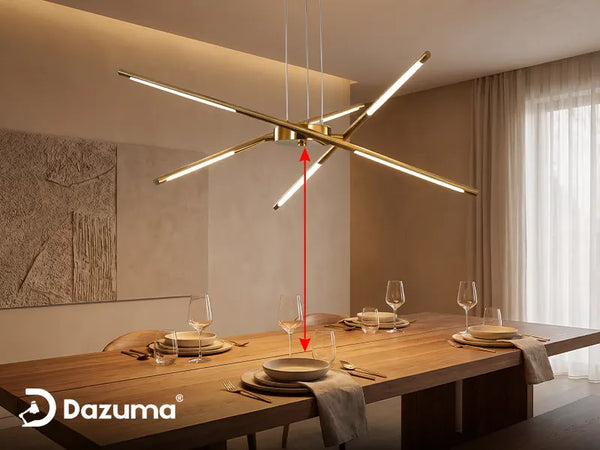
Most dining chandeliers begin around 30 to 36 inches above the tabletop, measured from the table surface to the lowest part of the fixture, in a room with an 8-foot ceiling. The final choice must also account for the chandelier's body height, ceiling height, sightlines, and whether anyone regularly walks beneath it when the table is moved.

Size the Chandelier to the Table First, Then Check the Room
A dining chandelier creates a visual zone around the table, so the table is the most useful first measurement. This is especially important in open-plan homes, where using the entire living-dining room dimensions can produce an enormous fixture over a modest table. Browse a broader Glass Chandelier selection only after writing down the table's everyday width, length, and shape.
The familiar room formula—add the room's length and width in feet, then use that sum as an approximate chandelier diameter in inches—is best used as a cross-check. A 12-by-14-foot dining room suggests about 26 inches. If the table calculation suggests 24 to 30 inches, the two methods agree. If the room formula suggests 34 inches but the table is only 36 inches wide, the table and physical clearance should win.

Measure the Furniture You Actually Use
Measure the tabletop, not the chairs pushed underneath it and not the rug. If the table has leaves, record both its everyday and extended dimensions. Also note whether the ceiling box is centered over the current table position; a perfectly sized chandelier can still look wrong when it hangs six inches off center.
Glass Chandelier Size Chart for Common Dining Tables
The ranges below are practical starting points. “Round chandelier” refers to a circular or drum-shaped fixture. “Linear chandelier” refers to an elongated fixture aligned with the table length.
| Dining Table | Round Chandelier Starting Range | Linear Chandelier Starting Range | Design Note |
|---|---|---|---|
| 36-inch round | 18–24 inches diameter | Usually not needed | Choose an airy profile to keep a small nook open. |
| 48-inch round | 24–32 inches diameter | Usually not needed | A 24-inch fixture feels tailored; 30–31 inches makes a stronger statement. |
| 60-inch round | 30–40 inches diameter | Usually not needed | Check fixture weight and body height at this scale. |
| 72 x 36-inch rectangle | 18–24 inches diameter | 36–48 inches long | A single round fixture centers the table; a linear shape covers more length. |
| 84 x 40-inch rectangle | 20–27 inches diameter | 42–56 inches long | Consider visual weight before moving above the range. |
| 96 x 42-inch rectangle | 21–28 inches diameter | 48–64 inches long | A linear fixture or two coordinated lights often balances the length better. |
Do not treat the chart as a reason to ignore a fixture you love. It tells you when a closer look is needed. A 30-inch transparent chandelier may work over a 40-inch-wide table if the profile is open, the lowest crystals stay well inside the edge, and the room has enough breathing space. A solid 30-inch drum in the same position may feel imposing.
Match Chandelier Shape to the Dining Table
Round Tables: Repeat the Geometry
A round chandelier over a round table creates an easy, centered relationship. Use the table diameter for the one-half-to-two-thirds calculation. A round glass or crystal fixture from the wider Chandeliers collection can sit toward the larger end of the range when it has visible space between its glass elements and does not block faces across the table.
Square Tables: Round or Square Can Both Work
For a square table, measure one side as the table width. A round chandelier softens the geometry, while a square fixture reinforces it. The more important test is whether the fixture remains comfortably inside all four edges. This matters with tiered glass drops because the lowest tier may flare beyond the frame shown in a simple diameter listing.
Rectangular Tables: Decide Whether You Want a Centerpiece or Coverage
A single round chandelier creates one dramatic center, which is appealing when the table is not extremely long. A Linear Chandelier follows the table's length and usually gives more even visual coverage. For a 7- or 8-foot table, two smaller fixtures may also work, but their spacing should be planned as one composition rather than two independent purchases.
Use Width for Round Fixtures and Length for Linear Fixtures
This distinction prevents a common mistake: choosing a giant round chandelier based on a rectangular table's full length. On a 72-by-36-inch table, the 36-inch width controls a round chandelier, while the 72-inch length guides an elongated fixture.

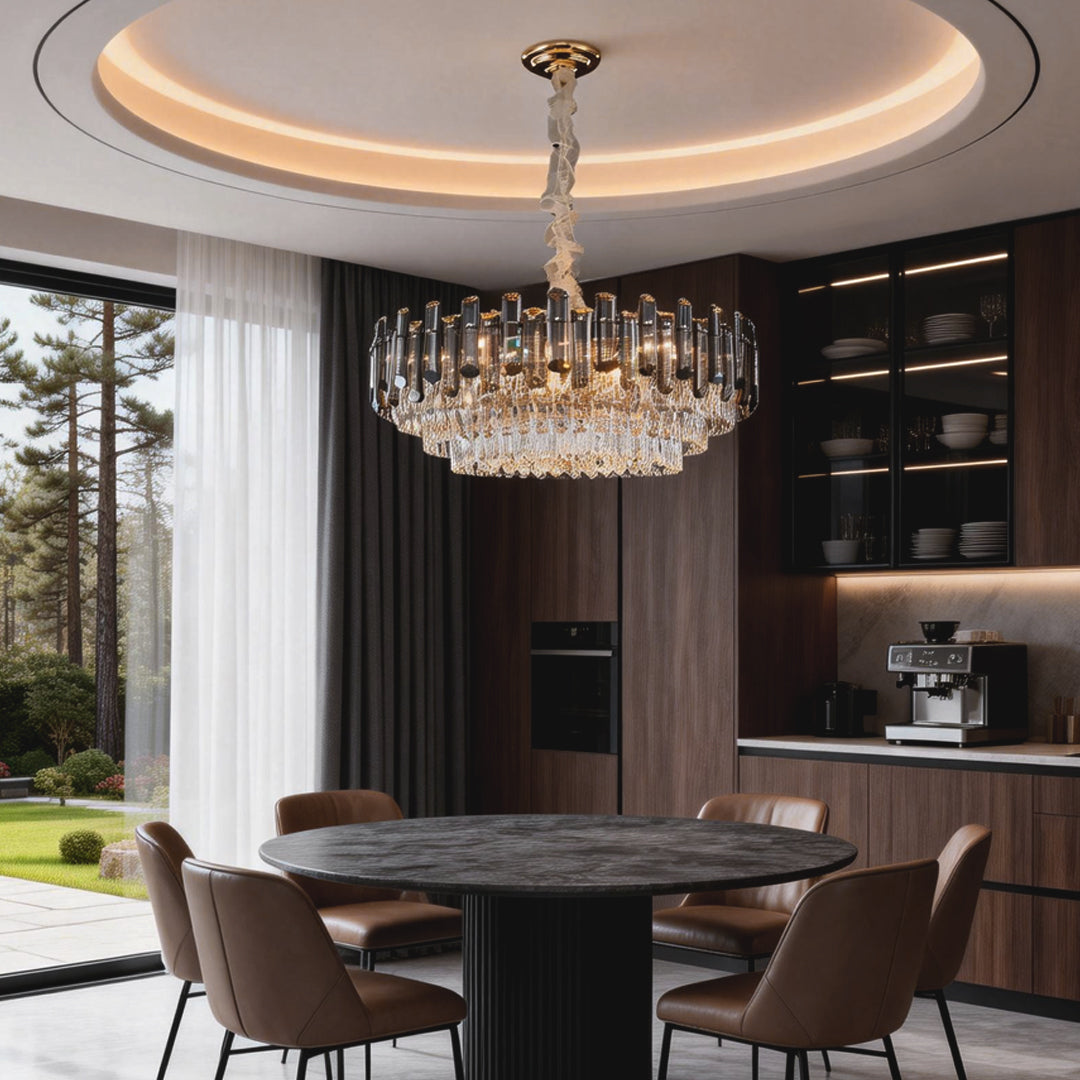
Round Drum Crystal Chandelier Modern Metal Ceiling Light
Listed price: From $324.99 at the time of writing.
- Round options include 20 x 10, 24 x 10, 30 x 12, and 37 x 17 inches.
- Smoky gray and clear crystal tiers give the fixture substantial visual presence.
- The gold iron frame uses E14 sockets; bulbs are listed as included.
For a 48-inch round table, the 24- or 30-inch option falls within the usual starting range. The larger 37-inch round size is better considered for a 60-inch table or a generously scaled dining room. Confirm the exact shape, dimensions, power, and suspension details before ordering.
Compare Shape and Size OptionsExtendable Tables: Size for the Way You Live Most Days
If the table is extended only on holidays, size the chandelier to the everyday table and accept that it will appear more centered than expansive during large gatherings. If the leaves stay in most of the year, use the extended length. A long adaptable table may benefit from an oval or linear fixture because it remains visually connected in both configurations.
Also think about furniture movement. When an extension leaf causes the table to shift rather than expand equally at both ends, the chandelier may no longer sit over the center. Solve that ceiling-box and suspension question before choosing a wide, heavy glass fixture.
Glass Chandelier Size Is Also About Visual Weight
Dimensions tell you how much space a fixture occupies; visual weight tells you how strongly it occupies that space. Clear glass disappears at the edges and reflects the room, so it often feels lighter. Thick crystal layers, smoked glass, closely spaced prisms, a dark metal cage, or a deep drum silhouette make the same diameter read larger.
This is why browsing Crystal Chandeliers by diameter alone can be misleading. Compare fixture height, number of tiers, density of drops, frame color, and the amount of open space. The product photo should be treated as a composition clue, not a scale drawing.

The Upper End of the Range Is Not Always the Bolder Choice
An airy 31-inch glass fixture may feel quieter than a dense 24-inch crystal drum. If the dining room already has a dark hutch, patterned wallpaper, heavy chairs, or dramatic art, a more transparent chandelier can provide scale without adding another visually solid object.
How High Should a Glass Chandelier Hang?
Begin at 30 to 36 inches above the tabletop for an 8-foot ceiling. For each additional foot of ceiling height, adding roughly 3 inches is a useful first adjustment. A 9-foot ceiling might therefore start around 33 to 39 inches above the table. This is not a rule that overrides comfort: the fixture should still illuminate the table, avoid blocking faces, and feel connected to the dining zone.
Transparent glass can tempt homeowners to hang a chandelier too low because they can partly see through it. Remember that reflections, bulbs, crystal edges, and a dark frame still cross the sightline. Sit in every chair and check the view of the person opposite you. Our detailed guide to how high a chandelier should hang over a dining table covers ceiling-height adjustments and sightlines more closely.
Now check the fixture body. An 8-foot ceiling gives less vertical room than many shoppers expect: a 30-inch-high table plus a 32-inch gap places the chandelier bottom 62 inches above the floor, leaving about 34 inches from the bottom of the fixture to the ceiling. That space must accommodate the chandelier body, chain or rods, canopy, and required installation hardware.
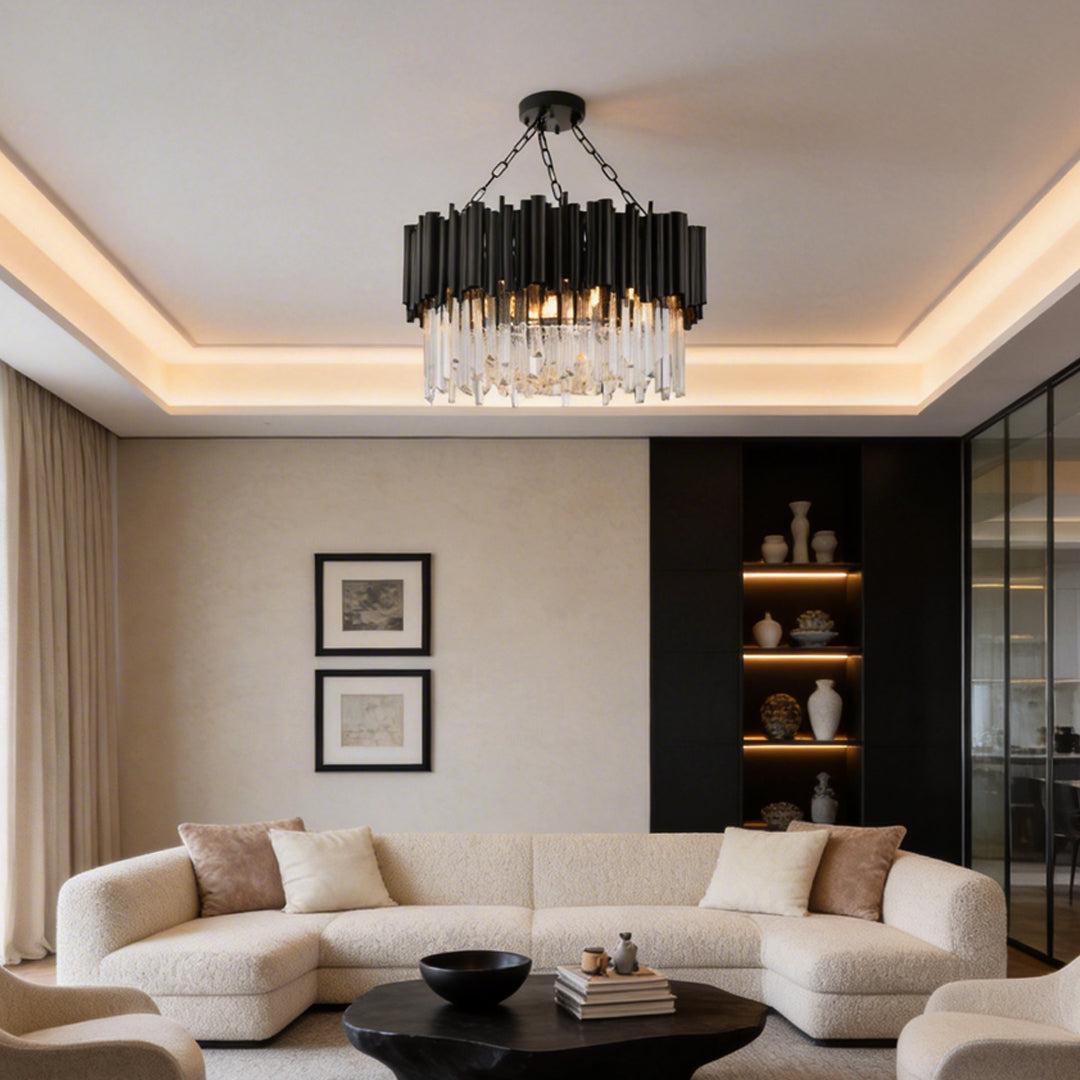
Black Metal and Crystal Chandelier Modern Round Ceiling Light
Listed price: From $672.99 at the time of writing.
- The transparent crystal and black hardware create a stronger outline than clear glass alone.
- The 24-inch model weighs 28.66 pounds; the 31-inch model weighs 39.68 pounds.
- E14 LED bulbs are listed as included, with wall-switch control and IP20 indoor use.
The 24-inch size is a practical starting point over a 36- to 48-inch-wide table. The 31-inch model suits a wider round table or a room that can support a bold centerpiece. Because both versions are substantial, verify ceiling-box support and use a qualified installer.
Check 24- and 31-Inch SizesThe Mockup Test That Prevents Expensive Sizing Regrets
Before ordering, create the chandelier's footprint with painter's tape, a cardboard ring, or an opened umbrella held at the proposed diameter. Suspend a lightweight paper outline at the intended height if possible. Step into the adjacent kitchen and hallway, then sit at the table. You are checking proportion, not beauty, so the mockup can be crude.
Here is a typical sizing scenario: a homeowner with a 60-inch round table initially chooses a 24-inch chandelier because it sounds safely proportional. On paper it is not “wrong,” but the mockup often shows that it disappears over a large table in a tall room. Testing a 30- or 36-inch outline reveals a more confident relationship. With transparent glass, that larger footprint may still feel open; with dense crystal tiers, the 30-inch version may already be enough.
Photograph the Mockup From the Doorway
A phone photo flattens the room and makes proportion easier to judge. Compare the fixture outline with the table, rug, windows, and nearby casework. Also take a seated photo to catch glass or metal crossing diners' faces.

Common Glass Chandelier Sizing Mistakes
Choosing by Room Size Alone
The room formula can recommend a fixture wider than the table can comfortably support. Use it to confirm scale, then let tabletop clearance and seated sightlines make the final decision.
Ignoring the Lowest and Widest Glass Elements
Catalog diameter may refer to the frame, while crystal drops or glass arms extend beyond it. Ask for the maximum assembled width and height. A few extra inches matter when the fixture already sits near the edge of the recommended range.
Centering on the Room Instead of the Table
In a formal dining room, these centers may match. In an open floor plan or a room with a sideboard, they often do not. The chandelier should normally follow the dining table because that relationship is what people notice.
Forgetting Weight and Maintenance Access
Crystal fixtures can be much heavier than their transparent appearance suggests. Confirm the ceiling junction box and framing can support the listed weight. Leave enough practical access for dusting and bulb changes; the Crystal Chandelier Guide covers ownership questions that are easy to overlook while shopping.

Do a Final Seated and Standing Check
Before the installer fully trims the chain or rods, view the chandelier while seated, standing, and entering the room. Confirm that the bottom tier does not block faces and that people can rise from every chair without feeling close to the glass.
Final Buying and Installation Checklist
- Measure the table: Record everyday width, length, shape, and extended dimensions.
- Choose the sizing rule: Use table width for a round fixture and table length for a linear fixture.
- Keep edge clearance: Aim to leave about 6 inches or more inside each relevant table edge.
- Cross-check the room: Add room length and width in feet for an approximate diameter in inches, but do not let that override the table.
- Judge visual weight: Account for crystal density, frame color, tiers, glass thickness, and open space.
- Calculate vertical fit: Combine table height, tabletop-to-fixture gap, chandelier body height, and suspension hardware.
- Confirm maximum dimensions: Use the widest and lowest assembled points, not only the frame measurement.
- Mock it up: Test the proposed diameter and height from the doorway and every dining chair.
- Verify support: Match the fixture weight to a properly supported ceiling box and mounting system.
- Plan professional installation: Use a qualified electrician for hardwired fixtures and any ceiling-box relocation or reinforcement.
Conclusion
A well-sized glass chandelier does not need to be timid. Begin with one-half to two-thirds of the table width, keep the fixture comfortably inside the table edges, and use the room dimensions as a reality check. Then adjust for the feature shoppers most often miss: visual weight. Clear, open glass can carry a larger footprint, while layered crystal and dark framing make every inch feel more present.
If two sizes both seem plausible, mock up the larger one first. Homeowners are often surprised by how quickly a chandelier shrinks once it is suspended in open air. The winning size is the one that anchors the table from the doorway, keeps faces visible while seated, and still leaves the dining room feeling comfortable rather than crowded.