
Who This Is For: This guide is for homeowners planning a great room, cabin, mountain home, or updated rustic living space where a stone fireplace and chandelier will both command attention. It is especially useful if you like the warmth of rustic materials but worry that the finished room could feel heavy, themed, or visually crowded.
The Short Answer: Balance Visual Weight, Not Just Style
A rustic chandelier can look excellent with a stone fireplace, but the two features should not compete at the same volume. Let the fireplace supply the room's grounded, permanent weight. Let the chandelier answer it with an open silhouette, an appropriate diameter, and warm light. The goal is connection, not literal matching: a blackened iron finish might echo dark mortar lines, while a few wood accents elsewhere repeat the warmth of tan stone.
The most reliable rule is simple: if the stone is busy, keep the chandelier quieter; if the stone is calm, the chandelier can carry more detail. Irregular fieldstone, a thick mantel, and prominent ceiling beams already create many lines and textures. A dense fixture with antlers, beads, crystals, and heavy shades may push that room into visual overload. Smooth limestone or a restrained stacked-stone surround leaves more room for a sculptural fixture.
Before shopping, stand at the main entry to the room and take a photo. Squint at it until small details disappear. The fireplace becomes one shape and the future chandelier location another. This quick test helps you judge mass much better than looking at product photos against a white background.
First, Choose Which Feature Should Lead

Make the Fireplace the Anchor
In most living rooms, the stone fireplace should be the primary architectural focal point. It is large, close to eye level, and difficult to change. The chandelier should support that architecture from above. Look for negative space between arms, a visible ceiling beyond the frame, and a finish that reads as one calm shape from across the room.
This is why many rustic chandeliers work best when their frame is expressive but visually open. You still get character, but you do not block the sightline to stone, beams, or windows.
There are exceptions. If the fireplace is low, pale, or simple and the ceiling is tall, a chandelier may become the room's main sculpture. Even then, create hierarchy: give the chandelier the stronger shape, but keep the fireplace mantel styling restrained. One substantial art piece or a quiet timber beam is usually enough. A crowded mantel directly beneath a statement chandelier creates two layers of small objects fighting for attention.
A Useful Visual-Weight Guide
| Fireplace Condition | Chandelier Response | Usually Avoid |
|---|---|---|
| Large, dark, irregular fieldstone | Open frame, simple arms, warm low-glare bulbs | Dense tiers and many competing textures |
| Pale limestone or smooth ledgestone | More sculptural form or refined ornament | A fixture so thin that it disappears |
| Tall fireplace with heavy timber mantel | Broad but airy chandelier with clean finish | More chunky wood at ceiling level |
| Mixed stone with noticeable color variation | One quiet metal tone pulled from the stone | Several unrelated metals and shade colors |
Get the Chandelier Scale and Hanging Height Right
Scale is where good intentions often go wrong. Homeowners see a tall ceiling and assume they need the largest fixture available. Height does require presence, but a wide, solid chandelier can cover the room like a lid. Start with the common sizing shortcut: add the room's length and width in feet, then use that number as an approximate chandelier diameter in inches. A 16-by-20-foot room suggests about 36 inches. Treat that as a starting point, not a purchase order.
Then adjust for the actual architecture. Increase slightly when the ceiling is very high, the room is open to a second story, or the fixture has an exceptionally thin frame. Reduce the diameter when the fireplace is massive, beams sit close to the fixture, or the chandelier has dense shades and ornament. For a broader calculation framework, use this room-size guide for ceiling lights before narrowing down a model.
Mock Up the Lowest Point
Tape a cardboard circle to lightweight string and hang it at the proposed diameter and drop. View it from the entry, sofa, stair landing, and kitchen if the floor plan is open. The lowest point should not cut across the fireplace opening, television, or the face of a person seated across the room.
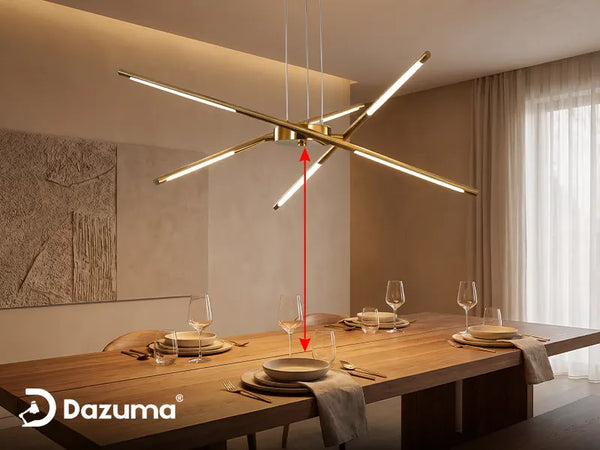
In an open walking path, designers often begin by keeping the fixture at least about 7 feet above the floor, but ceiling shape, local code, manufacturer instructions, and the fixture itself can change the safe placement. A chandelier above a coffee table may sit somewhat lower because people do not walk beneath it. Confirm the final support and clearances with a licensed electrician.

Also check the suspension range before ordering. A fixture body may be correctly sized but come with a chain that is too short for a steep vaulted ceiling. Ask for the total installed height, canopy dimensions, fixture weight, and sloped-ceiling compatibility. Heavy chandeliers need a ceiling box or structural support rated for the actual load; a standard lightweight-fixture box may not be adequate. The practical steps in this guide to hanging a chandelier safely can help you prepare better questions for your electrician.
A Sculptural Option for a Calm Stone Backdrop
When the stone has a relatively controlled pattern and the room needs a clear rustic gesture, an antler-inspired silhouette can provide it. The key is to repeat its black finish in only a few places—perhaps the fireplace doors, window frames, or a side table—so it feels intentional rather than themed.
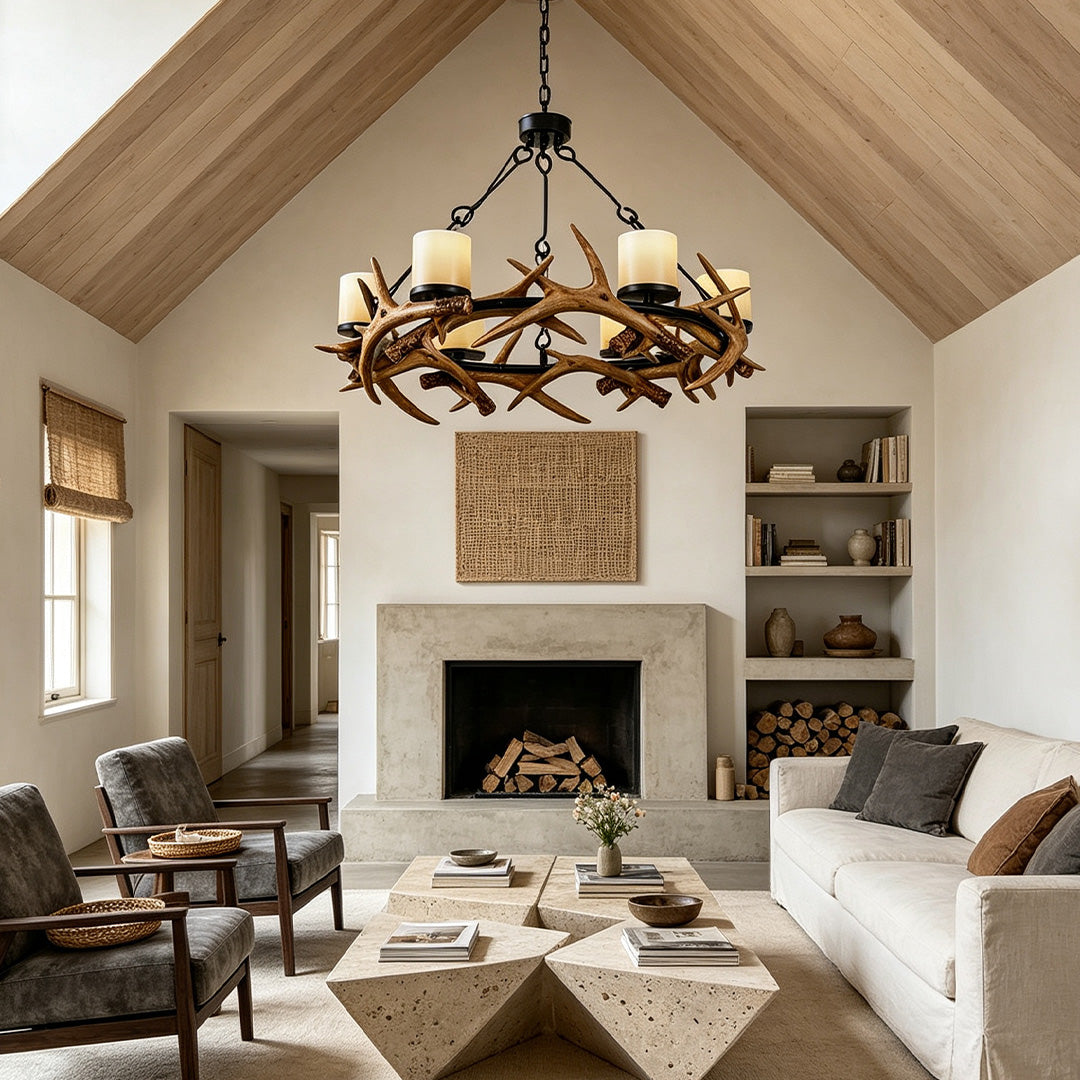
Sculptural Rustic Contrast
Modern Antler Chandelier Vintage Metal Ceiling Light
Price: $1,253.99
Consider this for a vaulted living or dining area where a pale or moderately patterned stone fireplace needs an organic counterpoint overhead.
- The antler-inspired frame creates organic movement without introducing another wood species.
- An adjustable 19.7-inch chain offers some control over the installed height.
- The fixture is hardwired and uses E14 light sources; verify support, bulbs, and ceiling conditions before ordering.
Connect the Stone, Metal, and Wood Without Matching Everything

Pull One Undertone From the Stone
Warm limestone, sandstone, and tan fieldstone tend to welcome aged bronze, softened black, or muted brass. Cool slate and blue-gray granite usually look cleaner with blackened iron, pewter-like tones, or deep bronze. Mixed stone already contains several colors, so choose one restrained metal and stop there.
If black gives the room needed definition, compare the proportions in the black chandelier collection. A matte or softly textured finish usually sits more comfortably beside rugged stone than a mirror-bright metal.
Do not force every finish to match. Fireplace doors, chandelier, cabinet hardware, and curtain rods can live in the same dark-metal family without being identical. Exact matching sometimes makes a layered room feel like a furniture showroom. Controlled variation feels collected, especially when a repeated undertone connects the pieces.
Wood needs similar restraint. If you already have exposed beams, a thick mantel, and wide-plank floors, adding a chunky wood chandelier may be one rustic cue too many. An iron frame can provide welcome contrast. If the room lacks wood elsewhere, a fixture with a modest wood element may create the bridge you need; explore wagon wheel chandeliers with particular attention to openness, not merely diameter.
When a More Refined Rustic Look Works
Rustic does not have to mean rough. In a room with pale cut stone, tailored upholstery, and fewer timber elements, a black glass chandelier with small reflective details can keep the fireplace from feeling too lodge-like. The sparkle should be an accent, not another dominant texture. If the stone is already dark and highly varied, this type of ornament may be too busy.
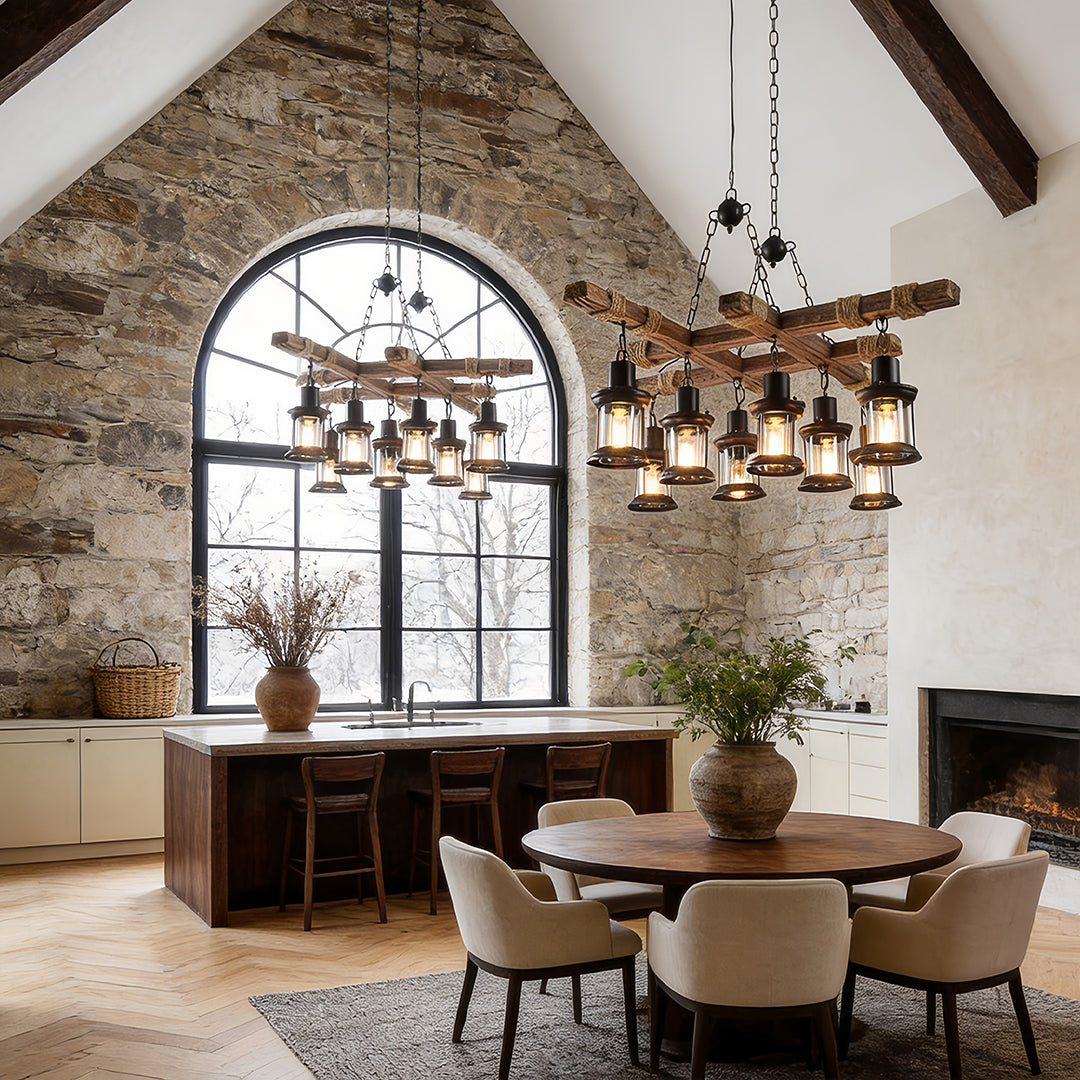
Linear Farmhouse Warmth
Rustic Wood Chandelier Vintage Unique LED Ceiling Light
Price: $560.99
Best for a rectangular dining table or open-plan zone that needs a horizontal counterweight to a tall stone fireplace.
- The long wood structure visually relates to tables, mantels, and beams.
- Glass shades and chain suspension reinforce the vintage farmhouse character.
- The listed illumination area is 161 to 215 square feet.
Place the Chandelier for the Room You Actually Use
Do not automatically center the chandelier on the fireplace. In many great rooms, the fireplace, roof ridge, window wall, and seating group sit on slightly different axes. The fixture should usually center over the activity zone—often the main seating arrangement or dining table—because that is what it illuminates and organizes. A chandelier centered on masonry but visibly off-center over the furniture can make the whole room feel unsettled.
Use the Furniture Plan as Your Map
Lay out the rug, sofa, chairs, and coffee table first. Mark the chandelier center over that composition. Then view the mark from the doorway. A small offset from the fireplace may be acceptable when the seating zone reads clearly; a confusing half-alignment is not. If several axes almost—but do not quite—line up, a designer or electrician can help determine whether moving the ceiling box is worth it.
For open-concept spaces, let each overhead fixture define its own zone while sharing one finish family or shape language. The living-room chandelier does not need to match the dining fixture, but they should not tell unrelated stories.

Soften Stone With Layered, Warm Light
A chandelier is not responsible for lighting the entire room. If it is bright enough to illuminate every corner alone, it will probably create glare and flatten the stone texture. Think in layers: the chandelier provides ambient glow and visual focus; recessed or directional lights graze the fireplace; table and floor lamps make seating comfortable; discreet accent light can serve shelves or art.
For most rustic living spaces at night, 2700K to 3000K is the forgiving range. It warms gray stone, wood, leather, and natural textiles without turning everything orange. Put the chandelier on a compatible dimmer when the fixture and bulbs allow it. Note that “three-color” or “three-step” control often changes color temperature rather than brightness, so confirm the exact behavior before assuming a product is brightness-dimmable.
Firelight changes the equation, too. Test your lighting with the fireplace on. Flames become the warmest and most animated element in the room; the chandelier should settle back rather than compete. Dimming overhead light and raising a pair of lamps beside the sofa usually feels more comfortable than leaving the chandelier at full output. The chandelier, fireplace, portable lamps, and accent lights can then share the work instead of competing to be the brightest source.
Common Mistakes That Make the Room Feel Harsh or Themed

Stop After Two or Three Strong Rustic Cues
Stone, exposed beams, and a sculptural chandelier may already be enough. Adding antler accessories, plaid everywhere, log furniture, and multiple animal motifs can turn a personal home into a themed rental. Keep the architecture honest, then bring in simpler upholstery, clean-lined tables, and quieter art.
If you prefer candle arms, compare shapes in the candle chandelier collection, but judge each fixture against a photo of your actual fireplace—not against an empty product-page background.
- Choosing by diameter alone: Two fixtures can share a diameter but have completely different visual mass.
- Ignoring the daytime view: At noon, the chandelier is sculpture, not light. Make sure its frame still relates to the room.
- Using cool, exposed bulbs near warm stone: High-output points of light can feel glaring and make the room look commercial.
- Matching every rustic material: Repeating the same wood and metal everywhere removes depth instead of creating harmony.
- Buying before checking installation: Fixture weight, ceiling slope, junction-box support, chain length, and access for future cleaning all matter.
A Representative Great-Room Test
Picture an 18-foot-high great room with a floor-to-ceiling mixed-stone fireplace, dark timber mantel, and exposed roof beams. A dense two-tier wagon-wheel fixture may sound appropriate on paper, yet the mockup can reveal a ceiling crowded with horizontal lines. Switching to an open, single-level frame preserves the necessary diameter while allowing the stone and beams to remain visible. The room still reads rustic, but it breathes. This is not about one “correct” chandelier; it shows why silhouette and negative space are more useful than a style label.
Final Buying Checklist
- Name the lead feature. Decide whether the fireplace or chandelier gets the stronger pattern and detail.
- Photograph the room. Judge the fixture against the fireplace from the entry and main seats.
- Calculate a starting diameter. Add room length and width in feet, then adjust for fixture density and ceiling height.
- Mock up the silhouette. Test both width and lowest point with cardboard or tape.
- Choose one connecting finish. Pull a dark, warm, or muted undertone from the stone.
- Limit rustic motifs. Count beams, mantel, stone, chandelier, furniture, and textiles as part of one composition.
- Plan the lighting layers. Do not expect the chandelier to provide task, accent, and ambient light by itself.
- Verify installation facts. Confirm dimensions, weight, suspension length, sloped-ceiling compatibility, dimming behavior, support, and local requirements.
Final Advice
The best rustic chandelier with a stone fireplace does not win a contest for being the most rustic object in the room. It gives the fireplace a visual partner: broad enough to belong in the architecture, open enough to preserve breathing room, and warm enough to make stone feel inviting after dark. Start with hierarchy, scale, and sightlines. Finish with material repetition and layered light. When those decisions are right, the room feels collected and comfortable rather than decorated around a theme.