

Who This Is For: This guide is for homeowners considering a bladeless ceiling fan for a bedroom, especially if you have a low ceiling, dislike exposed fan blades, want a fan-and-light combination, or simply wonder whether a compact enclosed fan can move enough air to sleep comfortably.
Quick Answer: Yes, but Airflow Depends on More Than the Fan’s Size
For many small and medium bedrooms, a well-designed bladeless ceiling fan can provide enough air movement for everyday comfort. But “bladeless” does not automatically mean weak, and a compact-looking fixture does not automatically mean strong. The useful question is: how much tested air does this specific fan move, and where does that air go?
That distinction matters in a bedroom. You usually do not need the room to feel like a wind tunnel. You want a gentle, noticeable breeze across the bed at low or medium speed, enough circulation to reduce that stuffy feeling without papers fluttering, dry eyes, or constant motor noise. A homeowner who sleeps hot in a 220-square-foot primary bedroom will have a very different definition of “enough” than someone using a fan in a 110-square-foot guest room.
The first number I look for when comparing ceiling fans is airflow in CFM (cubic feet per minute). CFM tells you the volume of air the fan moves, while CFM per watt tells you how efficiently it does so. Diameter, motor wattage, and number of blades are not substitutes for tested airflow. This is especially important with enclosed and hidden-blade designs.

First, What Does “Bladeless Ceiling Fan” Actually Mean?
Most residential “bladeless ceiling fans” are not literally blade-free. In many models, the blades are smaller and enclosed behind a grille or built into the fixture so you do not see exposed spinning blades. That makes the ceiling look cleaner and can be reassuring in rooms with bunk beds or lower ceilings.

Hidden Blades Change the Airflow Pattern
A traditional ceiling fan has a broad swept area and is designed to establish circulation through the room. An enclosed fan moves air through a smaller opening or grille, so the breeze can feel more focused or localized. That is not inherently worse; it simply means placement becomes more important.
If your priority is a compact look, start with Bladeless Ceiling Fans With Light, then compare actual airflow information rather than judging by appearance alone.
I often explain it this way to homeowners: a large traditional fan is trying to circulate the whole room; a compact enclosed fan may be more about creating a useful comfort zone below and around the fixture. In a bedroom, that can work very well if the bed falls within that zone.
5 Things That Decide Whether the Airflow Will Feel Strong Enough
1. Tested CFM Matters More Than the Word “Bladeless”
If the manufacturer publishes a high-speed airflow rating, use it. Compare it with other fans you are seriously considering, ideally using ratings measured under a recognized test procedure. If a listing does not state CFM, do not try to calculate it from wattage. Motor power tells you electrical input, not how effectively the entire fan assembly turns that power into room air movement.
2. Your Bed Location Matters More Than You Might Expect
A ceiling fan centered over the open floor can look perfectly symmetrical yet feel disappointing from the mattress. For an enclosed fan with a more concentrated outlet, I would rather align the useful airflow with the sleeping zone than chase visual centering to the inch. This is particularly important in long bedrooms where the bed occupies only one end of the room.
Think in Terms of a Comfort Zone
Imagine the breeze as a three-dimensional zone beneath the fixture. Is the bed inside it? Is a tall canopy, beam, or unusually high ceiling putting extra distance between the fan and the sleeper? Those practical questions tell you more about comfort than a styled product photo.

3. Ceiling Height Changes What You Feel at Mattress Level
In an 8-foot bedroom, a compact flush-mounted fan can keep the fixture visually and physically close to the ceiling while still placing it reasonably near the occupied zone. That is one reason Flush Mount Ceiling Fans make sense in many renovations. With a 10- or 12-foot ceiling, however, a very shallow enclosed fan may feel less direct at bed level unless it has enough airflow and the outlet pattern is designed for that distance.
If low clearance is your main concern, our earlier guide on how to choose the right flush mount ceiling fan with light for a low ceiling goes deeper into the proportion and installation side of the decision.
4. Room Shape and Heat Load Can Make the Same Fan Feel Different
A compact 12-by-12 bedroom with an 8-foot ceiling is an easier job than an open primary suite with a vaulted ceiling, west-facing glass, and a sitting area. Strong afternoon sun, warm upper floors, poor HVAC balance, and two sleepers all change the comfort problem. A ceiling fan can improve how warm air feels on your skin, but it does not lower the room’s actual air temperature like an air conditioner.
5. The Speed You Can Tolerate at Night Is the Speed That Counts
A fan that feels great only on its loudest setting may not be the best bedroom fan. Before buying, look for multiple speed settings, a quiet motor claim backed by useful specifications or reviews, and controls you can reach from bed. For most sleepers, useful low- and medium-speed performance is more valuable than an impressive maximum speed they rarely use.
How to Judge a Bladeless Fan for Your Bedroom Size
Traditional ceiling-fan sizing charts are a good starting reference, but there is a catch. ENERGY STAR’s published guidance for conventional fans pairs room area with blade span—for example, roughly 36–42 inches for rooms from 76–144 square feet. You should not take that chart and assume a 23-inch enclosed fixture equals a 23-inch traditional fan. The outer housing of a hidden-blade fan is not the same measurement as a conventional fan’s swept blade span.
For enclosed designs, I use room area to decide how cautious to be, then use tested CFM and the manufacturer’s intended coverage to validate the choice. If CFM is missing, I become more conservative as the bedroom gets larger.
| Bedroom Situation | What I Would Check | Risk of Disappointing Airflow |
|---|---|---|
| Small guest room or child’s room | Airflow over the bed, quiet low speeds, safe clearance | Lower if the fan is positioned well |
| Typical medium bedroom | Tested CFM, speed range, ceiling height, outlet direction | Moderate if airflow data is missing |
| Large primary bedroom | Verified CFM and whole-room circulation, not fixture diameter alone | Higher for compact enclosed models |
| Vaulted or unusually high ceiling | Mounting height, airflow reach, manufacturer guidance | Higher without verified performance data |
If you are also comparing conventional sizes, use our room-size ceiling fan guide as a baseline, then remember that enclosed fans need their own airflow validation.
A Compact Option for Bedrooms Where Clearance Matters
If your room is relatively compact and you want the ceiling fixture to stay visually quiet, this round flush-mount model is worth comparing. Its product page lists two sizes and positions it for bedrooms, but it does not currently publish a CFM figure. I would therefore treat its compact dimensions and controls as verified advantages while confirming airflow separately if you are a warm sleeper.

White Ceiling Fan Flush Mount with Light Smart LED Light
Price: $215.99
A compact fan-and-light choice for bedrooms where low-profile installation, lighting output, and convenient bedside control matter as much as the fan itself.
- Two listed diameters give you more flexibility for smaller bedroom proportions.
- Integrated dimmable LED lighting combines two ceiling functions in one fixture.
- Remote and app controls reduce the need to get out of bed for adjustments.
Bedroom Comfort Is About Airflow, Noise, and Light Together
People shopping at the beginning of a bedroom remodel often focus on the fan and forget that this fixture may also become the room’s main overhead light. A great bedroom fan can still be annoying if the LED is painfully bright at night, the remote is confusing, or the motor creates a tone you notice as soon as the room goes quiet.

Prioritize the Settings You Will Actually Use at 2 A.M.
For bedtime, I look for separate fan and light control, several fan speeds, dimming, and a warmer light setting. If you use the ceiling light before sleep, warm, lower-intensity illumination generally feels less stimulating than a cool bright setting. During cleaning or getting dressed, you can raise the brightness again.
A combination fixture can simplify a ceiling that would otherwise need both a light and a fan. If that is part of your renovation plan, browsing Ceiling Fans With Lights lets you compare enclosed designs with more conventional fan-light combinations before committing.
A Very Shallow Square Option for Low Ceilings
This square model is the more architectural-looking of the two options here. The flush-mount version is listed at only 4.72 inches high, which can be useful when an exposed fan would visually crowd an 8-foot bedroom. The listing also specifies a 3000K–6000K dimmable LED range and remote control. Again, because the page does not state CFM, its bedroom suitability should be judged conservatively if maximum airflow is your first priority.
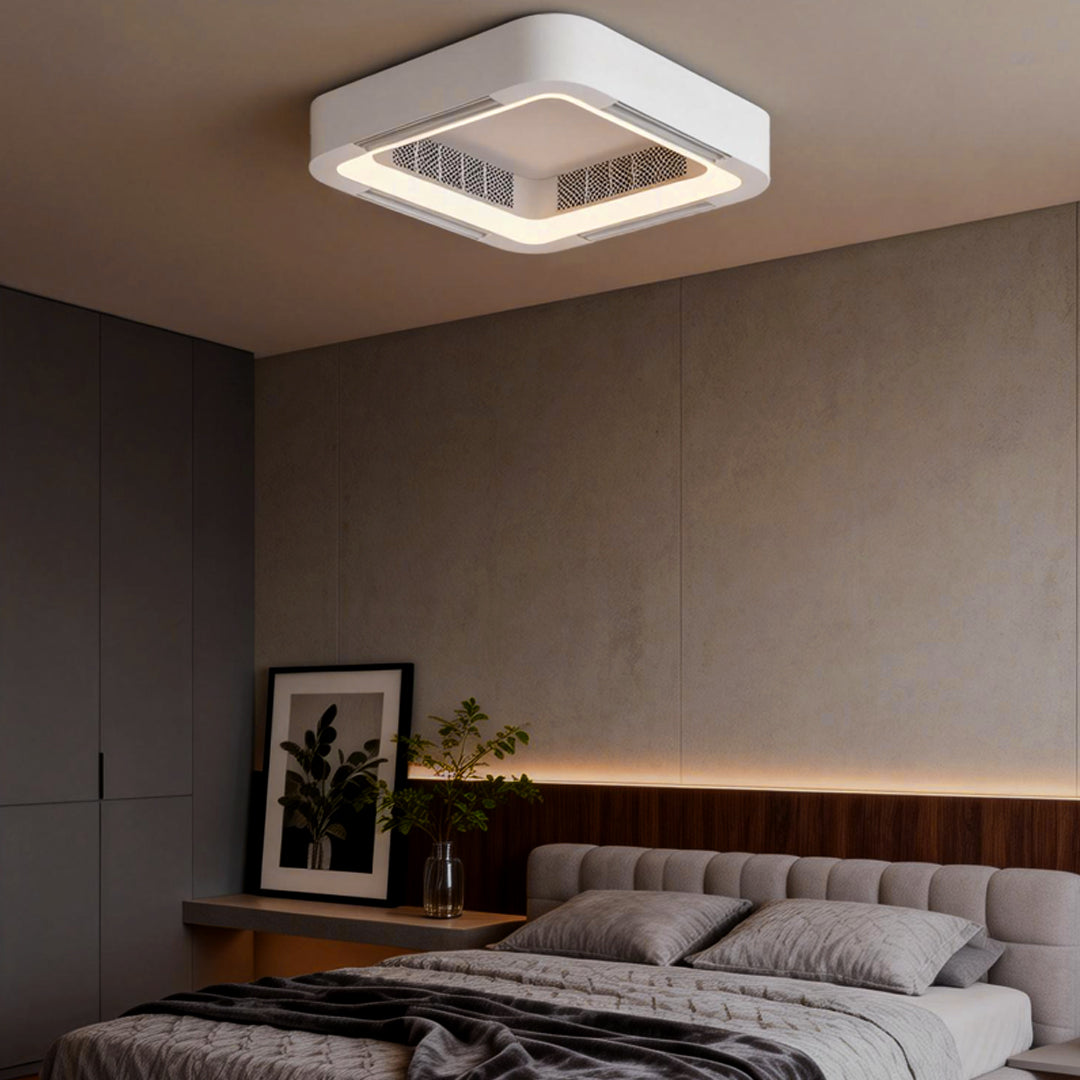
Low Profile Bladeless Ceiling Fan with Light Inverter LED Light
Price: $518.99
A slim square choice for modern bedrooms where exposed blades would feel bulky and adjustable overhead lighting is part of the design brief.
- Hidden blades keep the profile compact and the moving parts visually contained.
- The flush-mount version suits rooms where every inch of overhead clearance matters.
- Dimmable brightness and color temperature make the light more adaptable across the day.
A Bedroom Buying Checklist I Would Use Before Ordering
Measure the Room Before Falling in Love With the Fixture
Write down the room’s length, width, and ceiling height. Then note where the bed actually sits. If you are replacing an existing light, also check whether the electrical box is fan-rated; a ceiling fan has mechanical loads that an ordinary light-fixture box may not be designed to support.

- Ask for CFM if it is not listed. For airflow-first shoppers, this is the missing number that matters most.
- Check mounting height and bed clearance. A low-profile fan helps with low ceilings, but the installation still needs to follow the product instructions and local electrical requirements.
- Confirm independent light and fan control. You should not have to blast the ceiling light every time you want a breeze at night.
- Look at low-speed usability. Bedrooms spend far more time at quiet speeds than at maximum speed.
- Check the return policy before installation. Airflow is partly subjective, and installed electrical fixtures can have different return conditions than unopened products.
- Use a fan-rated electrical box. If you are converting a ceiling light location, have the existing box and support checked before mounting the fan.
One small design tip from real bedroom planning: do not let the ceiling fan be the only light source just because it has a powerful LED. Overhead light is useful for cleaning and dressing, but bedside lamps or sconces give the room depth and make the evening transition feel much softer.
When I Would Choose a Traditional Ceiling Fan Instead
I like enclosed fans for low ceilings, children’s rooms, guest rooms, and homeowners who strongly prefer the appearance of a ceiling light over visible blades. But I would lean toward a conventional larger fan if the bedroom is large, has a vaulted ceiling, gets significant afternoon heat, or belongs to someone who wants a strong breeze directly on the bed every night.
I would also choose the conventional fan when its tested airflow is clearly published and the enclosed alternative gives me no comparable data. A fan is not decorative hardware alone; it is comfort equipment. If two fixtures look equally good, the one with transparent performance information is easier to specify with confidence.

Do Not Oversell a Compact Fan to a Large Room
This is the mistake I most want early-stage renovators to avoid. A compact fixture can look beautifully proportional in a product photo and still leave a large room feeling still. If strong whole-room circulation is non-negotiable, prioritize verified airflow first and styling second.
Final Advice: Buy for the Breeze You Want to Feel in Bed
So, can bladeless ceiling fans provide enough airflow for a bedroom? Yes, they can—especially in smaller bedrooms, lower-ceiling rooms, and spaces where gentle localized airflow is the goal. But the category name alone is not proof of performance.
My practical order of decisions is simple: measure the room, decide how strong you want the breeze to feel while lying in bed, check ceiling height, locate the fixture relative to the bed, and then compare tested CFM. After that, choose the look, lighting, remote functions, and color that suit the room. If CFM is unavailable, ask for it rather than treating fixture diameter or motor wattage as a substitute.
For a low ceiling or a visually quiet bedroom, an enclosed fan-light can be a smart, space-efficient solution. For a large or hot bedroom where serious air movement comes first, a conventional fan with clearly documented airflow may be the more dependable choice. The right answer is not “bladeless versus blades”; it is whether the specific fan creates the level of comfort you want at mattress level.