
Who This Is For: This guide is for homeowners choosing a bedroom ceiling fan and wondering whether an integrated light will simplify the room—or create glare, visual clutter, and lighting limitations they may regret later.
The Better Bedroom Fan Depends on Your Lighting Plan
A fan with a light seems practical because one fixture handles two jobs. A fan without a light looks cleaner. Either can be wrong when the rest of the bedroom is ignored.
Ask what the ceiling must do after the room is furnished. If it is the only hardwired lighting point, removing the light may create a dark room. If recessed lights and bedside sconces already exist, another source above the bed may be unnecessary. Separate the decision into airflow, general illumination, bedtime lighting, and control from bed.

Quick Answer: Which Is Better for Bedrooms?
A ceiling fan with a light is usually better when the bedroom has one ceiling box, limited lamp space, or needs simple remote-controlled general illumination. A fan without a light is usually better when recessed lights, sconces, or lamps already cover the room and the ceiling should remain visually quiet.
Neither choice eliminates bedside lighting. A central light helps with dressing and cleaning but is rarely the most comfortable source for reading or winding down.
The Real Difference Is Lighting Flexibility
A Fan With Light Combines Two Functions
One hardwired fixture can cool the room and provide broad illumination, which is useful when only one junction box exists. Separate fan and light commands, selectable color temperatures, and timers add bedroom convenience.
A Fan Without Light Separates the Decisions
You can choose the fan for airflow, size, motor, and appearance, then assign reading, mood, and general light to separate fixtures. This gives more flexibility but requires a complete lighting plan.
The Ceiling Looks Different Even When the Fan Size Is the Same
A light kit adds a visible center element. A white fan without one can blend into the ceiling, while wood blades and an acrylic lens create a stronger focal point.

One Fixture Should Not Do Every Job
Even when the fan includes a light, keep a lower, softer source near the bed. General light helps you see the room; bedside light helps the room feel restful.
Ceiling Fan With Light vs Without Light: Bedroom Comparison
| Bedroom Situation | Better Starting Choice | Why | Still Add |
|---|---|---|---|
| Only One Ceiling Box | Fan with light | Provides airflow and general light from one location | At least one bedside reading light |
| Existing Recessed Lights | Fan without light | Avoids redundant overhead illumination | Bedside lamp or sconce |
| Small Guest Room | Fan with light | Reduces floor and nightstand lamp dependence | Compact task light if space allows |
| Design-Focused Primary Bedroom | Fan without light | Creates a cleaner ceiling and more tailored lighting layers | Sconces, lamps, and dimmable ambient light |
| Low Ceiling | Low-profile version of either type | Mounting depth matters more than the presence of light alone | Low-glare bedside lighting |
| Light-Sensitive Sleeper | Fan without light, or separately controlled fan light | Reduces accidental bright overhead light at night | Very low-level warm bedside light |
When a Ceiling Fan With Light Is Better
The Ceiling Box Is Your Main Source of General Light
When the center box is the bedroom’s only hardwired lighting point, an integrated light preserves general illumination without adding new recessed or wall wiring.
You Want Simple Control From Bed
Look for clear remote buttons, a timer, independent fan and light controls, and documented memory behavior after the wall switch is used.
Nightstands Are Small or Already Crowded
A central light cannot replace reading lamps, but it reduces dependence on small nightstands in compact rooms.
The Room Serves Different Users
Guest and children’s rooms benefit from simple controls and general light for cleaning, play, packing, or homework, with a softer source available at bedtime.
Browse Ceiling Fans With Lights by mounting depth, light control, color temperature, and blade span—not only by style.
A With-Light Option for One-Box Bedroom Layouts
When one fixture must provide airflow and general light, a low-profile fan with remote functions is practical. Natural wood blades also add warmth without another ceiling statement.
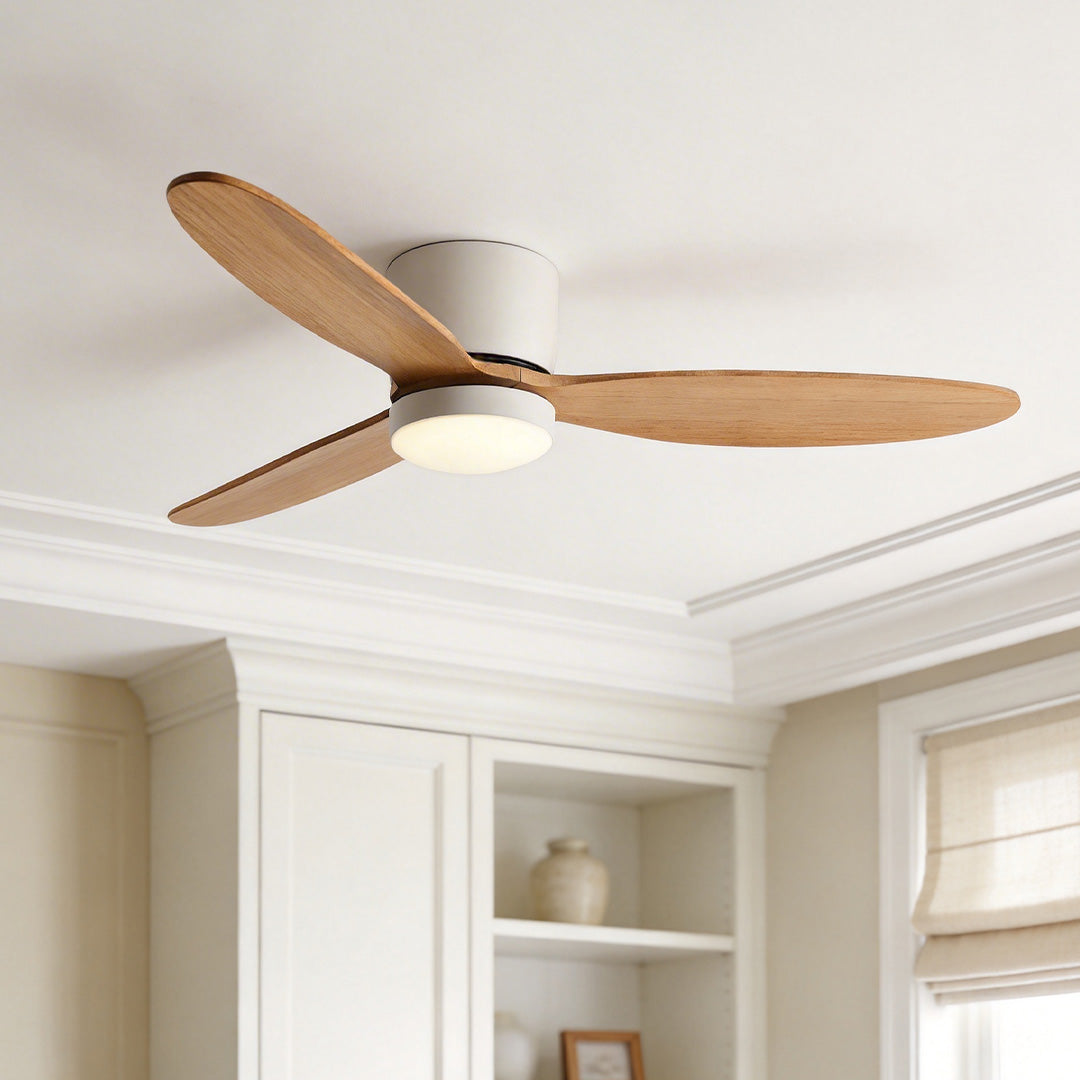
Airflow and Adjustable General Light in One Fixture
Natural Wood Ceiling Fan with Light Nordic LED Light
Current Page Price: From $527.99
Best for primary bedrooms, guest rooms, and one-box ceiling layouts where homeowners want remote control, warm wood texture, and a selectable integrated light.
- The product page offers both with-light and without-light configurations.
- Forward and reverse airflow supports seasonal circulation.
- A timer-off function is practical for nighttime bedroom use.
When a Ceiling Fan Without Light Is Better
The Bedroom Already Has Layered Lighting
If recessed lights, sconces, or lamps already provide enough illumination, an integrated fan light may be redundant. The fan can focus on airflow.
You Prefer a Softer Nighttime Atmosphere
Bedrooms usually feel calmer when evening light comes from lower positions. A no-light fan encourages better layering instead of dependence on one bright source.
You Want the Fan to Visually Disappear
A white low-profile fan can visually recede when the bed, artwork, windows, or headboard should remain the focus.
You Want Freedom to Change the Lighting Later
Separate lamps and sconces can change without replacing the fan. With integrated LED models, ask how the module is serviced and whether replacement components are available.
The Ceiling Fans Without Light category is particularly useful for rooms with an established lighting plan or homeowners prioritizing a minimal ceiling.
A No-Light Fan Can Make the Bed the Focal Point
When the fan blends into the ceiling, the eye stays on the headboard, textiles, artwork, and windows. This is often the better design choice in a carefully layered primary bedroom.

A Clean No-Light Option for Layered Bedrooms
When the room is already well lit, a white fan provides airflow without another lens or light mode—an effective choice for minimalist and contemporary bedrooms.
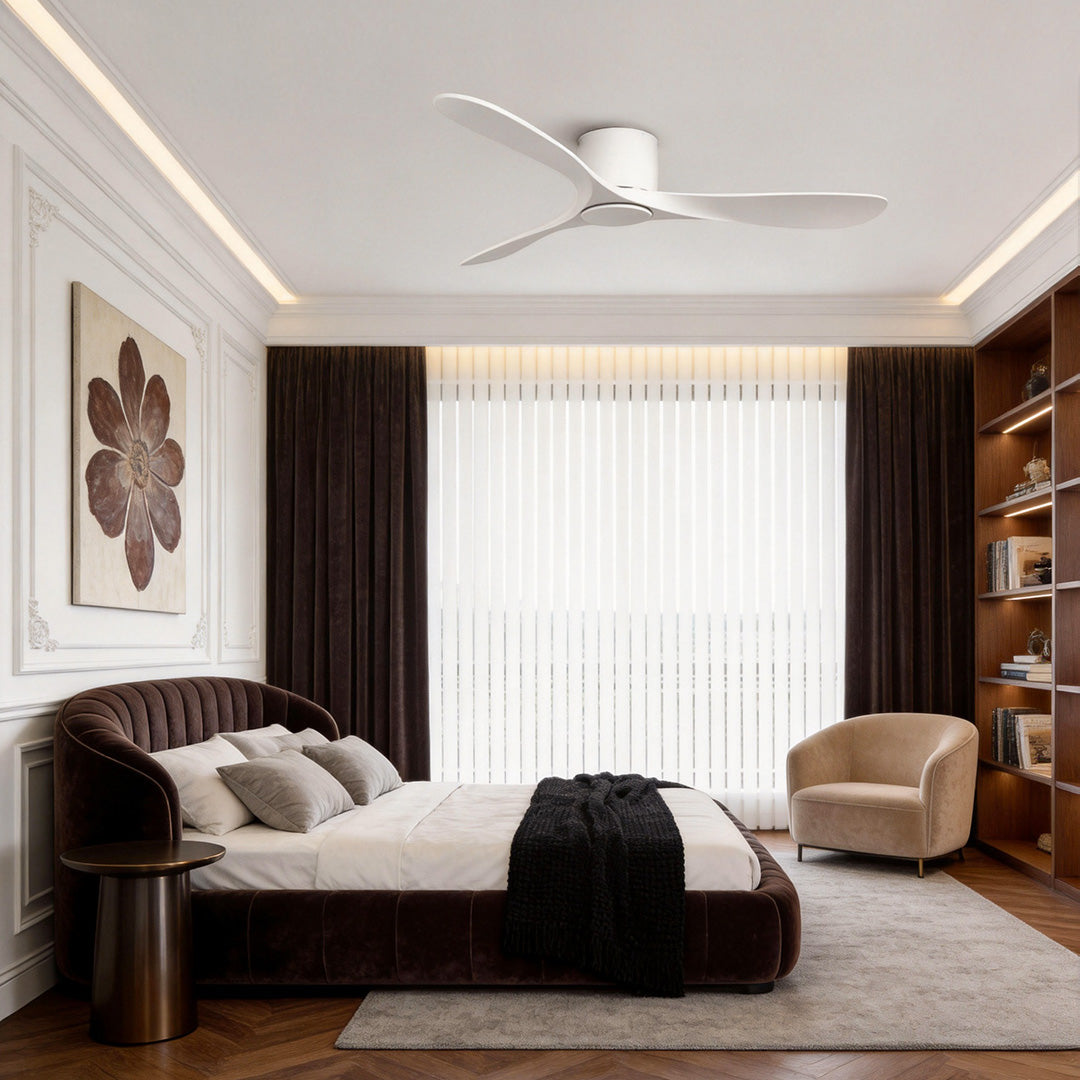
Quiet Visual Profile for an Already-Lit Room
White Ceiling Fan Modern 52-Inch Indoor 3-Blade Fan
Price: $358.99
Best for bedrooms with recessed lights, bedside sconces, or lamps where the fan should blend into the ceiling and focus only on comfortable air circulation.
- The matte white finish visually recedes against a light ceiling.
- A low-profile ceiling mount suits many standard-height bedrooms.
- The product page describes quiet operation for rest and daily activities.
Light Quality, Glare, and Bedtime Comfort
Central Light Is Best for General Tasks
A fan light helps with organizing, packing, and cleaning but is less successful as the only reading source because it arrives from above.
Warm Light Is Usually Easier at Night
Many homeowners prefer the warmer setting at night. On a 3000K/4500K/6000K fixture, 3000K generally feels softer beside wood and fabric, while cooler settings can help with daytime tasks.
Confirm Whether Brightness and Color Are Controlled Separately
Three color temperatures do not automatically mean brightness dimming. Confirm whether the light can actually reduce output for nighttime use.
Keep a Low Light Near the Bed
A bedside lamp, wall sconce, or small reading light lets one person stay awake without illuminating the entire room and is usually more practical for books and nighttime routines.
Energy Use and Long-Term Flexibility
A Fan Without Light Is Not Automatically More Efficient
The presence of a light kit does not determine how efficiently the fan moves air. Motor design, blade shape, speed setting, and how long the fan operates matter more for airflow energy use. A fan with a light simply adds another electrical load when the light is turned on.
Compare Fan and Light Functions Separately
When product information is available, review the fan motor and the light source as separate systems. Ask whether the light and fan can operate independently, whether the LED brightness can be reduced, and whether the motor offers several useful speeds. A bedroom fan that runs quietly at a comfortable low speed may be more useful than one chosen only for a high maximum setting.
Think About Replacement Before Choosing Integrated LED
Integrated lighting can create a shallow, clean fixture and remove the need to buy bulbs. The tradeoff is that future service may involve a light module rather than a standard replacement bulb. Before purchasing, confirm whether replacement parts are available and how the light is serviced.
Use the Light Only When It Improves the Room
A separately controlled fan light does not need to remain on whenever the fan runs. Use the fan for nighttime airflow, the central light for dressing or cleaning, and lower lamps for bedtime. This separation gives a with-light model much of the flexibility associated with a no-light fan.
Fan Size and Ceiling Height Matter More Than the Light Kit
Choose Blade Span for the Room, Not the Bed
A king-size bed does not automatically require the largest fan. Measure the entire room and consider wardrobes, slopes, and walls. Useful airflow may place the fan away from the exact mattress center.
The guide A Comfort Size Ceiling Fan for Room provides a broader framework for matching fan span to room dimensions.
Check the Total Installed Height
Both featured fans are about 52 inches wide, but their listed heights are 12.60 and 11.02 inches. Measure to the lowest point of the complete selected configuration.
Leave Safe Clearance
Follow product instructions and local requirements. Low-profile mounting helps, but it does not make every fan suitable for every ceiling.
You can compare compact mounting structures in Flush Mount Ceiling Fans.

Noise, Controls, and Nighttime Use
Motor and Installation Quality Affect Sleep More Than the Light Choice
A light kit does not inherently make a fan noisier. Motor design, blade balance, mounting security, and installation quality affect sound.
Listen for More Than Air Movement
Test several speeds after installation. If clicking, humming, or vibration develops, the guide Why Is My Ceiling Fan Making Noise? explains common causes.
Remote Layout Matters in the Dark
Fan speed, light, direction, and timer buttons should be easy to distinguish. Keep the remote in a fixed holder near the bed.
Think About Switch Behavior During a Power Cycle
Ask whether the fixture restores its previous setting, cycles colors, or resets after the wall switch is used.

Convenience Is Part of Comfort
A feature is only useful when it can be controlled easily from bed. Review the remote, timer, memory behavior, and wall-switch setup before installation.
Bedroom-by-Bedroom Recommendations
Primary Bedroom
Choose without light for a complete layered plan and a quiet ceiling. Choose with light when the center fixture is needed for dressing and cleaning.
Small Bedroom
A low-profile fan with light can reduce lamp dependence. With recessed lighting, a no-light fan may make a small ceiling feel calmer.
Guest Bedroom
A fan with a clearly labeled remote is easy for guests. Add a bedside lamp and brief instructions when needed.
Child or Teen Bedroom
General light supports play, homework, and cleaning. Independent controls let airflow continue after the light is off.
Bedroom With Vaulted Ceilings
Either type can work on a vaulted ceiling; mounting and downrod compatibility matter more. Use a light only when the room still needs general illumination.
Bedroom Used as a Home Office
A fan light can add broad illumination, but a desk lamp is still needed for focused work and screen comfort.
A Realistic Primary Bedroom Example
Consider a 14-by-16-foot bedroom with an 8-foot ceiling, one center box, two small nightstands, and no recessed lights. Replacing the only ceiling light with a no-light fan would leave lamps responsible for wardrobes, dresser drawers, and cleaning.
A low-profile fan with integrated light is the practical choice. The warm setting handles evenings, other settings support organizing, and bedside lamps serve reading. If the same room already had dimmable recessed lights and hardwired sconces, the answer would reverse: a white no-light fan would preserve airflow and reduce ceiling clutter.
The existing electrical plan—not the popularity of either product type—determines the better choice.
Bedroom Ceiling Fan Buying Checklist
- List every existing source of general, task, and bedside light.
- Decide whether the ceiling box must provide general illumination.
- Measure room dimensions, fan span, and total installed height.
- Confirm light and fan functions can be controlled independently.
- Check color-temperature options and actual brightness control.
- Review remote layout, timer, memory, and wall-switch behavior.
- Choose a motor and mounting system described for quiet operation.
- Ask how an integrated LED module is serviced or replaced.
- Keep a lower reading or bedtime light near the bed.
- Confirm electrical support and installation requirements with a qualified professional.
Final Advice: Choose the Lighting System, Not Just the Fan
A fan with a light is better when one fixture must provide airflow, general illumination, and convenient control. A fan without a light is better when the room is already well lit and the ceiling should remain quiet.
Map dressing, cleaning, reading, and bedtime needs before choosing. Then prioritize blade span, installed height, quiet operation, independent controls, and a softer bedside source. Browse Ceiling Fans only after those requirements are clear.