
Who This Is For: This guide is for homeowners, students, and remote workers trying to light a compact desk without losing valuable surface space, creating screen glare, or buying a lamp that cannot reach the work area.
A Small Desk Makes Every Lamp Decision More Noticeable
On a compact writing desk, dorm desk, or work-from-home corner, the lamp base competes with a laptop, notebook, charger, and mouse. The adjustable-versus-fixed decision therefore affects usable space, shadows, screen glare, and how easily you can switch tasks.
A swing arm offers reach and repositioning. A fixed lamp offers simplicity and predictable placement. The better choice depends on whether your work area changes during the day.

Quick Answer: Which Lamp Is Better for a Small Workspace?
A swing arm desk lamp is usually better for mixed computer, paper, reading, drawing, or craft tasks because it brings light closer without moving the base. A fixed desk lamp is better for one stable layout and a visually quiet workspace.
For very small desks, the best lamp is not always the smallest one. It is the lamp whose base stays out of the main work zone while the shade still reaches the page or keyboard.
The Real Difference Is Where the Light Can Go
Swing Arm Lamps Move the Light Without Moving the Base
A long articulated arm can extend over papers, retract when the desk must stay clear, and change height while its base remains behind a laptop or beside a monitor.
Fixed Lamps Make One Lighting Zone Predictable
A fixed lamp usually has a stationary stem and fixed or pivoting shade. Its consistent pool of light suits routine keyboard work and desks that are rarely rearranged.
“Adjustable” Can Mean Several Different Things
Some lamps only rotate at the shade; others use an elbow, gooseneck, or counterbalanced arm. Check which parts move and how far, because “adjustable” may still mean limited reach.

Judge the Movement, Not the Product Label
Ask whether the lamp changes height, horizontal reach, shade angle, or all three. Those movements determine whether it can adapt to a small desk.
Swing Arm vs Fixed Desk Lamp Comparison
| Small-Workspace Factor | Swing Arm Lamp | Fixed Lamp | Better Choice When |
|---|---|---|---|
| Horizontal Reach | Wide and adjustable | Limited to shade angle and placement | Swing arm for changing work zones |
| Base Footprint | May be heavier or wider for balance | Often compact and simple | Fixed when every inch of desk matters |
| Task Changes | Easy to redirect | Best for one repeatable task | Swing arm for mixed screen and paper work |
| Visual Simplicity | More joints and mechanical detail | Cleaner, quieter silhouette | Fixed for living-room or bedroom offices |
| Stability | Depends on base weight and arm position | Usually predictable | Fixed for busy family desks |
| Glare Control | Can redirect light around screens | Works well if placed correctly once | Swing arm when monitor position changes |
When a Swing Arm Desk Lamp Is Better
You Work With Both a Screen and Paper
Computer screens need controlled light with minimal reflection, while printed documents benefit from brighter local light. A swing arm can move across papers without flooding the monitor.
You Need the Base at the Back or Side of the Desk
A long arm can reach forward from beside the monitor or near the wall. Measure its real extension and confirm stability at full reach.
You Perform Detailed Tasks
Drawing, model building, needlework, and handwriting benefit from moving the source closer, changing its angle, and reducing the need to lean forward.
More Than One Person Uses the Desk
A shared desk must accommodate different users and handedness. A movable arm can shift opposite the writing hand to reduce page shadows.
Explore Swing Arm Desk Lamps by actual reach, joint movement, base or clamp design, and shade direction rather than appearance alone.
A Long-Reach Option for Changing Tasks
This fixed-base adjustable-arm lamp has a 24-inch listed width and is suited to moving light between books, documents, and a keyboard.
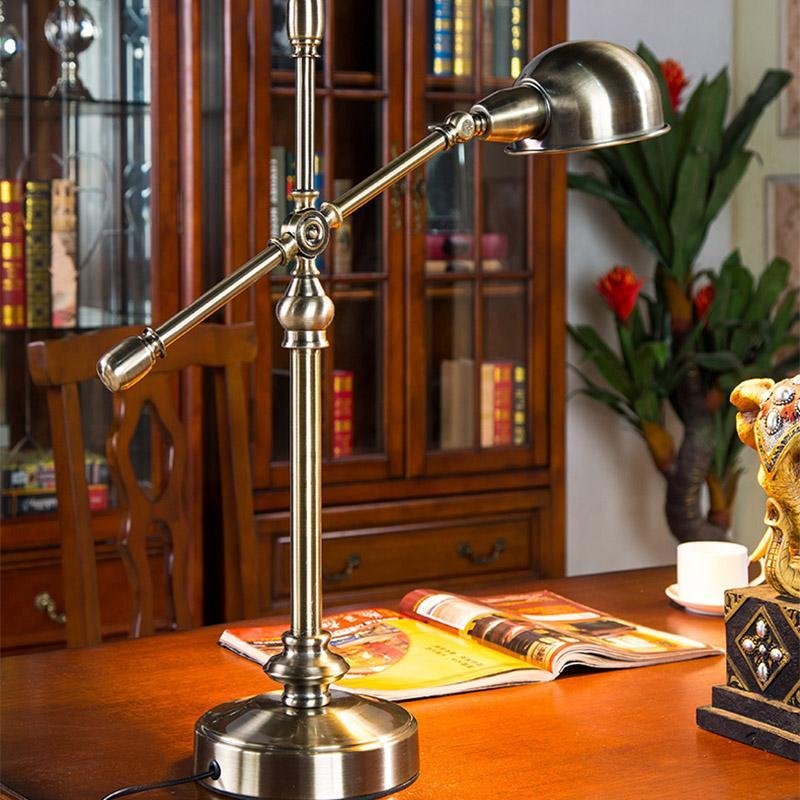
Extended Reach for Reading and Detailed Work
Vintage Metallic Dome Adjustable Desk Lamp
Current Page Price: $119.99
Best for a home office or study desk where the lamp must reach across books, paperwork, or a keyboard while the 7-inch base stays in one location.
- The adjustable arm directs light toward reading or writing tasks.
- A metal dome helps limit upward spill and shape the beam.
- Replaceable bulbs allow the light output and color to be selected.
When a Fixed Desk Lamp Is Better
Your Desk Layout Rarely Changes
If the laptop, keyboard, and notebook stay in the same positions, a fixed lamp can be aimed once and left alone.
You Want Fewer Moving Parts
Joints and counterweights add visual complexity. A simple upright lamp blends more easily into a bedroom, living room, or hallway office.
The Lamp Sits in a High-Traffic Area
On a shared or children’s desk, a stable compact design may be easier to manage. Check base weight, switch access, and cord direction.
You Only Need a Small Pool of Light
A fixed lamp works well for a keyboard, journal, or short reading session when the task stays close. Keep the shade low enough to shield the source without blocking the view.
The broader Desk Lamps collection includes fixed, pivoting-head, gooseneck, and articulated designs. Compare the movement shown in the product images before deciding which category best matches your desk.
A Compact Lamp Can Still Be Adjustable
There is a useful middle ground between fully fixed and long swing arm: a stationary base and stem with a pivoting shade. It offers simple glare control without a large mechanical arm.

A Compact Fixed-Footprint Option
The first product is named as a swing arm lamp, but its listed 4.72-inch width and upright product images suggest a compact fixed-footprint design with directional head adjustment rather than traditional wide reach.
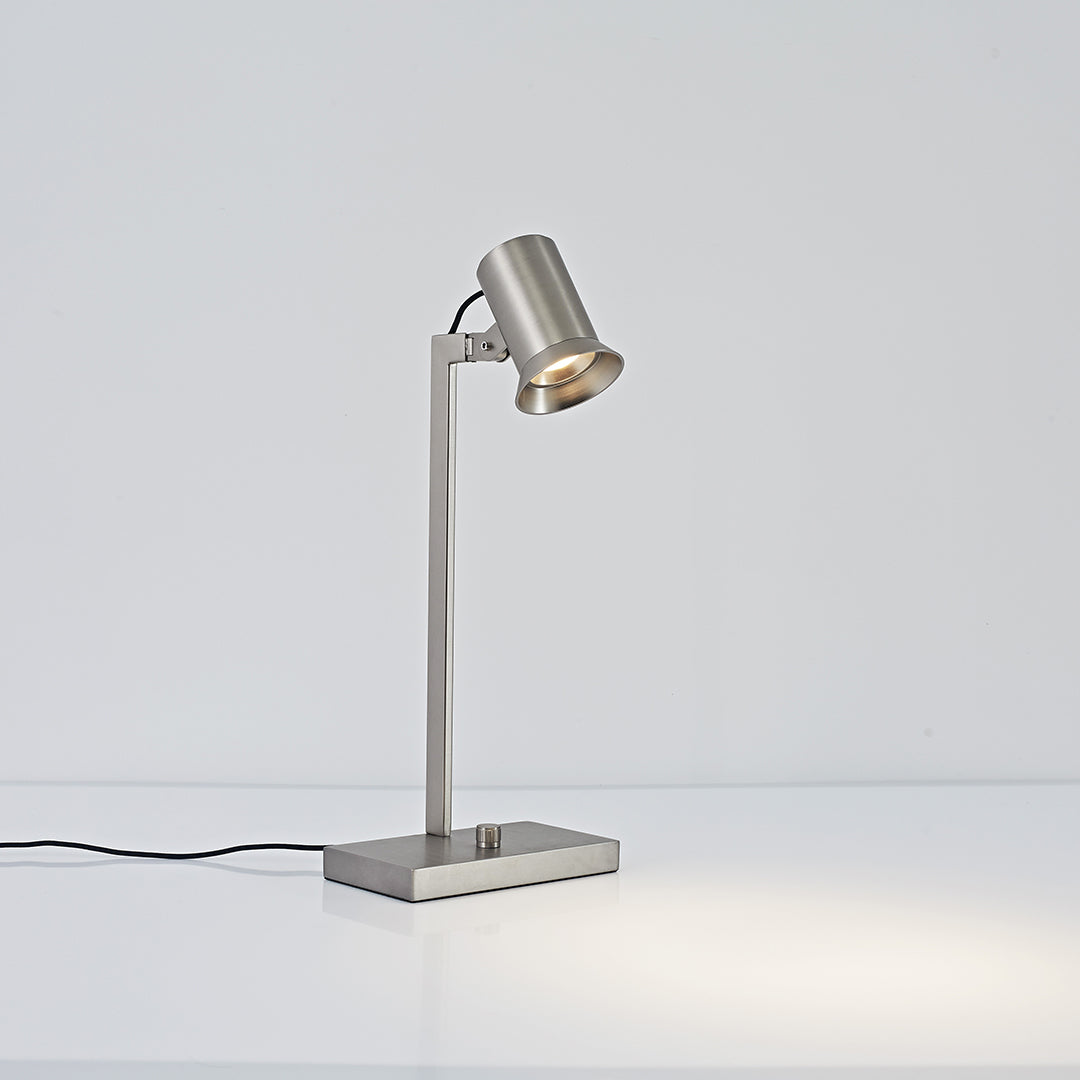
Small Base for a Stable Desk Layout
Italian-Style Metal Adjustable Desk Lamp
Current Page Price: $4,116.99
Best for a narrow desk, bedside workspace, or reading corner where a compact base and focused warm light matter more than wide horizontal reach.
- The nickel-finish metal body suits modern and industrial spaces.
- A push-button switch is located on the compact rectangular base.
- The directional shade focuses light on a small task area.
Desk Footprint and Reach: Measure Both
Base Size Is Only Half the Space Equation
A small base may still occupy the center if the shade cannot reach. A larger balanced base can sit farther back while the arm reaches forward.
Check the Arm’s Parked Position
Measure the arm both extended and parked so it does not hit a wall, shelf, monitor, or cabinet.
Consider a Clamp Only When the Desk Edge Allows It
Clamp lamps free the desktop but need a suitable edge and clearance below. Drawers, glass tops, aprons, and tight wall placement may prevent clamping.
Plan the Cord Route
Route the cord behind the lamp with enough slack for adjustment but no loop that catches papers or the moving arm.

Glare, Shadows, and Monitor Placement
Keep the Bright Source Out of Your Direct View
The shade should hide the bulb or LED from the seated position. If the source is visible, lower or move the lamp, or reduce brightness.
Avoid Reflections on the Screen
Place the lamp beside the monitor and aim across documents rather than toward the screen. A swing arm makes this easier when the monitor angle changes.
Place the Lamp Opposite Your Writing Hand
Right-handed writers usually benefit from light on the left, and left-handed writers from light on the right, reducing hand and forearm shadows.
Do Not Create a Bright Island in a Dark Room
A bright desk surrounded by darkness can feel uncomfortable. Add low ambient light so contrast is not extreme; the Home Office Lighting Design Guide explains the layering.

Aim Across the Work, Not Into the Screen
The best lamp is adjustable enough to illuminate documents while keeping the bright source and reflected glare outside your normal viewing angle.
Light Source and Controls Matter as Much as the Arm
Integrated LED Keeps the Lamp Compact
An integrated LED can create a small shade and controlled beam because the light source is designed with the fixture. The tradeoff is less flexibility later. Before buying, check whether brightness is adjustable and how the LED or driver is serviced if it eventually fails.
Replaceable Bulbs Offer More Choice
An E26 or E27 socket lets you change brightness, color temperature, beam spread, and bulb finish. That flexibility is useful when the first bulb creates too much glare or feels too warm. Stay within the product’s listed wattage and physical bulb limits so the bulb remains safely inside the shade.
Brightness Control Is Valuable on a Small Desk
The same lamp may need brighter output for printed material and lower output for computer work. A dimmer or several output levels can reduce the need to move the lamp constantly. Do not assume that an LED lamp is dimmable unless the product page explicitly says so.
Choose a Switch You Can Reach Without Rearranging the Desk
A base switch is convenient when the lamp sits beside the keyboard. An in-line switch may work well when it can be clipped or routed to a predictable place. Remote controls add flexibility but create another small object to store. The best control is the one you can operate from your normal seated position without reaching behind the monitor.
When comparing modern integrated options, browse LED Desk Lamps by brightness control, beam direction, and serviceability—not simply by wattage.
Best Desk Lamp Type by Task
Mainly Laptop or Monitor Work
A compact fixed or pivoting-head lamp is often enough when paper use is limited. Aim it toward the keyboard or side work area, not the monitor.
Computer Work Plus Frequent Documents
A swing arm can move closer to printed material and retract for screen-focused work, making it the better mixed-task choice.
Studying and Handwriting
Choose enough reach to cover the notebook without placing the shade in front of your face. A stable arm and accessible switch matter; see the guide to choosing a table reading lamp for studying.
Drawing, Sewing, and Detailed Crafts
Prioritize reach, accurate aiming, stability, and sufficient brightness. Detailed work usually favors a swing or flexible arm.
Occasional Desk in a Bedroom or Living Room
A fixed lamp blends more easily into the room and can provide enough light for short sessions.
Video Calls
For video calls, avoid light directly above or below the face. A dedicated diffused source usually produces more even light.
A Realistic Small-Desk Example
Imagine a 36-inch desk with a monitor, keyboard, mouse, notebook, and charger. A small fixed lamp seems space-efficient, but it must sit beside the notebook to provide enough light, blocking the mouse area. Behind the monitor, its short reach leaves the page dim.
A swing arm at the back-left corner reaches the notebook and retracts for video calls. For a right-handed user, light from the left also reduces hand shadow. If the desk were used only for a laptop and email, however, the long arm would be unnecessary; a compact pivoting-head lamp would be calmer.
The better lamp is determined by task movement, not desk size alone.
Common Desk Lamp Buying Mistakes
Assuming a Small Base Guarantees More Work Space
If the lamp cannot reach, its base may need to sit in the center. Measure where the light lands, not only where the lamp stands.
Buying by Maximum Height Alone
Height does not reveal reach, joint stiffness, or shade rotation. Review every movement point.
Ignoring the Arm’s Stability
A lamp that drifts, tips, or needs two hands to adjust becomes frustrating. Base weight and joint quality matter.
Using a Bare or Visible Bulb Near Eye Level
Choose a shade that shields the source from the seated position.
Lighting the Monitor Instead of the Task
Aim the lamp toward documents, keyboard, or detailed work—not into the screen.
Choosing Color Temperature Without Considering the Room
Warm 3000K light suits bedroom offices, while neutral light may support detail. Brightness and glare control matter as much as Kelvin.
Forgetting Switch Access
Check whether an in-line, base, or remote switch is easy to reach from the normal seated position.
Small-Workspace Desk Lamp Buying Checklist
- Measure the desk width, depth, wall clearance, and available edge space.
- Mark the lamp base and full arm movement with painter’s tape.
- List whether you use a monitor, documents, crafts, or all three.
- Check horizontal reach, vertical movement, shade rotation, and parked position.
- Place the source outside direct view and away from screen reflections.
- Position the lamp opposite the writing hand when possible.
- Confirm base stability at the arm’s maximum extension.
- Review bulb type, brightness control, color temperature, and replacement needs.
- Check switch position and cord routing.
- Use ambient room light so the desk is not a bright island in darkness.
Final Advice: Choose Reach for Changing Tasks, Simplicity for Stable Ones
Choose a swing arm when the work zone changes, the base must stay at the back, or detailed tasks need frequent repositioning. Choose a fixed lamp when the layout is stable and visual simplicity matters.
Measure the base, arm movement, shade position, screen reflection, and cord route. Then browse Office Lighting with a clear idea of where the light must land and how often that location changes.