
Who This Is For: This guide is for homeowners choosing one ceiling fixture to handle both light and comfort in a living room—especially anyone drawn to the polished look of a fandelier but unsure whether it will move enough air for everyday use.
Introduction
A fandelier can solve a decorating problem that many people have with ceiling fans: you want moving air, but you do not want a broad set of blades to become the first thing you notice from the sofa. A conventional ceiling fan with a light solves the opposite problem. It makes the fan function obvious and usually spreads the blades across more of the room, but it may not feel as special as a decorative light fixture.
The choice is not simply “pretty versus practical.” Some fandeliers are capable, quiet fans, and some conventional fans are beautifully designed. The more useful comparison is between visual presence, active airflow coverage, usable light, and fit. Those four things do not always come from the same measurement on a product page.

The Short Answer: Which Is Better for a Living Room?
Choose a fandelier when the living room is small to medium in size, the ceiling fixture is an important decorative focal point, and you mainly want comfortable air movement around a central seating group. It is also appealing when visible blades would compete with a chandelier-like interior.
Choose a conventional ceiling fan with a light when airflow is the first priority, the room is wider or open-plan, or people sit in several zones. A model with a broader blade sweep is usually easier to position for more even perceived cooling across a sofa, reading chair, and nearby walkway.
For many living rooms, the conventional fan is the safer performance-first choice. The fandelier is the stronger design-first choice. The exception is a compact room where a correctly sized fandelier covers the occupied seating area well and its integrated light fits the lighting plan.
Fandelier vs Ceiling Fan With Light: What Actually Changes?
“Fandelier” combines “fan” and “chandelier.” The category includes highly decorative fan-light fixtures, often with concealed, caged, or retractable blades. Not every fandelier has retractable blades. Some, including the starburst model discussed below, keep the fan blades hidden above the decorative light body.
A standard ceiling fan with a light normally has visible blades extending from the motor housing and a light kit at the center. It reads as a fan first, even when the materials and proportions are refined. If you want to compare the wider category before narrowing the style, browse ceiling fans with lights as well as more decorative fandelier designs.
| Living Room Priority | Fandelier | Ceiling Fan With Light |
|---|---|---|
| Visual effect | Decorative focal point; fan may visually disappear | Relaxed, architectural, and clearly functional |
| Air distribution | Often more concentrated near the fixture | Often broader with a larger exposed blade sweep |
| Best room shape | Compact or centered seating arrangement | Wide, long, or open-plan living room |
| Cleaning | More decorative arms or openings to dust | Blades are exposed but usually easy to reach |
| Design risk | Can feel busy if the room already has many focal points | Can feel oversized or utilitarian if poorly proportioned |

When the Ceiling Fixture Needs to Feel Intentional
A fandelier works best when you give it visual breathing room. If the rug, fireplace wall, drapery, and coffee table are already highly patterned, another complex shape overhead may be one focal point too many. In a quieter room, however, a sculptural fixture can make a simple sofa arrangement feel finished without adding more furniture.
The Creative Ceiling Fan Light below is a good example of that design-first approach. Its blades are concealed above a radial LED body, so the fixture reads more like a modern starburst light from normal viewing height.
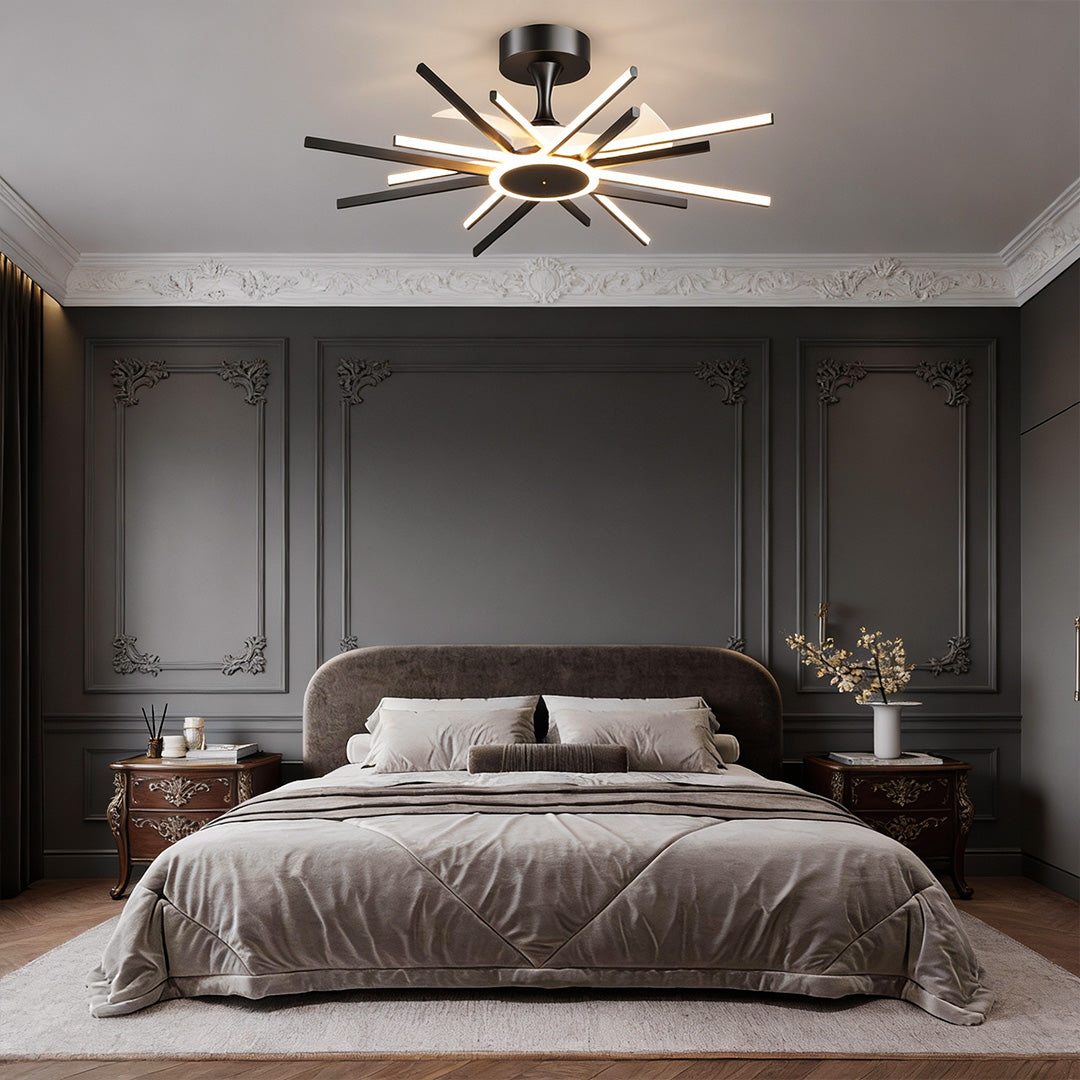
Creative Ceiling Fan Light Modern LED Starburst Light
Price: From $507.99
This flush-mounted fandelier suits a design-led living room where you want the fan mechanism to stay visually quiet while the light fixture supplies the statement.
- Hidden blades preserve the starburst silhouette when viewed from below.
- The 13.78-inch profile works with many standard-height flat ceilings.
- Three selectable color temperatures adjust tone, but not brightness.
Which One Is Better for Airflow?
A ceiling fan does not lower the room's air temperature; it helps people feel cooler by moving air across the skin. That means the most important question is not whether the product is labeled “powerful.” It is whether its airflow reaches the places where people actually sit.
A conventional 52-inch fan often has an advantage in a typical living room because its visible blades sweep a broad circle. A smaller concealed-blade mechanism may create a more focused column of air. That can be perfectly comfortable over a central conversation area, but less noticeable at a chair placed well outside the fixture's centerline.
Blade count, motor wattage, and fixture diameter alone cannot prove which fan moves more air. Blade pitch, RPM, motor design, and the clearance around the fan all affect performance. The conventional model offers a broader physical span; that supports a reasonable expectation of wider coverage, not a guaranteed CFM result.
Map the Airflow to the Seating, Not Just the Room Center
Before buying, mark the fixture center on a floor plan and draw the fan's listed diameter around it. Then mark the sofa seats and reading chairs. If the people who most need the breeze sit outside that footprint, a larger conventional fan—or two fans in a long room—may be more useful than a decorative fixture placed at the geometric center.

The Natural Wood model uses an approximately 52-inch overall span and visible wood blades. It is the more straightforward choice when the room needs a calm, familiar fan profile and broader circulation matters more than disguising the blades.
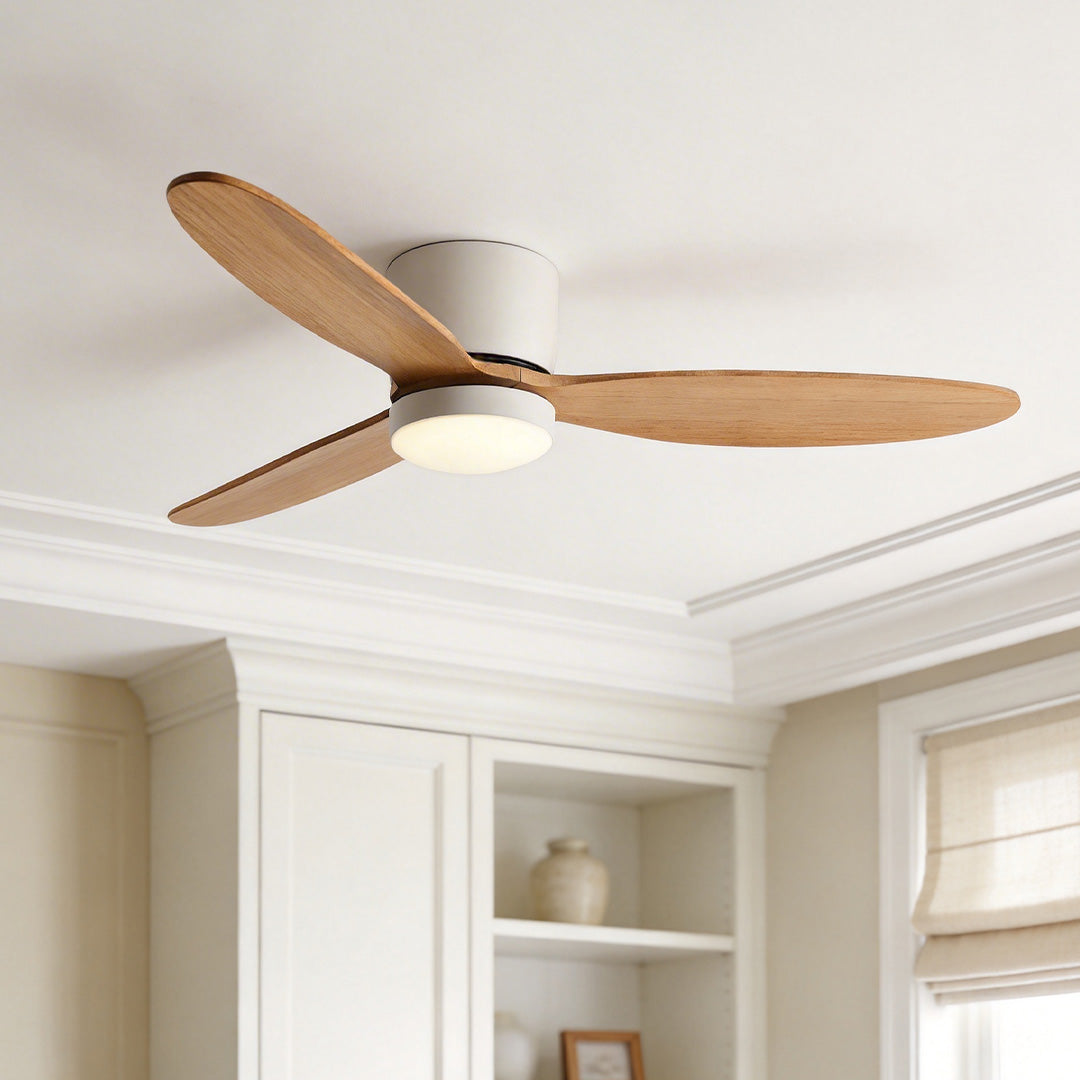
Natural Wood Ceiling Fan with Light Nordic LED Light
Price: Listed from $527.99; select the “With Light” option
This conventional three-blade fan is suited to medium and larger living rooms where natural material, restrained styling, and wider everyday circulation are the priorities.
- The 11.02-inch overall height keeps the profile relatively close to the ceiling.
- The lit version offers 3000K, 4500K, and 6000K color selections.
- A timer-off function supports comfortable evening use.
Match the Fan to Room Size and Layout
As a starting point, ENERGY STAR's ceiling fan basics page lists 50- to 54-inch fans for rooms of 225 to 400 square feet, while smaller spans are suggested for smaller rooms. Treat that as a first filter, not a complete design rule. A 240-square-foot square living room and a long 240-square-foot living-dining room do not distribute air the same way.
For more sizing context, use this ceiling fan sizing guide. Then check these three living-room-specific conditions:
- One centered sofa group: A fandelier can work well when its airflow is centered over the occupied area.
- Multiple seating zones: A wider conventional fan usually gives you a better chance of reaching both the sofa and secondary chairs.
- Open-plan room: Do not size the fan by the entire kitchen-living area if the breeze is only needed over one zone. Size and position it for the occupied living area, then coordinate the ceiling visually with the rest of the plan.
This is also where product-page numbers can mislead. Decorative fixture diameter, actual blade sweep, and stated illumination area are three separate measurements. The starburst fandelier page lists a 33.5- or 39.4-inch overall diameter and an illumination area of 193 to 269 square feet. That does not prove its hidden fan covers the same area. Ask for CFM and actual fan-blade sweep when performance is critical.

Measure the Lowest Point, Not Just the Mounting Style
“Flush mount” does not automatically mean “small.” The starburst model is 13.78 inches high, while the natural wood model is listed at 11.02 inches. Measure from the ceiling to the lowest decorative or light element, then confirm the finished clearance over the floor and tall furniture.
Which One Gives Better Living Room Light?
Neither type automatically provides better light. A fandelier may distribute light through several decorative arms, while a conventional fan may use a broad central diffuser. What matters is output, glare, dimming, color temperature, and whether the room has other light sources.
Both featured fixtures offer selectable 3000K, 4500K, and 6000K light. For a living room, 3000K is usually the most comfortable starting point in the evening. The cooler settings can feel useful during cleaning or detailed tasks, but 6000K may look stark beside warm wood, beige upholstery, or traditional finishes.
Do not confuse color-temperature switching with brightness dimming. The starburst product page specifically states that its three-color function changes the light tone but does not dim the brightness. The natural wood page also describes three color choices, but does not publish lumen output or confirm full-range brightness dimming. If movie-night light levels matter, verify the control behavior before ordering.
I rarely treat a fan light as the only living room light. It is excellent for general illumination, but a comfortable room also needs lower light near faces and activities. A floor lamp beside the sofa, a table lamp near a reading chair, or wall lighting near artwork prevents the ceiling from doing all the work. This guide to lighting a living room the right way explains that layered approach in more detail.
Layered Light Makes Either Fan Feel More Expensive
At night, turn the fan light down or off if the controls allow, then use lamps closer to eye level. The room feels calmer, faces look better, and the ceiling fixture can remain a visual feature instead of becoming a bright disk overhead. If true dimming is essential, make it a nonnegotiable specification.

Clearance, Controls, Noise, and Maintenance
Ceiling Height and Blade Clearance
For standard eight- or nine-foot ceilings, start with close-to-ceiling or flush mount ceiling fans. Keep the moving blades safely above the occupied space and follow the manufacturer's clearance instructions. A vaulted ceiling may require a downrod-compatible model; neither featured product should be assumed suitable for a slope unless the product page explicitly confirms it.
Control Convenience
Think through how you enter the room. The starburst model lists wall-switch control, while the natural wood model lists remote control. A remote is convenient from the sofa but frustrating if it is easily misplaced. A wall control is predictable for guests, but it should give practical access to fan speed, direction, and light settings. If you use smart-home controls, confirm compatibility rather than assuming an ordinary dimmer or smart switch will work.
Noise
“Silent” is a common product description, but living-room noise can also come from loose canopies, unbalanced blades, decorative parts, or a receiver in the ceiling box. A quality motor matters; careful installation matters just as much. Run the fan through every speed before the installer leaves, and listen from the sofa rather than directly below the motor.
Cleaning and Long-Term Care
A fandelier hides the blades visually, not from dust. Its decorative arms and upper fan area may require more careful cleaning. A conventional fan exposes more blade surface but is usually straightforward to wipe. If the fixture will be mounted in a tall living room, choose the design you can realistically maintain without a complicated ladder setup.
For a warmer, less mechanical appearance, wooden ceiling fans can bridge modern, Scandinavian, organic, and transitional interiors without turning the fan into a chandelier substitute.

Ask for the Missing Numbers
If a product page does not list CFM, RPM, lumen output, brightness dimming, sloped-ceiling compatibility, or the active blade sweep, do not fill in the blanks with assumptions. Ask the seller. A beautiful photo can show scale and style, but it cannot prove airflow or light output.
A Practical Decision Guide
Choose a fandelier if:
- The living room has one central seating zone.
- You want the ceiling fixture to look more like decorative lighting than a fan.
- A smaller overall diameter fits the furniture arrangement better.
- You are comfortable verifying airflow data before purchase.
- The room has enough visual simplicity to support a sculptural ceiling feature.
Choose a conventional ceiling fan with a light if:
- You prioritize broader perceived airflow over disguising the fan.
- The living room is medium to large, long, or open-plan.
- You have seating outside the exact center of the room.
- You prefer easier blade access and a familiar maintenance routine.
- A wood or neutral blade finish supports the room's materials.
Before You Order, Confirm These Eight Details
- Actual fan blade sweep—not only decorative fixture width.
- High-speed airflow in CFM and airflow efficiency when available.
- Finished height from ceiling to the fixture's lowest point.
- Required distance from walls, cabinets, and tall built-ins.
- Lumen output and whether brightness truly dims.
- Light color temperatures and whether the fixture remembers the last setting.
- Wall, remote, app, or smart-control compatibility.
- Flat-versus-sloped ceiling compatibility and electrical-box requirements.
Final Advice
For a typical medium or large living room, I would choose the conventional ceiling fan with light when comfort is the deciding factor. Its approximately 52-inch span is easier to relate to a broad seating plan, and the simple wood blades can still feel refined. For a smaller, design-conscious living room centered under one fixture, the starburst fandelier offers a much more decorative ceiling without visible blades interrupting the look.
The best answer is the fixture that serves the people on the sofa, not the one that looks best in an isolated product photo. Measure the occupied area, confirm the missing performance specifications, and plan the light in layers. When those pieces are right, either type can feel both attractive and genuinely useful.