
Who This Is For: This guide is for homeowners choosing a linear chandelier for a rectangular dining table, especially anyone comparing two fixture lengths and wondering whether the larger one will feel elegant or oversized.
A linear chandelier usually looks most natural when its shape follows the long axis of the dining table. That sounds simple until you compare a 39-inch fixture with a 48-inch one and realize both may technically fit. The better choice depends on more than the table's length: the fixture's width, density, end shape, hanging height, and even the chairs at the head of the table affect how large it appears.
The goal is not to fill every inch above the tabletop. It is to create a centered pool of light while leaving enough visual breathing room at both ends. Done well, the chandelier makes the table feel grounded and intentional. Done poorly, it can look like a short light bar floating in the middle or a heavy object pressing down on dinner guests.

Quick Answer: How Long Should a Linear Chandelier Be?
Start with a fixture that is one-half to two-thirds of the dining table's length. For a 72-inch table, that produces a useful starting range of 36 to 48 inches. For a 96-inch table, begin around 48 to 64 inches.
Then check a second rule: leave roughly 6 to 12 inches of tabletop visible beyond each end of the chandelier. The larger clearance feels calmer and more traditional; the smaller clearance creates a stronger contemporary statement. In most homes, staying near 9 to 12 inches per end prevents the fixture from crowding the people seated at the head of the table.
These are design ranges, not building-code formulas. A visually light, narrow fixture may look comfortable near two-thirds of the table length, while a dense crystal chandelier may feel balanced closer to one-half. If the two rules point to different sizes, use the table-end clearance as your practical limit and visual weight as the deciding factor.

Think in Ranges, Not a Single Perfect Number
A 42-inch and a 48-inch chandelier can both work over a 72-inch table. The shorter option feels quieter and leaves more room at the ends. The longer one has more architectural presence. Your room style and the fixture's optical weight determine which interpretation looks better.
Measure the Dining Table Before the Room
For a chandelier installed directly over a table, the table is the primary sizing reference. Measure the actual tabletop from end to end, not the distance between chair backs and not the rug below it. If the table has rounded corners, use its longest dimension.
Also record the table width. As a conservative starting point, keep the chandelier at least about 12 inches narrower than the tabletop—roughly 6 inches of inset on each long side. This reduces the chance that a broad fixture will feel too close to diners when they stand or lean forward. Many linear chandeliers are naturally narrow, but crystal tiers, branching arms, or large shades can add unexpected width.
Use the Table at Its Everyday Length
If you extend the table only a few times a year, size the chandelier for its closed, everyday configuration. A fixture chosen for the fully extended table often looks too long during the other 350 days. If the table stays extended for months at a time or the room routinely hosts large groups, use the extended length instead.
Homeowners sometimes use room dimensions to size a chandelier by adding the room's length and width in feet and converting that number to inches. That formula can help with a chandelier floating in an open room, but it is less reliable over furniture. Here, the fixture and table read as one composition, so tabletop proportions should lead.
Linear Chandelier Length Chart for Common Dining Tables
| Table Length | Starting Fixture Range | Typical Design Direction |
|---|---|---|
| 48 inches | 24–32 inches | Compact fixture with open ends |
| 60 inches | 30–40 inches | Short linear chandelier or clustered pendants |
| 72 inches | 36–48 inches | Most versatile residential pairing |
| 84 inches | 42–56 inches | Longer statement fixture |
| 96 inches | 48–64 inches | Substantial linear design or two coordinated fixtures |
| 120 inches | 60–80 inches | Large fixture, modular system, or matched pair |
Treat the chart as a first filter. If you are choosing between two sizes within the range, mock up each length with painter's tape on the table or hang a strip of cardboard at the planned height. View it from the doorway, the adjacent living space, and from a chair at the end of the table. This inexpensive test catches scale problems that a product-page diagram cannot.
Adjust the Formula for Visual Weight
One of the most useful designer concepts is the fixture's optical footprint: how much space it appears to occupy, which may be greater or smaller than its measured length. A 47-inch chandelier filled with crystal bars, multiple bulbs, and a solid frame can read larger than a 48-inch slim LED line.
Dense Fixtures Need More Breathing Room
Crystal prisms, layered glass, thick frames, and bright exposed bulbs increase visual weight. For these designs, start near one-half to three-fifths of the table length. An airy frame or very slim LED bar can often move toward two-thirds without overwhelming the setting.

The finish changes perception too. Black creates a crisp silhouette and may appear more defined against a pale wall. Polished gold and clear crystal reflect their surroundings, but sparkling highlights can extend the fixture's visual reach. Browse both crystal chandeliers and simpler modern profiles before deciding whether your room needs ornament or restraint.
For a 60- to 78-inch dining table, a medium-size rectangular crystal fixture can provide enough presence without running into the head-seat zones. The following design offers three lengths, making it easier to match the fixture to the actual table rather than accepting a one-size-only compromise.

Gold Rectangular Chandelier Modern Crystal Ceiling Light
Price: $396.99
Its layered crystal bars give this fixture a fuller optical footprint, so the 31-, 39-, and 47-inch options should be matched carefully to the table rather than judged by length alone.
- Clear crystal bars soften and scatter light across the dining area.
- Three fixture lengths accommodate common six- and eight-seat tables.
- The gold metal and stainless-steel structure creates a formal focal point.
Match the Fixture to Table Shape and Seating
A straight linear chandelier works most naturally over a rectangular or racetrack-shaped table. Over an oval table, choose a fixture with softened corners, rounded ends, or a gentle curve so the silhouettes feel related. A perfectly rigid rectangular frame can still work, but it creates a sharper, more architectural contrast.
For a round or square table, a linear chandelier is usually not the easiest match. A round, globe, or compact branching chandelier tends to distribute visual weight more evenly. If you strongly prefer a line over a round table, keep it shorter than the tabletop diameter and use a design that looks balanced from every side.

Protect the Head-Chair Zones
At the two ends of the table, diners are more likely to stand directly under the fixture edge. Keeping the chandelier inset makes those seats feel comfortable and prevents a low-hanging decorative element from appearing to hover over someone's head.
What If the Table Has Extension Leaves?
Choose based on how the table is used most often. Another practical option is to size the chandelier between the closed and extended proportions, but never so long that it overwhelms the closed table. A ceiling-mounted track or two smaller fixtures can offer more flexibility, though spacing and junction-box placement should be finalized before installation.
If you are comparing a chandelier with a row of pendants, the same composition rules apply, but spacing between individual shades becomes part of the overall length. The golden rules of pendant lighting sizing and placement can help you calculate that combined visual span.
How High Should a Linear Chandelier Hang?
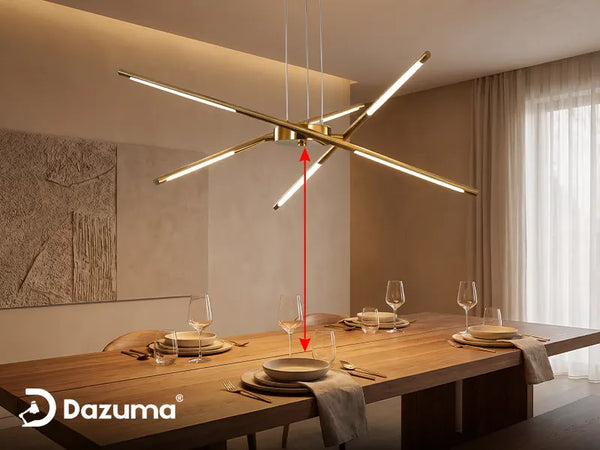
For an 8-foot ceiling, begin with the bottom of the chandelier 30 to 36 inches above the tabletop. That range is low enough to connect visually with the table and high enough to preserve conversation and sightlines. With a 9- or 10-foot ceiling, you can often raise the fixture about 3 inches for each additional foot of ceiling height, but do not automatically keep raising it until it feels detached.
Height changes how long a fixture appears. A chandelier hung close to the table occupies more of your field of view and therefore looks larger. The same fixture hung several inches higher appears lighter and shorter. Before exchanging a chandelier that feels slightly oversized, test it 2 to 3 inches higher while staying within a comfortable dining range.
Check Sightlines While Seated
Sit at the long side and at the head of the table. You should be able to see other diners without looking through a dense band of crystal or directly into bright LEDs. The ideal hanging height relates to the fixture's construction, not just the ceiling.

For a detailed ceiling-height adjustment, see how high a chandelier should hang over a dining table. Always confirm that the included rods, chains, or cables can achieve your planned overall drop before ordering.
Center the Chandelier on the Table, Not Automatically on the Room
If the dining table is intentionally offset to create a walkway or clear a buffet, the chandelier should generally center over the table. Centering it on the room while the furniture sits elsewhere creates a misalignment people notice immediately. The fixture's long axis should run parallel to the table, and its midpoint should align with the midpoint of the everyday tabletop.
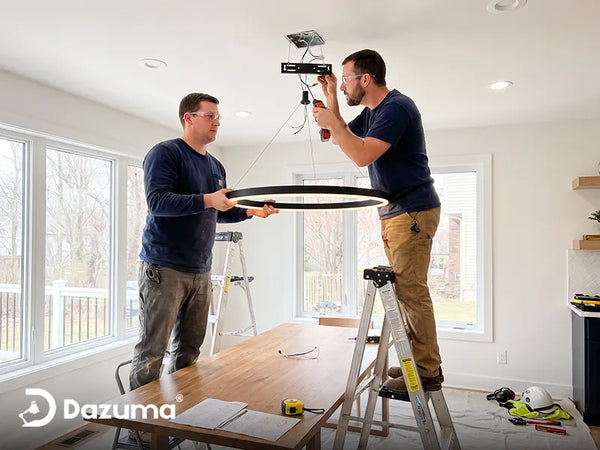
Before moving a junction box, check where the table can realistically stay. Door swings, chair pull-back space, and traffic to the kitchen matter more than a perfectly symmetrical ceiling plan. A qualified electrician can evaluate whether a new box, ceiling support, or safe swag solution is appropriate. Heavy crystal designs also require a ceiling box and structure rated for the fixture's installed weight.
A narrow profile is more forgiving when you want a long fixture without a heavy overhead presence. This 48.43-inch linear LED design is only 3.54 inches wide, so it can suit a 72- to 96-inch table when the room calls for a clean line rather than a large decorative mass.

Contemporary Linear Chandeliers Luxury RGB Ceiling Light
Price: $1,260.99
The 48.43-inch aluminum body creates a long architectural line without the visual bulk of a wide frame, making it easier to use near the upper end of the sizing range.
- Stepless dimming supports brighter meals and softer evening ambience.
- RGB modes add optional color for parties and special occasions.
- The adjustable 59.1-inch suspension cable suits varied ceiling heights.
For everyday dining, use a comfortable white-light setting and reserve saturated RGB color for entertaining. If you want to compare this profile with other restrained fixtures, the modern chandelier collection provides useful examples of how open space and slim materials reduce optical weight.
Common Linear Chandelier Sizing Mistakes

Buying by Length Alone
Depth, height, crystal density, and brightness can make two equally long fixtures feel completely different. Always read the full dimension diagram and mark both length and width on the tabletop.
Choosing for the Room Instead of the Table
A grand dining room does not automatically require a chandelier nearly as long as the table. Tall walls can justify more vertical presence, extra tiers, or a bolder finish without sacrificing the end clearances diners need.
Ignoring the Canopy and Suspension Points
The glowing body may be 48 inches long, but the ceiling canopy, cables, or mounting points can create a different visual span. Confirm that the fixture can hang level on a sloped ceiling if applicable and that its canopy will cover the existing electrical opening.
Assuming “Dimmable” Means Every Type of Adjustment
Three selectable color temperatures do not necessarily mean the fixture's brightness can be dimmed. Likewise, an integrated LED fixture may need its included controller rather than a standard wall dimmer. Match the control method to how you actually use the dining room.
Forgetting Maintenance Access
A fixture can fit beautifully but still be frustrating if crystals, shades, or LEDs are difficult to reach. Leave enough clearance to clean the top surfaces without moving the table every time. For large or heavy chandeliers, plan professional installation and future service access from the start.
Final Buying Checklist
- Measure the tabletop at its everyday length and full width.
- Calculate one-half to two-thirds of the table length.
- Confirm at least 6 inches of inset at every table edge.
- Move toward the shorter end for dense crystal or heavy frames.
- Move toward the longer end for slim, open, or visually light fixtures.
- Plan approximately 30 to 36 inches from tabletop to fixture bottom.
- Check seated sightlines from both the sides and head chairs.
- Verify canopy size, adjustable drop, weight, and dimmer compatibility.
- Mock up the final length and height before installation.
Final Advice
For most rectangular dining tables, a linear chandelier measuring one-half to two-thirds of the table length is the right place to begin. A 72-inch table commonly pairs with a 36- to 48-inch fixture; a 96-inch table usually supports roughly 48 to 64 inches. From there, protect 6 to 12 inches of end clearance and adjust for the fixture's optical footprint.
If you are torn between two sizes, choose the larger one only when its frame is slim, its ends remain comfortably inside the table, and the room has enough openness to support a stronger focal point. Choose the smaller one when the design is dense, the table sits near a wall or buffet, or you want conversation—not the chandelier—to dominate the room. The best result is not merely mathematically correct; it looks composed from the doorway and feels comfortable from every chair.