
Who This Is For: This guide is for parents planning a child’s bedroom, nursery transition, playroom, or homework space and trying to choose a ceiling fan that is safe, comfortable, easy to control, and practical after the colorful “kid” phase passes.
A Cute Ceiling Fan Still Has to Work Like a Serious Appliance
Colorful blades and rounded shapes can make a child’s bedroom feel personal, but a ceiling fan is a moving electrical fixture above a bed, play area, or desk. Parents must first check blade height, furniture reach, room size, lighting, controls, and ceiling support.
A good kid ceiling fan should pass the same practical tests as any adult-bedroom fan, then add age-appropriate style.

Quick Answer: What Should Parents Check First?
Before buying a kid ceiling fan, check the installed blade height, distance from walls and tall furniture, room dimensions, fan span, mounting type, ceiling-box support, control behavior, noise, light settings, and available safety-listing information.
A practical order of decisions is:
- Map the bed, bunk bed, loft bed, dresser, bookcase, and climbing furniture.
- Confirm the blades will remain at least 7 feet above the floor and safely outside reachable zones.
- Choose fan span for the room—not for the child’s age or the product’s color.
- Check whether published square footage refers to airflow or only illumination.
- Confirm the fan and light can be controlled independently.
- Verify whether “three-step dimming” means brightness control or only color-temperature switching.
- Request installation instructions and recognized safety-listing information when it is not shown on the product page.
Do not treat “kid-friendly,” “silent,” or “safe” as complete specifications. Look for measurable dimensions, control details, electrical information, and documented installation requirements.
What “Kid Ceiling Fan” Really Means
It Usually Describes Style and Scale
A child-focused label usually describes color, scale, or shape. It does not replace clearance rules, structural support, electrical installation, or safety documentation.
Smaller Does Not Automatically Mean Safer
A small fan may still hang too low, wobble when poorly installed, or sit within reach of a bunk bed. Installed position matters more than diameter alone.
“Kid-Friendly” Should Also Mean Easy for Parents
Parents should know who controls the fan, where the remote is stored, what the timer shuts off, and whether previous settings are remembered.
Choose a Design That Can Grow With the Room
Bright colors suit younger children, while white, wood, gray, or restrained blue may transition more easily into a tween room.
The Kid Ceiling Fans collection is most useful when parents compare dimensions, mounting depth, controls, and light functions alongside color.

Measure From Reachable Surfaces, Not Only the Floor
A bunk mattress, loft bed, tall dresser, or climbable shelf changes what a child can reach. Keep those items completely outside the blade zone.
Check Blade Clearance Before Style
Use Seven Feet as the Minimum Floor Clearance
ENERGY STAR guidance places ceiling fans at least 7 feet above the floor and 18 inches from walls. Measure the lowest moving point after installation—not the canopy.
Be More Conservative Around Bunk and Loft Beds
A bunk bed raises the child toward the ceiling. Keep upper bunks and loft beds completely outside the blade sweep and measure from the highest reachable surface.
Watch Doors, Closet Doors, and Tall Storage
Mark the full blade circle and check doors, wardrobe panels, loft ladders, balloons, canopy fabric, mobiles, and hanging decorations.
Low-Profile Does Not Mean Zero-Depth
Low-profile mounting helps, but include the motor, blades, diffuser, and any stem when calculating total depth.
Parent Safety and Practicality Check
| What to Check | Practical Target | Why It Matters |
|---|---|---|
| Blade Height | At least 7 feet above the floor | Reduces contact risk in occupied space |
| Wall Clearance | At least 18 inches from walls | Supports safer placement and airflow |
| Bunk or Loft Bed | Completely outside reachable blade sweep | A raised child can reach far above floor level |
| Fan Size | Matched to room dimensions and verified airflow | Small diameter does not guarantee useful circulation |
| Light Control | Independent fan/light control and clear night setting | Prevents accidental bright overhead light at bedtime |
| Ceiling Support | Fan-rated electrical box and secure mounting | A standard light box may not support fan movement |
| Certification Information | Recognized listing documentation confirmed | Marketing language is not a substitute for testing information |
Match Fan Size to the Actual Room
Use Room Area as a Starting Point
ENERGY STAR’s general size guidance suggests 29- to 36-inch fans for rooms up to 75 square feet, 36- to 42-inch fans for 76 to 144 square feet, 44-inch fans for 144 to 225 square feet, and 50- to 54-inch fans for larger rooms up to 400 square feet.
These ranges are starting points. Blade pitch, motor design, speed, mounting distance, and actual airflow still matter. See A Comfort Size Ceiling Fan for Room for more sizing context.
Do Not Confuse Lighting Area With Airflow Coverage
The Macaron page lists an illumination area of 161 to 215 square feet, but that is lighting coverage—not airflow. Its 21.65-inch width and missing CFM should not be interpreted as proof it can circulate a 215-square-foot bedroom.
Ask for CFM When Airflow Is Important
Neither featured page lists CFM. Request airflow information for each speed when the fan will be the room’s main source of circulation.
A Playful Fan for a Small Children’s Room
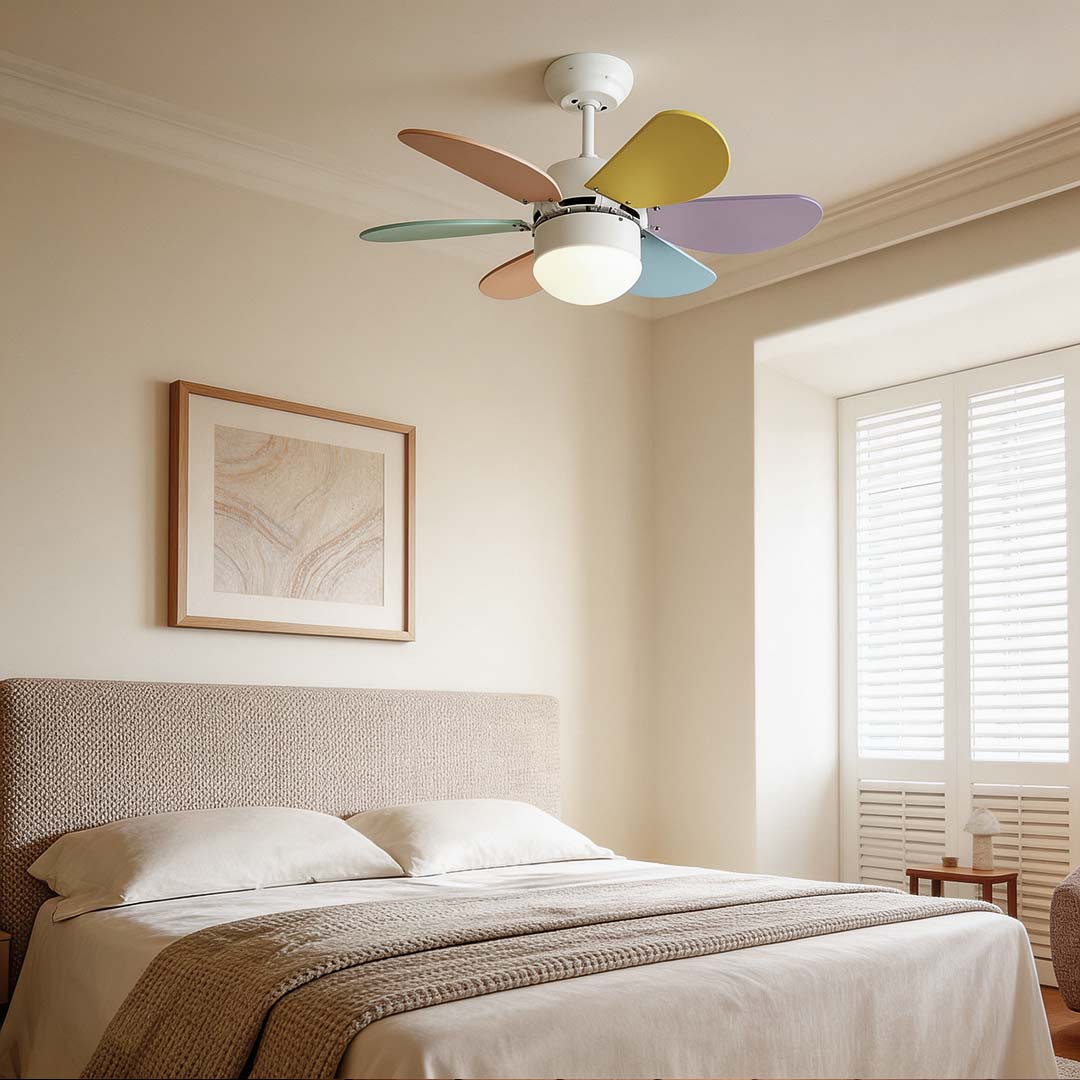
The first fan has a 29.92-inch span suitable as a starting point for a very small room, but its 15.55-inch total height requires careful clearance measurement.
Playful Color With Parent-Friendly Dual Control
Colored Fan with Light Creative Mini Children’s Room Ceiling Fan
Current Price: $355.99
Best for a small standard-bed children’s room where parents want a strong decorative accent, remote and wall-switch operation, a timer, and softened central light.
- Three fan speeds support gentle or stronger circulation.
- Wall-switch and remote operation provide a backup control method.
- An acrylic diffuser softens the integrated LED source.
Map the Fan to the Room, Not the Bed
The fan should circulate the usable room while clearing walls, doors, and furniture. Centering over a bed is not automatically the safest or most effective location.

Evaluate the Light Separately From the Fan
General Light Is Not Bedtime Light
An integrated light helps with dressing, cleaning, play, and homework. Add a lower lamp or sconce for bedtime stories.
Color Temperature Is Not Brightness
The Macaron page uses “3-Step Dimming,” but clarifies that it only switches among 3000K, 4500K, and 6000K. Brightness is not adjustable.
Warm Light Usually Works Better Before Sleep
Among selectable settings, 3000K usually feels softer at night. Cooler color can help with daytime tasks but does not necessarily mean more output.
Check What Happens at the Wall Switch
Ask whether the fixture remembers the previous fan speed and light color after wall-switch power is restored.
Compare more integrated options in Ceiling Fans With Lights, paying attention to actual brightness control rather than the word “dimming.”
Choose Parent-Friendly Controls
Independent Fan and Light Buttons Are Essential
Confirm the remote separates fan speed, light, timer, and direction so airflow can continue after the light is off.
Store the Remote Where Young Children Cannot Lose It
Store the remote in a wall holder outside the play area. A wall-switch backup helps when the remote is missing.
A Timer Can Help, but Test Its Behavior
Confirm whether the timer shuts off the fan only or the entire fixture and whether its intervals fit the bedtime routine.
Reverse Direction Should Not Be a Toy
The Macaron fan offers forward and reverse operation. Direction changes should follow the instructions and remain under adult control.
A Compact Color Option for Lower-Profile Installations
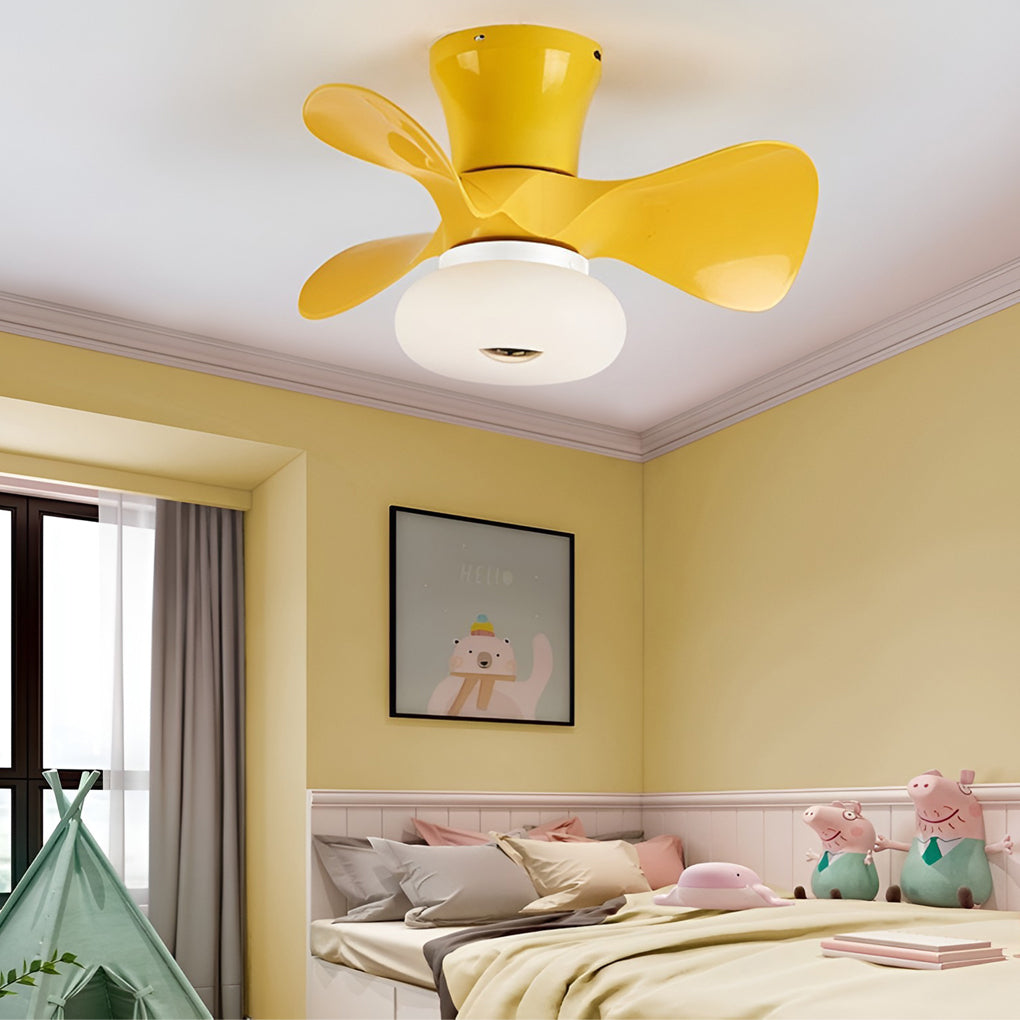
The Macaron fixture is smaller and shallower. Seven finishes range from playful yellow and blue to adaptable white, gray, wood, and brown.
Compact Color With Seasonal Airflow Control
Macaron Ceiling Fan with Light Modern Decoration LED Light
Current Price: $206.99
Best for a small bedroom or playroom where parents want a compact ceiling profile, multiple color choices, remote control, timer, and forward/reverse circulation.
- Seven finish options range from bright color to neutral wood tones.
- The remote controls speed, timer, and forward/reverse direction.
- The product page clearly states that brightness is not adjustable.
Noise, Balance, and Bedtime Use
“Silent” Is Not a Measured Noise Specification
Neither featured page lists a decibel rating, so “quiet” or “silent” should not be treated as a measured guarantee.
Installation Quality Can Create or Prevent Noise
A loose canopy, unbalanced blades, or unsuitable ceiling box can cause noise and wobble. Test every speed before normal use.
Watch for New Wobble Over Time
Stop using the fan if wobble increases, parts loosen, or unusual noise appears. See Why Your Ceiling Fan Wobbles and How to Fix It; structural or electrical concerns need a qualified professional.

Installation and Certification Questions Parents Should Ask
Use a Fan-Rated Ceiling Box
A fan creates repeated moving load. Confirm the electrical box is fan-rated and the structure supports the model.
Ask for the Installation Manual Before Ordering
Request a manual showing clearances, wiring, control pairing, maintenance, and ceiling limitations—especially for a “hanging” mount.
Verify Recognized Safety Listing Information
The visible specifications on both featured pages do not identify UL or ETL listing information. Ask the seller for applicable documentation for the exact model.
Use a Qualified Installer
Follow local electrical requirements and use a qualified electrician when the box, wiring, or ceiling structure is uncertain.
For low ceilings, compare complete installed dimensions in Flush Mount Ceiling Fans rather than assuming every compact fan is a true hugger design.
Plan for the Room Three Years From Now
A low bed may become a loft bed, a toy shelf may become a tall bookcase, and a nursery may become a homework room. Leave enough flexibility for those changes.

A Realistic Kids’ Bedroom Example
Consider a 9-by-10-foot room with an 8-foot ceiling. The rainbow fan’s 29.92-inch span is a reasonable starting point, but its 15.55-inch listed height would place the lowest point at about 6 feet 8 inches if that number represents the full installed drop—below the 7-foot guidance.
The 11.42-inch-high Macaron model would sit slightly above 7 feet under the same assumption, but its 21.65-inch width and missing CFM still require airflow verification. A planned loft bed could make either location unsuitable.
The parents should confirm actual blade height, airflow, and future furniture placement before choosing. “Small” and “made for kids” are not final safety answers.
Common Kid Ceiling Fan Buying Mistakes
Choosing Color Before Measuring Installed Height
A favorite color cannot compensate for blades that hang too low. Confirm the lowest moving point first.
Using Illumination Area as Fan Coverage
Lighting square footage does not describe airflow. Look for CFM or request performance information.
Putting a Bunk Bed Under the Fan
The upper bunk moves the child into a much higher occupied zone. Keep bunk and loft beds completely outside the blade sweep.
Assuming “Dimming” Always Changes Brightness
Some pages use dimming language for color-temperature switching. Confirm whether output can actually become lower.
Relying on the Remote as the Only Control
Remotes get lost and batteries fail. A clear wall control or switch strategy gives parents a backup.
Ignoring Long-Term Furniture Changes
Plan for taller beds, desks, shelves, and hanging decorations before fixing the fan location.
Installing on a Standard Light Box
Use a fan-rated box and appropriate structural support. Movement changes the load compared with a stationary ceiling light.
Assuming Playful Design Equals Verified Safety
Ask for installation and listing documentation. Style labels are not testing records.
Parent Buying Checklist
- Measure ceiling height and calculate the lowest blade height.
- Keep the blade sweep at least 18 inches from walls.
- Remove bunk beds, loft beds, and climbable furniture from reachable zones.
- Match blade span to room size and request CFM when it is not listed.
- Separate illumination-area claims from airflow performance.
- Confirm fan and light controls operate independently.
- Check whether the light adjusts brightness, color temperature, or both.
- Ask what the wall switch, remote, timer, and memory functions do.
- Verify a fan-rated ceiling box and secure mounting.
- Request installation instructions and recognized safety-listing information.
- Test all speeds for noise and wobble after installation.
- Recheck clearance whenever the room furniture changes.
Final Advice: Buy for the Reachable Room, Not the Product Photo
The best kid ceiling fan clears the child, furniture, walls, and future room changes; provides verified airflow; offers understandable controls; and mounts securely.
The rainbow model has stronger decorative impact, dual control, a timer, and a 29.92-inch span, but its 15.55-inch height needs careful review. The Macaron model is shallower and offers more colors plus forward/reverse operation, but brightness is fixed and illumination area is not airflow coverage.
Measure first and ask for missing specifications. Once clearance, airflow, control, and installation are resolved, let the child help choose from the wider Ceiling Fans collection.