
Who This Is For: This guide is for homeowners choosing exterior lights for a porch, garage, driveway, side yard, or backyard—and wondering whether the light should stay on all night or switch on only when someone approaches.
Quick Answer: Choose the Behavior, Not Just the Fixture
Dusk-to-dawn lights are better when you need steady visibility throughout the night. They suit front entries, house numbers, steps, and regularly used walkways where arriving home should never mean walking into darkness. Motion sensor lights are better when you need brighter light only during activity. They suit driveways, garage approaches, gates, side yards, and utility areas where continuous illumination would be unnecessary or intrusive.
For many homes, the best answer is not one system everywhere. I usually think in layers: a modest, warm dusk-to-dawn light identifies the entrance and makes the property legible, while motion-activated light adds short bursts of stronger visibility where a person, car, or animal may approach.
If you want a one-fixture compromise, look for a dual-mode model that stays at a low output after dark and rises to full brightness when motion is detected. Read the operating sequence carefully, though. Some fixtures labeled with both features simply use a photocell to prevent the motion sensor from activating in daylight; they do not necessarily provide low-level light all night.

How Dusk-to-Dawn and Motion Sensor Lights Actually Work
Dusk-to-Dawn Lights Respond to Ambient Light
A dusk-to-dawn fixture uses a photocell, sometimes called a photosensor, to monitor surrounding light. It switches the fixture on when the environment becomes dark enough and off when daylight returns. Unlike a simple clock timer, it naturally follows changing sunset and sunrise times.
This is convenient, but the sensor needs a truthful view of the sky. A photocell shaded under a deep eave may turn on too early. One that sees its own lamp, a neighboring fixture, or reflected light can cycle on and off. When browsing Dusk To Dawn Outdoor Wall Lights, check where the photocell sits and whether the installation location will cover or confuse it.

Steady Light Makes an Entrance Easy to Read
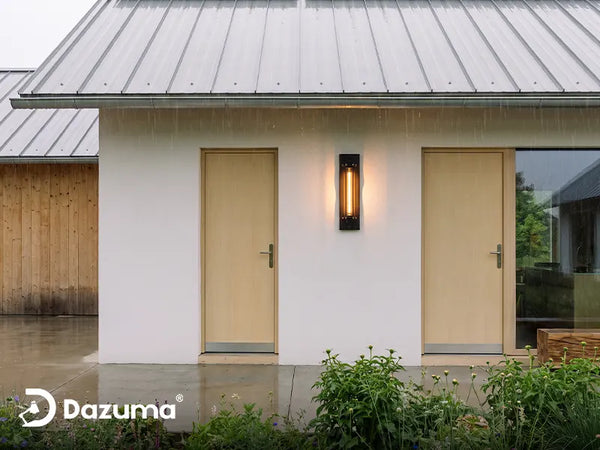
At a front door, the design goal is often orientation rather than high brightness. Guests should see the house number, path, step, handle, and face of the person greeting them. A shielded, low-output light can do that without making the doorway feel like a loading dock.
Motion Sensor Lights Respond to Movement
Most residential motion lights use passive infrared sensing, which reacts to changes in heat moving across the detection area. The light stays off—or at a lower level—until it detects activity, then remains on for a selected period. The exact range, field of view, sensitivity, and hold time vary by fixture.
One useful detail is easy to miss: a sensor often notices a person moving across its detection zones more reliably than someone walking directly toward it. That means the longest advertised detection distance is not automatically the best layout. Place and aim the sensor so the expected walking route crosses the field of view before the person reaches the dark step, gate, or car door.
Motion control is also different from scheduling. A timer follows programmed hours whether or not anyone is present. If you are comparing those options too, see Motion Sensor vs Timer Outdoor Lights: Pros and Cons.
Light the Arrival, Not the Whole Block
For a driveway, aim the detection area across the vehicle and pedestrian approach. Direct the beam toward the driveway surface and garage apron, not into drivers' eyes, upstairs windows, or the neighbor's yard. The light should reveal hazards without announcing every passing car.

Dusk-to-Dawn vs. Motion Sensor Outdoor Lights
| Decision Factor | Dusk-to-Dawn | Motion Sensor |
|---|---|---|
| Light behavior | On through the night; off in daylight | On briefly after detected activity |
| Best use | Orientation, welcome, and continuous low-level visibility | Task light, approach awareness, and occasional access |
| Energy use | More operating hours; choose modest output | Usually fewer lit hours; actual use depends on triggers |
| Main annoyance | Unneeded light, glare, or light trespass all night | False triggers or delayed activation |
| Maintenance check | Keep photocell exposed to natural ambient light | Keep sensor clear and re-aim after landscape changes |
| Better choice when... | The area must be readable before anyone arrives | Brightness is needed only during a specific event |
The Best Control for Each Outdoor Area
Front Porch and Main Entry: Usually Dusk-to-Dawn
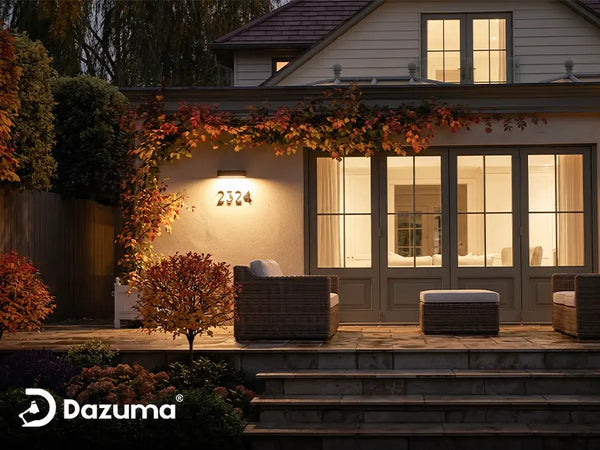
The main entrance is where continuous low-level light earns its keep. It helps residents find keys, lets visitors confirm the address, and keeps steps visible before a sensor decides someone is close enough. Choose warm, shielded light and let it support the architecture rather than overpower it.
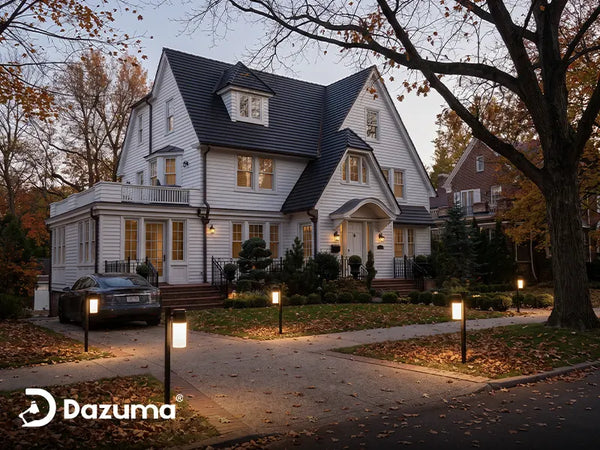
If the property is very dark or the front walk is long, add a motion boost farther out while keeping the porch at a softer steady level. This avoids the unpleasant experience of approaching a black doorway and then being hit with sudden, high-output glare.
Garage and Driveway: Usually Motion Sensor
A garage apron benefits from brighter, wider task light when someone parks, unloads groceries, checks a tire, or takes out trash. Keeping that same output on all night often adds little value. A motion-controlled fixture can provide useful brightness during activity, then return the property to a calmer nighttime condition.
Avoid aiming the sensor at the public sidewalk or street unless that is intentional. Traffic, cyclists, and pedestrians can trigger it repeatedly. Select a fixture from a Motion Sensor Wall Lights collection only after checking whether its sensitivity, detection direction, and on-time can be adjusted.
Side Yard, Gate, and Utility Area: Motion Sensor
These spaces are often used for a few minutes at a time and may sit close to bedroom or neighboring windows. Motion activation supplies light when someone opens a gate, accesses bins, or checks equipment without leaving a narrow corridor illuminated for hours.

Aim Across the Path and Below the Windows
Mounting position matters more than maximum range. Let the route cross the sensor's field, keep branches and dryer vents out of the main detection area, and shield the source so a late-night trip to the bins does not light a bedroom.
Back Patio and Entertaining Area: Manual, Scheduled, or Hybrid
Motion-only light can be irritating on a patio: it may switch off while people sit still, then flash back on when someone gestures or a pet walks by. Dusk-to-dawn may run far longer than the space is used. A manual dimmer, schedule, or smart control is often more comfortable, with motion reserved for steps or the route back to the house.
House Number and Public-Facing Walk: Dusk-to-Dawn at Low Output
If delivery drivers or guests need to identify the property, the address should be readable before they enter a motion zone. This is a good place for a small, directed dusk-to-dawn source. Review the broader Outdoor Wall Lighting options by beam direction, scale, wet-location suitability, and glare control—not by control type alone.
Energy Use, Security, and Nighttime Comfort
Motion Control Usually Reduces Lit Hours
Energy use depends on wattage multiplied by operating time. A 12W LED burning for 12 hours uses about 0.144 kWh that night. The same 12W light operating for a total of one hour uses about 0.012 kWh. That is an illustration, not a promise: pets, trees, passing traffic, sensitivity settings, and household activity can greatly change motion-light runtime.
Dusk-to-dawn does not automatically mean wasteful. A well-shielded, modest-output LED at the front door may use little electricity while serving a clear purpose. The poor setup is a high-output, unshielded fixture washing the entire yard, neighboring windows, and sky from sunset to sunrise. If you are deciding whether any exterior light should stay on that long, our guide Should You Leave Outdoor Lights On All Night? explores the question in more detail.
Security Is About Useful Visibility, Not Maximum Brightness
Both controls can support a safer-feeling exterior, but neither is a complete security system. Steady entry light removes dark transitions and makes routine access easier. Motion light calls attention to activity and helps a homeowner or camera capture a clearer view. Locks, clear sightlines, cameras, and sensible landscape maintenance still matter.
Overlighting can work against you. A bare, very bright lamp creates glare and deep shadows, making it harder to see beyond the hot spot. It can also disturb neighbors and encourage them to block the light. Aim downward, use the lowest level that lets people complete the task, and favor warm light—often 2700K to 3000K for residential settings.
The Most Livable Hybrid Uses Two Light Levels
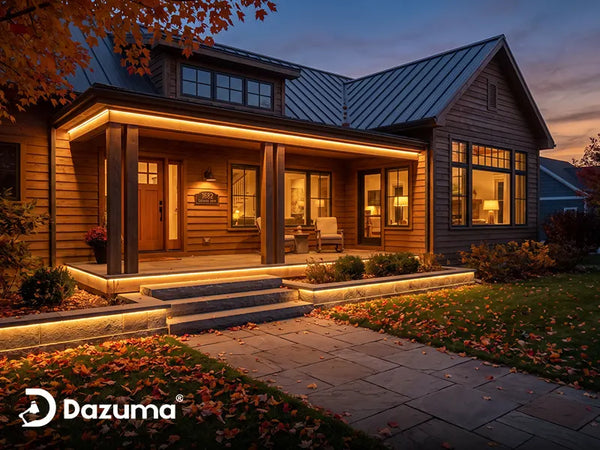
A low-output evening layer keeps the entrance and key edges readable. Motion then raises brightness only where a person needs more detail. This feels calmer than an all-night floodlight and less abrupt than a completely dark property that suddenly flashes bright.

Common Problems and Practical Fixes
The Dusk-to-Dawn Light Stays On During the Day
First, clean the photocell and check whether paint, dirt, an eave, or a new landscape feature is blocking daylight. Confirm that the sensor is not covered by a decorative plate. If the fixture has a test or override mode, reset it according to the manual. A failed photocell may require replacement rather than repeated switch cycling.
The Light Flashes On and Off at Night
The photocell may be seeing the fixture's own output or light reflected from a pale soffit or wall. The lamp turns on, convinces the sensor that dawn has arrived, turns off, then sees darkness again. Repositioning the sensor, reducing reflected light, or following the manufacturer's shielding guidance can stop the loop.
The Motion Light Activates Constantly
Reduce sensitivity and shorten the detection reach before assuming the unit is defective. Re-aim it away from roads, sidewalks, HVAC exhaust, moving branches, flags, and reflective surfaces. Trim vegetation that has grown into the detection area. Start with a shorter on-time, then increase it only if people regularly lose light before finishing the task.
The Motion Light Turns On Too Late
Map the actual walking route after dark. If a person approaches straight toward the sensor, rotate the detection area so the route crosses it earlier. Make sure the sensor is mounted at the height and orientation specified by its manufacturer. Do not hide it behind a post, deep trim, or overgrown shrub to make the fixture look cleaner.
A Homeowner's Buying and Installation Checklist
- Name the task. Decide whether the light provides orientation, task visibility, approach awareness, atmosphere, or a combination.
- Choose the control by zone. Use steady low-level light where people need to see before arriving and motion light where activity is occasional.
- Confirm the operating sequence. “Photocell plus motion” may mean motion works only after dark, not that the fixture stays dim all night.
- Check adjustability. Look for usable sensitivity, detection angle, hold-time, and brightness settings rather than the largest range number.
- Control glare. Choose shielding and aim light downward onto the door, step, path, or driveway surface.
- Keep color comfortable. Warm 2700K light is a strong default near entries and bedrooms; 3000K can work when well shielded and used only as needed.
- Verify outdoor suitability. Match the fixture's wet- or damp-location rating to the actual exposure and follow its installation instructions.
- Test from every viewpoint. Check the effect from the street, neighboring property, upstairs windows, indoor rooms, and the approach path.
- Protect electrical safety. Turn power off at the breaker and use a qualified electrician when adding, relocating, or troubleshooting hardwired exterior lighting.
Final Advice: Most Homes Need a Small Lighting System, Not One Universal Mode
If you want the simplest rule, use dusk-to-dawn lighting for quiet, continuous orientation and motion sensor lighting for brighter, occasional tasks. The front door and house number usually benefit from modest steady light. The driveway, garage, gate, and side yard usually benefit from responsive light.
Then refine the result. Keep all-night light warm, low, and shielded. Aim motion detection across the actual approach, not toward every movement beyond the property. If one fixture must serve both purposes, choose a dual-brightness design and verify exactly how its photocell and motion modes interact.
The better choice is not the one with more features or the highest lumen number. It is the one that turns on at the right moment, lights only the useful area, stays on for the right amount of time, and lets the rest of the night remain comfortably dark.