
Who This Is For: This guide is for homeowners planning a backyard renovation who are wondering whether step and deck lights are a real safety upgrade, a design detail, or just one more expense on the outdoor lighting list.

Quick Answer: Are Step And Deck Lights Necessary?
Step and deck lights are not necessary for every backyard, but they become close to essential when a renovation includes stairs, raised decking, retaining walls, sunken seating, pool-adjacent walkways, or any level change that guests might miss at night. In a flat backyard with one simple patio and strong porch lighting, you may be able to skip them. In a layered outdoor space, they are one of the most practical lighting upgrades you can add.
The main reason is not decoration. It is orientation. A backyard renovation often looks beautiful in daytime photos, but the way people move through it changes after dark. Shadows hide stair edges. A single bright wall light creates glare but leaves the deck surface unevenly lit. Guests carrying drinks, children running across a patio, or older family members stepping down from a deck need lighting that is low, calm, and close to the walking surface.
That is where step and deck lights are different from general Outdoor Lighting. Instead of flooding the yard, they mark edges. Instead of making the whole backyard bright, they help the eye understand depth. A small amount of light in the right place can feel safer and more polished than one oversized floodlight aimed across the entire space.
Where Step And Deck Lights Matter Most In A Backyard Renovation
The simplest rule is this: if someone has to change elevation, turn a corner, or cross from one material to another, that spot deserves lighting attention. Step and deck lights are most useful where the body needs a visual cue before the foot lands.

Level Changes Are The First Priority
Any step between a deck and a patio, a patio and a lawn, or a path and a raised garden bed should be easy to read at night. Even one step can be missed if the surrounding surfaces are similar in color. Low step lights help define the drop without making the backyard feel overlit.
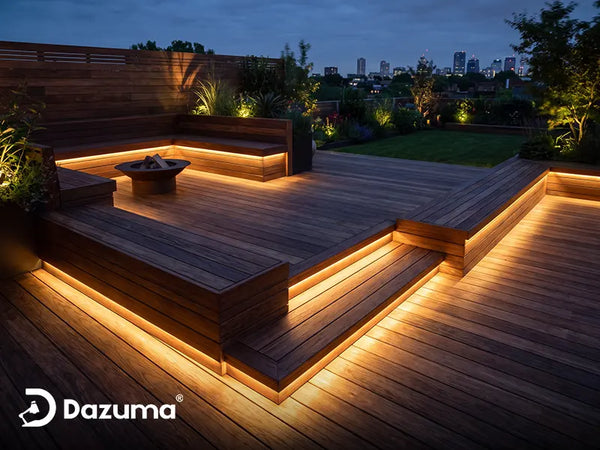
They also matter along long deck edges, especially when there is no railing. A floating deck, hot tub platform, or outdoor dining platform may look clean during the day, but the edge can disappear at night. Deck lights placed along the perimeter give guests a quiet boundary line. They do not have to be bright; they just need to make the edge visible.
Path transitions are another good place to use them. If a gravel path meets a paver patio, or a narrow side-yard walkway opens into a backyard entertaining area, a few low lights can guide movement more naturally than overhead brightness. For wider circulation zones, you may combine step lighting with low Path Lights so the route feels continuous rather than patched together.
How Step And Deck Lights Improve Safety And Flow
The biggest benefit of step and deck lights is that they reduce uncertainty. People do not need a runway-bright backyard. They need to know where to place their feet, where the next surface begins, and whether there is an edge ahead. This is especially important in backyard renovations that include outdoor kitchens, fire pits, pool areas, or dining zones where people move around while talking, carrying plates, or looking away from the ground.
One useful design principle is to light the walking surface, not the face. A strong wall light mounted at eye level can create glare, which makes the surrounding dark areas feel even darker. A small step light mounted low sends light across the tread or down toward the surface, giving the eye useful information without competing with the view.
If you have had problems with uneven light, flickering fixtures, or dark pockets around steps, it may help to compare the issue with existing troubleshooting guidance like Issues with Step and Deck Lighting: Troubleshooting & Solutions. Many step-light problems come from poor placement, incompatible transformers, weak waterproofing, or fixtures that are too bright for close-range viewing.
Subtle Lighting Often Feels Safer Than Bright Lighting
For backyard stairs, more brightness is not always better. The goal is even visibility. A warm, shielded light along each step edge can feel calmer and safer than one harsh fixture that creates shadows behind every tread.

Choosing The Right Style For Your Renovation
Step and deck lights should match the architecture of the backyard, not call attention to themselves. In most renovations, the fixture style matters less than the beam control, finish, color temperature, and installation location. A black recessed light may disappear into dark deck fascia. A slim linear strip may work better under stone treads. A small wall-mounted light may be useful along a retaining wall where cutting into the step face is not practical.
For modern decks, choose low-profile fixtures with clean edges. For traditional patios, use softer finishes and warmer light. For concrete, stone, or stucco outdoor spaces, recessed or flush-mounted lights tend to look more intentional. If your backyard uses long retaining walls or architectural surfaces, you may also coordinate step lighting with Outdoor Wall Lighting so the vertical surfaces do not feel disconnected from the walking areas.
Color temperature is another important choice. Around decks, steps, and seating areas, warm white light usually feels more comfortable than cool white. A range around 2700K to 3000K tends to feel residential and relaxed. Neutral 4000K can work for task-heavy circulation zones, but it may feel sharper and more commercial if used throughout an entertainment backyard.
Recommended Style For Recessed Step Edges
If your renovation includes deck stairs, retaining-wall steps, or a clean modern path where you want each tread to be visible without a bulky fixture, a recessed rectangular step light is usually the easiest look to blend in. It works best when the light is mounted into the riser, fascia, or side wall and aimed downward across the walking surface.

Recessed edge lighting
Deck Lights for Steps Modern Minimalist Embedded Outdoor Step Lights
Price: $64.99
Best for modern backyard stairs, deck fascia, and low retaining-wall steps where you want a clean built-in look rather than visible lanterns or stake lights.
- Integrated LED design with a slim rectangular face for flush step or deck installation.
- Available in warm and neutral color temperatures for different backyard moods.
- The downward light angle helps mark stair edges while reducing direct glare.
Step And Deck Lighting Planning Table
Before you decide whether step and deck lights are necessary, walk through the backyard in the evening and mark every place where movement feels uncertain. The table below gives a practical starting point for planning.
| Backyard Area | Lighting Need | Best Fixture Approach | Priority |
|---|---|---|---|
| Deck stairs | Show each tread and riser clearly | Recessed step lights or low side-wall lights | High |
| Deck perimeter | Define the edge of a raised platform | Small deck lights along fascia or posts | High if there is no railing |
| Long outdoor steps | Create continuous guidance | Linear under-tread lighting or repeated small fixtures | High |
| Flat patio | General ambience and seating comfort | Wall lights, string lights, or nearby path lighting | Medium |
| Garden paths | Guide direction and avoid dark turns | Path lights or low landscape lights | Medium to high |
If the renovation includes a larger deck layout, it may also help to review How to Plan a Perfect Outdoor Deck Lights? before finalizing wiring points. Deck lighting is much easier to install cleanly while framing, fascia boards, risers, and access panels are still being planned.

Plan Lighting Before The Deck Is Finished
The cleanest step and deck lighting usually happens before the final surface is installed. That is when an electrician can plan low-voltage runs, switch zones, transformer locations, and service access without cutting into finished materials later.
Recommended Style For Long Steps And Under-Tread Glow
For wide outdoor steps, guardrail bases, or long masonry treads, a strip-style step light can create a smoother line of visibility than several small point lights. This works especially well in modern renovations where you want the step to appear softly floating at night.

Linear under-tread glow
Exterior LED Step Lights Long Strip Decorative Lamp
Price: $66.99
Best for long outdoor steps, courtyard stairs, garden paths, and guardrail areas where a continuous warm line of light feels cleaner than separate small fixtures.
- Low-voltage DC 24V design for outdoor step and pathway applications.
- Available in multiple lengths for different tread widths and railing runs.
- Warm linear light adds visibility without making the backyard feel harsh.
Are They Worth The Cost?
Step and deck lights are usually worth the cost when they are planned as part of the renovation rather than added afterward. Retrofitting can require cutting, patching, fishing wires, and working around finished surfaces. During construction, the installer can place wiring paths, low-voltage transformers, and access points more neatly.
From a value perspective, step and deck lights do three things at once. They improve nighttime safety, extend the hours you can comfortably use the backyard, and make the renovation feel more finished. A deck without lighting can look like a daytime feature. A deck with carefully placed lights becomes part of the evening living space.
They are not always the first lighting purchase, though. If your backyard has no main ambient lighting at all, start with basic zones: entry, patio, path, and key task areas. Then add step and deck lights where elevation changes or deck edges need definition. For renovations that use long benches, stairs, or linear planting beds, discreet Outdoor Led Strip Lights can help create the same low, guided feeling when installed in an appropriate outdoor-rated housing or channel.
Think In Zones, Not Fixtures
A good backyard lighting plan separates movement, seating, cooking, planting, and accent zones. Step and deck lights belong mostly in the movement zone, but they can also support ambience when they are warm, low, and evenly spaced.

Common Mistakes To Avoid
The most common mistake is spacing lights too far apart. If only the top and bottom of a staircase are lit, the middle steps may still feel uncertain. Another mistake is using fixtures that are too bright. Step lights are close to the eye and close to the walking surface, so glare becomes noticeable quickly. A shielded beam, frosted diffuser, or downward angle usually works better than an exposed source.
Homeowners also forget service access. Outdoor lighting lives in weather, dust, irrigation overspray, and temperature changes. Even high-quality fixtures need practical access for inspection. Transformers, drivers, junction boxes, and wiring connections should not be buried where they cannot be reached.
| Mistake | Why It Matters | Better Approach |
|---|---|---|
| Using one bright floodlight | Creates glare and harsh shadows on stairs | Use smaller low lights near the walking surface |
| Skipping the bottom step | The final drop is often where people misjudge the surface | Light the first and last step clearly |
| Choosing cool, harsh light | Makes a residential backyard feel commercial | Use warm white around seating and entertaining zones |
| Ignoring waterproof ratings | Outdoor stairs face rain, dust, and cleaning water | Choose outdoor-rated fixtures suited to the exposure |
Final Advice Before You Install
Step and deck lights are necessary when your backyard renovation creates places where people could misread the ground at night. They are especially valuable on stairs, raised decks, edges without railings, long outdoor treads, and transitions between materials. If the backyard is completely flat and already has balanced ambient lighting, they may be optional. If the renovation has layers, they are usually worth planning early.
Walk the yard at dusk before finalizing the plan. Notice where your eye loses the edge of a step, where a railing casts a shadow, where the deck disappears into the lawn, and where guests will naturally move between food, seating, fire, and doors. Those are the places where step and deck lights earn their keep.
For electrical work, use fixtures rated for the outdoor location, keep transformers and drivers accessible, and work with a qualified electrician for hardwired installation. The best backyard lighting should make the space feel safer, calmer, and more usable without making it feel like a parking lot.