
Who This Is For: This guide is for homeowners who want outdoor lights to switch on automatically at night but are concerned about leaving them on for eight, ten, or even twelve hours. It is especially useful if you are comparing LED, incandescent, solar, and motion-controlled lighting for a porch, garage, driveway, or side yard.
The Short Answer: Usually No, If You Use LED
A modern LED dusk-to-dawn light generally does not use a large amount of electricity. The photocell that detects daylight draws very little power; the lamp or integrated LED is what determines nearly all of the energy use. A single 12-watt LED operating for 10 hours per night consumes about 3.6 kilowatt-hours (kWh) in a 30-day month. At an illustrative electricity rate of $0.16 per kWh, that is about $0.58 per month.
The answer changes quickly with older bulbs and multiple fixtures. A 60-watt incandescent bulb on the same schedule consumes 18 kWh per month, or about $2.88 at that same rate. Six of those bulbs could cost roughly $17.28 per month, while six 12-watt LEDs would cost about $3.46. Dusk-to-dawn operation is not automatically wasteful, but inefficient lamps left on all night can add up.

How Much Electricity Does a Dusk-to-Dawn Light Use?
You only need three numbers: fixture wattage, nightly runtime, and your electricity rate. Wattage is listed on the bulb or fixture label. Runtime changes by season and location, while your actual utility rate appears on your bill.
Monthly energy use: (Watts ÷ 1,000) × hours per night × days per month
Monthly cost: Monthly kWh × electricity rate per kWh
For example, a 15-watt LED that runs 11 hours each night for 30 days uses:
(15 ÷ 1,000) × 11 × 30 = 4.95 kWh per month
At $0.16 per kWh, the estimated monthly energy charge is $0.79. Substitute the rate from your own bill for a local estimate. If the fixture contains two 15-watt lamps, use 30 watts in the formula.

Wattage Is Power; kWh Is Energy
These terms are often mixed up. Watts describe how much power a light draws at a moment in time. Kilowatt-hours describe how much energy it uses over time, which is what utilities bill. A low-wattage light can run all night without consuming much energy, while a high-wattage fixture can become expensive even if it operates for fewer hours.
Dusk-to-Dawn Lighting Cost Examples
The table below assumes 10 hours of use per night, 30 days per month, and an illustrative rate of $0.16 per kWh. It shows energy cost only; taxes, fixed utility charges, and local rate structures are not included.
| Lighting Setup | Total Wattage | Monthly kWh | Est. Monthly Cost | Est. Annual Cost |
|---|---|---|---|---|
| One 8W LED marker light | 8W | 2.4 kWh | $0.38 | $4.61 |
| Two 12W LED wall lights | 24W | 7.2 kWh | $1.15 | $13.82 |
| Four 15W LED fixtures | 60W | 18 kWh | $2.88 | $34.56 |
| Two 60W incandescent bulbs | 120W | 36 kWh | $5.76 | $69.12 |
A useful way to read this table is to look at the whole property, not one fixture. One LED porch light may barely register on the bill. A long driveway, detached garage, deck, and multiple landscape zones can create a meaningful combined load. Count every lamp and use its actual wattage. Do not calculate from “60-watt equivalent,” which describes brightness compared with an incandescent bulb, not the LED's real power draw.
Also check whether your utility uses time-of-use pricing. Many residential plans charge one flat energy rate, but some charge different prices at different hours. Because dusk-to-dawn lights operate mostly overnight, their effective cost may differ from a simple estimate based on the bill's headline rate. The calculation method stays the same; use the applicable overnight rate when your plan provides one. Fixed monthly service fees normally do not change because you installed one light, so they should not be assigned to that fixture when comparing options.
What Makes Dusk-to-Dawn Lights Use More Electricity?
1. Bulb or Fixture Technology
LEDs produce useful light with much less power than traditional incandescent and halogen lamps. If an older outdoor lantern accepts replaceable bulbs, upgrading the bulb is usually the simplest energy-saving step. For a new exterior plan, explore efficient dusk-to-dawn outdoor wall lights and compare actual watts and lumens rather than judging efficiency from brightness alone.

2. Night Length and Seasonal Change
A photocell responds to ambient light, so runtime naturally increases during winter and decreases during summer. If your example assumes 10 hours every night, it may understate winter use in a northern climate and overstate summer use. Nearby shade, deep porch roofs, storms, and the fixture's sensor threshold can also change when it switches on.
3. Number of Lamps
A fixture with two bulbs uses the combined wattage of both. The same rule applies across a property: add the porch pair, garage pair, side-door light, and any fixtures operating on the same schedule. Decorative repetition can look polished, but leaving every exterior light at full output all night may illuminate areas that do not need continuous coverage.
4. Sensor Placement
A photocell facing a wall, tucked beneath a dark overhang, coated with dirt, or illuminated by its own lamp may switch at the wrong time. Some lights stay on during the day; others cycle on and off because the lamp shines into the sensor. Position and maintain the sensor according to the manufacturer's instructions, and do not cover it with paint or caulk.
5. Unnecessary Brightness
More watts do not automatically mean better security. Glare can make faces harder to see and create deep shadows beyond the bright area. A restrained, well-directed fixture often provides better visibility at lower power. Choose output and beam direction for the actual task: finding a key, seeing a step, identifying a visitor, or navigating a path.
Dusk-to-Dawn vs. Motion Sensors, Timers, and Solar Lights
The least expensive control is not always the best control. The right choice depends on whether the area needs continuous low-level visibility, predictable evening atmosphere, or brief security lighting.

A Hybrid Plan Often Works Best
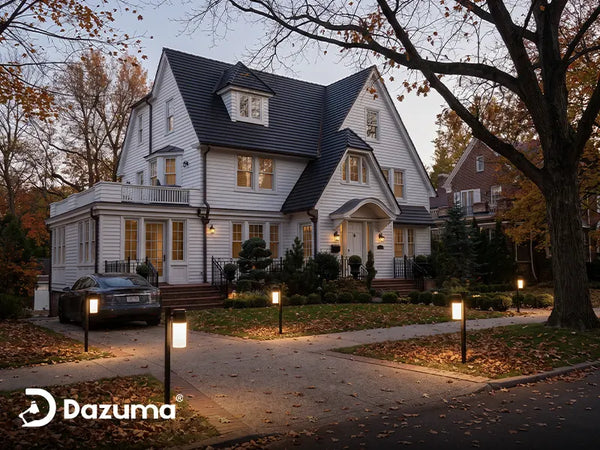
Use steady low-output light where people benefit from continuous orientation, such as a front door or main walkway. Use motion sensor wall lights at a driveway, side gate, or garage approach where full brightness is needed only during activity. This can reduce runtime without making the property feel dark.
Dusk-to-Dawn Photocell
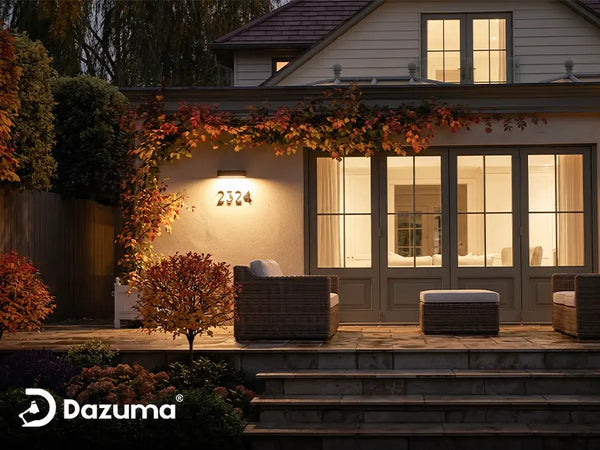
Best for: entrances, house numbers, steps, and locations that should remain visibly lit whenever it is dark. It is automatic and adapts to changing sunset times. The tradeoff is the longest nightly runtime.
Motion Sensor
Best for: low-traffic security zones and task lighting. Because the light operates for minutes instead of hours, it can use far less electricity. Poor positioning or excessive sensitivity may cause nuisance triggers. For a deeper control comparison, read Dusk-to-Dawn vs. Motion Sensor Outdoor Lights: Which Is Better?
Timer or Smart Schedule
Best for: decorative lighting that only needs to run from sunset until bedtime. A timer can cut several hours from daily use, but a basic fixed schedule needs seasonal adjustment. A sunset-based smart schedule is more adaptable, provided the device and outdoor installation are suitable for the location.
Solar Lighting
Best for: areas where running new wiring is inconvenient and where the panel receives adequate sun. Solar lights do not add to the home's utility consumption during normal operation, but brightness and runtime depend on panel exposure, weather, temperature, and battery condition. Compare outdoor solar lights with hardwired options based on site conditions rather than energy cost alone. The guide Solar vs. Hardwired Outdoor Lights: Which Is Better? explains the reliability and installation tradeoffs.
How to Lower the Cost Without Sacrificing Safety
Design for the Task, Not Maximum Brightness
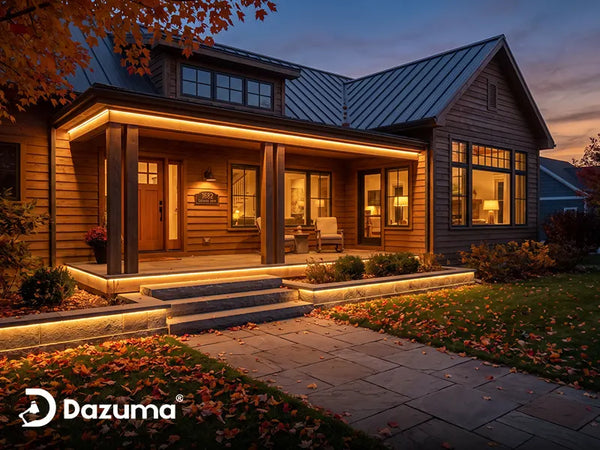
Layering a few carefully aimed lights is often more useful than flooding the entire yard. Keep light on doors, steps, paths, and vertical surfaces that help people understand the space. Shield the source from direct view where possible. The result feels calmer, improves visual comfort, and reduces wasted light beyond your property.

- Replace incandescent or halogen bulbs with outdoor-rated LEDs. Match the base, enclosed-fixture rating, dimming compatibility, and manufacturer limits.
- Use lower-output steady light. A soft porch light can remain on all night while a brighter motion-activated light handles the driveway or side yard.
- Clean the photocell and lens. Dirt can affect sensor response, while a dirty lens reduces useful light and may tempt you to install a brighter lamp.
- Check for daytime operation. Observe the fixture in the morning. If it stays on in full daylight, investigate sensor position or failure.
- Shorten runtime where all-night light is unnecessary. Use a timer for decorative facade or patio lighting that can turn off after household activity ends.
- Audit the whole exterior. Stand at the curb and walk the property at night. Remove redundant fixtures and correct glare before adding more output.
If you are planning several zones, start with a broad outdoor lighting layout, then decide which zones need constant light and which can use intermittent controls. This prevents the common mistake of giving every fixture the same brightness and schedule.
Buying Checklist for an Energy-Efficient Dusk-to-Dawn Light
- Actual wattage: Use this number in your cost calculation; ignore “equivalent wattage” for energy estimates.
- Lumen output: Compare useful brightness instead of assuming higher wattage is better.
- Photocell type and location: Make sure the sensor will receive open ambient light and will not see the fixture's own beam.
- Outdoor suitability: Confirm the fixture and installation method are rated for the exact exposure described by the manufacturer.
- Light distribution: Look for a beam that serves the door, path, or wall without shining into windows or neighboring property.
- Color temperature: Warm white light often feels more welcoming at residential entrances and can appear less harsh at night.
- Replaceable bulb or integrated LED: A replaceable bulb is easy to swap, while an integrated fixture may offer a slimmer design. Consider how you will service it later.
- Control flexibility: Decide whether you need photocell-only operation, motion plus photocell, or timer compatibility.
Final Advice
Dusk-to-dawn outdoor lights do not inherently use a lot of electricity. A small number of properly aimed LED fixtures can provide dependable nighttime visibility for only a few dollars per year. High wattage, outdated bulbs, excessive fixture counts, and lights that run during daylight are the real cost drivers.
Before replacing a useful all-night light, calculate its actual cost. Then look at the area after dark. If the light helps people find the entrance, see a step, or read the house number without causing glare, its modest energy use may be worthwhile. If it brightly illuminates an empty side yard for ten hours, a motion sensor or shorter schedule is likely the better tool.