
Who This Is For: Homeowners, remodelers, and apartment dwellers deciding between visible, aimable ceiling spotlights and flush recessed lights for a living room.
Ceiling spotlights and recessed lights can both make a living room feel polished, but they solve different problems. Recessed lights are usually the better foundation when you want the ceiling to look quiet and the room to receive broad, even ambient light. Ceiling spotlights are usually better when you want to direct attention toward art, bookshelves, a fireplace, or an architectural surface—and when you may want to change that aim later.
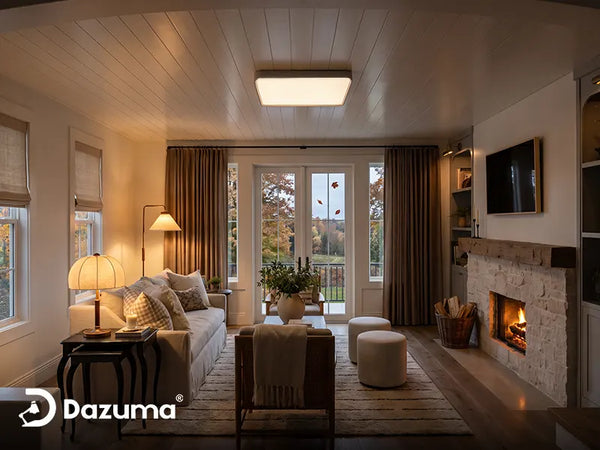
That does not mean every living room needs one type exclusively. In many successful rooms, a restrained number of ceiling fixtures supports table lamps, floor lamps, sconces, and decorative lighting. The goal is not to make every square foot equally bright. It is to create comfortable layers that support conversation, reading, entertaining, and TV viewing without putting glare in anyone’s eyes.

Quick Answer
Choose recessed lights if your top priorities are a clean ceiling, low visual clutter, and even general illumination. Choose ceiling spotlights if you need precise aiming, want to highlight vertical surfaces or objects, or expect the furniture and artwork to change. For most living rooms, the strongest plan is recessed lighting or another soft ambient source for the base layer, plus a few directional spotlights only where emphasis is useful.
If the ceiling cannot be cut open, compact surface-mounted spotlights may also be the more practical choice. If the ceiling is low, recessed fixtures often feel less intrusive. Those are useful rules of thumb, not automatic answers: joist locations, insulation, ceiling construction, wiring access, and the exact fixture design can change what is feasible.
What Each Type Actually Is
Ceiling Spotlights
In this comparison, ceiling spotlights are visible fixtures mounted at or near the ceiling surface, usually with one or more adjustable heads. Some are individual cylinders; others sit on a bar, canopy, or short track. Their main advantage is direction. You can rotate or tilt the beam toward a painting, the face of a bookcase, a textured wall, a reading chair, or the fireplace surround.
Because their housings remain visible, spotlights become part of the ceiling composition. A slim monochrome fixture can look crisp and architectural, while a bulky multi-head bar can dominate a small room. Browse ceiling spotlights with the room’s ceiling color, hardware finish, and sightlines in mind—not just the beam they produce.

Design distinction: A fixture can be visually quiet during the day yet uncomfortable at night, or visibly prominent during the day yet produce a well-shielded beam. Judge the hardware and the light effect separately.
Recessed Lights
Recessed lights sit inside an opening in the ceiling, leaving a trim or trimless aperture visible below. They are often called can lights, although modern versions may use shallow integrated housings rather than traditional cans. Fixed downlights send light straight down; adjustable or gimbal versions provide some directional control.
Their biggest visual advantage is restraint. They preserve long ceiling lines and do not compete with a pendant, chandelier, fan, or architectural feature. Their limitation is that placement becomes harder to change after installation. A grid that fits today’s sofa and coffee table may be awkward after the seating rotates. If this clean approach suits your room, compare modern can lights by beam, shielding, dimming, and housing requirements rather than by trim diameter alone.
Side-by-Side Comparison
| Decision Factor | Ceiling Spotlights | Recessed Lights |
|---|---|---|
| Ceiling appearance | Visible and architectural | Flush and visually quiet |
| Aiming | Usually easy to redirect | Fixed unless an adjustable trim is selected |
| Best role | Accent and task lighting | Quiet ambient foundation |
| Installation | Surface hardware remains visible | Requires suitable ceiling openings and cavity conditions |
| Later furniture changes | Beams can often be re-aimed | Fixed locations offer less flexibility |
| Glare risk | High if aimed toward faces or reflective surfaces | High if the source is shallow, bright, or directly overhead |
| Low ceilings | Compact models can work, but add visual depth | Usually the cleaner visual choice |
Neither column is inherently more comfortable. A deep, well-shielded recessed light can be gentle; a shallow high-output one can feel sharp. Likewise, a carefully aimed spotlight can brighten a wall without visible glare, while a poorly aimed one can shine directly into a seated person’s eyes. Fixture quality, position, output, and control matter as much as fixture category.
Which Is Better for Common Living Room Goals?
A Clean, Even Ambient Base
Recessed lighting normally wins when the brief is “make the whole room usable without calling attention to the ceiling.” A small number of wide or medium beams, placed around the occupied areas rather than in a rigid edge-to-edge grid, can support circulation and cleanup while leaving decorative fixtures to set the mood.
Evenness should not become flatness. Living rooms benefit from some contrast: brighter vertical surfaces, calmer seating areas, and localized pools of light near reading positions. Put recessed fixtures on a dimmer and pair them with table or floor lamps. The result will usually feel more residential than relying on downlights at full output. For a fuller system view, explore living room lighting rather than treating the ceiling as the entire plan.
Practical approach: Use overhead light for orientation and flexible everyday brightness, then let shaded lamps create the relaxed evening layer.

Art, Shelves, and Textured Walls
Ceiling spotlights are the stronger choice when the room’s character lives on vertical surfaces. A beam aimed at a bookcase, stone fireplace, wood paneling, curtains, or artwork reveals color and texture. It also makes the room feel brighter at eye level without forcing more light onto the floor.
Do not aim every head at a different decorative object simply because it can move. Choose one or two visual priorities and keep the pattern calm. The beam should land where the eye naturally rests, with enough spread to avoid a tiny bright dot surrounded by darkness. If the art or furniture changes, re-aiming is much easier than relocating a recessed opening.

Best aiming rule: Light the surfaces people look at, not the tops of their heads. Wall brightness often creates more perceived spaciousness than extra floor brightness.
TV Viewing and Glare Control
For a TV-centered living room, fixture type matters less than beam direction and source shielding. Keep strong beams off the screen, glossy cabinetry, glass tables, and the direct sightline of reclined viewers. Fixed recessed lights placed directly over a sofa can become uncomfortable because people naturally look upward when leaning back. Surface spotlights create the same problem if a head points toward the seating area.
Use dimmable circuits and preserve soft light behind or beside the viewing area so the room does not become a black box around a bright screen. Wall-washing or shaded lamps can maintain gentle context without reflecting in the display. The guide How to Layer Living Room Lighting Without Glare explains how ambient, task, and accent layers work together.
TV-room test: Sit in every normal viewing position with the lights on and dimmed. If you can see a bright source or its reflection on the screen, adjust the aim, output, or placement.

Ceiling Height and Architecture
Low, flat ceilings often favor recessed lights because surface fixtures can make the overhead plane feel busier and lower. If recessed installation is not possible, look for compact spotlights that sit close to the ceiling and match its color. A black cylinder against a white ceiling creates deliberate contrast; a white fixture tends to recede.
Higher ceilings can support more visible hardware, but they also require enough output and an appropriate beam angle for light to reach its target. A very narrow beam mounted high may make isolated pools; a very wide beam may lose emphasis before it reaches the wall. Sloped ceilings usually benefit from directional spotlights or adjustable recessed trims that can be aimed independently of the ceiling angle.
Ceiling features should guide the layout. Beams, coffers, vents, fans, speakers, and curtain pockets all compete for space. Start with the room’s focal surfaces and furniture plan, then coordinate fixtures with those fixed elements. Shopping a broader ceiling lights collection can also reveal alternatives when neither a spotlight bar nor a recessed grid suits the architecture.
Installation and Future Flexibility
Recessed lighting generally asks more of the ceiling. The installer must confirm cavity depth, framing positions, insulation conditions, air sealing, wiring access, and any applicable fire or acoustic requirements. A shallow LED unit may solve a depth problem, but it does not make every location workable. Patching or moving an opening later also affects the finished ceiling.
Surface-mounted spotlights may reduce the number or size of ceiling penetrations, especially when several heads share one canopy or track. They still require appropriate wiring and secure mounting, and the visible base must align cleanly with the room. In a finished space where cutting multiple openings is undesirable, that can be a meaningful advantage.
Think beyond day one. If the room is frequently rearranged, aimable heads give you more control. If the furniture, fireplace, and built-ins are permanent, carefully placed recessed lights can look more integrated. Before purchasing either type, ask a qualified electrician to verify the site conditions and the fixture’s installation requirements.
Beam Angle, Brightness, and Color
Compare lumens, beam angle, color temperature, color rendering, dimming range, and glare control—not wattage alone. A narrow beam concentrates light and works for accents; a wider beam spreads light more gently for general illumination. The exact choice depends on mounting height and the size of the surface being lit, so sample or mock up the effect when possible.
Warm white light around 2700K creates a relaxed residential mood. Around 3000K can feel a little crisper while remaining comfortable with many neutral interiors. Consistency matters: mixing noticeably different whites in the same view can make finishes look unsettled. A good color rendering specification helps wood, textiles, art, and skin tones appear natural.
Dimming is essential in a multifunctional living room. Confirm that the fixture, driver, dimmer, and control method are compatible; “dimmable” on two separate boxes does not guarantee smooth performance together. Separate ambient and accent circuits when practical. That lets you lower general light for conversation while keeping a wall, bookcase, or reading area gently illuminated.
Best Layouts by Living Room Type
Small living room: Keep the ceiling quiet. A few well-spaced recessed lights or a compact two- or three-head spotlight can work, but avoid filling the ceiling with apertures. Add a floor lamp near the sofa and a table lamp or sconce across the room to create depth.
Large or open-concept room: Use zones rather than one uninterrupted grid. Recessed lights can define circulation and provide a baseline; spotlights can pick up art, shelving, or the fireplace. Put major zones on separate controls so the seating area does not need to match the kitchen or dining area at all times.
Minimal modern room: Recessed lights usually preserve the architecture, especially when trim color matches the ceiling. Use fewer, better-shielded fixtures and let one decorative light or a linear lamp provide identity. If you choose surface spotlights, repeat a clean finish already present in the room.
Eclectic or gallery-like room: Adjustable ceiling spotlights offer the flexibility to rotate art and objects. Keep the fixture family consistent and avoid crossing too many beams. For more help balancing the entire scheme, read How to Light a Living Room the Right Way.
Common Mistakes
- Defaulting to a perfect grid: The ceiling plan should respond to furniture, walls, and activities, not only room dimensions.
- Using downlights as the only source: Light from one direction flattens the room and can create harsh facial shadows.
- Aiming spotlights at people: Check seated and reclined sightlines, not just the view while standing.
- Ignoring the nighttime ceiling: A flush fixture can still expose a bright LED. Look for deeper shielding and comfortable cutoff.
- Overlighting the floor: Bright walls and selected objects often make a living room feel more inviting and spacious.
- Choosing fixtures before controls: Plan circuits, switches, and dimming along with the fixture layout.
- Mixing color temperatures accidentally: Coordinate the ceiling layer with lamps and adjacent open-plan areas.
Buying Checklist
- Decide whether each fixture provides ambient, task, or accent light.
- Mark the sofa, chairs, TV, artwork, shelving, and circulation paths on the plan.
- Check ceiling height, slope, framing, cavity depth, insulation, and installation access.
- Compare delivered lumens, beam angle, shielding, color temperature, and color rendering.
- Confirm the heads or trims provide the adjustment range your targets require.
- Verify dimmer and driver compatibility before installation.
- Group ambient and accent lighting separately where practical.
- Mock up critical beams or review a photometric diagram before cutting the ceiling.
- Have a qualified electrician confirm electrical and local installation requirements.
Final Advice
For a typical living room, recessed lights are the better choice when you need an unobtrusive ambient foundation, especially under a low, flat ceiling. Ceiling spotlights are better when the room depends on art, shelving, textured walls, or a layout that may evolve. If you must choose only one, choose according to the harder problem: general visibility favors recessed lighting; precise emphasis and adaptability favor spotlights.
The most comfortable answer is often a restrained combination rather than a ceiling full of either type. Keep overhead output dimmable, protect seated sightlines, light vertical surfaces, and add lamps at human height. When those pieces work together, the living room feels calm in the evening and practical when more light is needed.