
Who This Is For: This guide is for homeowners who like the clean, architectural look of long wall sconces but are not sure how large they should be, where they should sit, or whether they will feel too bold in a hallway, bedroom, or entryway.
The Quick Answer
A long wall sconce works best when its length relates to the wall section, furniture, doorway, or architectural feature around it—not simply to the overall size of the room. In a narrow hallway, a slim vertical fixture can add rhythm without taking up floor space. Beside a bed, a long sconce can replace a table lamp and leave the nightstand clear. In an entryway, it can visually stretch a short wall or frame a console, mirror, or piece of art.
The mistake I see most often is choosing by product photo alone. A 40-inch fixture can look beautifully restrained on a tall showroom wall and unexpectedly dominant on an eight-foot residential wall. Before you fall in love with a shape, compare the fixture’s height and projection with the exact wall area where it will be installed.

What Counts as a Long Wall Sconce?
There is no official cutoff, but in residential interiors, I generally think of a sconce as “long” when its visible body is roughly 20 inches or taller, or when it reads as a continuous vertical or horizontal line rather than a compact decorative fixture. Many modern linear sconces range from about 24 inches to 60 inches.
That length does not always mean more brightness. Some long sconces use a narrow LED strip to create soft ambient light, while others use two lamps at opposite ends to send light upward and downward. A long silhouette is mostly a design and distribution choice. You still need to check wattage, lumen output, shade material, and whether the fixture is meant for ambient, accent, or task lighting.

Long Does Not Automatically Mean Brighter
A narrow 48-inch LED line may produce gentler light than a compact two-bulb sconce. Think of fixture length, brightness, and beam direction as three separate decisions.
For broad browsing, start with the wall sconces category, then filter by actual dimensions rather than relying on the word “linear” in the product name. Product photos are rarely shown at the same scale.
A Practical Size Guide for Early Planning
The following ranges are useful starting points, not rigid rules. Ceiling height, trim, furniture, and sightlines can all justify going smaller or larger. The easiest way to avoid regret is to tape the fixture outline on the wall with painter’s tape and view it from the doorway, the center of the room, and the nearest seating position.
| Location | Useful Starting Length | What to Check | Common Risk |
|---|---|---|---|
| Narrow hallway | 20–32 in. | Projection and eye-level glare | Fixture feels too bulky in circulation space |
| Wide hallway or gallery wall | 30–48 in. | Spacing between repeated fixtures | Uneven bright and dark patches |
| Beside a bed | 22–36 in. | Mattress height and seated reach | Light source visible while lying down |
| Above a headboard | About 50–70% of headboard width | Centering and clearance above pillows | Fixture looks undersized or visually floats |
| Entry console or mirror | 22–40 in. | Relationship to console and mirror | Too many competing vertical lines |
A useful designer habit is to size the sconce to the “visual zone,” not the whole wall. If an entry wall is 10 feet wide but a console only occupies 48 inches, the console and mirror form the zone that matters. If a long hallway has three door openings, each uninterrupted wall segment becomes its own zone.
How to Choose Long Wall Sconces for Hallways
Hallways are where long sconces can be most useful—and most uncomfortable. The attraction is obvious: they add character without using floor space. The problem is that people pass close to them, often at eye level. Projection, glare, and spacing matter more here than dramatic styling.
Prioritize a Shallow Profile
In a tight corridor, check how far the fixture extends from the wall. A broad decorative arm may technically fit but still feel like an obstacle. Slim linear sconces that sit close to the wall are usually easier to live with, especially near door swings, closets, or corners where people turn.
Use Light to Create Rhythm, Not a Runway
Repeated long sconces can make a hallway feel intentional, but too many create a commercial “runway” effect. Start by placing fixtures at important moments: near the entrance to the hall, beside artwork, at a turn, or at the far end. Add more only if the dark zones between them are uncomfortable.
Look Down the Hall Before Finalizing Height
A fixture that looks balanced when you stand directly in front of it may produce visible glare when viewed from 20 feet away. Check the longest sightline in the hall before the electrician closes the wall.

If your goal is a continuous architectural line rather than a decorative shade, this long-format fixture is a practical example of how multiple lengths can help the sconce fit the wall instead of forcing the wall to fit the fixture.
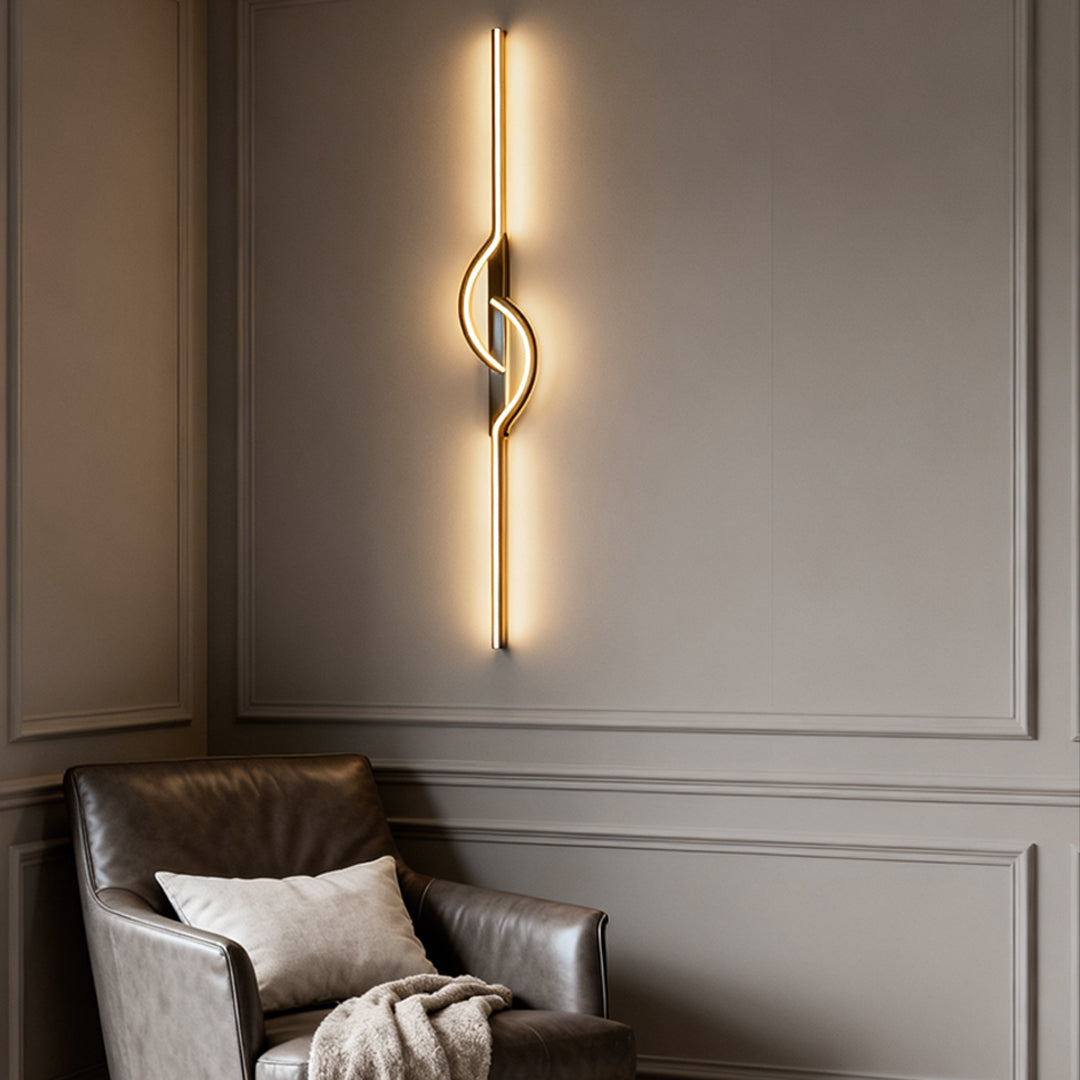
Modern Linear Wall Sconce Creative Black Aluminum Lamp
Price: $100.99
Its slim silhouette and multiple lengths make it easier to match narrow corridor sections, bedside walls, or larger architectural features without relying on one oversized standard dimension.
- Five length options help match different wall widths and ceiling heights.
- Aluminum body with a silicone diffuser creates a softer continuous line of light.
- Available in fixed warm white, three-step color temperature, or dimmable versions.
How to Choose Long Wall Sconces for Bedrooms
In bedrooms, long sconces usually serve one of two jobs: freeing up nightstand space or creating a calm decorative layer around the bed. Decide which job matters more before choosing the design. A beautiful ambient sconce may not provide focused reading light, while a brighter fixture may be uncomfortable if the light source is visible from the pillow.
For Bedside Use, Start With Your Body Position
Sit against the headboard as you normally would. Note where your shoulder, eye level, and hand naturally fall. The fixture should be high enough that you do not bump it, low enough that the switch is convenient, and positioned so the brightest part is not directly in your line of sight. The exact height depends more on your bed and mattress than on a generic floor measurement.
For a deeper look at bedside placement, see How High to Hang Wall Sconces Next to Bed?. Use the suggested ranges as a starting point, then adjust for your mattress, headboard, and whether you read upright or reclined.
One Long Horizontal Sconce or Two Vertical Sconces?
A horizontal fixture above the headboard creates one broad visual line and works well when nightstands are different sizes or there is no room for symmetrical bedside fixtures. Two vertical sconces feel more traditional and give each sleeper a defined pool of light. If the room already has a strong horizontal headboard, vertical sconces can add helpful contrast.

Choose the Layout Before the Finish
Homeowners often begin with black versus gold. The bigger decision is whether the fixture should frame the bed, stretch across it, or provide individual task light on each side.
This two-light option is better suited to homeowners who want a decorative vertical shape with softer diffused light rather than a continuous LED line. The left- and right-facing versions also make it possible to create a mirrored pair.
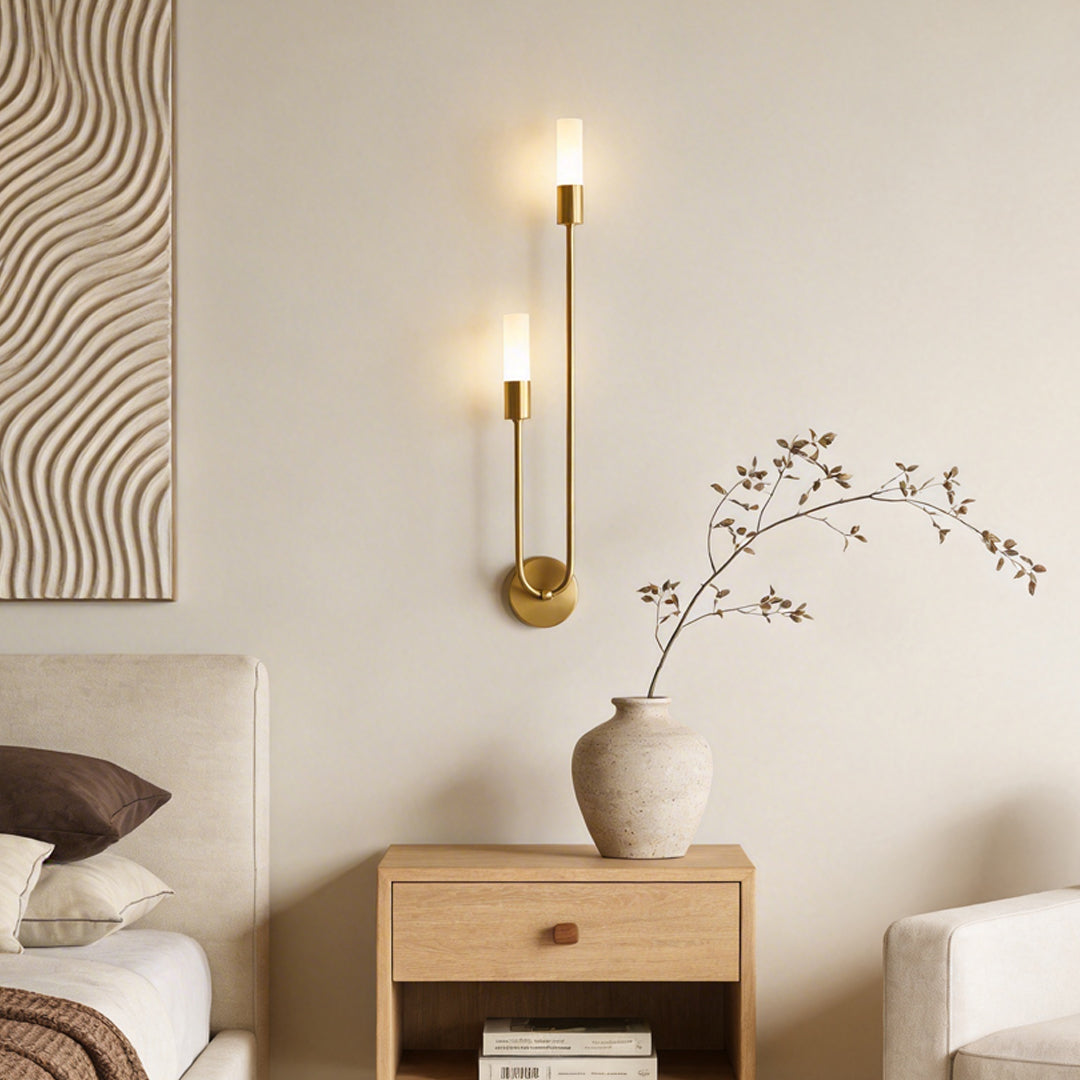
Modern Double Heads Wall Sconce Creative Luxury Metal Light
Price: $108.99
The slim double-ended form gives bedrooms and compact entry walls a decorative vertical accent, while the frosted acrylic diffuses the warm light more gently than an exposed bulb.
- Left- and right-facing versions support mirrored bedside installations.
- Frosted acrylic shades soften the two points of light and reduce direct glare.
- Replaceable G9 bulbs make future maintenance more flexible than sealed integrated LEDs.
How to Choose Long Wall Sconces for Entryways
An entryway is usually viewed from several angles: from the front door, the adjacent living area, and often a staircase or hallway. Long sconces work well because they can give a small transition zone architectural presence without adding another piece of furniture.
Build Around the Main Focal Point
If the entry has a mirror, decide whether the sconce is framing it, replacing an overhead picture light, or standing alone beside it. A pair of vertical sconces should leave enough breathing room that the mirror still reads as the focal point. A single long sconce can work beside an off-center console when perfect symmetry would feel forced.
Watch Door and Coat Clearance
Before placing electrical boxes, open the front door fully, swing nearby closet doors, and imagine a person wearing a winter coat moving through the space. Fixtures close to a door casing need a shallow projection and enough side clearance that they do not feel squeezed.
A Small Entry Can Handle a Long Fixture
Length is not the same as visual heaviness. A thin 30-inch line can feel lighter than a bulky 14-inch lantern-style sconce. In compact entries, profile and contrast often matter more than height alone.

Choose the Light Effect Before the Finish
Black, brass, and gold are easy to compare in a shopping tab. Light distribution is harder to see online, but it has a bigger effect on daily comfort. Before choosing the finish, identify which of these effects you actually want:
- Diffused front light: Softens faces and walls, making it useful in bedrooms and entries.
- Up-and-down light: Adds vertical drama and makes walls feel taller, but can emphasize uneven drywall or texture.
- Continuous linear glow: Reads as architectural and calm, especially in modern hallways.
- Directional task light: Better for reading or artwork, but requires careful aiming.
If the sconce will be one layer in a larger plan, coordinate it with your ceiling lights instead of expecting the wall fixture to illuminate the whole room. Bedrooms may also need table lamps or a floor lamp for flexible task lighting, even when the sconces create a beautiful background glow.
A good long sconce should look intentional when it is off. During the day, the fixture becomes part of the wall composition. That is why proportion, finish, and alignment matter even more with an elongated design than with a small compact sconce.
Plan the Wiring Before You Order
Long hardwired sconces can be less forgiving than compact fixtures because the electrical box, mounting bracket, and fixture centerline may not align the way you expect. Always review the installation diagram before the electrician places the box.
Ask These Questions Early
- Does the fixture mount from the center, top, or another point?
- Can it be installed vertically and horizontally, or only one way?
- Does a dimmable version require a compatible wall dimmer?
- Is the LED integrated, or can the bulb be replaced?
- Will the fixture cover the existing electrical box and wall opening?
- Is the wall blocking or junction box strong enough for the fixture?

Painter's Tape Is Cheaper Than Moving a Junction Box
Mark the full fixture outline, not just the center point. Live with the taped shape for a day and check it in daylight, at night, and from the doorway.
For additional background on selecting fixture styles and light effects, the existing guide Long Wall Light Ideas, Types and Inspirations provides useful visual categories. Use that inspiration only after confirming your wall dimensions and wiring conditions.
Common Mistakes to Avoid
Choosing the Longest Option Because the Wall Is Large
A large wall does not always need the longest sconce. Furniture, doors, artwork, and trim divide the wall into smaller visual areas. Choose for the relevant area, not the total drywall width.
Ignoring Fixture Projection
This is especially uncomfortable in hallways. A fixture that extends four or five inches may be perfectly acceptable in a wide entry and intrusive in a narrow corridor.
Mounting Two Bedside Fixtures Without Checking the Mattress
Mattress thickness, adjustable bed frames, and tall upholstered headboards can move your seated position several inches. Generic mounting heights are not a substitute for sitting on the actual bed.
Using a Decorative Sconce as the Only Light Source
Many long sconces are ambient or accent fixtures. If you need to find keys, read in bed, or safely navigate a hallway, verify that the overall lighting plan provides enough usable illumination.
Matching Every Metal Finish Exactly
A black sconce does not require every handle, frame, and faucet to be black. Repeating the finish two or three times in the room is usually enough. What matters more is that the finishes share a similar visual weight and undertone.
Final Buying Checklist
- Measure the uninterrupted wall section, not only the room.
- Check fixture height, width, depth, and mounting-point location.
- Use painter’s tape to test the silhouette at full scale.
- View the taped outline from the doorway and the longest sightline.
- Confirm whether the light is ambient, decorative, or suitable for tasks.
- Check color temperature and dimming compatibility.
- Decide whether you prefer integrated LED or a replaceable bulb.
- Confirm door swings, headboard clearance, and walking clearance.
- Have the electrician review the product diagram before rough-in.
Summary: Choose the Wall Relationship, Not Just the Fixture
The right long wall sconce should make the wall feel more balanced, not simply more decorated. In hallways, prioritize a shallow profile and comfortable sightlines. In bedrooms, design around the mattress, headboard, and how you actually sit in bed. In entryways, relate the fixture to the mirror, console, doorway, and viewing angles.
Start with function and proportion, then choose the finish. That order may feel less exciting than shopping by color, but it is what prevents a beautiful fixture from becoming an expensive placement problem. Once the length, projection, light direction, and wiring make sense, the style decision becomes much easier.