
Who This Is For: This guide is for homeowners choosing entrance lighting who like the character of outdoor lanterns but also appreciate the cleaner look of modern wall sconces—and want to know which option will fit the door, architecture, wiring, and everyday arrival experience.
Your Entrance Light Is Seen Before Almost Anything Else
An entrance light must help with the lock, visitors, packages, and steps while surviving outdoor exposure and looking correctly scaled during the day.
A lantern adds familiarity, depth, and decoration. A streamlined wall sconce feels quieter and more architectural. The better choice depends on what the entrance lacks: visual presence, shallow projection, dependable hardwired light, or a solar solution for a sunny secondary location.

Quick Answer: Which One Suits Your Entrance?
Choose a lantern-style outdoor light when the entrance needs a visible decorative statement, the facade has traditional or transitional details, and there is enough wall width and clearance for a projecting framed fixture.
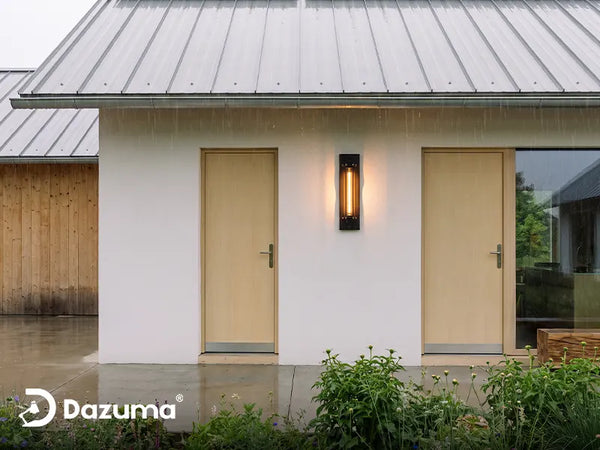
Choose a streamlined outdoor wall sconce when the entrance is modern, the wall is narrow, the walking path passes close to the fixture, or you prefer directional or softly diffused light without a prominent lantern silhouette.
A useful rule is to let the architecture lead:
- Traditional, European, colonial, craftsman, or farmhouse entrance: a lantern usually feels natural.
- Modern, minimalist, mid-century, or highly geometric entrance: a simple vertical, horizontal, or up-and-down sconce often fits better.
- Transitional entrance: choose a simplified lantern or a sconce with warmer materials and softened geometry.
- Secondary door without wiring: consider solar only when the panel receives reliable sun.
- Main front door used every night: prioritize predictable illumination and controls before decorative style.
First, Lantern and Sconce Are Not Exact Opposites
“Wall Sconce” Describes How the Light Is Mounted
A wall sconce is attached to a wall rather than suspended or post-mounted. It can be a cylinder, rectangle, globe, LED form, or lantern.
“Lantern” Usually Describes the Silhouette
A lantern usually has a visible frame and enclosed or partly enclosed glass panels. Many outdoor lanterns are therefore also wall sconces.
The Practical Comparison Is Lantern-Forward vs. Sconce-Forward
In practice, homeowners are usually comparing a dimensional framed lantern with a flatter architectural wall light. That distinction is more useful than the category names.
Browse Outdoor Wall Lanterns for frame-and-glass silhouettes, and compare them with the broader Outdoor Wall Lighting category to see how cylinders, linear forms, and integrated LED sconces change the entrance.

Compare Shape and Light Behavior
Do not reject a fixture because of the category name. Look at its depth, glass, visible light source, beam direction, and relationship to the door.
Outdoor Lantern vs. Streamlined Wall Sconce
| Entrance Factor | Lantern-Style Light | Streamlined Wall Sconce | What to Check |
|---|---|---|---|
| Visual Presence | Decorative and dimensional | Quiet and architectural | Does the wall need a focal point or visual calm? |
| Projection | Often extends farther from the wall | Often shallower | Door swing, shutters, shoulders, and narrow walkways |
| Light Spread | Broad through clear or frosted panels | Directional, diffused, or up-and-down | Face, lock, steps, and wall effect |
| Glare Risk | Higher with clear glass and visible bulbs | Depends on shielding and LED position | Standing and approach sightlines |
| Maintenance | More frame corners and glass panels | Often simpler exterior surfaces | Bugs, pollen, salt air, and access |
| Best Style Fit | Traditional through transitional | Modern through transitional | Door, windows, roof, and hardware lines |
Match the Fixture to the Entrance Architecture
Traditional and European Entrances
Arched doors, divided-light windows, stone trim, shutters, and decorative ironwork can support crowns, scrolls, tapered frames, and antique finishes.
Craftsman and Mission Entrances
Strong rectangular framing, restrained ornament, and frosted glass can repeat porch posts and window grids without competing with wood, brick, or stone.
Modern and Minimal Entrances
Clean sconces suit flush doors, narrow sidelights, flat roofs, stucco, concrete, and vertical siding. A simplified geometric lantern can still fit.
Transitional Entrances
Transitional entries offer the most flexibility. Match one or two cues—finish, geometry, or glass—rather than every detail.
The guide How to Choose Outdoor Lanterns for Every Space offers additional style and location examples.
A Simplified Lantern That Bridges Traditional and Modern
Frosted glass, restrained grid lines, and a compact body can provide lantern character with softer, glare-controlled light.

Soft Lantern Character With Flexible Power
Lantern Wall Sconce Retro LED Die-Cast Aluminum Glass Lamp
Current Selected Price: $188.99 for one solar fixture
Best for a porch, courtyard wall, secondary entrance, or transitional facade that needs a compact lantern silhouette, softened glass, and a choice between solar and hardwired configurations.
- Frosted glass reduces the visual intensity of the light source.
- Black and bronze options support modern or traditional exteriors.
- Multiple pack sizes can serve paired doors or repeated courtyard walls.
Let the Door and Wall Share the Visual Weight
A detailed door usually needs a quieter fixture. A plain door on a broad wall can support a more sculptural lantern without making the entrance feel busy.

Compare Light Spread, Glare, and Door Tasks
Clear Glass Creates Sparkle but Exposes the Bulb
Clear panels preserve bulb sparkle and frame detail, but visitors may see the source directly. A frosted bulb, lower output, or warmer color can reduce discomfort.
Frosted Glass Produces a Softer Luminous Object
Frosted panels hide the bulb and spread light across the shade, which is useful where people stand close. The tradeoff is less sparkle.
Directional Sconces Can Protect the Eyes
Up-and-down or shielded sconces hide the source and use the wall as a reflector. They create atmosphere, but may not light a lock or visitor’s face as broadly as a lantern.
The Main Entrance Needs Face and Lock Light
Test where a guest waits and where you use the lock. A beautiful wall pattern may still need help from a porch ceiling light.
Scale, Projection, and Available Wall Space
Use Door Height as a Scale Reference
A common visual starting point is one lantern at roughly one-third of the door height or paired lanterns at about one-quarter. Transoms and two-story porches may support larger sizes.
Projection Can Matter More Than Width
Check projection against shoulders, door swing, shutters, railings, downspouts, and packages carried through the entrance.
Shallow Sconces Help Narrow Entrances
On a tight wall or close walkway, a flatter fixture is easier to live with and can still be decorative through material or light pattern.
Make a Full-Size Mock-Up
Tape the width, height, and projection on the wall, then view it from the street, steps, and foyer. Large lanterns often feel much bigger beside a real person.
Decide Between One Fixture and a Pair
A single light on the lock side works well when the door is narrow, the opposite wall is interrupted, or the entrance is intentionally simple. A pair creates stronger symmetry and more even face lighting, but it also doubles the visual weight. Two ornate lanterns may overwhelm a modest porch, while two slim sconces can make a wide contemporary entry feel complete.
Keep the Mounting Height Human
As a starting point, many entrance lights are centered roughly 5.5 to 6 feet above the landing. Adjust for the body and light source rather than raising a large lantern toward the roofline. The fixture should still serve the visitor, lock, and steps at ground level.
A Full Lantern Statement for a Large Traditional Entrance
Antique copper, clear glass, a tall crown, and a curved arm create a strong daytime object when the entrance has enough scale.

Decorative Scale for Estate-Style Entries
Outdoor Lantern Wall European-Style Sconce Garden Light
Current Selected Price: $1,315.99 for one small fixture
Best for a tall front door, gated courtyard, stone villa entrance, or substantial traditional facade where the wall can support a large projecting copper-and-glass lantern.
- Three sizes support single or paired large-scale entrances.
- Replaceable bulbs allow output and color temperature selection.
- Clear glass preserves the ornamental frame and bulb appearance.
Solar vs. Hardwired Entrance Lighting
Hardwired Light Is the Safer Default for the Main Door
Hardwired fixtures provide consistent output and can connect to switches, timers, smart controls, or dusk-to-dawn sensors.
Solar Can Solve a Real Wiring Problem
Solar can suit a secondary gate, detached structure, courtyard wall, or rental where wiring is difficult. A deep covered porch is often a poor charging location.
Check the Exact Configuration Before Ordering
Solar and hardwired variants may use different light sources and controls. Confirm the selected power, bulb, switch behavior, and installation method.
Plan for Winter and Shade
Trees, eaves, buildings, winter days, and clouds reduce solar performance. Do not depend on it alone for critical steps, locks, or accessibility.
Compare wire-free choices in Solar Outdoor Wall Light, but evaluate the actual sun path before choosing the fixture location.

Weather Exposure and Maintenance
Lantern Frames Collect More Debris
Roofs, scrolls, ledges, and glass panels collect pollen, insects, and webs. Clear glass shows residue quickly, so confirm cleaning access.
Simple Sconces Are Often Faster to Wipe Down
Smooth cylinders and flat LED bodies have fewer corners, though openings still collect debris. Integrated LED models also need a service plan.
Match the Rating to Exposure
A deep porch and uncovered gatepost have different exposure. Review the stated outdoor rating and installation instructions.
Expect Natural Metal to Change
Copper and brass can develop patina. Decide whether that natural change supports the architecture before choosing a large metal lantern.
Maintenance Is Part of the Style Decision
A complex lantern can be worth the care at the front door, while a hard-to-reach side wall may be better served by a simpler fixture.
Three Realistic Entrance Examples
Small Covered Bungalow Porch
With an 8-foot ceiling, 36-inch door, and narrow wall strip, a large lantern crowds the trim. A compact frosted lantern or shallow sconce fits better, and deep shade favors hardwired power.
Modern Stucco Entry With a Plain Door
On a broad stucco wall with a flush door, either a clean vertical sconce or simplified black grid lantern can work. Frosted glass adds warmth without a visible bare bulb.
Two-Story Traditional Entry With an Arched Transom
At a tall brick or stone entry, small flat sconces disappear. Large copper-and-glass lanterns create a proportional daytime frame, but clear glass requires careful bulb selection.
In each case, wall width, projection, power, architecture, and comfort matter more than labels.
Common Entrance Lighting Mistakes
Treating Lantern and Sconce as Mutually Exclusive Categories
Many lanterns are wall sconces. Compare silhouette, projection, glass, and beam behavior instead of relying on naming alone.
Choosing a Fixture That Is Too Small
Entrance lights often look larger online than they do on a facade. Use the door and full entry composition as the scale reference.
Ignoring Projection
A fixture can fit the wall on paper and still interfere with shoulders, shutters, door swing, or a narrow approach.
Using Clear Glass With an Overly Bright Bulb
The light source becomes the first thing visitors see. Select bulb output, shape, and color temperature as part of the fixture design.
Putting Solar Under a Covered Porch
A convenient no-wire fixture cannot charge effectively without adequate direct sunlight.
Choosing Style Before Confirming the Lighting Job
A decorative wall pattern does not automatically provide useful illumination for faces, locks, packages, and steps.
Matching Every Exterior Light Exactly
The front door can use a statement lantern while a side entrance uses a simpler related sconce. Coordinate finish, proportion, or geometry without forcing identical fixtures everywhere.
Forgetting Daytime Maintenance
Clear glass, ornate metal, and large crowns require more cleaning and become very visible when neglected.
Entrance Lighting Checklist
- Decide whether the wall needs decorative presence or visual calm.
- Measure the door, sidelights, transom, and available wall width.
- Check fixture width, height, projection, backplate, and mounting point.
- Stand at the lock and confirm the light supports faces and door tasks.
- Review clear, frosted, seeded, or shielded light-source visibility.
- Choose solar only where the panel receives reliable direct sun.
- Confirm the exact selected variant’s power, bulb, and control details.
- Match the outdoor rating to covered or exposed placement.
- Plan access for glass cleaning, bulb replacement, or LED service.
- Tape the full fixture silhouette and projection on the wall.
- View paired lights from the street before installation.
- Use a qualified electrician for new exterior wiring or box relocation.
Final Advice: Choose the Entrance Experience, Not the Label
A lantern can be a wall sconce, and either can carry traditional or modern character. The meaningful differences are visual weight, projection, glass, beam direction, power, and maintenance.
Choose a lantern-forward fixture for visible framing and daytime decoration. Choose a sconce-forward fixture for narrow walls, clean architecture, and controlled light. Above all, make sure the address, lock, visitor, and steps are easy to see.
For a wider comparison of placement, size, materials, and controls, see How to Choose Outdoor Wall Lighting: A Complete Buyer’s Guide.