
Who This Is For: This guide is for homeowners, remodelers, and designers choosing a bubble chandelier for a room with a 10-foot ceiling, vaulted ceiling, two-story foyer, open staircase, or another space where a small fixture could disappear overhead.
Introduction
A high ceiling gives a bubble chandelier room to breathe, but it also makes scale harder to judge. A cluster that looks generous in a product photo can appear surprisingly small when viewed from the floor of a 14-foot living room. The opposite problem happens too: adding more globes without checking the fixture’s total diameter can create a dense visual ball that crowds an open sightline.
The useful question is not simply, “How many globes should I buy?” It is, “How much visual volume does this ceiling need, and how should that volume be distributed?” Globe count affects rhythm, sparkle, and light distribution. Overall width, fixture height, drop length, and globe size determine whether the chandelier feels properly scaled. Treat those measurements as a group, and the number of globes becomes much easier to choose.

Quick Answer: How Many Globes Do You Need?
For many homes, 7 globes are a practical starting point for a 10- to 12-foot ceiling, while 10 to 13 globes usually create better presence in a 12- to 16-foot room or a modest two-story void. A compact 3- to 5-globe fixture can work in a narrow landing, beside a stair, or over a small table, but it often looks undersized in the center of a large high-ceiling room.
That is a starting framework, not a fixed code. Three large globes may have more visual weight than thirteen small ones. A wide, asymmetrical arrangement can fill a room better than a tight spherical cluster with the same number of lights. Before ordering, compare the fixture’s listed width and height with the room’s floor dimensions and the distance from which people will usually see it.
If you are still exploring silhouettes, the Bubble Chandelier collection makes it easier to compare compact clusters, branching designs, and fuller arrangements before focusing on globe count alone.

Judge the Empty Space, Not Just the Ceiling Number
A 12-foot ceiling over a small dining nook does not need the same chandelier as a 12-foot ceiling over a 20-foot-wide great room. Furniture grouping, room width, balcony openings, and the amount of blank wall all influence how many globes the eye expects to see.
What Globe Count Actually Changes
Visual Mass
Every additional globe adds another highlight, reflection, and edge. From the floor, those repeated circles read as a single visual mass. More globes help a fixture remain noticeable at a greater viewing distance, which is why fuller clusters often suit vaulted living rooms and double-height entries. However, crowding many globes into a small diameter makes the fixture feel heavier rather than larger.
Light Distribution
More globes can spread light across a broader area when each globe contains its own light source. They do not automatically guarantee more usable brightness. Bulb wattage, LED lumen output, shade texture, glass color, and whether the globe is open or enclosed all matter. Count bulbs and confirm allowable lamp specifications when comparing fixtures. For integrated LED models, use the listed illumination area or lumen information instead of guessing from the number of visible glass balls.
Maintenance and Long-Term Use
More glass also means more surfaces to dust. In a two-story space, that practical issue matters. A 13-globe chandelier may create the right architectural impact, but it should be paired with a realistic cleaning plan, safe access, and replaceable lamps or serviceable components. If you prefer a clean contemporary look, compare the construction of different Modern Chandeliers as well as their appearance.
Large Globes Can Do More With Fewer Pieces
Globe diameter changes the equation. Five substantial glass shades may feel more appropriate than nine tiny spheres in a restrained modern room. Ask for the dimensions of individual globes when the overall product photo does not reveal their true scale.

Globe Count by Ceiling Height and Room Scale
Use the table below as a visual-planning guide. It assumes standard residential proportions and a fixture placed where people can walk beneath it. Always confirm actual product dimensions, hanging hardware, and clearance before installation.
| Ceiling and Space | Starting Globe Count | What Usually Works |
|---|---|---|
| 10 ft, compact room or landing | 3–7 globes | A narrow or medium cluster that leaves comfortable clearance |
| 10–12 ft, average dining or living room | 7–9 globes | A balanced cluster with enough width to relate to the furniture group |
| 12–16 ft, large room or vaulted ceiling | 10–13 globes | A fuller fixture or a wider branching arrangement with adjustable drop |
| Two-story foyer or open stair void | 13+ globes or a long cascade | Vertical distribution that can be seen from both levels |
For a stairwell, vertical length may be more valuable than adding globes to a wide cluster. A long composition follows the direction of travel and gives both floors something to see. That is why browsing purpose-built Staircase Chandeliers can be more useful than simply choosing the highest globe count available.
Adjust the Count for the Shape of the Room
Room shape can move you up or down one size. In a long rectangular living room, a seven-globe ball may look isolated even when its diameter seems acceptable on paper. A branching 10- or 13-globe composition spreads repeated highlights across more of the ceiling plane and connects better with a long sofa or paired seating groups. In a square room, a compact rounded cluster often feels more centered and calm.
Open-plan rooms need another check: decide which zone the chandelier belongs to. If it hangs over a table, scale it to that dining zone rather than the entire combined kitchen and living area. If it hangs in the shared center of a great room, use the larger architectural volume. This distinction prevents buying thirteen globes for a table that only needs seven, or installing a small dining-sized cluster where the room needs a stronger central landmark. Take photographs from the main approach paths and mark the proposed fixture width on each image; this reveals whether the cluster will read as a focal point from real viewing distances.
Choose Overall Size Before Globe Count
A common room-sizing shortcut is to add the room’s length and width in feet and use that total as a starting chandelier diameter in inches. A 14-by-18-foot room, for example, points to roughly 32 inches. This is not a rule, but it quickly shows why a 16-inch fixture may feel too small at the center of that room. Over a dining table, base the fixture on the table as well: the chandelier should feel connected to the tabletop without extending so far that seated guests feel crowded.
Bubble designs complicate the formula because clear glass has less visual weight than an opaque drum or solid metal frame. In a tall room, a transparent cluster can often be slightly wider without feeling bulky. If you like that airy effect, compare other options in the Glass Chandelier collection, but keep the canopy, frame, and suspension lines in your scale calculation.

Full Glass Cluster
Glass Bubbles Ball Designer Creative LED Post-Modern Chandelier Light
Price: $593.99
Best for homeowners who want one substantial, rounded glass composition rather than counting separate visible lamp heads.
- The layered glass balls create a dense focal point from multiple angles.
- Two diameters allow the fixture to fit different room proportions.
- The listed illumination area is 107 to 161 square feet.

Mock Up the Volume Before You Commit
Tape a circle on the floor matching the listed diameter, then suspend a lightweight cardboard outline or balloons at the planned height. View it from the doorway, seating area, and upper landing. This inexpensive test reveals undersizing faster than measurements on paper.
Set the Right Hanging Height
In an open walking area, keep the bottom of the chandelier at least about 7 feet above the finished floor, then raise it as needed for tall occupants and long sightlines. A high ceiling does not mean the chandelier belongs close to the ceiling. If it hangs too high, it becomes a bright object overhead rather than part of the room. The goal is to bring the fixture into the occupied volume while preserving safe clearance.
In a two-story foyer, start by studying the second-floor view. The chandelier often looks best when its visual center relates to an upper window, balcony rail, or the open section between floors. Avoid placing the main cluster directly at eye level from the landing, where exposed lamps can cause glare.
Over a dining table, people do not walk beneath the fixture, so it can hang lower. A common starting point is 30 to 36 inches above the tabletop for an 8-foot ceiling, with additional height added thoughtfully as ceilings rise. The old-blog guide How High Should a Chandelier Be Over a Dining Table? provides more detail for table-centered installations.
Use Staggering to Fill Vertical Space
If the design permits individual globe drops, stagger them in a loose vertical composition instead of forming a flat horizontal line. This makes a moderate globe count feel intentional in a tall stairwell and reduces the need for an oversized canopy.

A Flexible 3-, 7-, or 13-Globe Option
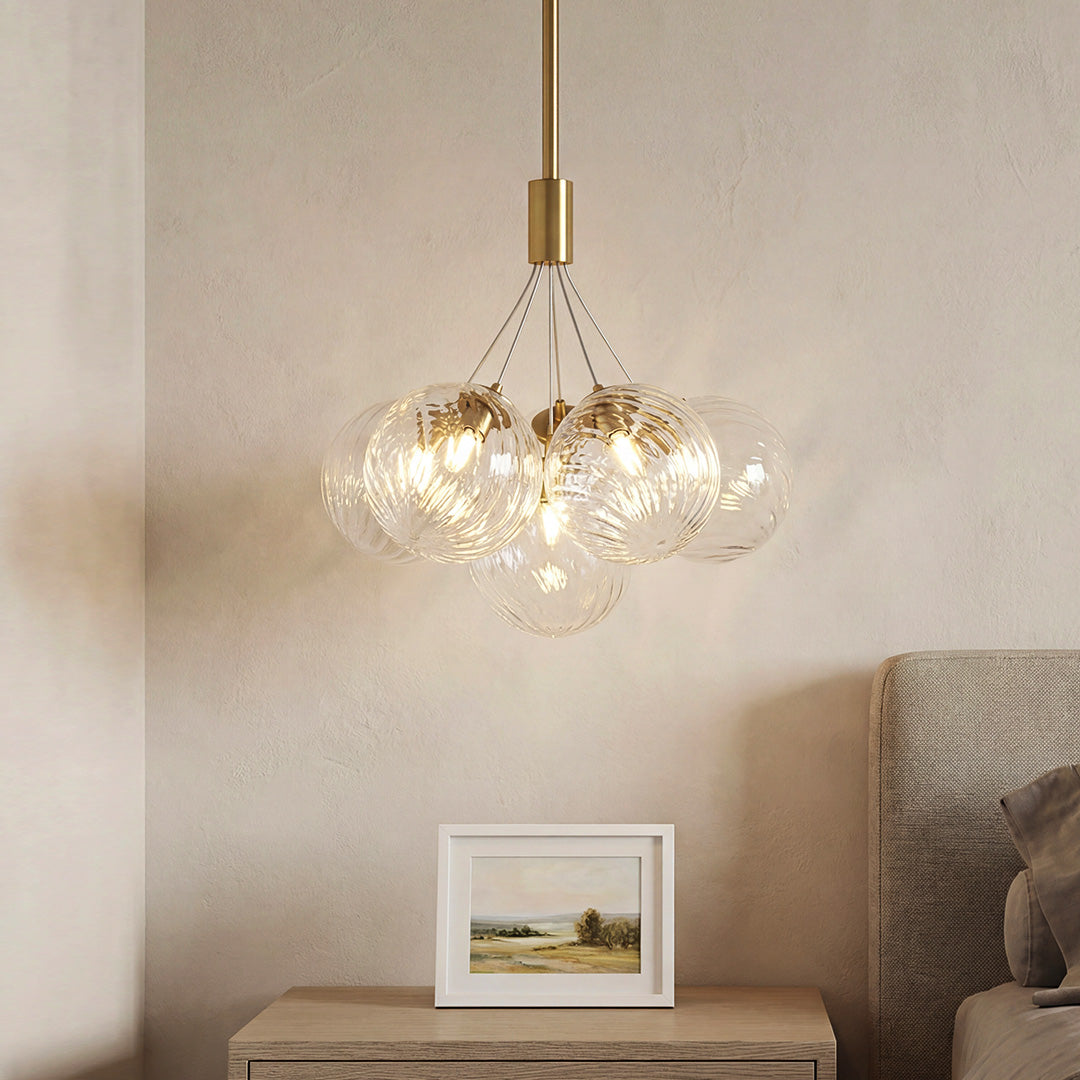
When the same design is offered in several head counts, you can keep the material and style consistent while scaling the fixture to the room. The smallest version can suit a focused corner or bedside zone, the middle version can anchor a standard seating or dining group, and the largest version provides a stronger read in a wide or high-ceiling space.
Scalable Globe Count
Modern Bubble Chandelier Minimalist Solid Copper Ceiling Light
Price: $265.99
Best for choosing a consistent bubble silhouette in 3-, 7-, or 13-head configurations as room scale increases.
- The 13-head version measures 26.38 inches wide and 14.37 inches high.
- Copper, nickel, and black finishes support different interior palettes.
- The hardwired indoor fixture operates at 110V with wall-switch control.
Plan Structure, Bulbs, and Maintenance
Confirm Support for the Actual Fixture Weight
A chandelier is not supported by drywall. The electrical box and framing or independent support must be rated for the fixture’s actual weight and installation method. This is especially important for glass clusters. For example, the two listed diameters of the full glass bubble model above weigh 66.14 and 77.16 pounds. Share the product page, canopy details, weight, and ceiling construction with a qualified installer before ordering.
For a general overview of mounting sequence and safety checks, refer to How To Hang A Chandelier Safely And Correctly. High ceilings, heavy fixtures, sloped canopies, and difficult access are good reasons to use a licensed electrician and the appropriate lifting or access equipment.
Calculate Bulbs as a System
For multi-head fixtures, choose bulbs only after checking the specified base, maximum wattage, enclosure conditions, and dimmer compatibility. Thirteen overly bright clear bulbs can create uncomfortable sparkle at eye level from an upstairs landing. Lower-output warm bulbs often create a calmer cluster, while supplemental recessed or wall lighting handles general illumination. A chandelier can be the visual centerpiece without being the room’s only light source.
Design for Cleaning Access
Before finalizing the drop, decide how the fixture will be cleaned and how bulbs will be changed. A reachable chandelier lift can be valuable in a tall foyer. If no lift is planned, leave enough space for approved access equipment and avoid positioning fragile glass directly over furniture that cannot be moved. Turn off power and allow lamps to cool before wiping glass with a dry, soft cloth according to the product care instructions.

Plan the Support Before the Decorative Finish
The best time to confirm blocking, junction-box rating, canopy placement, and cable routing is before drywall repair or ceiling painting. Early planning prevents a beautiful fixture from becoming an expensive last-minute structural problem.
Common Mistakes to Avoid
- Choosing by globe count alone: Always compare overall width, height, globe diameter, and drop length.
- Scaling only to ceiling height: Room width, furniture footprint, and viewing distance are equally important.
- Hanging the fixture too high: Safe clearance matters, but the chandelier still needs to visually connect with the room.
- Assuming more heads mean better lighting: Confirm lumen output, bulb specifications, shade transmission, and dimming needs.
- Ignoring the upper-floor view: In an open stair or foyer, check glare and composition from both levels.
- Leaving support questions until installation day: Verify weight ratings and ceiling construction before purchase.
Final Advice
Start with seven globes for a typical 10- to 12-foot room, move toward 10 to 13 for a larger 12- to 16-foot space, and consider 13 or more—or a vertical cascade—for a two-story void. Then verify the fixture’s real dimensions. A bubble chandelier succeeds when its width, drop, glass scale, brightness, and viewing angles work together. The right number of globes is the one that fills the architecture without making the room feel crowded.