
This guide is for U.S. homeowners and property managers comparing low-voltage 12V and line-voltage 120V landscape lighting for walkways, planting beds, trees, patios, driveways, and larger outdoor spaces.
A softly lit path and a broad driveway entrance can look as though they belong to the same lighting plan while needing different electrical solutions. The right voltage depends on where power is available, how far the fixtures sit from it, what the light must accomplish, and how you expect the landscape to change.
The choice also comes with several misleading shortcuts. Low voltage does not mean low brightness. Line voltage does not automatically mean high energy consumption. And a larger transformer does not, by itself, solve a poorly planned cable run. Understanding those differences helps you compare complete systems instead of buying fixtures around a single number.

Quick Choice: Which Voltage Fits Your Yard?
For a typical residential garden with path lights, planting-bed accents, and several tree lights, a compatible 12V LED system is often a useful starting point. It offers many compact fixture options and can accommodate future layout changes when capacity and cable routes are planned properly.
For permanent fixtures served by an existing suitable circuit, or projects with larger loads and long distribution distances, evaluate 120V with an electrician. It may be practical for entrance lighting, some bollard installations, or broad-area illumination. A large property can also use professionally supplied power at several locations feeding separate low-voltage zones.
You do not have to choose one voltage for the entire property. A home can retain suitable 120V exterior fixtures while using a separate 12V landscape system around the garden. Keep their electrical circuits and components appropriately separated and coordinated.
What 12V and 120V Actually Mean
Low-Voltage Landscape Lighting: Usually a Separate Power Supply
A typical low-voltage landscape system takes household power into a suitable transformer or power supply and delivers the specified lower voltage to the fixtures. The visible garden lights operate on that output, while the supply side remains connected to household electricity.
Check the full input specification. A 12V AC fixture and a 12V DC fixture are not automatically interchangeable. Some products accept both, while others require a particular output type or proprietary controller. Matching the number “12” is only part of establishing compatibility.
Line-Voltage Landscape Lighting: Household Voltage at the Fixture
A 120V fixture receives nominal household line voltage at its rated input. An LED fixture may contain its own driver, but it does not require the same external 12V landscape transformer used by a conventional low-voltage system. The wiring, connections, grounding where required, and protection must suit that installation.
Voltage describes electrical potential. Lumens describe light output. Beam angle, shielding, placement, and the illuminated surface then shape the result you see. Choose a voltage system for distribution and compatibility, and choose the fixture's optical performance for the actual lighting job.
Compare the Two Systems
| Decision Factor | 12V Low Voltage | 120V Line Voltage |
|---|---|---|
| Power Arrangement | Compatible external transformer or power supply | Suitable line-voltage circuit at the fixture |
| Typical Uses | Residential paths, planting accents, and tree lighting | Permanent exterior fixtures and selected area-lighting projects |
| Design Flexibility | Often convenient for adjusting garden layouts | Relocation may involve more electrical and landscape work |
| Distance Planning | Voltage drop needs close attention on long or heavily loaded runs | Lower current for equivalent power can help distribution; calculations still matter |
| Installation | Some complete plug-in systems suit homeowner assembly when permitted | Plan qualified electrical installation |
| Energy Use | Depends on fixtures, operating hours, and system losses | Depends on fixtures, operating hours, and system losses |
| Future Expansion | Check supply capacity and each cable run | Check circuit capacity, controls, and wiring provisions |
Choose by Lighting Job and Property Layout
Front Walks and Planting Beds
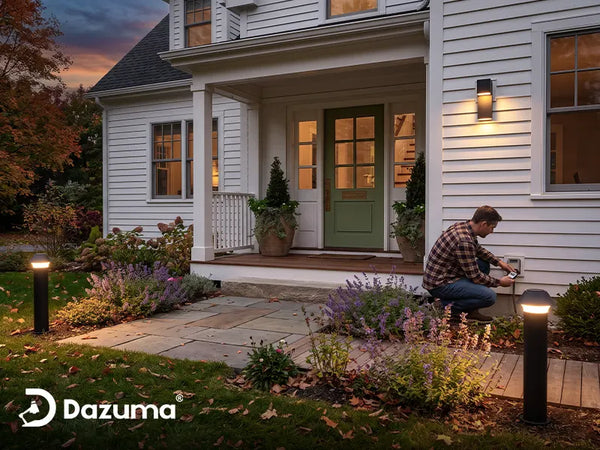
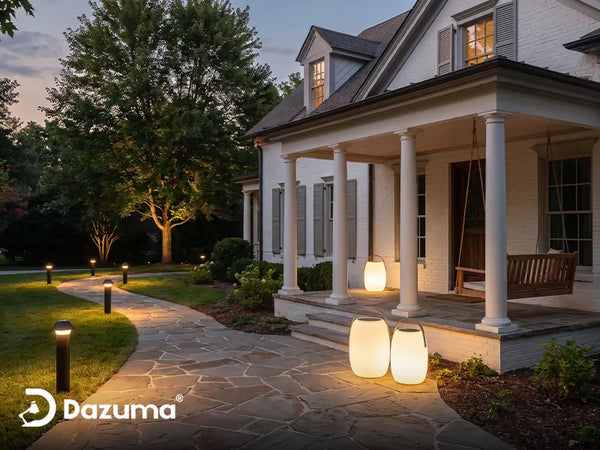
A low-voltage system often fits a garden that needs several modest pools of light rather than one large wash. The ability to shift a stake-mounted fixture can be useful as plants mature or a bed changes shape. That flexibility still depends on appropriate cable routing and approved connections.
When comparing path lights, prioritize where the light falls. A shielded fixture that reveals a turn or step can be more useful than a brighter fixture that shines toward approaching guests. Confirm the input voltage on each product page; a category name does not establish the power requirement.
Tree and Architectural Accents
For tree lighting, compare beam shape with the size and distance of the target. A narrow beam may highlight a trunk, while a broader beam can suit a canopy or wall. Tall trees do not automatically require 120V fixtures. The required output, aiming position, and electrical distribution determine the shortlist together.
Review outdoor spotlights by output, optics, adjustment, and location suitability. Test the view from the house as well as from outdoors. A well-aimed accent can give the yard depth without creating a bright point outside a bedroom window.

Choose the Beam Before Adding More Power
Move or re-aim a temporary fixture before increasing output. A small change in position can reveal bark texture, reduce a distracting hot spot, or keep light out of neighboring windows. Electrical voltage does not correct an unsuitable beam.
Long Driveways and Permanent Routes
On a large site, ask where power can be supplied and serviced economically. One very long low-voltage run may be less practical than several local zones. Conversely, installing a new 120V distribution route solely for a few small accents may create unnecessary cost.
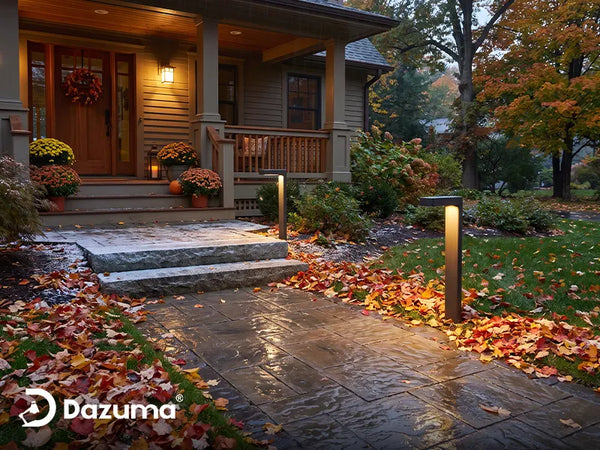
For bollard lights, compare mounting foundations, light distribution, available voltage options, and maintenance access. Their substantial appearance does not tell you whether they need 12V or 120V. Review the actual specification rather than deciding from fixture size.
Understand Voltage Drop and Transformer Capacity
Voltage drop occurs as current passes through resistance in cable and connections. Distance, conductor size, and the load along the route affect it. A system can have enough total supply capacity and still deliver an unsuitable voltage to its farthest fixtures.
Why 12V Systems Need Careful Run Planning
For an idealized 60W load, dividing power by voltage gives 5 amps at 12V and 0.5 amp at 120V. Real AC LED systems also involve power factor and driver behavior, so this is an illustration rather than a cable-sizing calculation. It explains why low-voltage distribution can become sensitive to long, loaded cable routes.
Use the manufacturer's cable chart or voltage-drop calculator for the actual layout. A shorter route, larger conductor, or additional approved feed can improve performance. A higher transformer tap is appropriate only when the equipment permits it and the resulting voltage stays within every connected fixture's input range.
Do not judge correct voltage solely by visible brightness. Some LED drivers maintain output across a range, then flicker or shut down outside it. Have the completed system checked under load using the manufacturer's testing method.
Size the Supply With the Correct Load Information
Use actual rated input data, including volt-amperes when the equipment specifies VA for transformer sizing. Incandescent-equivalent wattage describes a comparison, not the connected electrical load. Follow the supply's stated loading limits and any minimum-load requirements.
For example, if a particular manufacturer specifies an 80% loading limit and the connected load is 72VA, the minimum capacity under that rule is 90VA: 72 divided by 0.8. Select a suitable listed size and check individual output limits too. That example is not a universal requirement for every transformer.
Plan the Next Phase Before Buying
Write down the fixtures you expect to add later and their likely locations. Spare capacity at the supply does not guarantee that an existing cable run can serve the new load. Recheck the affected run whenever the layout grows.

Compare Installed Cost and Energy Use
Price the Complete Project
Compare quotes that produce a similar lighting result. Include fixtures, power supplies where needed, cable, connectors, mounting hardware, controls, labor, access, and restoration of disturbed surfaces. Existing infrastructure can change the answer more than the price difference between two fixtures.
A 12V project may need a suitable power location and a new transformer. A 120V project may need circuit work, protective wiring methods, or more extensive restoration. Either can be economical in the right setting. Ask for an itemized scope instead of relying on a blanket claim that one voltage is always cheaper.
Lower Voltage Does Not Mean One-Tenth the Electricity
Electricity use follows power over time. As a hypothetical example, a system drawing 60W at the household supply for five hours uses 0.3kWh. That arithmetic is the same whether the downstream fixtures receive 12V or the fixtures operate at 120V.
For a real comparison, account for transformer or driver losses, standby consumption, fixture efficiency, and operating schedules. Compare delivered lumens and useful light distribution as well as watts. A timer that switches decorative accents off when they are no longer needed can make a meaningful difference without changing voltage.

Plan Installation and Compatibility
Low voltage reduces shock risk on the fixture side compared with line voltage, but it does not make the complete installation risk-free. The supply still connects to household power. Use equipment evaluated for its intended outdoor location and follow the instructions for its power connection, mounting, and weather protection.
Plan qualified electrical help for new outlets, circuits, hardwired supplies, and 120V fixtures. Requirements for cable protection and burial depend on the system and location. Ask the installer to identify them for the proposed route rather than applying one generic trench depth across planting beds, hardscape, and vehicle crossings.
Read the Full Input Label
Before combining components, confirm nominal voltage, AC or DC input, acceptable operating range, load, connectors, and control compatibility. A fixture labeled for 120V cannot be treated as a 12V fixture, and a 12V fixture must never be connected directly to 120V.
Wet-location suitability also needs separate checking. An IP rating does not identify the required voltage, prove compatibility with a power supply, or automatically make a light suitable for underwater installation. Pools, spas, and water features require equipment specifically appropriate to that application.
Once you have selected a system type, the guide to running low-voltage landscape lighting provides more detail on planning routes and testing the completed layout.
Keep the System Serviceable
Record fixture models, loads, cable routes, and control settings. Keep required service points accessible and leave the site documentation with the property records. A future repair should not depend on remembering which planting bed hides a particular connection.
Seasonal maintenance matters at either voltage. Check for displaced fixtures, damaged equipment, blocked light, and changing vegetation. De-energize equipment before service as instructed, and have electrical faults assessed rather than repeatedly resetting a tripping protective device.
Make the Final Decision
- Start with 12V: A typical garden needs several modest accents and paths, with a suitable supply location and manageable runs.
- Evaluate 120V: Permanent fixtures, existing infrastructure, or distribution requirements make a professionally designed line-voltage installation practical.
- Consider separate zones: A large property has distant lighting areas or different operating schedules.
- Verify before purchase: Match the complete fixture input, power supply, controls, location rating, and installation method.
Use the beginner's low-voltage landscape lighting planning guide when turning a shortlist into a yard plan. The strongest choice is the system that delivers the intended light reliably and remains practical to maintain.

Choose the lighting effect first, map the power and distances second, and compare complete installed solutions. For many homes, 12V provides a flexible garden system. Where 120V fits the infrastructure and task, it can be equally deliberate. The voltage should support the design rather than substitute for one.