
Who This Is For: This guide is for homeowners whose motion sensor outdoor wall lights switch on for empty driveways, passing cars, moving branches, pets, or seemingly no reason at all—and for anyone choosing a new fixture who wants to prevent that frustration before installation.
Introduction: When a Helpful Light Becomes a Household Annoyance
A motion light that comes on as you reach the front steps feels thoughtful. The same light flashing through a bedroom window every time a car turns the corner feels like a mistake. Frequent activations can also worry homeowners who assume someone is outside, irritate neighbors, and make the light less useful because everyone eventually stops paying attention to it.
The good news is that repeated activation usually does not mean the fixture is defective. More often, the sensor is seeing the wrong slice of the property, reacting to a changing heat source, or using a sensitivity setting that is too broad for the location. The solution is rarely “turn everything down and hope.” It is to identify what crosses the detection field and then make one controlled adjustment at a time.

The Quick Answer
To reduce false triggers, first watch the light from a safe indoor position and note exactly what happens before each activation. Then clean the sensor lens, narrow or redirect the detection area if the fixture allows it, lower sensitivity one step, and keep the sensor away from roads, moving foliage, dryer vents, HVAC equipment, reflective water, and other rapidly changing heat or motion sources. Test after dark because daylight conditions may not reproduce the problem.
Do not change range, sensitivity, time delay, and dusk settings all at once. If the nuisance stops, you will not know which adjustment fixed it—and you may accidentally create a blind spot. Also, controls vary: some fixtures offer adjustable sensitivity and aim, while others use fixed sensing. The product manual should always take priority over generic advice.
How Motion Sensors “See” Your Yard

Motion Is Not Always What You Think It Is
Many residential motion lights use passive infrared sensing, often called PIR. A PIR sensor responds to changes in infrared energy across its detection zones. In plain English, it is looking for a warm body moving through the scene—not filming the yard. Some fixtures use different sensing technology, so never assume the sensor type unless the manufacturer states it.
This explains why a light can react to a dog, a person, warm air near an exhaust vent, or sun-warmed objects shifting in the wind. It also explains why a person walking directly toward some sensors may be detected later than someone moving sideways across the field. The best detection pattern depends on the actual sensor and its orientation.
A useful new way to think about placement is this: you are not choosing only where the light should shine; you are also choosing what the sensor is allowed to watch. Those two areas may not be identical. A fixture can illuminate a wide entry while its sensor is aimed toward the last few steps of the walkway.
What Is Actually Causing the False Triggers?
Use the pattern below to narrow the cause before touching the settings. The timing of the problem is often more revealing than the activation itself.
| What You Notice | Likely Source | Best First Test |
|---|---|---|
| Activates when traffic passes | Detection field reaches the street or driveway | Aim the sensor inward or reduce range one step |
| Worse on windy nights | Branches, tall grasses, flags, or moving warm objects | Trim or temporarily secure the moving object |
| Occurs after sunset or sunrise | Changing light, reflections, or dusk control interaction | Review the dusk threshold and nearby reflective surfaces |
| Activates near vents or equipment | Warm air, compressor heat, or moving exhaust | Redirect the sensor away from that area |
| Rapid or random cycling in rain | Moisture, insects, dirty lens, or an electrical issue | Clean and dry the unit; inspect the installation safely |
Passing Cars and Neighbor Activity
A sensor facing a street often covers much more than the front walk. Even if the lamp is mounted beside your door, its detection field may extend across a driveway or toward a neighbor’s sidewalk. Narrowing that field is usually more effective than reducing the light-on duration. A shorter timer only makes the same false trigger end sooner.
Branches, Pets, Insects, and Decorations
Wind-blown plants are common suspects, especially when foliage crosses an area warmed by the sun or nearby building surfaces. Pets may trigger a sensor mounted too low or set too sensitively. Insects can gather around the warm lens or light source and appear much larger to a nearby sensor than they do to you. Seasonal wreaths, hanging baskets, flags, and inflatable decorations deserve the same attention.
Heat, Reflections, and Weather Changes
Dryer exhaust, outdoor HVAC units, vents, and heat-pump discharge can create rapidly changing conditions. Wet pavement, pools, glossy vehicles, and pale walls can also change the visual and thermal environment around the fixture. A setup that behaves perfectly in winter may become unreliable when summer foliage grows into the detection zone. Recheck the aim seasonally instead of assuming the original installation will remain ideal forever.
A Simple Nighttime Diagnostic Test
Change One Variable at a Time
- From indoors, record the time and conditions for three to five unwanted activations.
- Look for repeatable events: a car, sprinkler cycle, wind gust, pet route, or HVAC startup.
- With power off and following the manual, gently clean the sensor lens and fixture surfaces.
- If available, reduce sensitivity or range by one increment—not all the way down.
- Walk the route you want covered from several directions, then wait through a full shutoff cycle.
- Repeat the test in the weather that caused the problem.

Masking part of a sensor should only be done if the manufacturer specifically permits it and identifies the safe method. Improvised tape can trap moisture, leave residue, interfere with the lens, or void support. Likewise, never open a hardwired outdoor fixture while it is energized. If you are unsure whether the circuit is off or the mounting is weather-sealed, stop and call a qualified electrician.
Placement and Settings That Work Better
Aim Across the Approach, Not Across the Property
For many sensors, a person crossing the detection zones is easier to recognize than someone moving straight toward the unit. Position the field so it catches a visitor as they enter the final section of the walkway. Keep its outer edge away from public sidewalks and traffic. A slightly tighter, intentional zone is more useful than maximum range that includes the whole neighborhood.
If you are still planning the exterior, browse motion sensor wall lights with the sensor location in mind, not just the fixture’s finish. For broader style planning, the outdoor wall lighting collection helps you compare forms that can fit beside, above, or along an entrance.
Use the Controls in the Right Order
If your fixture provides adjustable controls, start with aim or range, then sensitivity, then light-on time, and finally the dusk threshold. Range determines where the fixture watches. Sensitivity determines how readily it responds within that field. Time controls how long it stays on. The dusk setting controls when motion activation becomes available. Treating these as interchangeable is one reason homeowners end up with a light that still triggers falsely but now turns off too quickly.
After each change, walk-test the edge of the desired zone and the routes you want excluded. Test a normal approach while carrying groceries and while walking beside a child, not only a perfect straight-line path. The goal is reliable daily use, not a laboratory-perfect result.
Keep the Light Comfortable, Too
Stopping false triggers is only half the job. A correctly triggered fixture can still create glare through a window or toward a neighbor. Downward or shielded light is often easier to live with near entries and corridors. For more placement ideas, see how to avoid glare from outdoor wall lights.

Two Fixture Options for Different Exteriors
The right fixture depends on exposure, mounting position, desired beam, and whether the sensor version is available in the size you need. Neither of the following products publishes adjustable detection distance or sensitivity details on its product page, so confirm those controls before purchase if fine-tuning is essential.
For a Sheltered Entry That Benefits From Warm Up-and-Down Light
On a covered porch or beneath an eave, architectural light can make the entry feel welcoming even when the sensor is idle. This curved fixture throws light both upward and downward, so it emphasizes the wall rather than projecting a broad flood across the yard.
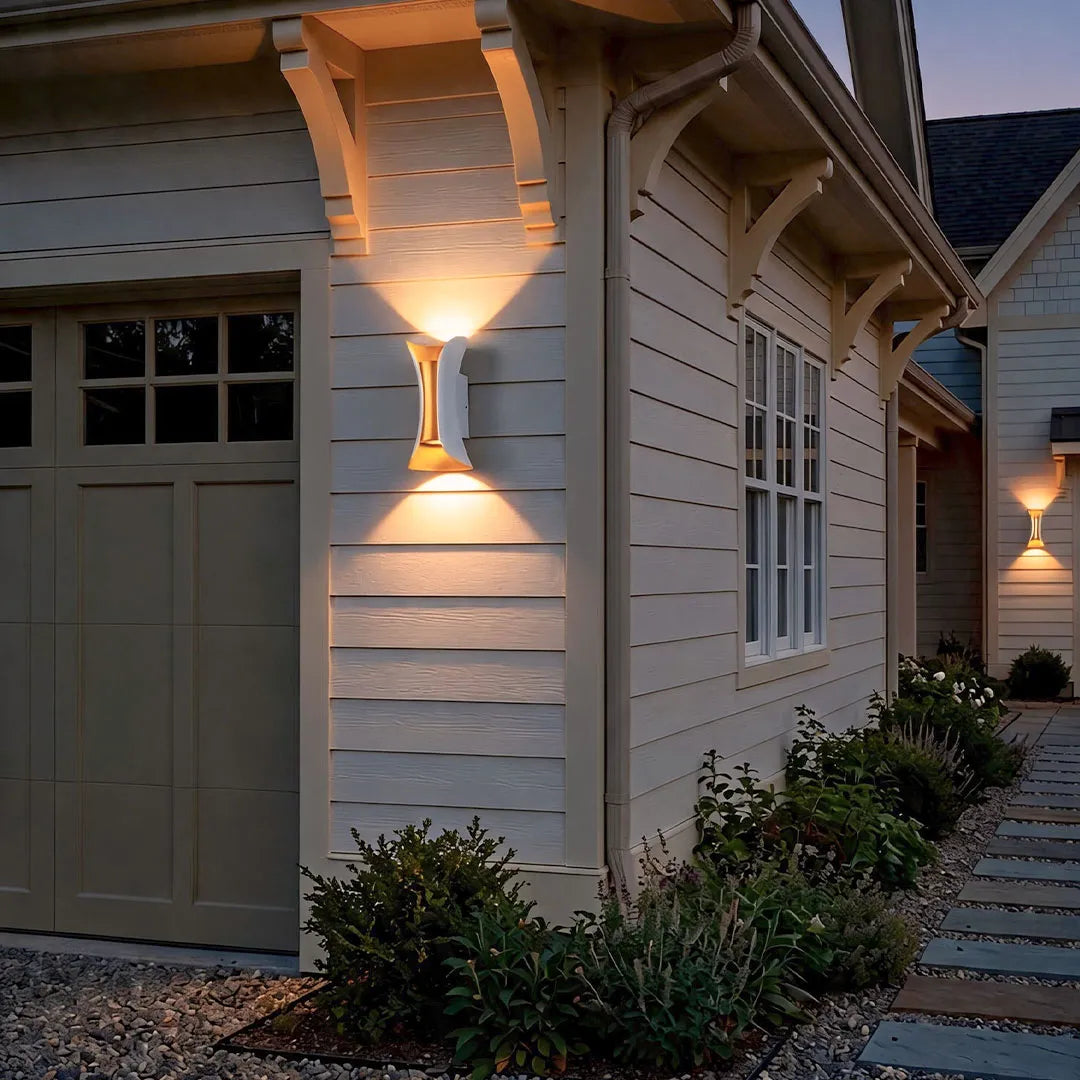
Warm Architectural Light for Covered Areas
Up Down Lighting Wall Lights Modern Curved LED Waterproof Light
Price: $115.99
Best for sheltered porches, courtyard entrances, and balcony walls where warm 3000K light and a sculptural beam matter. The page lists an optional motion-sensing size; check current availability before planning the installation.
- Aluminum body and glass shade create a clean, substantial exterior profile.
- Up-and-down beams add wall depth without imitating a security floodlight.
- IP54 protection is described for semi-outdoor, sheltered locations.
Because this model’s page describes IP54 protection for semi-outdoor areas, do not treat it as the automatic choice for an exposed wall. If you like the same architectural emphasis, you can also compare other up-and-down wall lights while matching the protection rating to the actual location.
For an Exposed Modern Entry or Corridor
Above a doorway or along an exterior corridor, a linear fixture can define the entrance while directing light downward. This option is especially useful when you want the sensor feature but also need a stronger published weather rating.
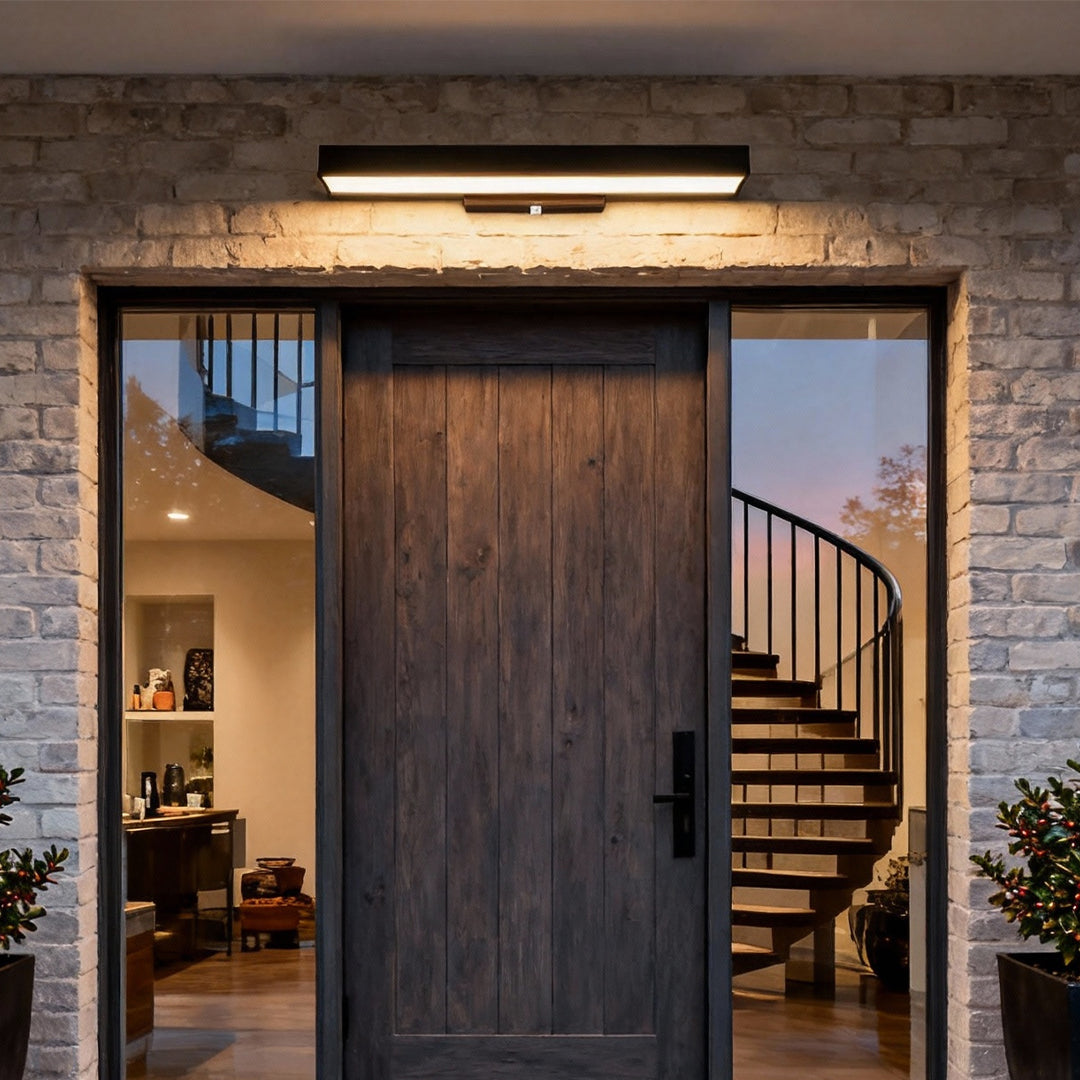
Clear Downlight for Modern Entrances
LED Linear Wall Light Outdoor Black Rectangular Lamp
Price: $176.99
Best for exposed entrances, balconies, and corridors that suit a slim black fixture, neutral 4000K light, and a choice between motion-sensor and continuous-light versions.
- Stainless steel frame and PMMA shade support a streamlined exterior look.
- Downward illumination keeps attention on the doorway and walking surface.
- Three lengths help scale the fixture to narrow or wide architecture.
The 4000K light will read clearer and more neutral than the first fixture’s 3000K warm white. That can be helpful for visibility at a busy entrance, but choose based on the atmosphere you want as well as the sensor. More options with similarly restrained profiles appear in the modern outdoor wall lighting collection.
When the Problem Is Not a Setting

Know When to Stop Troubleshooting
Call a qualified electrician if the fixture flickers, buzzes, smells hot, trips a breaker, shows water inside, has loose wiring, or behaves unpredictably after a storm. A sensor that activates randomly even when its viewing area is covered according to the manufacturer’s approved test procedure may also need service or replacement.
Repeated on-off cycling can sometimes come from a photocell seeing the fixture’s own light, an incompatible control, a poor connection, or moisture—not motion. If the light is new and never worked correctly, verify wiring, compatible switches, mounting orientation, and required sealing rather than assuming the sensitivity is wrong.
If you are deciding whether motion control suits the location at all, the comparison in Motion Sensor vs Timer Outdoor Lights can help. A timer or dusk-to-dawn approach may be calmer for a busy sidewalk, while motion control can make more sense at a private side door or occasional-use passage.
Buying and Installation Checklist
- Define the useful zone: Mark the last section of walkway, steps, gate, or driveway that should activate the light.
- Identify nuisance movement: Note roads, neighboring paths, pets, branches, vents, water, decorations, and mechanical equipment.
- Confirm adjustability: Check whether detection angle, range, sensitivity, timer, and dusk threshold can actually be changed.
- Match weather exposure: Use the manufacturer’s stated outdoor rating and location guidance; an eave does not protect every wall equally.
- Plan the beam: Keep direct glare out of windows and neighboring property while lighting the walking surface and lock area.
- Check power and installation: These featured fixtures are hardwired; use a qualified installer where required.
- Test before declaring success: Walk every intended route after dark, wait through the full timer, and repeat during wind or rain if those conditions caused the issue.
Final Advice: Make the Sensor Watch Less, but Watch Better
The most dependable motion light is not the one with the longest advertised reach. It is the one whose detection field matches the small part of your property where a person’s approach matters. Start by observing the pattern, move the field away from unrelated activity, adjust one control at a time, and retest under real conditions.
If false triggers continue after cleaning, careful aiming, and verified settings, treat that as useful evidence rather than a reason to keep turning knobs. Moisture, wiring, control compatibility, or a failing sensor may require professional attention. When you are ready to compare replacements, focus on mounting position, weather rating, beam direction, and documented sensor controls—not appearance alone.