
In the realm of interior design, lighting is often referred to as the jewelry of the home. Among all the fixtures available, Pendant Lighting holds a unique position. It is highly visible, structurally dynamic, and serves as both a functional light source and a commanding artistic focal point. However, selecting a beautiful fixture is only the first step of the journey. As an experienced lighting designer, I can assure you that even the most exquisite, handcrafted pendant will look awkward and out of place if it is hung at the wrong height, spaced incorrectly, or sized disproportionately to the room.
The secret to a magazine-worthy aesthetic is not just expensive taste; it is strict adherence to spatial geometry. When clients ask me, "What are the rules for pendant lights?" the answer always comes down to mathematical harmony. Whether you are installing a single statement piece in a grand foyer or hanging a series of elegant fixtures over a bustling kitchen island, there are definitive industry standards you must follow. By integrating high-quality fixtures from our premium Ceiling Lights collection and applying these exact designer rules, you can transform your space with absolute confidence.

Rule 1: The Magic Height Formulas
The most common and visually disruptive mistake homeowners make is hanging their pendants too high or too low. If the fixture is too low, it creates a claustrophobic environment and obstructs the line of sight across the room. If it is hung too high, the light dissipates before it reaches the surface, and the fixture loses its intimate connection to the furniture below it.
The standard baseline rule is the "30-to-36-Inch Rule." When hanging a pendant over a surface—such as a kitchen island, a dining table, or a reading desk—the bottom rim of the fixture should sit exactly 30 to 36 inches above the countertop or tabletop. This precise measurement ensures that the light source is low enough to provide excellent task illumination, but high enough that it will not block the view of a person standing or sitting across the table.
| Location | Standard Hanging Height | Designer Notes |
|---|---|---|
| Over Kitchen Islands | 30" - 36" above the counter | Measure from the bottom of the pendant to the stone surface. |
| Over Dining Tables | 30" - 36" above the table | Adjust slightly higher if your family members are unusually tall. |
| Open Floor (Hallways) | Minimum 7 feet (84") from the floor | Ensures ample door clearance and prevents tall guests from bumping heads. |
| Two-Story Foyers | Level with the second floor | The fixture should not hang below the second-story balcony line. |
Rule 2: The Sizing Mathematics
Scale is everything. A delicate, tiny pendant will get lost in a massive, vaulted living room, while an oversized industrial dome will completely overwhelm a compact breakfast nook. To eliminate the guesswork, lighting professionals use a simple mathematical formula to determine the ideal diameter of a central room fixture.

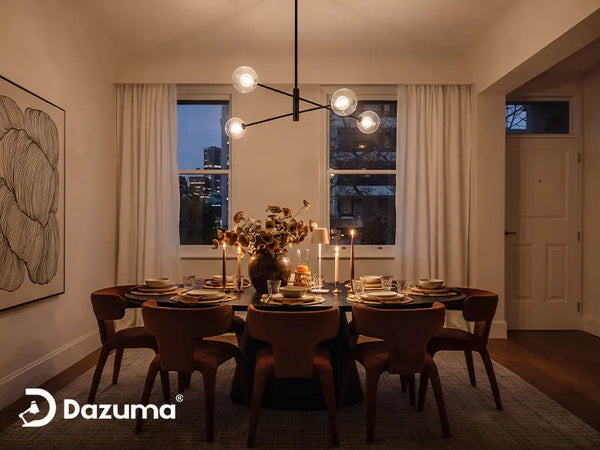
To calculate the perfect diameter for your room, measure the length and width of the room in feet. Add those two numbers together. That sum, converted into inches, is the ideal diameter for your primary pendant. For example, if your dining room is 12 feet by 14 feet, you add 12 + 14 to get 26. Therefore, you should be shopping for a pendant (or a piece from our Chandeliers collection) that is approximately 26 inches in diameter.
When sizing a fixture for over a dining table, there is an additional constraint: the fixture should be about 12 inches narrower than the width of the table itself (leaving 6 inches of clearance on each side). This ensures no one bumps their head when standing up or sitting down.
Rule 3: The Rule Of Three For Spacing
When hanging multiple pendants—particularly over a kitchen island or a long bar—you must master "The Rule of Three." In design psychology, odd numbers are inherently more appealing, memorable, and visually balanced to the human eye. Three identical fixtures create a beginning, a middle, and an end, establishing a satisfying rhythm across the space. While massive islands may require five, and very small peninsulas may only fit two, three remains the golden standard for American homes.
Spacing these three fixtures requires precision. First, measure the total length of your island. You want to leave at least 12 to 15 inches of empty space from the edge of the island to the center of the outermost pendants. Once your outer boundaries are set, space the remaining fixtures evenly. As a general industry guideline, the space between each pendant should be roughly equal to the diameter of the fixtures themselves. For example, if you are using 10-inch glass globes, try to leave about 10 to 12 inches of empty air space between them to prevent the ceiling from looking cluttered.
Rule 4: Environmental Specifications for Outdoor Spaces
Pendant lighting is not strictly an indoor affair. Hanging a statement fixture over a covered front porch, a backyard pergola, or a sunroom adds immediate architectural elegance. However, the rules shift dramatically when you move outside. You cannot simply take an indoor fixture and hang it on your patio; moisture will rapidly destroy the finish and short out the electrical components.
When designing an exterior living space, you must utilize products specifically engineered for the elements, such as those found in our Outdoor Pendant Lighting collection. These fixtures are rigorously tested and assigned specific environmental ratings.
If your pendant is going under a fully covered porch where it is protected from direct rain but still exposed to humidity and fog, it must be "Damp Rated." If you are hanging a pendant from an open-slat pergola or a tree branch where water can directly hit the fixture, it absolutely must be "Wet Rated" (IP65 or higher). Investing in the correct structural rating ensures your outdoor sanctuary remains beautifully lit and perfectly safe through all seasons.

Elevate Your Space with Perfect Proportions
Now that you are armed with the professional formulas for height, sizing, and spacing, you are ready to make a brilliant design decision. Don't let bad placement ruin a beautiful fixture. Apply these golden rules and explore our curated collections to find the perfect statement piece for your home.
Shop Modern Chandeliers & Pendants