
Who This Is For: This guide is for homeowners who love the sparkle and dimension of a glass chandelier but worry that the fixture will become a dusty, fragile maintenance project after installation.
Why Homeowners Worry About Glass Chandeliers
A glass chandelier can make a room feel finished in a way that a plain ceiling light rarely does. Glass reflects daylight, softens evening light, and gives the ceiling depth even when the fixture is turned off. Then the practical questions begin: Will every fingerprint show? Will dust settle between the petals? Will I need to take the whole fixture apart twice a year?
Those concerns are reasonable, but “glass chandelier” covers a wide range of designs. A fixture with six large removable shades is not maintained the same way as a chandelier with dozens of small leaves, droplets, beads, or ribbed flower petals. In my experience, the material itself is not the biggest problem. Access, number of pieces, surface texture, and installation height determine how much work the fixture creates.
The right chandelier should fit your maintenance tolerance as well as your decorating style. If you dislike ladders and detailed cleaning, that does not mean you must avoid glass. It means you should choose a simpler silhouette, a reachable location, and a fixture whose individual pieces can be cleaned without a complicated disassembly process.

Quick Answer: Are Glass Chandeliers Hard to Clean?
Some are, but many are manageable. Large smooth glass panels, open bowls, and simple shades are usually easier to wipe than chandeliers made from many small flowers, crystal drops, or overlapping leaves. A low dining-room fixture is also easier to maintain than the same design in a two-story foyer.
For most homes, a light dusting every month or two keeps buildup from becoming stubborn. A more thorough cleaning once or twice a year is usually enough, although kitchens, fireplace rooms, homes with pets, and dusty climates may need attention sooner.
The best cleaning method is the one specified by the fixture manufacturer. Both products discussed in this guide list the same basic care direction: turn off the power and wipe with a dry cloth. Do not assume that a general glass cleaner is safe for every decorative coating, painted frame, connector, or specialty glass surface.
What Actually Makes a Glass Chandelier Hard to Clean?
The Number of Individual Pieces
A chandelier with eight broad shades may take less time than a smaller fixture with 50 crystal leaves. Every extra pendant, flower, bead, and connector creates another front surface, back surface, edge, and attachment point. Detailed fixtures are not impossible to clean, but they reward patience.
Overlapping Petals and Leaves
Layered designs create beautiful depth because the glass pieces sit in front of one another. That same layering creates narrow spaces where a full-size cloth cannot reach. A soft detailing brush or small microfiber cloth becomes more useful than a spray bottle.
Texture and Etching
Smooth clear glass releases dust more easily than heavily ribbed, etched, seeded, or carved glass. Textured surfaces can hold lint, so use a lint-free cloth and avoid paper towels that leave fibers behind.
Installation Height
A chandelier may be easy to wipe at eye level before installation and difficult once it hangs 14 feet above a foyer. Safe access should be part of the buying decision, not an afterthought. If you cannot reach the fixture from a stable ladder without leaning, consider professional cleaning or a light lift.
The Room Around It
Dining rooms and bedrooms generally expose a chandelier to ordinary household dust. Kitchens add airborne grease. Wood-burning fireplaces can add soot. Open windows, construction, HVAC vents, and pet dander also affect how quickly the glass loses clarity.

Complexity Matters More Than Price
An expensive fixture is not necessarily harder to clean. Count the individual pieces, look behind the decorative layers, and check whether your hand can reach the frame without bending fragile connectors.
How Often Should You Clean a Glass Chandelier?
A practical schedule has two levels: frequent light dusting and occasional detailed cleaning. Regular dusting prevents loose particles from mixing with moisture or cooking residue and becoming a film.
| Location or Condition | Light Dusting | Detailed Cleaning | Main Concern |
|---|---|---|---|
| Bedroom or Formal Dining Room | Every 1–2 months | About twice a year | Ordinary household dust |
| Living Room With Fireplace | Monthly during heating season | As film becomes visible | Soot and fine particles |
| Kitchen or Open Kitchen Area | Monthly | Every 3–6 months if needed | Grease film that traps dust |
| Two-Story Foyer | When safe access is available | Professional schedule as needed | Access and ladder safety |
These are practical starting points, not rigid deadlines. Turn the fixture on at night and look across it from the side. Dust is often easier to see when light grazes the glass than when you stand directly underneath it.
How to Clean a Glass Chandelier Safely
1. Turn Off Power at the Source
Turn off the power at the breaker, not only at the wall switch, and allow bulbs and metal parts to cool. Protect the table or floor below with a soft drop cloth in case a small piece is dropped.
2. Photograph the Fixture Before Touching It
Take clear photos from several angles. If a removable drop or leaf becomes detached, the photos provide a quick reference for its correct position. For highly detailed crystal fixtures, a labeled diagram is even better.
3. Start With Dry Dust Removal
Use a clean microfiber cloth, a soft natural-bristle brush, or a gentle extendable duster. Support delicate pieces with one hand while cleaning with the other. Do not pull on crystal connectors or rotate the chandelier to reach the far side; move your ladder around the fixture instead.
4. Follow the Product-Specific Care Instructions
Some removable glass shades can be hand washed with mild soap and water, but that does not mean every chandelier should be wet-cleaned. Coatings, painted details, adhesive points, electrical sockets, and metal finishes can be damaged by excess moisture or harsh cleaners. The two Dazuma fixtures in this article specifically direct homeowners to use a dry cloth after turning off the power.
5. Clean One Section at a Time
Work in small sections and keep one hand free for balance. With a flower chandelier, complete one ring of petals before moving to the next. With a branch fixture, move from the center outward so you do not repeatedly brush against areas you already cleaned.
For a longer step-by-step process, the internal guide How to Clean a Crystal Chandelier: The Complete Step-by-Step Guide covers preparation, cleaning sequence, and reassembly in more detail.

Which Glass Chandelier Designs Are Easiest to Maintain?
Easiest: Large, Smooth, Open Glass Forms
Broad shades, simple globes, and open glass panels are usually fastest because the surfaces are visible and reachable. They are a good fit for homeowners who want reflection without detailed upkeep.
Moderate: Semi-Flush Branch and Leaf Designs
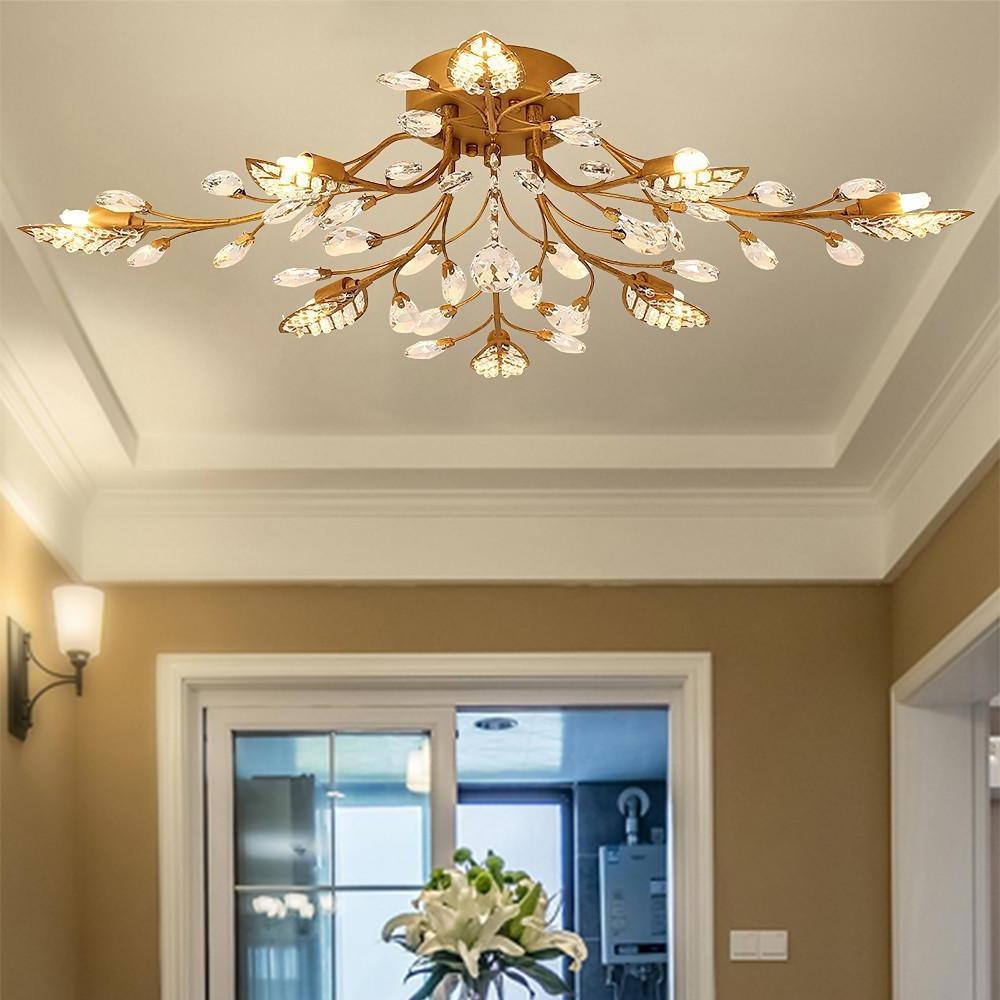
Branch chandeliers have more individual surfaces, but a semi-flush design can be easier to reach from a standard ladder than a long suspended fixture. The tradeoff is density: each branch, leaf, crystal drop, and bulb area needs individual attention.
The Glass Chandelier collection includes both simpler silhouettes and more decorative forms. When comparing them, look beyond the front photograph and study close-ups of the back, center frame, and attachment points.
Reachable Botanical Sparkle
Branch Chandelier Modern Vintage Crystal LED Light
Price: $242.99
Best for bedrooms, dining rooms, living rooms, and entries where homeowners want detailed crystal-and-leaf character without a long hanging drop.
- Semi-flush profile keeps the fixture closer to a standard ceiling.
- Iron branches combine textured leaves with K9 crystal accents.
- Hardwired 110–120V design includes eight G4 LED bulbs.
More Detailed: Layered Flower and Petal Chandeliers
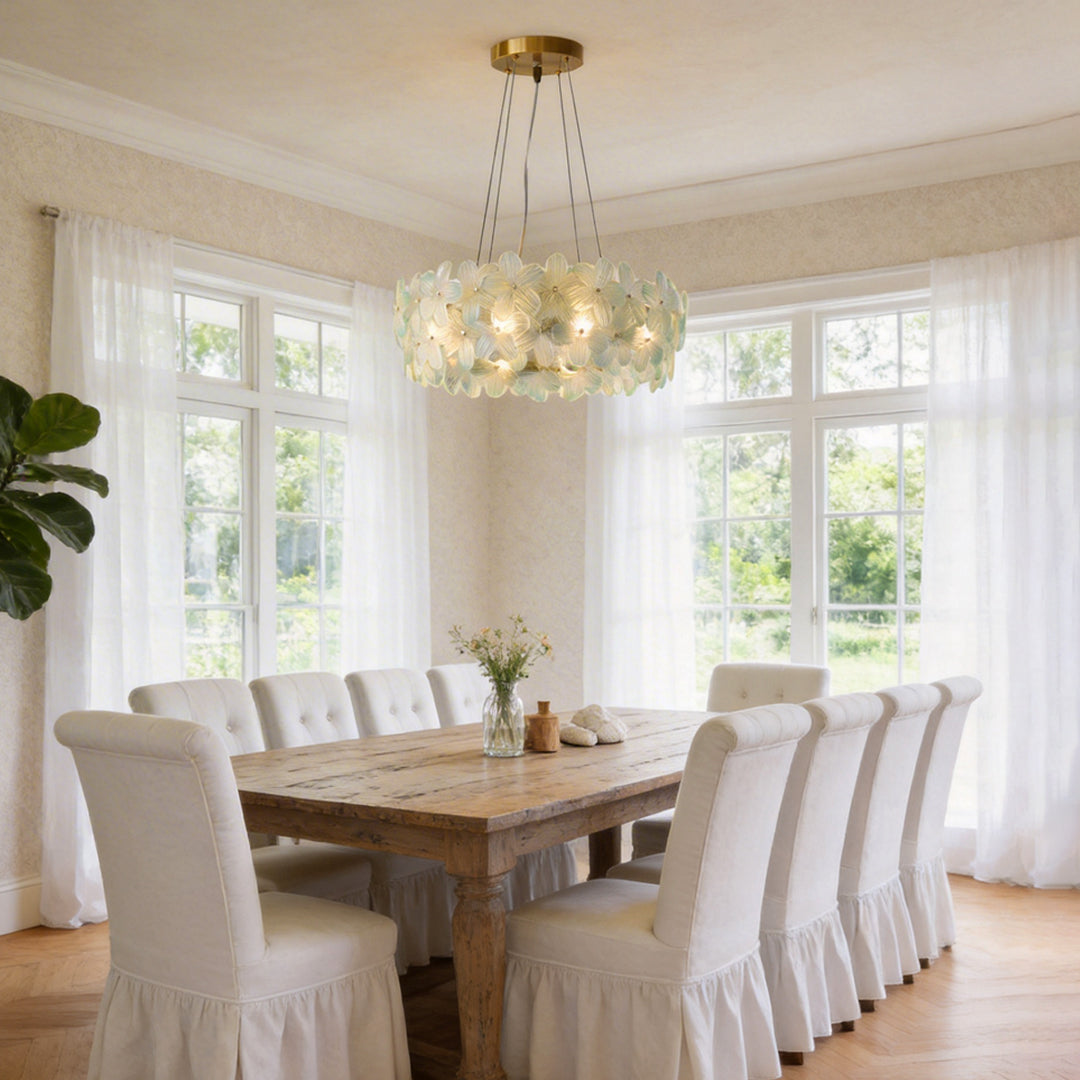
A Flower Chandelier can produce a soft, artistic glow because each petal catches light differently. Cleaning takes longer when petals overlap or have ribbed surfaces, but the round layered form can still be manageable if the chandelier hangs over a table where a stable ladder can be positioned nearby.
Most Demanding: Dense Crystal Drops in a Tall Space
Traditional multi-tier fixtures with many suspended crystals are usually the most time-consuming. They may be worth the effort in a formal foyer or dining room, but plan for professional access if the fixture is beyond comfortable reach. The Crystal Chandeliers collection can help you compare open modern arrangements with denser traditional silhouettes.
Look at the Back of the Fixture
Product photos often emphasize the sparkling front. Maintenance becomes easier to predict when you also examine the rear surfaces, center frame, bulb access, and how closely decorative pieces overlap.

How Room Placement Changes the Cleaning Work
Over a Dining Table
This is often one of the easiest placements because the fixture is lower than a foyer chandelier and the table limits foot traffic below. Move the table only if doing so creates a safer ladder position. Do not stand on dining furniture.
In a Bedroom
Bedrooms usually have less grease and soot, so dry dusting may be enough for long periods. Choose a semi-flush design if the ceiling is standard height and you want easier access.
Near a Kitchen
Glass in an open kitchen can develop a thin film that traps dust. A powerful range hood helps, but consider a simpler fixture if the chandelier sits close to the cooking zone. Decorative petals and crystals are better placed over the dining side than directly above a cooktop.
In a Two-Story Foyer
Height changes everything. A glass fixture that is easy to clean on the floor may require scaffolding once installed. Before buying, ask how bulbs are replaced, whether decorative elements are removable, and whether a light lift is compatible with the installation.
A Layered Glass Chandelier for Homeowners Who Accept More Detail
Some homeowners are comfortable spending more time on maintenance because the fixture functions as the room’s main artwork. In that case, a layered flower chandelier can be a reasonable choice—especially in a dining room where it is visible every day and accessible from a properly positioned ladder.
Layered French Flower Detail
Glass Flower Chandelier French Glass Round Ceiling Light
Price: $516.99
Best for dining rooms, bedrooms, and living areas where the layered glass petals can serve as the primary decorative focal point.
- Layered glass flower panels create a soft, dimensional glow.
- Multiple clear and colored combinations support different room palettes.
- Gold-tone iron frame uses six or eight replaceable bulbs; bulbs are not included.

Choose the Cleaning Position Before Installation
Imagine where a ladder will stand after the table, rug, railing, or kitchen island is installed. A beautiful fixture becomes frustrating when there is no safe way to reach it.
Glass Chandelier Buying Checklist for Easier Maintenance
- Count the number of separate glass or crystal pieces.
- Check whether the surfaces are smooth, ribbed, etched, or deeply textured.
- Look for product photos showing the back, top, and center frame.
- Confirm how bulbs are reached and replaced.
- Read the manufacturer’s product-care instructions before ordering.
- Measure the installed height, not only the fixture dimensions.
- Identify a safe ladder position that does not require leaning.
- Consider kitchen grease, fireplace soot, pets, and nearby HVAC vents.
- Ask whether replacement petals, drops, or connectors are available.
- Decide honestly whether you prefer quick monthly dusting or occasional professional cleaning.
For broader questions about crystal quality, placement, and ownership, see the Crystal Chandelier Guide: Answers to 15 FAQs and Expert Advice.
Common Glass Chandelier Cleaning Mistakes
Spraying Cleaner Directly on the Fixture
Liquid can travel into sockets, connectors, finishes, and hidden frame areas. Follow the product instructions; when moisture is permitted, apply it to the cloth rather than saturating the chandelier.
Using Household Window Cleaner Automatically
Ammonia, alcohol, abrasives, and general-purpose cleaners may affect coatings or finishes. “Safe for windows” does not mean safe for decorative lighting.
Rotating the Chandelier
Turning the fixture to reach the opposite side can twist wiring and strain the mounting hardware. Reposition the ladder instead.
Removing Every Piece Without a Plan
Detailed chandeliers may use similar-looking drops in different positions. Photograph the fixture, work in small sections, and label pieces only when the manufacturer allows removal.
Cleaning While Bulbs Are Warm
Warm bulbs and glass can be damaged by sudden temperature changes, and hot surfaces can burn your hands. Turn off the breaker and allow the fixture to cool fully.
Waiting Until the Glass Looks Cloudy
Quick dry dusting is easier than removing a heavy film later. Frequent light maintenance is usually less stressful than one major annual project.
Final Advice: Choose Detail You Are Willing to Maintain
Glass chandeliers are not automatically hard to clean. A simple smooth-glass fixture in a reachable dining room can be easier to maintain than a fabric shade that traps dust. The challenge increases when the chandelier has many small pieces, textured surfaces, overlapping layers, or an installation height that requires special access.
Before buying, study the full fixture rather than only the glowing room photo. Count the decorative pieces, locate the bulbs, read the care instructions, and plan where a ladder can stand. If a design still feels worth the extra attention, choose it with confidence and build short dry-dusting sessions into your routine.
The goal is not to find a chandelier that never needs cleaning. It is to choose one whose maintenance feels reasonable compared with the beauty it adds to your home.