
Who This Is For: This guide is for homeowners choosing exterior wall lights who like the clean architectural look of upward and downward beams but are unsure whether that effect will actually work beside a door, on a patio, between garage bays, or across a long exterior wall.
Why These Lights Look Better on Some Homes Than Others
Up and down outdoor wall lights are popular because they can make an ordinary wall feel more architectural after dark. Instead of putting a bright bulb behind glass, the fixture directs light toward the wall above and below it. The result can emphasize height, reveal brick or stone texture, and create a repeated rhythm along a patio or facade.
But the same fixture can disappoint when it is installed under a low soffit, too close to a window, on a badly patched wall, or in a place that actually needs broad task lighting. Homeowners sometimes expect one compact sconce to illuminate the driveway, identify a visitor, light the door lock, and create decorative beams. That is usually too many jobs for one accent fixture.
Separate atmosphere from function. Up-and-down lighting is strongest when the wall and beam pattern are part of the design, not when the real need is broad horizontal coverage.

Quick Answer: Where Do Up and Down Outdoor Wall Lights Work Best?
They work best on exterior walls with enough clear space above and below the fixture for both beams to develop. The most successful locations are covered entries, patio and courtyard walls, garage piers, columns, balcony walls, garden boundaries, and tall sections of a modern facade.
They are especially effective when you want to:
- Create a welcoming glow without seeing an exposed bulb.
- Emphasize vertical architecture or a tall doorway.
- Bring out the texture of brick, stone, concrete, or stucco.
- Add visual rhythm along a long wall.
- Support ambient lighting on a patio or balcony.
They are not the best single solution for wide driveways, work areas, or stairs needing even visibility. Combine them with ceiling, path, step, or directional lights.
What Up and Down Outdoor Wall Lights Actually Do
An up-and-down fixture creates two controlled areas of light: one above the body and one below. Depending on the lens and opening, the beams may appear narrow and crisp, broad and soft, symmetrical, or intentionally uneven.
This differs from a lantern that spreads light outward and from continuous Wall Wash Lighting planned for broader, more even coverage. Up-and-down sconces create individual compositions with darkness between them.
The Dark Space Is Part of the Design
One useful lesson homeowners often discover too late is that closer spacing is not always better. When fixtures are packed together, the beams can merge into a bright, busy band. Leaving intentional darkness between them gives each fixture a clear shape and makes the facade feel calmer.
The Wall Changes the Beam
A matte pale wall reflects more light and makes beams look softer. Dark siding absorbs more light. Deep brick joints and rough stone create stronger highlights and shadows, while glossy tile may show reflections or glare. The fixture is only half of the effect; the surface completes it.

Test the Light on the Actual Wall
A product photo on a smooth white wall cannot predict how the same fixture will look on rough stone or dark siding. A temporary nighttime test is more useful than guessing from finish samples.
Best Locations for Up and Down Outdoor Wall Lights
| Location | Why It Works | Main Check |
|---|---|---|
| Covered Front Door | Frames the entrance and adds indirect wall glow | Confirm the lower beam reaches the handle and landing |
| Patio or Courtyard Wall | Creates atmosphere without a visible bare bulb | Keep the brightest beam outside seated eye level |
| Garage Piers | Adds repeated vertical rhythm across a wide facade | Use other lighting for broad driveway coverage |
| Columns and Pillars | Emphasizes height and architectural form | Make sure the column is wide enough for the beam |
| Garden Boundary Wall | Turns a blank wall into a nighttime backdrop | Avoid direct glare toward neighbors or seating |
| Narrow Side Yard | Can provide orientation while keeping the fixture close to the wall | Use restrained output because viewers stand close |
Front Doors and Covered Porches
A pair can frame a modern entry, especially beside tall glass, vertical lines, or simple stonework. Upper beams add height; lower beams can reveal the handle area and porch surface.
The important limitation is task light. Stand where a guest waits and check whether the lock, face, package, and step are visible. If the fixture produces a dramatic wall pattern but leaves these areas dark, add a porch ceiling light or another source of functional illumination.
Covered locations also affect weather selection. A fixture rated for semi-outdoor use may be appropriate beneath a substantial eave, while a fully exposed wall needs a product suited to stronger rain exposure. Compare options within Up & Down Wall Lights only after deciding whether the wall is sheltered or exposed.

Compact Choice for Sheltered Entries
Up Down Lighting Wall Lights Modern Curved LED Waterproof Light
Price: $114.99
Best for covered doorways, sheltered porches, and semi-outdoor entrance walls where a compact fixture and symmetrical warm beams suit the architecture.
- Aluminum body with a glass shade and integrated LED light.
- Multiple sizes and black, white, or gold-accented finishes are listed.
- Hardwired design; selected product options include motion sensing.
Check the Beam Against the Soffit
A low porch roof can cut off the upper beam and create a bright patch above the fixture. Mock up the location before the junction box is finalized.

Patios, Courtyards, and Poolside Walls
Patios are strong locations because the goal is often atmosphere. The fixtures light the upper wall and ground below while keeping exposed bulbs out of direct view from chairs or a dining table.
Warm white around 3000K usually supports wood, stone, planting, and relaxed entertaining. A cooler white can make pale concrete and sharply detailed modern architecture look crisper, but it may feel harsh when viewed for hours from a nearby seat. The more closely people sit to the fixture, the more carefully you should manage output and beam angle.
Near a pool, match the fixture to the exposure and follow local electrical clearances. A rain-resistant wall light is not submersible.
A Sculptural Option for a Large Blank Wall
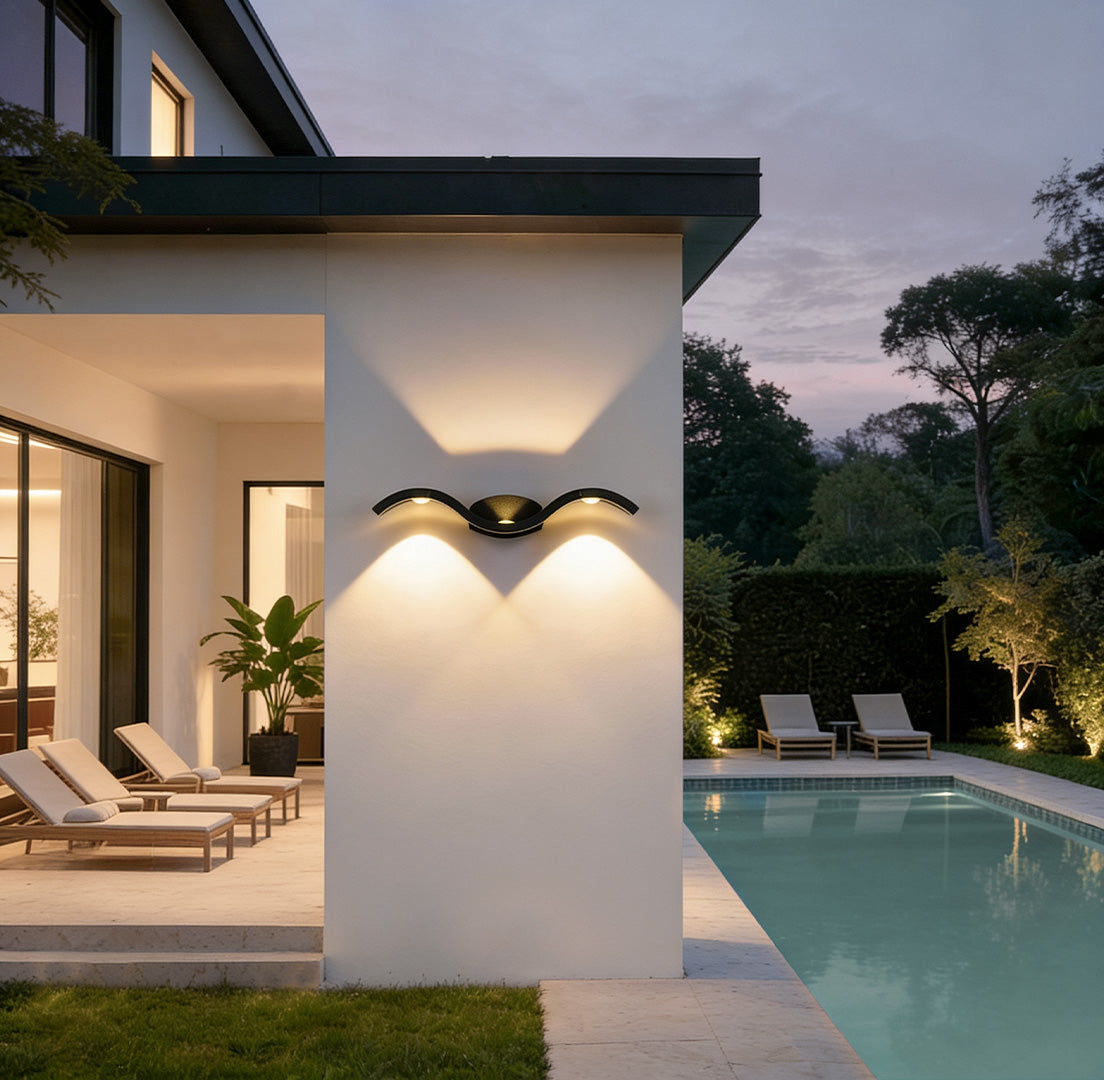
A conventional rectangular sconce may disappear visually on a broad courtyard wall. A wider sculptural fixture can create interest during the day and a layered light pattern after dark, provided the wall has enough open space for the full shape.
Sculptural Light for Open Exterior Walls
Wave Wall Sconce Outdoor Creative Up-Down LED Light
Price: $124.99
Best for patio, courtyard, balcony, and garden walls where the fixture’s wide seagull-inspired silhouette can become part of the exterior design.
- Die-cast aluminum body with a three-light wave design.
- Hardwired 110–220V construction in black or white.
- Available in sets of 2, 4, 6, or 8 for repeated wall layouts.
Garage Walls, Columns, and Modern Facades
Between Garage Doors
Narrow piers between garage bays are ideal for compact vertical fixtures. Repeated beams make a wide garage facade feel organized. However, these sconces rarely provide enough broad illumination for reversing vehicles or seeing the full driveway. Use them as the architectural layer and add suitable area lighting where needed.
On Columns and Pillars
Upward and downward beams reinforce the height of a column. The wall or pillar must be wide enough to catch the beam; otherwise, light spills off the edges and the intended shape disappears. A paper template showing the fixture width and expected beam is a simple way to avoid this mistake.
Across a Long Facade
A row can turn a blank elevation into a nighttime composition. Align sconces with doors, windows, structural bays, or material changes; architectural alignment usually looks better than equal spacing alone.
The Modern Outdoor Wall Lighting collection can help you compare compact cylinders, curved fixtures, and longer linear forms before choosing one repeated rhythm.

Which Wall Surfaces Look Best?
Smooth Stucco or Painted Masonry
Smooth pale walls produce clear, graphic beams and are the easiest surfaces for predicting the result. The downside is that angled light can reveal patches, waves, cracks, and uneven paint. Inspect the wall at night before using a long row of fixtures.
Brick
Brick creates texture and warmth, especially with 3000K light. Narrow beams emphasize mortar joints and can make irregular brickwork look dramatic. If the brick already has strong color variation, choose a restrained fixture shape so the wall and fixture do not compete.
Natural Stone
Stone responds beautifully to directional light, but very rough surfaces break up crisp beam edges. That can be desirable when you want organic shadow rather than a precise hourglass pattern.
Dark Siding
Dark materials absorb more light, so the beam may appear less bright than it does on a white product-page wall. Do not automatically solve this by choosing excessive output; a modest, controlled glow often looks richer on dark architecture.

A Ten-Minute Night Test Can Prevent a Permanent Mistake
Hold or temporarily mount one fixture near the proposed location. View it from the street, doorway, patio seat, and neighboring window before repeating it across the wall.
Placement, Spacing, and Glare
Let Both Beams Breathe
A soffit, balcony slab, window sill, planter, or tall shrub can interrupt the beam. Check the full vertical area around the fixture, not just whether the body fits between trim pieces.
Space by Architecture First
Place fixtures at meaningful architectural points, then evaluate whether the light rhythm feels balanced. On a long blank wall, spacing may be fairly regular. Around doors and windows, alignment usually matters more than equal distance.
Control the View From Seating
Even shielded lights can glare when a person sits very close and looks into the lower aperture. For patios, test from the dining chairs, sofa, and grill position. The article How to Avoid Glare from Outdoor Wall Lights provides a fuller checklist for brightness and viewing angles.
Use Height as a Starting Point, Not a Rule
Door-side fixtures are often mounted slightly above direct eye level, but the correct position depends on fixture height, beam opening, door trim, soffit, and the location of the actual LEDs. For a broader framework, see Wall-Mounted Lighting: Placement, Height, and Coverage.
Coordinate Color Temperature
If nearby porch, landscape, and interior lights are warm white, a cool 6000K wall beam may look disconnected. Use cooler light intentionally with very crisp contemporary materials, not simply because it appears brighter in a product image.
A Realistic Homeowner Example
A couple updating a plain rear patio planned to install six identical up-and-down lights evenly across a 28-foot stucco wall. On paper, equal spacing looked neat. During a temporary nighttime test, two problems appeared: one fixture reflected in the dining-room glass door, and another sat directly behind the main patio chair, creating glare.
They reduced the layout to four lights and aligned them with the wall sections between the doors and windows. The darker gaps made each beam more visible, the glass reflection disappeared, and the patio felt calmer. A separate ceiling light handled food preparation near the grill.
The lesson: outdoor wall lighting should respond to how people move, sit, and look through the space—not only to wall length.
Common Mistakes to Avoid
Expecting Accent Lights to Illuminate the Whole Yard
Up-and-down lights are usually strongest as ambient and architectural lighting. Add task or area lighting where people drive, cook, use stairs, or unlock doors.
Ignoring the Wall Condition
Directional light can expose patched stucco, uneven masonry, conduits, and stains. Repair or clean the wall before installing a repeated pattern.
Using IP54 in a Fully Exposed Location
An IP54 fixture is better suited to sheltered or semi-outdoor conditions when the manufacturer describes it that way. Choose a more weather-resistant option for walls exposed to direct rain and follow the product instructions and local requirements.
Placing a Fixture Too Close to the Roofline
The upper beam may terminate in a harsh bright patch under the soffit. Lower the fixture, narrow the beam, or select a down-only solution if there is not enough vertical room.
Mixing Too Many Beam Shapes
Using narrow cylinders, broad wave fixtures, lanterns, and floodlights on one small facade can feel visually unsettled. Choose one dominant wall-light language and let other fixture types remain quieter.
Skipping Electrical Planning
Hardwired exterior fixtures need suitable boxes, connections, mounting support, weather protection, and controls. Have permanent installation completed or reviewed by a qualified electrician.
Buying and Placement Checklist
- Decide whether the location needs accent light, task light, or both.
- Measure clear wall space above and below the fixture.
- Check soffits, windows, cameras, plants, and neighboring views.
- Compare the wall material with the product-page background.
- Choose 3000K for a warmer residential mood or cooler light only when it fits the architecture.
- Match IP protection to covered, semi-exposed, or fully exposed conditions.
- Test one fixture at night before ordering a large repeated set.
- Coordinate spacing with doors, windows, columns, and structural bays.
- Plan separate practical lighting for driveways, stairs, and work areas.
- Use a qualified electrician for permanent hardwired installation.
Final Advice: Use Them Where the Wall Can Participate
Up and down outdoor wall lights work best when they are chosen as part of the architecture, not simply as decorative replacements for ordinary porch lights. Give the beams enough wall space, choose a surface worth highlighting, and make sure the fixture does not interfere with soffits, windows, cameras, or seated sightlines.
Use compact sheltered fixtures at covered entries, sculptural IP65 options on more exposed patio or garden walls, and repeated simple forms on garage piers and columns. For a wider selection of fixture shapes and weather applications, compare Outdoor Wall Lighting by location rather than by appearance alone.
Most importantly, test the effect at night. A well-placed up-and-down light should make the wall look better, help the space feel comfortable, and support other functional lighting without becoming the brightest object in the yard.


![[Open-Box]Outdoor up down Wall Light Waterproof Adjustable Beam Angle Light](http://dazuma.us/cdn/shop/products/two-way-luminous-outdoor-waterproof-led-wall-light-with-adjustable-beam-angle-788330.jpg?v=1653635295&width=400)
![[Open-Box]Wave Wall Sconce Outdoor Creative Up-Down LED Light](http://dazuma.us/cdn/shop/files/wave-wall-sconce-modern-outdoor-patio-light.jpg?v=1767081429&width=400)