
Who This Is For: This guide is for homeowners who like the clean, rounded look of globe lighting but are unsure whether a globe chandelier or a globe pendant light will fit their room, ceiling, and furniture better.
Introduction
A globe describes a shape, not a complete fixture type. That is why two lights with nearly identical round glass shades can behave very differently once installed. A globe pendant usually suspends one shade and one light source from a cord, cable, or rod. A globe chandelier usually combines several globes on a branching, clustered, or extended frame. The pendant creates a focused visual point; the chandelier occupies more space and becomes part of the room's architecture.
There is some gray area. Lighting names are not applied with perfect consistency, and a multi-light pendant can look a lot like a compact chandelier. Instead of trusting the product label alone, look at the number of light sources, overall width, hanging structure, light distribution, and the amount of visual attention the fixture demands. Those details tell you far more about how the light will feel at home.

The Short Answer
Choose a globe pendant light when you want one clear point of light over a kitchen counter, small table, nightstand, reading corner, or narrow entry. Choose a globe chandelier when the room needs a broader centerpiece, more than one light source, or enough visual scale to relate to a dining table, living area, foyer, or high ceiling.
The better choice is not automatically the larger or brighter one. A small pendant can look beautifully intentional in a compact room, while a wide chandelier can give a large room the visual anchor it has been missing. The goal is to match the fixture's visual footprint—the amount of space it appears to occupy—to the zone below it.
Globe Chandelier vs Globe Pendant Light Comparison
| Feature | Globe Pendant Light | Globe Chandelier |
|---|---|---|
| Typical construction | One suspended globe and one light source | Several globes arranged on a frame, branch, or cluster |
| Visual effect | Simple, calm, and focused | Sculptural, layered, and attention-grabbing |
| Light coverage | Localized; often repeated when broader coverage is needed | Broader, with multiple points of light |
| Best scale | Small to medium zones | Medium to large rooms or focal zones |
| Common placement | Kitchen island, breakfast nook, bedside, small entry | Dining room, living room, foyer, stairwell |
| Planning priority | Shade diameter, repetition, and task-light position | Overall width, total drop, weight, and ceiling-box support |

The Globe Is the Shared Design Language
Clear, opal, smoked, or textured glass can appear on either fixture type. Shade material affects glare and atmosphere, but it does not decide whether the fixture is a pendant or chandelier. The supporting structure does.
What Makes a Globe Pendant Light?
A globe pendant light is usually a single hanging fixture with one round shade and one bulb or integrated light source. Its simplicity is its strength. The eye reads one circle, one drop, and one pool of light. That clean geometry works especially well in modern, mid-century, transitional, and minimalist interiors.
A single pendant can stand alone over a small round table or reading chair. Over a longer island, two or three pendants create rhythm without requiring one wide fixture. This repeatable quality makes globe pendant lights flexible when the room layout may change or when evenly spaced task light matters.
If you want a broader introduction to the category before comparing shapes, the guide What Is A Pendant Light? Complete Guide explains how suspended fixtures work and where they are commonly used.
A Practical Single-Globe Option
This glass pendant is a useful example of what a true single-point fixture does well. The round shade keeps the silhouette soft, while the compact dimensions make it easier to repeat above a counter or use alone in a smaller zone.
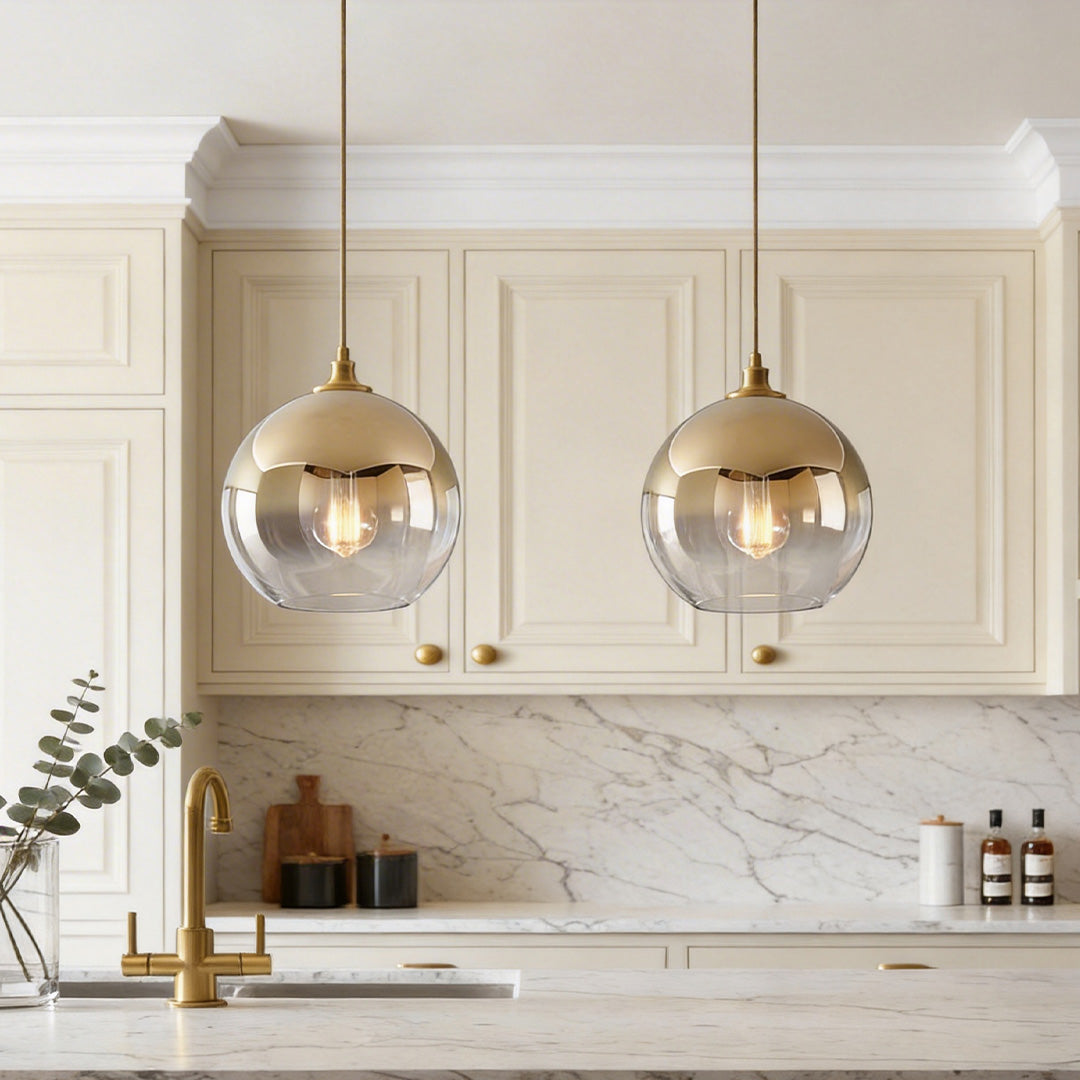
Compact Single-Globe Lighting
Glass Round Pendant Light Modern Single-Ball Ceiling Light
Price: $119.99
Best for kitchen islands, breakfast tables, bedsides, home offices, and other areas that need a clean point of light without a wide ceiling presence.
- The adjustable hanging length helps adapt the fixture to different ceiling heights.
- Gold and silver finishes make it easy to coordinate with common cabinet and furniture hardware.
- Bulb options vary, so confirm whether you are selecting the no-bulb, warm-light, or three-color-temperature version.
What Makes a Globe Chandelier?
A globe chandelier turns the same rounded shade into a larger composition. Several globes may branch outward, gather in a cluster, align along a bar, or descend at different heights. Because the fixture has multiple visual points, it can fill open air above a dining table or seating group more convincingly than one small pendant.
The word “chandelier” does not require crystals, candles, or traditional ornament. Many current globe chandeliers use simple metal frames and clear glass, giving them a light, modern appearance. You can also browse the wider chandelier collection when you want to compare globe arrangements with linear, candle, or starburst silhouettes.
Why Multiple Globes Feel More Architectural
A chandelier creates relationships between several circles, the frame, and the empty space around them. Even with clear glass, that composition can visually connect a large table to a high or wide ceiling.

A Scalable Multi-Globe Option
This bubble chandelier shows how one design can change scale. The three-light version is compact enough for a smaller dining zone, while the seven- and thirteen-light versions spread farther and carry more visual weight.
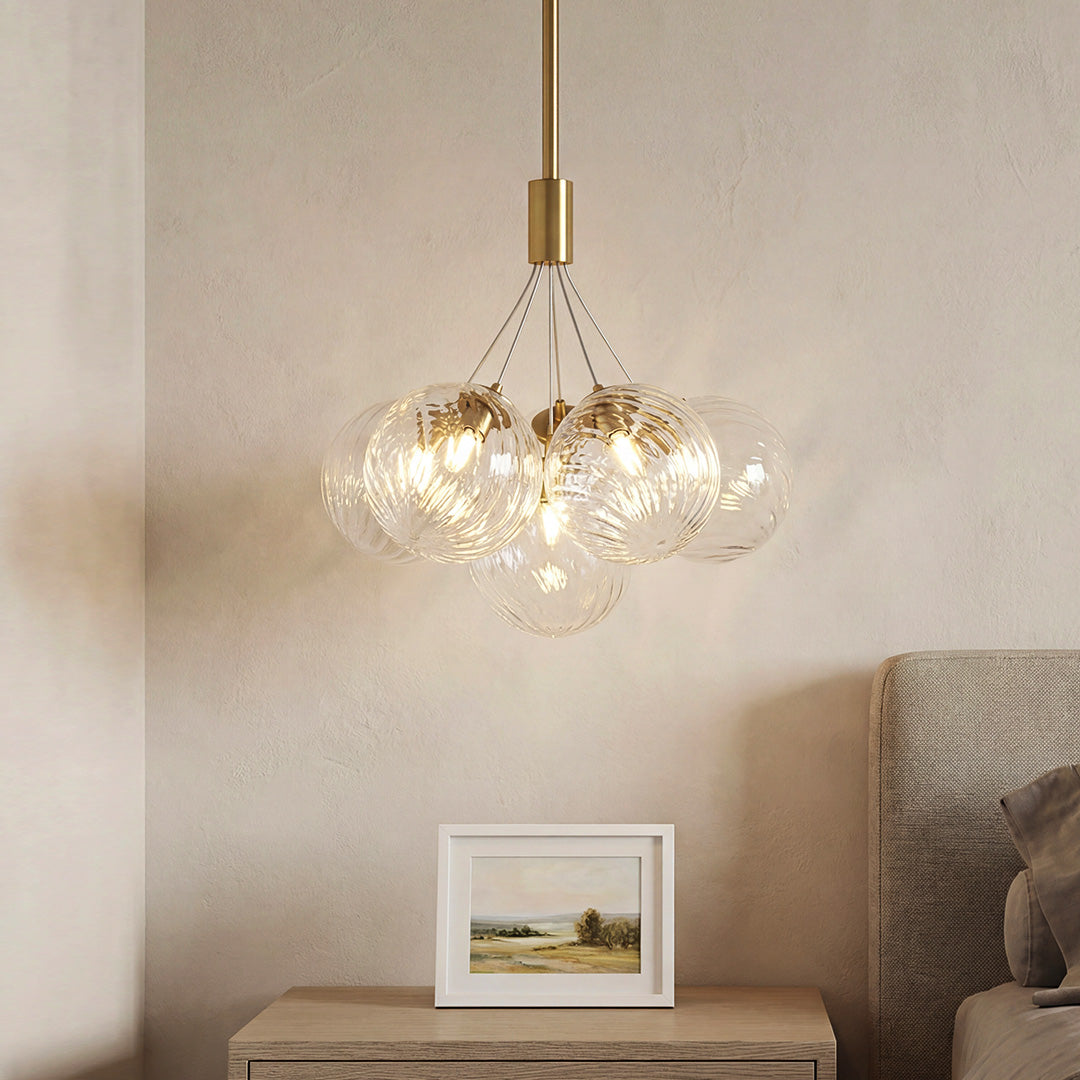
Sculptural Multi-Globe Lighting
Modern Bubble Chandelier Minimalist Solid Copper Ceiling Light
Price: From $265.99
Best for dining rooms, living rooms, and statement zones that need several points of light in one coordinated fixture.
- Clear glass globes keep the multi-light arrangement visually lighter than an opaque fixture of similar size.
- Copper, nickel, and black finishes support warm, bright, or graphic room palettes.
- G9 bulbs are not included, so plan bulb quantity, wattage, and color temperature before installation.
Which One Works Better by Room?
Kitchen Island: Pendants Usually Offer Better Control
Globe pendants are easy to position along the working length of an island. Repeating two or three fixtures gives you control over spacing and keeps the visual rhythm aligned with stools or cabinet sections. It also leaves more negative space than a large clustered chandelier, which can help an open kitchen feel calm.
A chandelier can still work over a kitchen island when the room is large and the fixture is linear or wide enough to follow the counter. Just make sure the globes do not block sightlines across the room. For more detailed spacing guidance, see The Golden Rules Of Pendant Lighting: Sizing & Placement.
Dining Room: Match the Fixture to the Table's Footprint
A single globe pendant can be charming above a small round or square table because the repeated geometry feels deliberate. Over a long six- or eight-seat table, however, one small globe may look visually underweight. A multi-globe chandelier usually relates better to the table's width and creates useful ambient light across more seats.
Do not assume that more bulbs always mean harsh light. Clear globes expose the bulb and can create sparkle, while frosted or opal globes soften contrast. Put a dimmer-compatible fixture and compatible bulbs on a proper dimmer if you want bright dinner preparation and a gentler mood later.

Use Shape Repetition Without Making Everything Match
You can use simple globe pendants in the kitchen and a multi-globe chandelier in the dining area. The round shades connect the zones, while the different fixture structures give each area its own hierarchy.
Living Room or Foyer: A Chandelier Usually Holds the Volume Better
Living rooms and foyers often contain more open air than a countertop zone. A globe chandelier can occupy that volume without making the floor crowded. Choose a configuration that can be appreciated from the main entrance and from seated eye level. In a two-story space, also check how the fixture looks from an upper landing.
Bedroom or Reading Corner: One Pendant Can Feel More Personal
A small globe pendant beside the bed frees the nightstand and creates a quiet, tailored look. It should hang where the glow is useful without placing the bare bulb in your direct line of sight. A compact chandelier is better when the bedroom needs a centered decorative feature and has enough ceiling height to maintain safe clearance.
Size, Height, and Spacing Matter More Than the Label
Start with the furniture or activity zone below the light. Above a dining table, a fixture around one-half to two-thirds of the table width is a useful visual starting range, not an absolute rule. A common starting height is roughly 30 to 36 inches from the tabletop to the fixture's lowest point with an 8-foot ceiling. Adjust for ceiling height, sightlines, fixture transparency, and the manufacturer's installation requirements. The dedicated guide on how high a chandelier should hang over a dining table goes deeper into those adjustments.
Over a kitchen counter, 30 to 36 inches between the countertop and the bottom of a pendant is another practical starting range. With multiple pendants, spacing depends on globe diameter and island length. Rather than forcing a fixed number, mark the fixture centers with painter's tape and view them from the room entrance, sink, and seating area.
For open walkways, preserve comfortable head clearance and follow applicable local electrical and building requirements. A chandelier's listed height is only part of its total drop; the rod, chain, cord, canopy, and any required minimum suspension length can change the installed result.
Measure the Entire Fixture Envelope
For a chandelier, record the maximum width and the lowest point. For a pendant group, measure each globe plus the empty space between them. This “fixture envelope” is what people actually see and move around.

Light Quality: One Bulb Versus Several
A single pendant often provides a more concentrated pool of light. That is helpful for a small work surface, but it may not be enough as the room's only source. A multi-light chandelier spreads light from several positions and can reduce the sense of one bright hotspot, although total brightness still depends on bulb output, shade opacity, and dimming.
With clear glass, the bulb becomes part of the design. Choose bulbs with a shape that looks intentional and avoid excessive brightness at eye level. Frosted bulbs can reduce sharp glare inside transparent globes. For warm residential dining and living spaces, many people prefer a warm white appearance; what matters most is keeping the chandelier and nearby lights reasonably consistent so the room does not look visually divided.
Remember that neither fixture should be expected to do every lighting job. Combine decorative ceiling lighting with recessed lights, wall lights, or lamps when the room needs both atmosphere and practical illumination. Browse broader pendant lighting options if the globe shape does not give you the task-light direction or shade opacity you need.
Common Mistakes to Avoid
- Choosing by shade shape alone: Two globe fixtures can differ dramatically in width, weight, bulb count, and light spread.
- Ignoring the ceiling box: A multi-light chandelier may be heavier than the existing fixture. Have the support and wiring evaluated for the new load.
- Buying too small for the furniture: A tiny pendant over a long table can look accidental even if its style is attractive.
- Using exposed clear bulbs that are too intense: Glass globes can put the filament or LED source directly in view.
- Forgetting cleaning access: Multiple globes take longer to dust and may be difficult to reach over stairs or tall ceilings.
- Assuming every fixture is dimmable: The fixture, bulbs, driver, and wall control must all be compatible.
A Simple Buying Checklist
- Define the job: Is the light meant to illuminate a work surface, create ambient glow, or become the main decorative feature?
- Measure the zone below: Record table or island length and width, not just room dimensions.
- Check the full fixture dimensions: Include the globes, arms, canopy, and adjustable or minimum hanging length.
- Count the light sources: Confirm bulb base, bulbs included or not, maximum allowed wattage, and compatible dimming information.
- Review the glass: Clear glass feels bright and airy; opal or frosted glass gives a softer, more concealed glow.
- Plan the installation: Verify ceiling-box support, wiring, ceiling slope compatibility, and access for future bulb changes and cleaning.
- Mock up the scale: Use cardboard, paper circles, or painter's tape to visualize the fixture envelope before ordering.

Final Advice
A globe pendant light is the more flexible choice when you need one focused drop of light or a repeatable row over a counter. A globe chandelier is the stronger choice when the ceiling needs a wider focal point and the room benefits from several coordinated light sources.
If the product name still leaves you uncertain, ignore it for a moment. Count the bulbs, measure the total width and drop, consider the fixture's weight and support, and picture how much visual space it will occupy above the furniture. Once those practical questions are answered, the difference becomes much easier: the pendant punctuates the room, while the chandelier composes it.
Whichever direction you choose, confirm the product specifications and have hardwired fixtures installed in accordance with the manufacturer's instructions and local requirements. Good globe lighting should feel effortless after installation—even when the planning behind it was careful.