
Who This Is For
This guide is for property owners, facilities managers, contractors, and homeowners who need to light a large outdoor area and want to get the spec right the first time. Whether you're illuminating an arena, parking lot, barn, warehouse perimeter, construction site, or wide residential driveway — the wrong fixture choice means either a dark zone that defeats the purpose or an over-spec'd system that wastes money on energy. This guide tells you exactly what to look for and which products deliver on it.
Flood lights for large outdoor areas are one of the most misspecified product categories in commercial and residential lighting. The two most common errors: buying too little wattage and ending up with a dim perimeter that doesn't actually deter trespassers or illuminate working zones, and buying a single oversized fixture when three correctly-placed smaller units would provide more even coverage. This guide cuts through both problems — with specific wattage guidance, placement math, and two top-performing products that cover the two most common commercial flood light applications.
Wattage vs. Lumens: The Number That Actually Matters

Wattage measures energy consumption. Lumens measure actual light output. They're related but not interchangeable — and confusing them is how most buyers end up with the wrong fixture. A 200W LED fixture from a quality manufacturer will output significantly more lumens per watt than a 200W fixture built with cheap diodes and poor thermal management. The difference can exceed 30% in real-world output even between fixtures with the same wattage rating.
The industry standard for commercial LED flood lights is approximately 130–150 lm/W for well-engineered fixtures. That means:
- 50W: ~6,500–7,500 lumens — adequate for residential driveways, small barn entrances, pathway security
- 100W: ~13,000–15,000 lumens — appropriate for large parking areas, loading docks, mid-size arenas
- 150W: ~19,500–22,500 lumens — suitable for sports courts, warehouse exteriors, large construction perimeters
- 200W: ~26,000–30,000 lumens — required for stadium approaches, large-scale advertising boards, multi-lane roadway sections
For a thorough breakdown of how many lumens different outdoor applications actually require, see our guide: How Many Lumens Do I Need for Outdoor Lighting?
Flood Light Use Cases: Matching Output to Application

Security and Perimeter Lighting
Security flood lights need to eliminate shadows — not just illuminate bright spots. The typical mistake is mounting one very powerful unit at a single point and leaving 60-degree shadow cones on either side. A better approach: three or four correctly aimed 100W units providing overlapping coverage across the full perimeter, with no gap wider than the height of the mounting pole.
Color temperature matters for security applications. 6000K daylight white is the professional standard for security lighting — it matches camera sensor sensitivity, enhances facial recognition, and creates a visual deterrent that warm-white lights don't. Both products featured in this guide use 6000K output.
Browse the full flood lights collection for options across the full 50W–200W range.
Arena, Sports Court, and Stadium Lighting
Sports and arena applications require high uniformity ratios — the ratio of average illuminance to minimum illuminance across the playing surface. Recreational sports courts typically require a uniformity ratio of 2:1 or better, meaning no point on the court should be darker than half the average. Achieving this requires careful fixture placement, not just high wattage. For most full-size courts, six to eight 100W–150W fixtures positioned at the four corners and midpoints of each long side produces an acceptable uniformity ratio without hot spots at the center.
Commercial Exterior Walls and Advertising
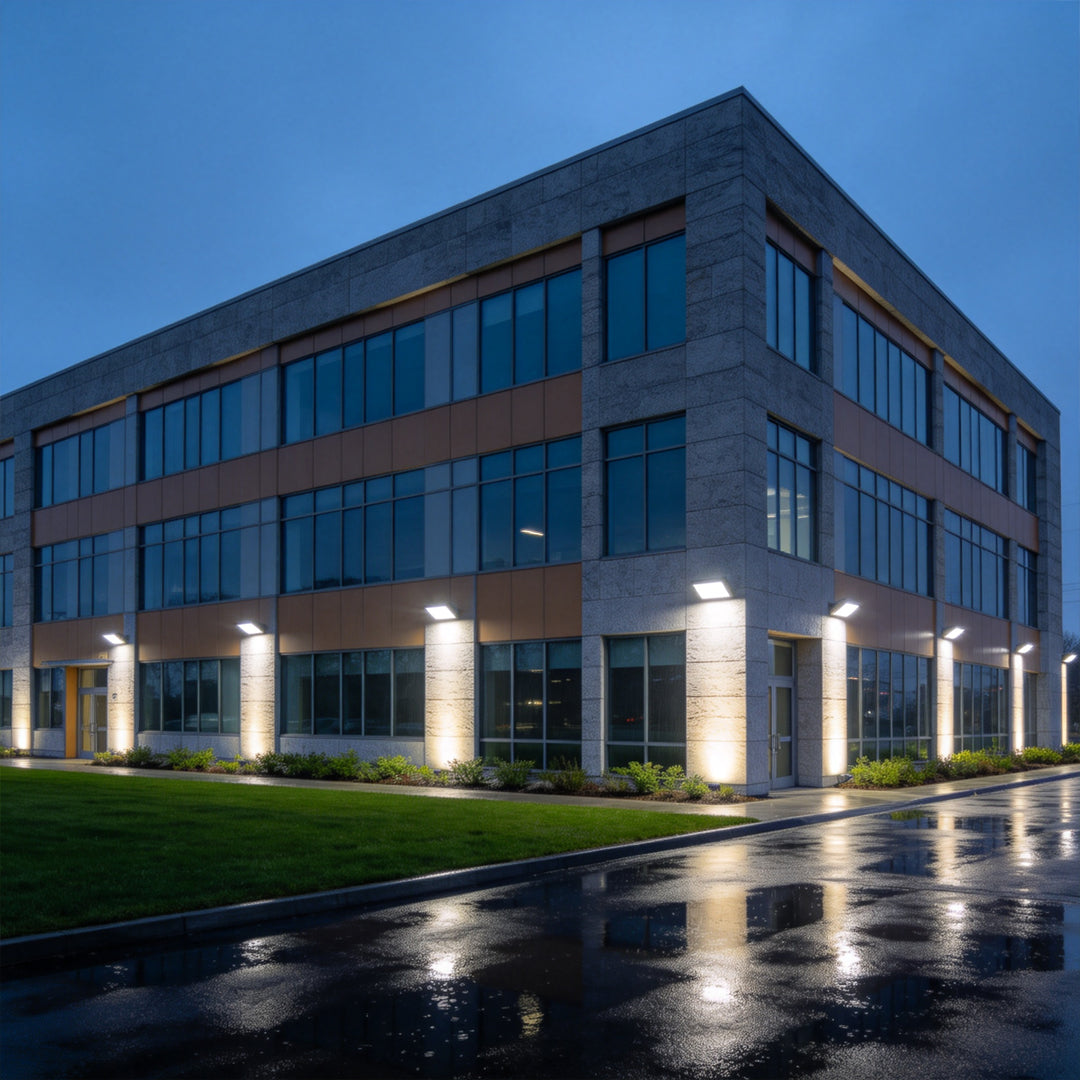
Flood lighting commercial building exteriors and advertising boards requires a different approach than area lighting. Wall-washing applications demand a fixture with a wide, even horizontal beam that distributes light across the full face of the surface without streaking or uneven falloff at the edges. The flat-panel form factor — like the high-power commercial fixture featured in this guide — is engineered specifically for this: its shallow profile keeps the fixture close to the wall and concentrates the beam angle in the vertical plane while spreading it horizontally.
For advertising boards and signage, the standard practice is mounting the fixture at the bottom of the board angled upward, or at the top angled downward — not at the side, where beam spread creates uneven brightness across the sign face. Mounting distance from the sign should be approximately 1/4 to 1/3 the sign's height for optimal coverage.
For guidance on broader commercial and residential outdoor lighting decisions: Commercial and Residential Outdoor Lighting Guide.

Construction Sites and Temporary Installations
Construction site lighting has specific requirements: the fixtures need to be bright enough to support safe working conditions (a minimum of 5 foot-candles at ground level per OSHA standards), durable enough to handle dust, concrete, and incidental impact, and wired for 110–277V to accommodate different site power supplies. Both featured products are rated 110V+ and carry IP65 ratings suitable for construction environments. The modular fixture's field-serviceable construction makes it a practical choice for long-term construction projects where maintenance access matters.
Product Pick #1: Modular LED Flood Light for Arenas and Industrial Sites
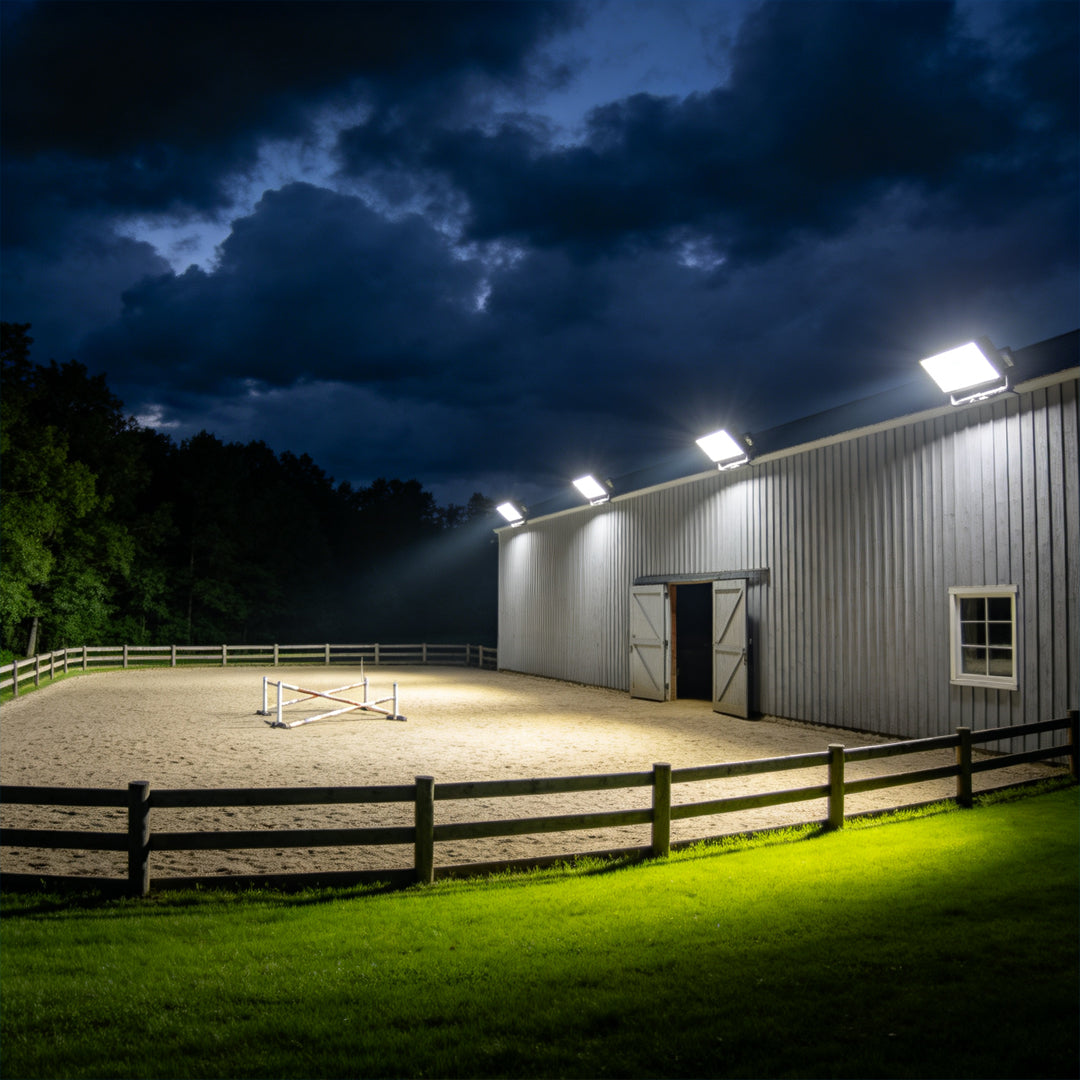
LED Flood Light Lamps for Outdoor Arena and Security
From $188.99 | 50W / 100W / 150W / 200W
- Modular construction — improved heat dissipation, field-serviceable without replacing the full fixture
- 6000K daylight white LED — wide coverage and consistent visibility for security and area lighting
- Aluminum housing + high-transparency tempered glass lens — corrosion-resistant, impact-rated
- IP65 waterproof and dustproof — rated for harsh outdoor environments year-round
- 110–277V universal voltage — compatible with most commercial and residential electrical systems
- Available in 50W, 100W, 150W, 200W — scalable across a wide range of area sizes
- 200W dimensions: 12.36" W × 12.91" D × 5.43" H, 9.92 lb
The modular design is the defining feature that separates this fixture from conventional flood lights. In a standard flood light, the LED module, driver, and housing are sealed as a single integrated unit — if one component fails, you replace the entire fixture. The modular approach decouples those components: a failed driver can be swapped in the field without removing or replacing the housing, lens, or LED array. For large multi-fixture installations running 24/7 — arenas, tunnels, warehouse exteriors — that difference in serviceability translates to real cost savings over a 5–10 year horizon.
The aluminum housing actively manages heat rather than just containing it. In LED systems, thermal management is the primary determinant of long-term lumen maintenance — a fixture that runs cooler retains its initial output longer. The 200W variant's dimensions (12.36" wide) reflect the modular heat sink architecture: wider housing means more surface area, more surface area means lower operating temperature, lower operating temperature means longer life and less lumen depreciation over time.
At 100W, this fixture is appropriate for single large parking bays, loading dock approaches, and mid-size arena zones. At 200W, it covers the primary lighting zones of a full sports court, a warehouse loading dock, or a plaza approach. The 110–277V voltage range makes it compatible with virtually any North American commercial or residential electrical supply without requiring a dedicated transformer.
For a deeper look at high-voltage vs. low-voltage outdoor lighting tradeoffs: High Voltage vs Low Voltage Outdoor Lighting Expert Guide.
Product Pick #2: High-Power Flat-Panel Flood Light for Commercial Exteriors
LED Flood Light Lamp for Commercial Exterior Walls
From $328.99 | 50W / 100W / 150W / 200W
- Flat-panel form factor — low-profile 2.05"–2.20" depth, minimal wind resistance at height
- 6000K bright white LED — concentrated output with broad horizontal coverage
- Aluminum alloy frame + tempered glass cover — IP65 rated for dust and water resistance
- Sleek matte black finish — modern aesthetic suited to commercial facades and high-visibility installations
- 110–265V voltage range — hardwired for permanent installation
- Multi-scenario use: construction sites, stadiums, advertising boards, large commercial exteriors
- 200W dimensions: 15.43" W × 19.57" D × 2.20" H, 12.13 lb
Where the modular fixture is built for serviceability and zone coverage, this high-power flat-panel unit is built for concentrated intensity and long-range projection. The shallow 2.05"–2.20" depth profile is a structural advantage in high-mount applications: a flat panel presents significantly less wind resistance than a deep-body fixture when installed at 30–50 feet on a pole or building facade. This isn't a minor consideration — improperly sized mounting brackets on high-body fixtures in wind-exposed locations are a documented failure point.
The 200W variant's footprint (15.43" × 19.57") maximizes the LED array surface, which directly affects beam uniformity across the target surface. A larger array produces a more diffuse, even beam; a smaller array with equivalent wattage produces a narrower beam with more center hot-spot and more edge falloff. For wall-washing applications — advertising boards, commercial facades, building entrances — the flat-panel's large-array design is the correct specification.
The matte black aluminum alloy finish is both functional and intentional. Functionally, the aluminum alloy construction reduces weight compared to cast iron alternatives while maintaining structural rigidity. Visually, the black finish reads as professional and architectural rather than utilitarian — meaningful for high-visibility commercial installations where the fixture itself is seen during daylight hours.
For installations alongside other outdoor lighting types, explore the full outdoor lighting collection. For landscape-specific flood and spot applications: Master Outdoor Spotlights: A Professional Landscape Lighting Guide.
Side-by-Side Comparison
| Spec | Modular Flood Light (Pick #1) | Flat-Panel Commercial (Pick #2) |
|---|---|---|
| Best For | Arenas, tunnels, industrial facilities, security perimeters | Stadiums, construction sites, advertising boards, commercial facades |
| Wattage Options | 50W / 100W / 150W / 200W | 50W / 100W / 150W / 200W |
| Color Temperature | 6000K daylight white | 6000K bright white |
| Housing Design | Modular deep-body (heat sink fins) | Flat panel (2.05"–2.20" depth) |
| 200W Dimensions | 12.36"W × 12.91"D × 5.43"H / 9.92 lb | 15.43"W × 19.57"D × 2.20"H / 12.13 lb |
| Voltage Range | 110–277V universal | 110–265V |
| IP Rating | IP65 | IP65 |
| Maintainability | Modular — components field-replaceable | Standard — full unit replacement if required |
| Wind Resistance | Standard (deep-body profile) | Superior (low-profile flat panel) |
| Starting Price | From $188.99 | From $328.99 |
Decision rule: If your application involves tunnels, warehouses, or industrial facilities where fixtures are mounted in accessible locations and you want long-term field serviceability, choose the modular unit. If your application involves high-pole mounting, building facades, advertising boards, or any installation where wind resistance and visual profile matter, the flat-panel is the correct specification.
Lumen and Coverage Reference Table
Use this table to select the right wattage for your application. Coverage figures assume a standard mounting height of 15–20 feet and a 120° beam angle. Higher mounting heights require proportionally higher wattage to maintain minimum illuminance levels.
| Wattage | Est. Lumens | Approx. Coverage Area | Typical Application |
|---|---|---|---|
| 50W | 6,500–7,500 lm | ~500–700 sq ft | Residential driveway, barn entry, small lot corner |
| 100W | 13,000–15,000 lm | ~1,000–1,400 sq ft | Large parking bays, loading dock, mid-size arena zone |
| 150W | 19,500–22,500 lm | ~1,500–2,200 sq ft | Sports court, warehouse exterior, construction perimeter |
| 200W | 26,000–30,000 lm | ~2,000–3,000 sq ft | Stadium approach, large advertising board, multi-lane roadway |
Note: Multiply single-fixture coverage by the number of units for total system coverage. Overlap adjacent fixture zones by 20–30% to eliminate dark patches at the boundaries between fixtures.
IP Ratings and Mounting Considerations

Both featured flood lights carry IP65 ratings. For outdoor flood light applications, IP65 is the practical minimum — it covers rain, snow, concrete dust, construction debris, pressure-washing, and sprinkler overspray from any direction. For the vast majority of large outdoor area lighting applications, IP65 is sufficient and correctly specified.
IP67 (temporary submersion rated) is only required for fixtures in low-lying areas subject to standing water or flooding, or for in-ground well lights. For pole-mounted or wall-mounted flood lights at standard installation heights, IP67 offers no meaningful advantage over IP65. For a complete breakdown: IP44 vs IP65 vs IP67 Outdoor Lighting Guide.
Mounting Height and Output Requirements
Mounting height directly affects coverage area and ground-level illuminance. The relationship follows the inverse square law: double the mounting height, and you need four times the lumen output to maintain the same ground-level illuminance. Practical guidelines:
- 10–15 ft: 50W–100W appropriate; residential driveways, small lots
- 15–25 ft: 100W–150W; standard commercial parking, warehouse loading zones
- 25–40 ft: 150W–200W; arena perimeters, large parking structures
- 40 ft+: Multiple 200W units with angled aims; stadium poles, large roadway fixtures
Aim Angle vs. Illuminance: 30° / 45° / 60° Reference Table
Aim angle — the angle of the fixture from horizontal — is the single most under-specified variable in flood light installations. Get it right and you maximize coverage efficiency; get it wrong and you waste a third of your lumen output illuminating sky or wall instead of the ground plane. The table below shows calculated average illuminance (lux) and effective coverage area at the three most common installation angles for both 100W and 200W units.
Calculation basis: LED efficacy 140 lm/W, utilization factor 0.70, maintenance factor 0.80. Coverage areas approximate based on 120° beam angle at the specified mounting heights.
| Mount Height | Aim Angle | 100W Avg Lux | 100W Coverage | 200W Avg Lux | 200W Coverage | Best Application |
|---|---|---|---|---|---|---|
| 15 ft (4.6 m) | 30° (shallow) | ~81 lux | ~1,300 sq ft | ~162 lux | ~1,300 sq ft | Long-range perimeter, fence line |
| 45° (standard) | ~141 lux | ~750 sq ft | ~282 lux | ~750 sq ft | Loading dock, barn entry, small lot | |
| 60° (steep) | ~264 lux | ~400 sq ft | ~528 lux | ~400 sq ft | Entry doorway, concentrated task zone | |
| 25 ft (7.6 m) | 30° (shallow) | ~44 lux | ~2,400 sq ft | ~88 lux | ~2,400 sq ft | Large lot perimeter, roadway section |
| 45° (standard) | ~75 lux | ~1,400 sq ft | ~150 lux | ~1,400 sq ft | Arena zone, warehouse exterior wall | |
| 60° (steep) | ~150 lux | ~700 sq ft | ~300 lux | ~700 sq ft | Stadium entrance, advertising board |
IES reference thresholds: 10–20 lux = basic outdoor security; 20–50 lux = standard parking; 50–150 lux = active commercial area; 150–300 lux = sports court / work zone; 300+ lux = professional sports, advertising boards. Use this table alongside the lumen coverage reference above to determine wattage and aim angle together — one without the other leaves money on the table.
4 Mistakes That Lead to the Wrong Flood Light Purchase
1. Buying based on wattage instead of lumens. Two fixtures with identical wattage ratings can differ by 30% or more in actual lumen output depending on LED quality, driver efficiency, and thermal design. Always verify the lumen specification — not just the watt rating.
2. Single point vs. distributed coverage. One 200W unit producing 28,000 lumens creates one bright zone and leaves shadow cones on either side. Four 50W units distributed across the coverage area deliver more even illumination at the same total wattage. For perimeter security, distributed placement consistently outperforms single high-power point sources.
3. Ignoring beam angle. Wattage and lumens describe how much light a fixture produces. Beam angle describes where it goes. A 60°–90° narrow beam concentrates output for long-range projection or wall-washing. A 120°+ wide beam maximizes ground coverage from a standard pole mount. Verify beam angle on the spec sheet before ordering for a specific application.
4. Underestimating voltage requirements. Commercial sites often run 277V circuits as the standard branch circuit voltage. Fixtures rated only to 240V will fail or require a step-down transformer. The modular flood light featured here is rated 110–277V, covering this without modification. Always confirm voltage compatibility before specifying for a commercial project.
Final Recommendations
There's a version of this decision that goes wrong in a very specific way: you install the fixtures, flip the switch, and realize you're looking at a dim, shadow-patched perimeter that doesn't actually make the space safer, more functional, or more professional. It happens because someone bought based on wattage instead of lumens, picked the wrong aim angle, or chose a fixture format that doesn't match the application. None of that needs to happen.
The modular flood light is the right call for any facility where serviceability matters — warehouses, industrial perimeters, arenas, anywhere a driver failure at 30 feet shouldn't mean a full fixture replacement. The flat-panel commercial unit is the right call when the fixture is going on a building facade, a stadium pole, or an advertising board where low profile, wind resistance, and wide surface illumination are non-negotiable. Both are IP65, both are 6000K, both scale from 50W to 200W. The difference is in what happens over the next ten years of use.
Use the wattage table to get your output right. Use the aim angle table to get your placement right. Then choose the fixture that fits your application — and put up lighting that actually does the job it's supposed to do.