
Who This Is For: This guide is for homeowners deciding between solar and wired pathway lights — whether you're installing fresh, replacing existing lights, or wondering whether solar technology in 2026 has finally closed the gap with hardwired systems.
Let's be honest: for years, solar pathway lights had a reputation problem. The cheap versions faded after a summer. The batteries died before midnight in winter. The light output was so dim you could barely call it illumination. "Solar" became shorthand for "looks good in the store, disappoints in the yard."
That reputation was earned — but it's increasingly outdated. Solar pathway light technology has advanced significantly, and the products available in 2026 are genuinely different from what was on the market five years ago. Better solar panels, higher-capacity lithium batteries, smarter charge controllers, and more efficient LEDs have changed the equation.
But "better than before" isn't the same as "better than wired." This comparison lays out both options honestly — what each does well, where each falls short, and how to decide which one actually belongs in your yard.
How Solar Pathway Lights Work in 2026

A solar pathway light consists of four core components: a photovoltaic (PV) panel that converts sunlight into electricity during daylight hours, a rechargeable battery (typically lithium-ion or LiFePO4 in quality 2026 models) that stores that energy, a charge controller that manages the charging and discharging cycle to extend battery life, and an LED light source that activates automatically at dusk.
The improvements in 2026 models center on three areas:
- Panel efficiency: Monocrystalline panels now common in mid-range fixtures achieve 20–23% conversion efficiency, up from 15–17% in previous-generation polycrystalline panels. The same panel size collects meaningfully more energy.
- Battery chemistry: LiFePO4 (lithium iron phosphate) batteries in premium models offer 2,000+ charge cycles versus 300–500 in older NiMH designs — translating to a fixture lifespan of 5–7 years before battery replacement becomes necessary.
- Smart controls: Dusk-to-dawn auto sensors, motion-activation modes, and adjustable brightness settings are now standard features on quality solar pathway lights rather than premium add-ons.
How Wired Pathway Lights Work

Wired pathway lights — in residential settings, almost always 12V low-voltage systems — connect a series of fixtures via a buried cable run to a transformer that plugs into a standard outdoor outlet. The transformer steps down household current from 120V to 12V, making the wiring system safe enough to handle without an electrician in most jurisdictions and relatively straightforward to install as a DIY project.
The system draws power continuously from the grid whenever the lights are on, which means performance is completely independent of sunlight, season, or weather. A wired pathway light in January in Minnesota performs identically to one in July in Florida — the energy source doesn't change.
The tradeoff is the wiring itself: cable must be run from the transformer to each fixture, buried shallow in the garden, and connected at each light stake. For a simple straight path, this is a manageable afternoon project. For a complex layout with multiple branching runs, it requires more planning, more cable, and more time.
The Honest Side-by-Side Comparison
| Category | Solar Pathway Lights | Wired Pathway Lights |
|---|---|---|
| Installation | Stake in ground — 5 min per fixture | Cable run + burial required; 2–6 hrs total |
| Upfront Cost | Lower per fixture; no transformer needed | Higher; transformer ($40–$150) + cable + fixtures |
| Ongoing Energy Cost | $0 — free sunlight | ~$5–$15/year for a 6-fixture run |
| Brightness (Lumens) | 15–100 lm (quality models); dim on low-sun days | 100–400 lm; consistent every night |
| Winter Performance | Reduced — shorter days mean less charge | No change — fully consistent year-round |
| Shaded Locations | Poor — requires 6–8 hrs direct sun to charge fully | Works anywhere — sunlight irrelevant |
| Reliability | Weather-dependent; battery degrades over time | Highly reliable; performance is predictable |
| Flexibility | Move anytime — no wiring commitment | Fixed once installed; repositioning requires rewiring |
| Lifespan | 3–7 yrs (battery limits lifespan) | 10–20 yrs (LED + quality hardware) |
| Maintenance | Battery replacement every 3–5 yrs; panel cleaning | Minimal — occasional bulb or fixture replacement |
Where Solar Pathway Lights Genuinely Win
Zero Installation Barrier
For anyone without the time, tools, or inclination to run buried cable across a lawn, solar wins by default. Each fixture stakes independently — no transformer, no wire connections, no digging. You can have eight solar pathway lights installed and illuminated in under an hour. That accessibility has real value, particularly for renters, first-time homeowners, or anyone who wants results without a project.
Remote and Off-Grid Locations
If your pathway is at the far end of a large property — a barn approach, a back gate, a garden shed access path — running a wired low-voltage circuit from the house may mean 100+ feet of cable and a very long installation day. Solar handles these locations effortlessly. As long as the path receives adequate sun, each fixture charges and operates independently of anything else on the property.
Flexibility to Redesign
Landscaping changes. Paths get moved. Garden beds get redesigned. Solar pathway lights move with you — pull the stake, relocate the fixture, done. A wired system requires digging up cable runs every time the layout changes, which in practice means most homeowners don't move their wired lights even when the garden design changes around them. For browse our solar pathway lights collection featuring 2026 models with upgraded lithium batteries and monocrystalline panels.

Where Wired Pathway Lights Genuinely Win

Consistent, Reliable Performance Every Night
This is the wired system's most important advantage — and it's not a small one. A wired pathway light delivers the same lumen output on a cloudy November evening as it does on a clear July night. It doesn't care whether the day before was overcast, whether the panel is slightly shaded by a tree, or whether the battery has degraded after three winters. It turns on at dusk and stays on until dawn, every single night, without variation.
Solar pathway lights, even quality 2026 models, cannot make this claim. After a series of cloudy days, a solar fixture operating in low-battery mode may reduce its output by 30–50% or shut off earlier than expected. In climates with long winters or frequent overcast weather — the Pacific Northwest, New England, the upper Midwest — solar pathway lights will underperform for a meaningful portion of the year.
Higher Lumen Output for Functional Lighting
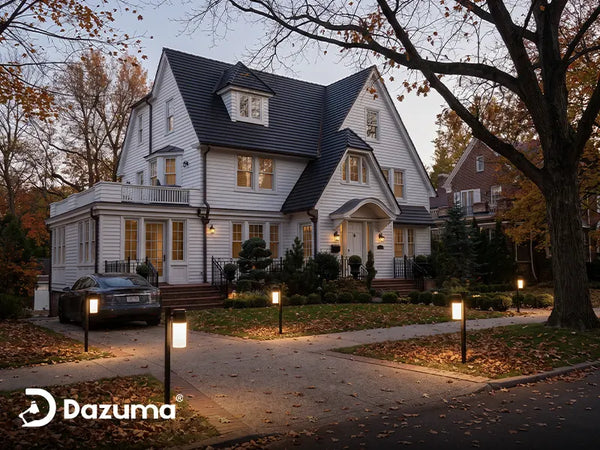
If you need your pathway lights to do actual work — illuminate steps, define a path clearly for elderly family members, provide enough light to navigate safely while carrying groceries — wired systems offer the lumen output to do it. Quality wired pathway lights in the 150–300 lumen range provide genuinely useful illumination. Most solar pathway lights, even improved 2026 models, produce 20–80 lumens in practical operation — enough for ambient atmosphere, not enough for confident navigation in complete darkness.
For pathways where safety and visibility genuinely matter, our wired pathway lights deliver the consistent output that solar simply can't match at equivalent price points.
Long Paths and Complex Layouts
A wired system can run a continuous, consistent line of lighting along any path length — 20 feet or 200 feet — from a single transformer. Each fixture looks identical, operates identically, and maintains consistent spacing and brightness regardless of individual panel positioning. For formal, symmetrical landscaping where visual consistency matters, wired is the only reliable choice.
Real Cost Breakdown: Solar vs Wired Over 5 Years
| Cost Item | Solar (6 Fixtures) | Wired (6 Fixtures) |
|---|---|---|
| Fixtures | $80 – $240 (quality models) | $90 – $300 |
| Transformer | $0 | $40 – $120 |
| Cable / Connectors | $0 | $20 – $60 |
| Installation Time | <1 hour | 2 – 5 hours |
| Energy Cost (5 yrs) | $0 | $25 – $60 |
| Battery Replacement (5 yrs) | $0 – $40 (if needed) | $0 |
| Estimated 5-Year Total | $80 – $280 | $175 – $540 |
Solar wins on total cost of ownership in most scenarios — but that assumes the solar fixtures actually perform adequately for your climate and location. In shaded or winter-heavy environments, solar fixtures that underperform may effectively need replacing sooner, closing the cost gap.
How Much Has Solar Pathway Light Technology Improved in 2026?

The improvements are real, but they're not magic. Here's what has genuinely changed:
- Panel efficiency gains: Monocrystalline panels now standard in mid-range ($15–$30/fixture) products deliver 20–23% efficiency. In practical terms, this means a quality solar fixture can fully charge in 4–5 hours of direct sun versus 6–8 hours previously.
- Better batteries: LiFePO4 chemistry, now more affordable and increasingly used in quality fixtures, maintains capacity through 2,000+ cycles versus 300–500 for older NiMH batteries. A fixture used daily can realistically last 5–7 years before battery degradation becomes noticeable.
- Smarter charging: MPPT (Maximum Power Point Tracking) charge controllers in premium 2026 models extract up to 30% more energy from the panel under variable light conditions compared to basic PWM controllers.
- What hasn't changed: The fundamental physics of solar charging. Shaded locations still underperform. Cloudy climates still mean reduced winter output. Short winter days still mean less charging time. Better technology mitigates these limitations — it doesn't eliminate them.
Which Should You Choose? A Simple Decision Framework
Choose solar pathway lights if:
- Your path receives at least 6 hours of direct sun daily
- You want zero installation effort and full flexibility to reposition
- You're in a mild climate without extended winter overcast periods
- Ambient ambiance matters more than functional brightness
- You're renting, or may redesign the landscape in the next few years
Choose wired pathway lights if:
- Your path is partially shaded or under a tree canopy
- You need consistent, reliable performance every single night
- Functional brightness for safe navigation is a priority
- You live in a climate with long winters or frequent cloudy weather
- You want a permanent installation that will last 10–20 years
Consider both together if you have a long property: use wired lights on the primary front path from the street to the door, and solar lights on secondary garden paths or back areas where wiring would be impractical. This hybrid approach is increasingly popular and leverages the genuine strengths of each system.
Ready to Light Up Your Pathways?
Whether you go solar, wired, or a combination of both, the right pathway lighting transforms a yard from functional to genuinely beautiful after dark — and makes every approach to your front door safer and more welcoming.
At Dazuma, we carry both systems. Browse our full selection of landscape lighting to compare solar and wired pathway options side by side — or explore the complete outdoor lighting collection for fixtures across every outdoor category. Every product is clearly rated for outdoor use, with honest specifications so you know exactly what you're buying before it arrives.
The best pathway lighting isn't the most expensive or the most technically advanced — it's the one that actually works, night after night, in your specific yard.