
Who This Is For: This guide is for homeowners creating a comfortable reading spot beside a sofa, especially anyone who has bought a beautiful floor lamp only to discover that it shines in their eyes, leaves the book in shadow, or crowds the walkway.
Introduction
A floor lamp beside a sofa looks simple in a styled photo: one lamp, one end table, one folded throw. In a real living room, the decision is more personal. You may read upright while your partner reclines. The sofa arm may be unusually wide. A side table may occupy the only obvious spot. The nearest outlet may be on the wrong wall. These small details determine whether the lamp becomes part of your nightly routine or an object you keep nudging out of the way.
The useful question is not only how close the lamp should be to the sofa. It is whether the light reaches the page from the correct direction while the bulb stays outside your direct line of sight. Once those two conditions are right, the exact distance can adapt to your furniture.

Where Should You Place a Floor Reading Lamp Beside a Sofa?
Start with the lamp base just outside the sofa arm and move it slightly behind the reader's shoulder. Aim the light diagonally down toward the lap, not horizontally toward the face. The switch should remain reachable from the seated position, but the base should sit outside the area where your feet land when you stand.
For a right-handed reader, light arriving from the left side usually reduces the shadow cast by the writing hand; reverse that arrangement for a left-handed reader. If you mostly hold a book with both hands, place the lamp on the side that gives the clearest page without reflecting off a tablet screen. This handedness check is more useful than automatically matching the lamp to the nearest outlet.
As a practical starting point, leave a small cleaning gap between the lamp and upholstery rather than pressing them together. Then sit down with an actual book. If the page is bright, the bulb is hidden, the switch is reachable, and you can stand without touching the base, the placement is working—even if it differs from a showroom formula.
Use Four Position Checks Instead of One Distance
The right position is easier to find when you assess four measurements separately: side, depth, height, and reach. This method works for slim task lamps, decorative globes, and broad arc lamps in the Floor Reading Lamps category.

1. Choose the Side That Reduces Shadows
If one person uses the reading seat most often, place the lamp opposite that person's dominant hand. Light from the left helps a right-handed reader; light from the right helps a left-handed reader. In a shared room, choose the side that serves the most-used seat, then use a second ambient source to balance the room visually.
2. Keep the Light Slightly Behind the Shoulder
A lamp set too far forward illuminates your knees and the outside edge of the book. Set too far back, it may light the sofa cushion more than the page. Begin with the lamp head roughly aligned with the back half of your shoulder, then move it forward in small increments until the light lands near the center of your normal reading position.
3. Hide the Bright Source From Seated Eye Level
From your normal posture, you should not see an exposed bulb or a harsh LED point. With a shaded lamp, the lower edge of the shade often sits around seated eye level or slightly above it. With a directional head, aim the beam below your face. If a lamp looks comfortable while standing but glares when you sit, it is too high, too far forward, or insufficiently shielded.

4. Keep the Base Out of the Stand-Up Zone
The lamp should be close enough to operate without leaning dangerously, but not where your heel or a guest's foot will catch it. A broad tripod or four-leg base needs more breathing room than a compact round base. Mark the proposed footprint with painter's tape before ordering; this five-minute test often reveals that the “empty” space beside a sofa is smaller than it looks.
| Placement Check | Good Starting Point | Sign It Needs Adjustment |
|---|---|---|
| Side | Opposite the reader's dominant hand | Hand or arm casts a dark shadow across the page |
| Depth | Light head slightly behind the shoulder | Light falls mainly on knees, cushion, or wall |
| Height | Bright source hidden from seated eyes | Bulb or LED strip is visible and distracting |
| Base and cord | Outside the foot and walking zones | You touch the base or cross the cord when standing |
Placement by Sofa Layout
Standard Sofa Against a Wall
The simplest location is outside one arm, with the lamp head slightly behind the front plane of the sofa. Leave enough space to clean around the base and keep hot components away from fabric. If an end table fills that area, a slim lamp can sit behind the table as long as the shade still clears the tabletop and directs light onto the reader rather than the wall.
Sectional Sofa
Use the open end near the seat where someone actually reads. The inside corner of an L-shaped sectional often looks visually balanced, but it is usually a poor place for a conventional floor lamp: the base becomes hard to access and the light may land between people. A tall arc can reach over an outside arm, while a narrow task lamp can fit near the terminal seat.
Floating Sofa
When the sofa sits away from the wall, place the lamp where its back looks intentional from the room entrance. Route the cord toward a floor outlet if available. Do not stretch a cord across open flooring and hide it under a rug; repeated foot pressure and an invisible edge create both wear and a trip risk. A console behind the sofa can visually anchor the lamp, but confirm that the shade or arc does not collide with décor.
Small Apartment or Narrow Walkway
Do not sacrifice the passage just to achieve a symmetrical sofa arrangement. A lamp can sit behind the sofa arm or in the corner if its head reaches the page. In tight rooms, prioritize a compact base, an accessible switch, and a cord that travels directly to the wall. The broader Floor Lamps selection can help you compare footprints before choosing only by shade shape.
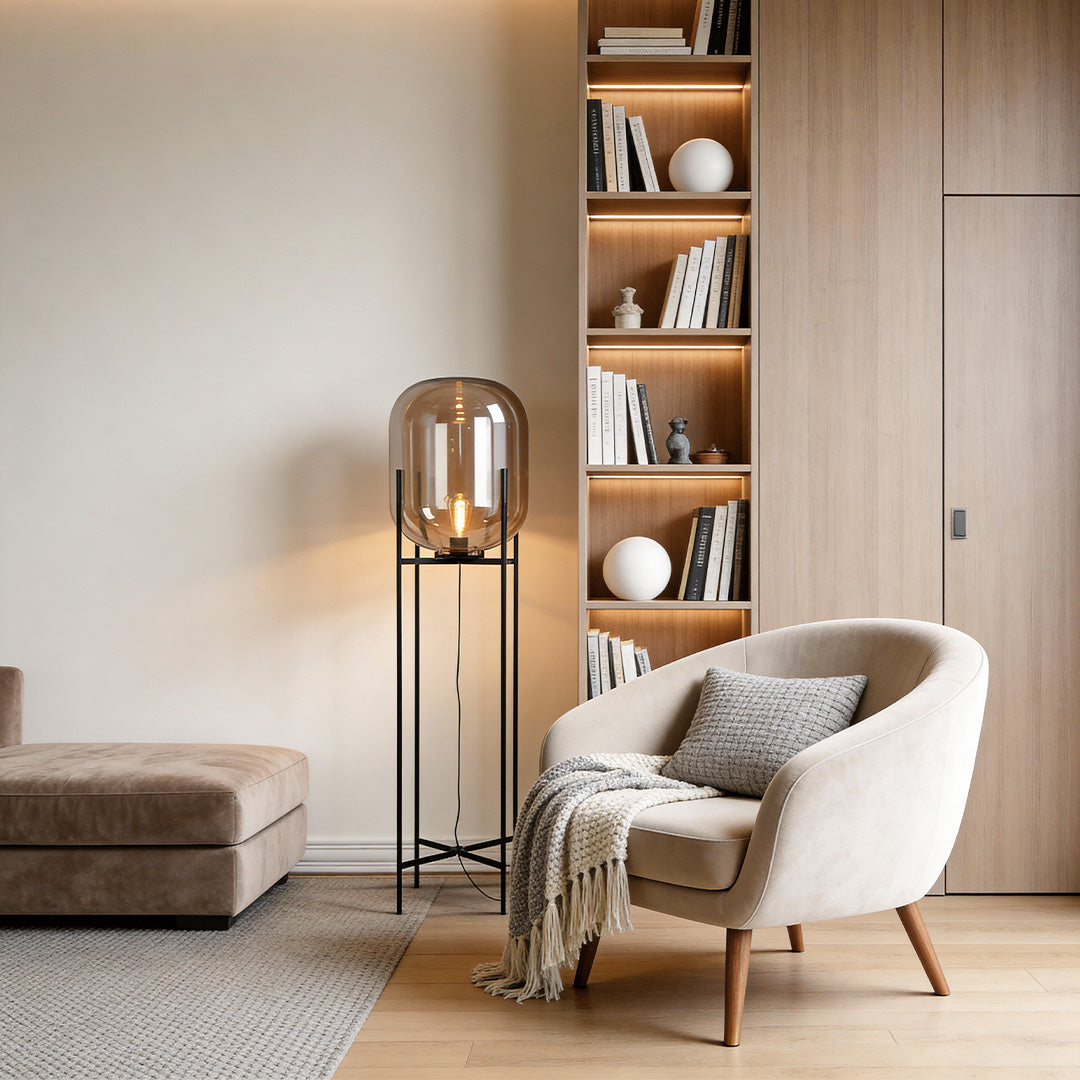
Bubble Glass Floor Lamp
Price: $209.99
Choose the 55.1-inch version for a decorative sofa-side glow. Its hand-blown glass and warm light suit relaxed reading, though the fixed shade is less targeted than an adjustable task lamp.
- Amber or smoke-gray hand-blown glass adds a softer decorative focal point.
- The black metal frame works well with industrial and modern rooms.
- Its 18.9-inch-wide tall version needs a measured, uncluttered footprint.
This type of decorative lamp works best when the room already has some general lighting and the goal is a warm, inviting corner for novels or casual browsing. If you regularly read small print for long periods, a lamp with a more controlled beam may be a better primary task source. You can also review what the best floor lamp height means in different seating arrangements before choosing a fixed-height design.
Straight, Decorative, or Arc Lamp?
Straight Task Lamp
A straight lamp with an adjustable shade is usually the easiest reading solution. It takes up little visual space, and the light can be aimed at one seat. It may feel less decorative than a sculptural floor lamp, but it gives you the most control over glare and page coverage.
Decorative Globe or Glass Lamp
These lamps spread a soft glow and make the sofa corner feel finished. They are often better at creating mood than producing a concentrated reading beam. Choose one when the lamp will share the work with ceiling lights, sconces, or another task source. The Decorative Floor Lamps category is most useful when atmosphere and visible material are part of the decision.

Arc Floor Lamp
An arc lamp is useful when there is no room for a lamp head directly beside the reader. Keep the heavy base beside or behind the sofa arm and let the arc terminate above the reading seat. Never position the arc across a route where people walk beneath it. Measure the full reach, not only the base diameter; this is the most common arc-lamp ordering mistake.
For additional room-specific examples, the guide to where to place an arc floor lamp explains how the same shape behaves near sofas, chairs, and other furniture.
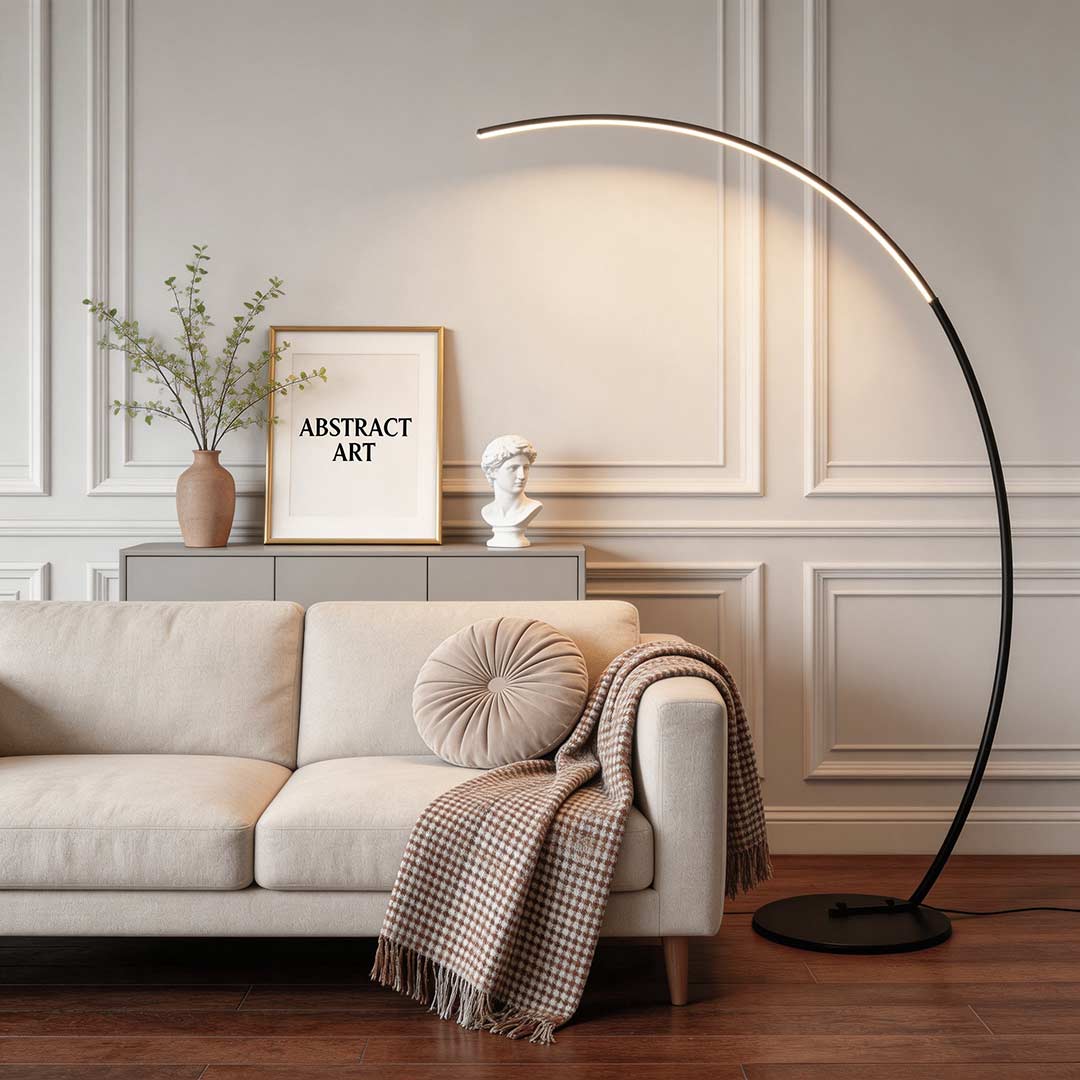
Modern Remote-Control Arc Floor Lamp
Price: $251.99
This slim arc can carry light over a sofa arm when the base cannot sit next to the reader. Select the Dimmable version if you want remote adjustment of both brightness and color temperature.
- The curved LED line spreads light across a broader sofa-side area.
- Black or white finishes suit uncluttered modern interiors.
- The wide arc should be measured against furniture and walking clearance first.
The product page does not publish lumen output or CRI, so choose it for its adjustable placement and dimming range rather than assuming a specific reading performance. Once installed, test the Dimmable version at a warm setting for relaxation and raise brightness only as needed. If the brightest setting still makes you lean toward the page, add a more focused task light instead of accepting eye fatigue.
Choose Light Quality for the Way You Read
Warm Light Is Comfortable, but Brightness Still Matters
For evening reading in a living room, 2700K to 3000K usually feels comfortable alongside warm residential lighting. Color temperature describes the appearance of the light, not how much light reaches the page. A warm lamp can still be bright enough, and a cool lamp can still be too dim. Look for dimming when the same lamp must serve both reading and conversation.
Control Glare Before Adding More Brightness
If the page seems difficult to see, do not immediately buy the brightest lamp. First check whether an exposed source is forcing your eyes to adapt to a bright point while the book remains comparatively dark. Shielding the bulb, moving the lamp behind the shoulder, or changing the angle may improve comfort more than increasing wattage.
Account for Screens and Glossy Pages
For a tablet, move the lamp sideways until the bright reflection disappears from the screen. For glossy magazines, raise or shift the lamp rather than tilting the page continuously. Matte book paper is forgiving; reflective surfaces expose poor placement quickly.
Use a Three-Minute Seated Test
- Read one page in your normal posture.
- Look up toward the television and across the room.
- Stand, sit, and reach for the switch.
- Check the page for hand shadows and screen reflections.
- Walk past the lamp without changing your path.
If all five actions feel natural, the lamp is serving the room rather than asking the room to work around it.

Common Floor Lamp Placement Mistakes
Centering the Lamp on the Sofa Instead of the Reader
A lamp can look perfectly centered in a photograph and still miss the reading seat. Design around the person first. Visual balance can come from art, pillows, or a smaller lamp elsewhere in the room.
Choosing Height While Standing
Glare becomes obvious only after you sit. Always evaluate the shade and exposed source from the lowest relaxed reading posture, not from the doorway.
Letting the Cord Decide the Entire Layout
The nearest outlet is a constraint, not a placement strategy. If the ideal spot is a short distance away, use a properly rated cord-management solution along the perimeter rather than pulling the lamp forward into the foot zone. Never pinch the cord under the sofa leg.

Ignoring Pets, Children, and Everyday Movement
A sculptural lamp with a broad base may be stable but still easy to bump. Keep it outside running routes, avoid dangling pull chains near small children, and secure loose cord slack. If a pet regularly circles the sofa, observe that route before deciding where the lamp belongs.
Expecting One Lamp to Do Every Job
A reading lamp should illuminate the page; it does not have to light the entire living room. Combine it with ambient ceiling light, wall light, or another shaded lamp so the surrounding room is not completely dark. Layering reduces the harsh contrast between the bright book and the rest of your view.
Final Advice
The best floor reading lamp placement is beside the reader, not merely beside the sofa. Put the light on the side that minimizes hand shadows, slightly behind the shoulder, with the bright source hidden from seated eyes. Keep the base clear of feet and the cord clear of traffic. Then test the arrangement with the book, tablet, posture, and seat you actually use.
For a decorative, softly lit nook, a warm glass lamp can make the corner feel welcoming. For greater reach over a sofa arm, an arc lamp can work beautifully if its span and head clearance are measured first. Neither shape replaces the seated test. Comfort is the final measurement—and you can usually feel the difference within one page.