
Who This Is For: This guide is for homeowners who like the handmade, sculptural look of ceramic pendant lights but are unsure whether they can handle the spills, grease, daily cleaning, and constant activity around a kitchen island.
Ceramic Pendants Can Be Practical—With the Right Expectations
Ceramic pendants add texture, softness, and handmade character, but homeowners often worry about grease, bumps, and chipping. Those concerns are reasonable, yet a small shade installed at the correct height is rarely touched during normal use.
Practicality depends more on finish, shade opening, scale, and placement than on the word “ceramic.” Treat these pendants as decorative task contributors: they can focus light on the island while ceiling and undercabinet lighting illuminate the rest of the kitchen.

Quick Answer: Are Ceramic Pendant Lights Practical Over a Kitchen Island?
Yes. Ceramic pendants are practical when they are correctly scaled, hung outside normal movement, and paired with other kitchen lighting. They suit islands used for serving, dining, homework, and light preparation.
Ceramic can chip if struck, but a smooth finish may be simpler to wipe than woven fiber or raw wood. Keep the shades clear of tall appliances, trays, and common leaning paths.
For a broader comparison of glass, metal, wood, and ceramic behavior, see Pendant Light Materials Compared for Every Room.
For a busy kitchen, ceramic is most practical when:
- The shades are compact rather than wide and heavy-looking.
- The surface is smooth enough for gentle routine wiping.
- The bulb opening is accessible without removing the entire shade.
- The pendants hang roughly 30 to 36 inches above the counter as a starting point.
- There is separate ambient and undercabinet lighting.
- The electrical box and hardware are suitable for the fixture weight.
Why Ceramic Pendant Lights Work Well Over Islands
They Add Texture Without Visual Clutter
A small ceramic shade makes white or wood kitchens feel less flat. It hides more bulb hardware than clear glass and creates fewer patterned shadows than woven material.
Opaque Shades Direct Attention Downward
An opaque ceramic shade directs much of the visible light toward the counter, defining the work and gathering zone.
Small Variations Make the Room Feel Collected
Speckling, marbling, and subtle variation keep a new kitchen from looking overly standardized.
They Bridge Modern and Natural Materials
Ceramic pairs naturally with quartz, marble, plaster, wood, brass, and matte black. Browse Ceramic Pendant Light options by finish and shade opening rather than color alone.

The Finish Determines Daily Maintenance
A smooth surface generally releases dust and cooking film more easily than deep grooves, rough unsealed texture, or complex cutouts. Look closely at the finish before choosing by shape.
Ceramic Pendant Practicality Comparison
| Feature | Practical Advantage | Possible Drawback | Best Decision |
|---|---|---|---|
| Smooth Ceramic Surface | Usually simple to dust and gently wipe | Fingerprints or cooking film may show on some finishes | Choose a finish with clear care instructions |
| Opaque Shade | Reduces direct side view of the bulb | Provides less upward and ambient light | Use with recessed or ceiling lighting |
| Compact 6-Inch Shade | Leaves sightlines open and supports grouped layouts | One pendant may look undersized over a long island | Plan two or three based on island length |
| Replaceable Bulb | Allows future changes in brightness and color temperature | Bulb shape may remain visible below the shade | Check base, wattage, dimensions, and glare |
| Rigid Ceramic Material | Holds a crisp sculptural form | May chip if struck or mishandled | Protect during installation and cleaning |
A Compact Ceramic Cone for Grouped Island Lighting
A six-inch cone supports a pair or trio without creating a heavy row, while its downlight form keeps attention on the counter.

Small-Scale Texture With Focused Downlight
Cone Shaped Ceramic Pendant Light Modern Ceiling Light
Price: $109.99
Best for a pair or trio over a small-to-medium island where homeowners want visible ceramic texture without a large opaque fixture blocking the kitchen view.
- White, black, and pink finishes support different kitchen palettes.
- The open bottom provides direct downward illumination.
- A replaceable bulb allows future light-quality adjustments.
Cleaning Ceramic Pendants in a Working Kitchen
Grease Exposure Depends on Location
An island far from the range usually receives less cooking film. Ventilation and distance matter, especially in open kitchens.
Use Gentle, Regular Cleaning
Turn off power and let the fixture cool. Use a soft dry or lightly damp cloth according to its care guidance. Do not soak components, spray into the socket, or use abrasive pads.
Check the Top Edge and Cord
Dust often settles on the shade’s upper shoulder. Simple cones are easier to reach than layered designs; dust the canopy and cord as well.
Plan Safe Access
Plan how the bulb and shade will be reached from a stable position without leaning across a wide counter.
Simple Shapes Are Easier to Maintain
A compact cone or cylinder has fewer ledges than a layered ceramic fixture. Regular light cleaning is easier than waiting for visible kitchen film to build up.

Durability: Where Ceramic Is Strong and Where It Is Vulnerable
Normal Heat and Daily Airflow Are Not the Main Concern
A stationary shade is unlikely to be touched during normal cooking. Impact risk is greater during installation, cleaning, moving, or lifting tall objects.
Protect the Shade During Installation
Keep ceramic wrapped until electrical work is complete. Support the shade during wiring, then confirm the cord, socket, and shade are secure.
Watch for Tall Objects
Floral arrangements, appliances, boards, and boxes can reach high. Busy work islands may need pendants toward the upper end of the practical range.
Confirm Weight and Ceiling Support
The product pages do not list fixture weight. Do not assume the existing box and hardware are sufficient; review support during installation.
Will Ceramic Pendants Provide Enough Island Light?
Opaque Ceramic Controls the Beam
Opaque cones and cylinders send most visible light through the bottom. The island may look bright while walls and circulation areas remain dim.
Bulb Choice Changes the Result
Both products use replaceable E26/E27 bulbs and exclude the bulb. Check brightness, shape, color temperature, and dimming compatibility. A bulb extending below the shade can glare; one sitting too high may create a narrow pool.
Layer the Kitchen Lighting
Pendants support island tasks but work best with ambient and undercabinet light. Compare the necessary layers in Kitchen Lighting.
Use Warm or Neutral Light Intentionally
Warm light flatters cream ceramic, wood, and brass; neutral light can feel clearer in a white task-focused kitchen. Avoid accidental warm-cool conflict with recessed lights.

Best and Worst Locations on a Kitchen Island
Best: Seating and Serving Zones
Ceramic pendants are especially comfortable above island seating, serving areas, and clear preparation surfaces. These zones give the shades a stable visual relationship with stools or place settings and usually involve fewer tall appliances.
Good With Planning: A Sink in the Island
A pendant can work above an island sink when the light helps illuminate washing and cleanup, but check faucet height, cabinet sightlines, and local electrical requirements. Keep the fixture far enough above the work surface that splashes do not become a routine cleaning issue.
Less Practical: Directly Beside a Cooktop
An island cooktop can expose pendants to more airborne grease and heat than a seating zone. It also introduces a range hood, which may compete visually and physically with hanging lights. In that layout, recessed or hood-integrated task lighting is often easier to maintain.
Avoid Major Traffic and Storage Paths
Do not place a low ceramic shade where people lift bar stools, open tall cabinet doors, unpack large boxes, or carry trays through the island. A pendant is safest when its vertical line sits over a fixed counter zone rather than an active passage.
How Many Ceramic Pendants Should Go Over an Island?
Small Shades Usually Work Best in Multiples
Both products are about six inches wide. One may suit a small prep zone, but a pair or trio usually fits a longer island better.
Use the Island and Pendant Together
The number depends on island length and empty space. Kichler recommends at least six inches from island ends and roughly 12 to 24 inches between the widest points of mini pendants, increasing space with diameter.
The existing guide How Many Pendant Lights Over an Island: A Designer's Guide provides a fuller layout method for different island lengths.
Start Around 30 to 36 Inches Above the Counter
Start around 30 to 36 inches above the counter. Comfort, glare, sightlines, and user height matter more than lowering a pendant simply because the ceiling is taller.
Center the Group on the Functional Zone
Center the group on the functional island zone, not automatically the entire slab. Check cabinet doors, sightlines, and ceiling features.

Mock Up the Full Row Before Wiring
Tape the pendant centers and shade widths above the actual island. A six-inch fixture can appear much smaller in the room than it looks in a close product photograph.
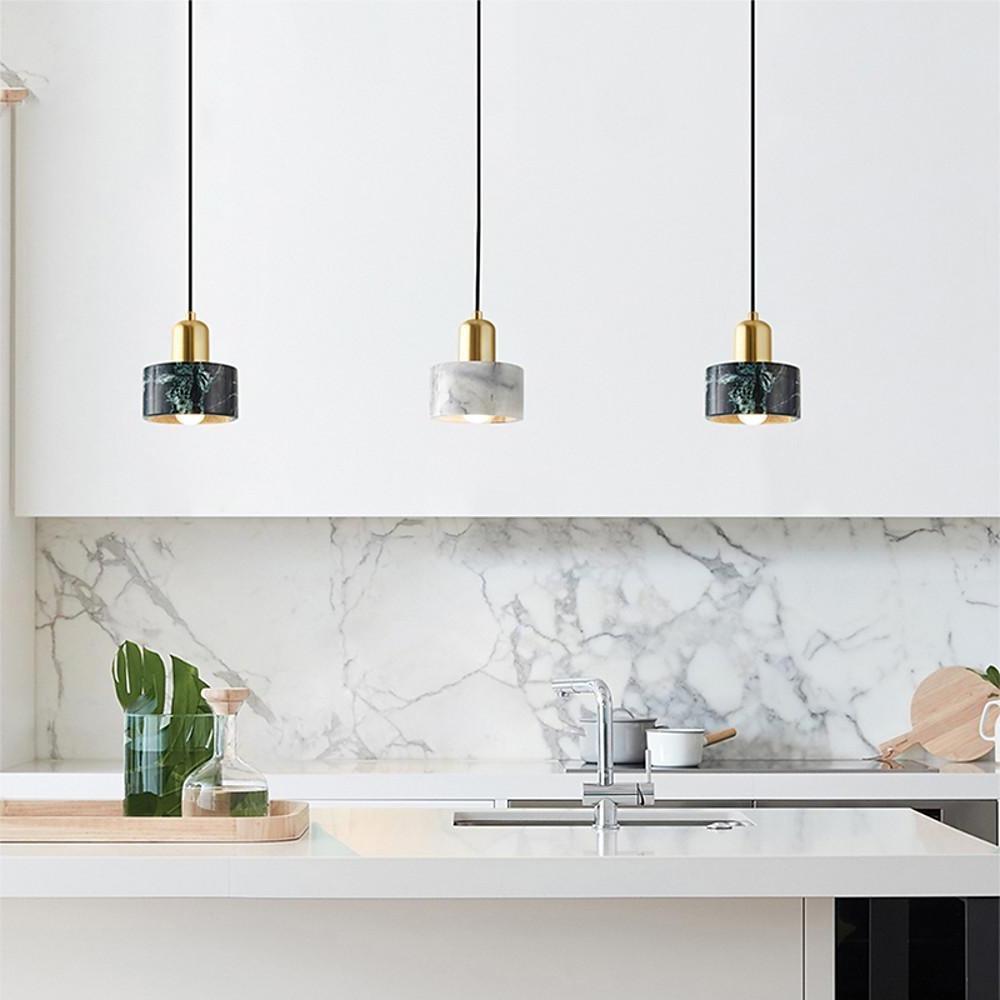
A Compact Ceramic-and-Marble Look for Taller Ceilings
This short cylinder offers a longer adjustable drop. Its white or black marble-look surface and gold-toned detail suit modern kitchens with stone and restrained brass.
Stone-Like Pattern in a Small Modern Profile
Nordic Ceramic Pendant Lighting Marble Ceiling Light
Price: $110.99
Best for a pair or trio over a stone-topped island where the homeowner wants a compact pendant with a longer adjustable drop and a more polished marble-inspired appearance.
- White and black choices coordinate with light or dark stone.
- The compact cylinder leaves open views across the island.
- The product page lists a 60W light-source specification.
How to Pair Ceramic Pendants With Kitchen Finishes
White and Cream Cabinets
White ceramic creates a quiet tonal effect, black provides a stronger outline, and pink introduces a controlled accent.
Natural Wood Cabinets
White and stone-patterned shades lighten oak and walnut kitchens. Gold-toned details relate to warm wood without exact hardware matching.
Black or Charcoal Cabinets
White ceramic separates clearly from dark cabinets. Black shades need pale counters and adequate room lighting.
Stone Countertops and Backsplashes
Do not match countertop veining exactly. Coordinate the overall cool, warm, or black-and-white temperature, then vary pattern scale.
Modern, Organic, and Scandinavian Kitchens
Ceramic softens clean cabinetry. Compare Modern Pendant Lights in metal or glass to decide whether the island needs texture or transparency.
A Realistic Kitchen Example
Imagine a seven-foot island with warm white cabinets, oak flooring, pale quartz, and an eight-foot ceiling. One six-inch paper template looks too small; three conflict with a nearby air vent. Two pendants become the cleaner solution over the main preparation and seating zone.
Mocked up about 33 inches above the counter, they preserve the living-room view and allow a tall family member to lean comfortably. Compatible warm bulbs remain mostly concealed, while recessed and undercabinet lights illuminate the rest of the kitchen.
The pendants are not expected to light every surface. They define the island, focus light, and add texture to an otherwise smooth room.
Common Ceramic Pendant Mistakes
Expecting One Mini Pendant to Fill a Long Island
Product photography can exaggerate scale. Check the real diameter and mock it up before deciding quantity.
Choosing Texture Without Considering Cleaning
Deep grooves and rough surfaces add character but may hold more dust and film. Match the finish to your willingness to maintain it.
Hanging the Shades Too Low
Low pendants can interrupt conversation, create glare, and increase impact risk. Begin with accepted island-height ranges, then adjust for users and sightlines.
Using Pendants as the Only Kitchen Lighting
Small opaque shades create focused pools of light. They cannot replace well-planned ambient, undercabinet, pantry, and circulation lighting.
Ignoring Bulb Visibility
A bulb that extends below a short shade can become the brightest object in the room. Check bulb dimensions before ordering multiples.
Assuming Every Ceramic Finish Has the Same Care Needs
Painted, glazed, matte, textured, and stone-like surfaces may respond differently to cleaners. Follow the care guidance for the exact fixture.
Ceramic Pendant Light Buying Checklist
- Confirm the real shade diameter and height.
- Inspect whether the surface is smooth, textured, painted, or glazed.
- Check how easily the bulb and inside of the shade can be reached.
- Choose the number of pendants from island length and fixture width.
- Mock up spacing, sightlines, and the bottom edge before wiring.
- Keep the group clear of vents, cabinet doors, and tall work items.
- Verify bulb base, wattage limits, shape, color temperature, and dimming.
- Plan separate ambient and undercabinet lighting.
- Confirm fixture weight and ceiling-box support during installation.
- Use a cleaning method approved for the exact finish.
Final Advice: Practicality Comes From Placement, Not Just Material
Ceramic pendants are practical when compact, carefully installed, and kept clear of impact. Choose a smooth accessible form for easier maintenance, and support its focused downlight with other kitchen lighting.
The six-inch cone offers relaxed speckled texture and more color choices. The marble-look cylinder creates a polished connection to stone and metal. Both usually work better in a pair or trio than alone over a long island.
Explore the broader Pendant Lighting category only after deciding how much texture, downward focus, cleaning effort, and visual weight your island can comfortably support.