
Who This Is For: This guide is for homeowners planning to replace an existing ceiling light with a chandelier and wanting to understand the preparation, support, wiring, mounting, and final checks before deciding whether the project is truly DIY-friendly.
Introduction
A chandelier can make a dining room, bedroom, entry, or living space feel finished in a way a basic ceiling fixture rarely does. The visual change happens in one afternoon; the safety of the installation needs to last for years. That means the ceiling support, electrical connections, hanging hardware, clearance, and fixture instructions all matter more than how quickly the job gets done.
Replacing one light with another may look simple from the room below, yet the ceiling box can hide several complications: damaged insulation, unfamiliar conductors, multiple switch legs, old wiring methods, or a box that was never intended to support the new fixture.

This guide explains the sequence without pretending every home has the same wiring. Always follow the instructions supplied with your fixture, applicable local requirements, and the ratings on the electrical box and mounting hardware. If you are still choosing among Chandeliers, review the installation drawing before ordering. Overall weight, canopy size, suspension type, assembly sequence, and minimum or maximum hanging length can materially change the job.
Quick Answer: Can You Install a Chandelier Yourself?
A competent homeowner may be able to replace an existing light with a relatively light chandelier when the ceiling box is securely supported and suitable for the fixture, the existing wiring is in good condition and clearly understood, the ceiling is safely accessible, and local rules permit the work. The power must be turned off at the correct breaker and verified off with an appropriate tester before any conductor is touched.
Use a qualified, licensed electrician when support is uncertain, the chandelier is heavy or difficult to handle, the ceiling is high or sloped, wiring is damaged or unfamiliar, the box contains a complex circuit, no grounding path is apparent, or a new box, brace, cable, switch, or dimmer is required. Stop if the tester gives an unexpected reading. A chandelier is not the project for learning electrical troubleshooting while standing on a ladder.
The most useful principle is simple: separate the structural decision from the electrical decision. A circuit can be wired correctly while the fixture is poorly supported, and a perfectly reinforced box can still contain unsafe or misidentified wiring. Both parts must be right.
Decide Whether This Is a DIY Job
Before opening the canopy, compare your situation with the table below. It is a screening tool, not permission to proceed beyond your training or local requirements.
| Condition | Possible DIY Replacement | Call an Electrician |
|---|---|---|
| Ceiling support | Box and support are secure, identifiable, and approved for the fixture | Box moves, support is hidden or unknown, or reinforcement is needed |
| Wiring | Existing conductors are intact and the circuit arrangement is understood | Brittle insulation, aluminum branch wiring, multiple unknown conductors, or no clear ground |
| Access | Stable floor, suitable ladder, comfortable working height | Vaulted ceiling, stairwell, scaffold need, or unsafe reach |
| Fixture handling | Manageable body with a safe temporary support method | Large, fragile, unusually heavy, or requires several installers |
| Scope | Like-for-like replacement using the existing approved location | New circuit, relocated box, new switch, dimmer changes, or code uncertainty |
When a Straightforward Replacement May Be Reasonable
The lowest-complexity situation is an existing ceiling fixture on a known, correctly labeled circuit, mounted to a solid box that is suitable for the new chandelier. The new fixture has clear instructions, manageable weight, compatible voltage and control requirements, and a canopy that fits the box location. You have the proper tester, ladder, tools, connectors specified for the conductors, and another adult available to help.
Even then, do not assume the old installation proves the support is adequate. A lightweight flush light may have been attached to a box that cannot support a larger hanging fixture. The new chandelier’s instructions and support requirements control the decision.
Stop Conditions That Belong With a Professional
Stop if the box is loose, cracked, unsupported, or hidden behind a makeshift opening. Stop if conductors are scorched, brittle, nicked, crowded beyond safe working space, or impossible to identify confidently. Stop if power remains present after you believe the breaker is off. Also stop when the fixture instructions call for a support method you do not have, or when the chandelier cannot be lifted and held without putting a person, ceiling, or glass parts at risk.
High foyers and stairwells deserve particular caution. A tall ladder on a stair tread is not a safe installation plan. Large Crystal Chandeliers may also require staged assembly after the frame is mounted, specialist lifting, or careful balancing. Professional installation can protect both the people doing the work and the fixture itself.
Tools and Materials Checklist
Your exact list must follow the chandelier instructions and the existing installation. Common items include:
- An appropriate voltage tester that you know how to verify and use correctly.
- A stable ladder rated and sized for the working height.
- Screwdrivers or drivers that fit the supplied fasteners.
- A level, tape measure, painter’s tape, and a pencil.
- Wire connectors suitable for the conductor material, size, quantity, and fixture instructions.
- The supplied mounting strap, crossbar, threaded hardware, canopy, chain, cable, or downrod.
- A safe temporary support method and a second person when the fixture is awkward.
- Bulbs that match the fixture’s base, type, and maximum rating, unless the chandelier has an integrated light source.
- Eye protection and any other protective equipment appropriate to the work.
Do not substitute random screws, wire connectors, hooks, or anchors because they happen to fit. Mounting parts work as a system. If hardware is missing or damaged, obtain the manufacturer-approved replacement or have a professional specify the correct support.
Before You Install the Chandelier
Unpack the fixture on a padded surface and compare every major part with the instruction diagram. Inspect glass, arms, sockets, wire insulation, canopy, suspension components, and mounting hardware. Photograph labels and keep the instructions accessible. Do not remove protective wrapping from delicate parts until the frame is safely hung if the manufacturer’s sequence allows it.
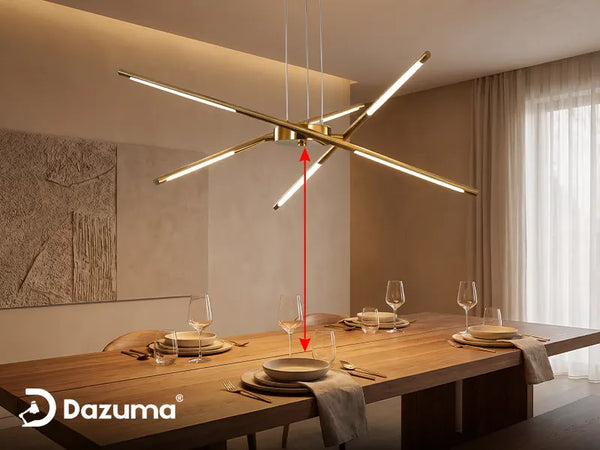
Measure the finished drop before changing the chain or cable. The lowest point must suit the room’s use, not just the ceiling height. Over a table, the fixture can hang lower because people do not normally walk beneath it. In an open foyer or circulation path, head clearance becomes the priority. The guide on how high a chandelier should hang over a dining table covers proportion and sightline adjustments in more detail.
If the fixture uses replaceable bulbs, check the maximum permitted bulb rating and whether the bulbs must be dimmable. For integrated LED fixtures, confirm control compatibility before connecting a dimmer. The fact that a chandelier belongs to the wider Ceiling Lights category does not mean it works with every existing dimmer or wiring configuration.
How to Install a Chandelier Step by Step
The sequence below describes a conventional replacement at an existing ceiling box. It cannot identify your home’s wiring or override the chandelier manual. If any step differs from the supplied instructions, follow the product documentation and consult a qualified electrician.

Step 1: Plan the Finished Height and Assembly Order
Set the intended drop while the fixture is safely supported on the floor. Account for the canopy, chain or downrod, chandelier body, and lowest decorative element. Mark a visual reference in the room and check it from seated and standing viewpoints.
Read the full assembly sequence before shortening any cable or conductor. Some suspension parts can be adjusted later; others cannot be restored once cut. Decide which shades, crystals, or decorative elements are installed before lifting and which must wait until the frame is secured.
Step 2: Turn Off the Breaker and Verify the Circuit
Turn off the circuit at the service panel, not only at the wall switch. Prevent someone else from restoring power while work is underway. Then verify the circuit is de-energized with an appropriate tester, following the tester manufacturer’s instructions. Confirm the tester works on a known energized source before and after checking the work area when that is part of the device’s prescribed procedure.
If you cannot identify the correct breaker, if the tester response is unclear, or if any conductor remains energized, stop. Do not proceed by assuming a wall switch removed the hazard. Electrical safety guidance consistently emphasizes de-energizing the circuit and testing before touching conductors.
Step 3: Remove the Old Fixture and Inspect the Box
Support the old fixture before loosening the canopy or mounting screws. Photograph the existing arrangement only as a reference; it does not prove that the old work was correct. Disconnect the fixture according to the applicable procedure and keep conductors separated and protected.
Inspect the ceiling box and its attachment to framing or an approved support. It should not shift when lightly checked. Confirm that its rating and the complete support system match the new chandelier’s requirements. A decorative crossbar attached to a weak box does not strengthen the structure behind it.

Step 4: Assemble the Fixture and Install Its Support Hardware
Assemble only the parts the manufacturer directs you to install on the ground. Set the suspension length, route the fixture conductors through the approved path, and protect finished surfaces. Attach the supplied mounting strap or support hardware exactly as instructed, using the specified fasteners and orientation.
Create a safe way to hold the chandelier independently while connections are made. Some fixtures include a temporary hanging cable or hook; others require a helper or lifting equipment. Never let electrical conductors carry the fixture’s weight, and do not balance a chandelier on the top of a ladder.

Step 5: Make the Electrical Connections
Identify conductors from the circuit design, verified testing, labels, and the fixture instructions—not from color alone. Common U.S. color conventions can be altered by older work, switch loops, re-identification, repairs, or incorrect prior installation. If you do not fully understand the conductors in the box, this is the point to call an electrician.
Use connectors approved for the specific conductor materials, sizes, and count. Follow the fixture instructions for line, neutral, grounding, and any control leads. Connections should be mechanically secure with no unintended bare conductor exposed. Arrange them inside the box without crushing insulation or forcing the canopy against an overcrowded space. For a more focused discussion, see how to connect chandelier wires safely and correctly.
Step 6: Secure the Chandelier and Canopy
With the fixture still properly supported, attach it to the mounting system in the order shown by the manufacturer. Confirm that load-bearing nuts, couplings, pins, set screws, cable grippers, chain links, and lock washers are fully engaged where applicable. The canopy normally conceals the box and connections; it should not be treated as the primary structural support unless the listed fixture design specifically makes it part of that system.
Tighten hardware firmly according to instructions without overtightening delicate finishes, glass, or threaded components. Check that the canopy sits evenly and that the chandelier hangs without twisting conductors. Do not correct a crooked fixture by pulling on its wire.
Step 7: Add Bulbs or Decorative Parts and Test
Once the frame is secure, install shades, crystals, bulbs, or other elements in the sequence provided. Distribute repeated decorative pieces evenly so the fixture remains visually balanced. Use only approved lamp types and do not exceed the fixture’s stated maximum rating.
Clear tools and people from the work area, then restore the breaker and test the wall control. Observe the chandelier without touching it. If the breaker trips, the light flickers unexpectedly, a dimmer buzzes, parts become unusually hot, or you notice an odor, turn the circuit off and have the installation checked. A successful test also includes confirming the fixture is level, stable, and at the intended height.

Common Chandelier Installation Mistakes
Assuming the existing box can hold any chandelier. The old fixture may have been much lighter. Confirm the support system before transferring weight.
Working from the wall switch alone. Switch position does not establish a safe work condition. Turn off the breaker and verify de-energization.
Identifying wires only by color. Colors are useful clues, not proof of function. Old or altered circuits may not follow the expected pattern.
Letting fixture wires carry the load. Use independent temporary support until the chandelier is mechanically secured.
Cutting suspension cable too early. Measure the complete installed drop and study the adjustment method before making irreversible changes.
Installing all fragile parts before lifting. Unless instructions require otherwise, adding crystals or glass after the frame is secure can reduce weight and damage risk.
Ignoring the dimmer. The chandelier, lamp or integrated LED driver, and dimmer must be compatible. Mismatch can cause poor range, flicker, noise, or failure to turn off cleanly.
Choosing height from a formula alone. Scale, sightlines, table position, ceiling height, and walking clearance must all work together. A coordinated Dining Room Lighting plan should also include other light layers, so the chandelier does not have to produce every kind of light in the room.
Post-Installation Checklist
- The canopy is even and does not move when the fixture is gently observed or checked as the instructions allow.
- The suspension hardware is fully engaged, and no conductor supports mechanical weight.
- The chandelier hangs level and does not contact walls, doors, cabinets, or people using the space.
- Bulbs match the allowed type, base, and maximum rating.
- The switch and any dimmer operate normally without unexpected flicker, heat, odor, or sound.
- All glass and decorative parts are secure and evenly distributed.
- The instructions, spare parts, finish information, and bulb specifications are stored for future maintenance.
Recheck accessible hardware after the fixture has settled only if the manufacturer recommends it, and follow the specified maintenance method. Turn off power before electrical servicing or other work that could expose energized parts. For high or fragile chandeliers, plan professional cleaning and lamp replacement rather than improvising unsafe access later.
Final Advice
Installing a chandelier safely is not about proving that you can finish the job quickly. It is about knowing exactly what supports the fixture, confirming the circuit is de-energized, understanding the existing conductors, following the listed installation instructions, and stopping when the conditions exceed your tools or training.
If the box, wiring, ceiling access, fixture weight, or local requirements create doubt, hire a qualified electrician. Once the support and connections are right, the design work becomes enjoyable: the chandelier can sit at the correct height, frame the table or room, and create the warm focal point you chose it for—without a hidden compromise above the canopy.