
1. The “Uh-Oh” Moment: When the Light Goes Out
It was one of those lazy Saturday mornings, you know the kind where you’ve got your coffee in hand and the day ahead seems like it’s going to be smooth sailing. Until, of course, the ceiling light in the living room flickered... and then flickered again. And then... nothing. The bulb had gone out, and I thought, "No big deal, I’ll just pop in a new one." But nope, turns out, it was the whole fixture that was done for. Ugh.
I was standing there, staring at the dark ceiling light, thinking, “Do I really need to call an electrician for this?” And then, like a light bulb turning on in my head (ironic, right?), I figured, “Why not try it myself?” So, with a bit of courage and a good dose of coffee, I decided to take on the task of swapping out my old, worn-out ceiling light fixture. Spoiler alert: It wasn’t as scary as I thought.

Room illuminated by a ceiling light.
2. Getting Ready: Not Just Tools, But Peace of Mind
I’ll be honest: When I first thought about doing this, I had a mini panic attack. Electricity? High up on a ladder? What if something goes wrong? But then I realized: With the right prep, I could totally handle this.
Step One: Turning Off the Power Let’s get this out of the way first: turn off the power. It seems obvious, but I’ve heard too many stories about people thinking they could get away with just flipping the light switch off. Nope, the circuit breaker is where the magic happens. I went over to the breaker box, flipped the switch for the room, and then—just to be extra cautious—I grabbed my trusty voltage tester. A quick check to make sure the wires weren’t live, and I was ready to dive in.
Step Two: Gather Your Tools Okay, now that I was all set safety-wise, it was time to gather my tools. Here’s what I grabbed:
- Ladder – Because, you know, ceilings are high.
- Screwdriver – A flathead and a Phillips. You never know which one you’ll need.
- Voltage Tester – Seriously, don’t skip this. Better safe than sorry.
- Wire Strippers – If you end up needing to trim wires, this little guy is a lifesaver.
- Electrical Tape – Just in case things need extra insulation or securing.

Tools required for safe light installation work.
3. The Big Moment: Taking Down the Old Fixture
Okay, I’d prepped enough to feel confident. So, up the ladder I went, heart pounding a little as I reached for the old fixture.
First Things First: Remove the Bulbs and Shade No surprises here—I unscrewed the light bulbs and carefully took off the lamp shade. But then came the moment I wasn’t fully ready for: the fixture itself. It was heavier than expected (because why wouldn’t it be?), and it wasn’t exactly just going to pop off.
The Twist: The Wires After unscrewing the fixture, I realized it was still attached by the wires. Time to get up close and personal with those electrical connections. I paused for a second to make sure I wasn’t about to get zapped (again, safety first!). I took a deep breath, and then carefully disconnected the wires. There was black, white, and green... and I made sure to remember which went where. If I had to be honest, I was a bit nervous, but knowing I had double-checked the power was reassuring.
4. The Fun Part: Installing the New Fixture
Here’s where the fun really started. I had my new fixture ready to go, and I was feeling pretty proud of myself. Let’s be real, it was starting to feel like a mini home renovation show in my living room.
Check the New Fixture I unboxed the new black light, which, by the way, looked WAY cooler than the old one. I was getting excited now. I quickly checked that it was compatible with my setup—wattage, voltage, all that good stuff. Easy enough!
Connecting the Wires This was the part that made me the most nervous, but when I looked at the wires from the ceiling and the new fixture, it all made sense. The black wire from the ceiling went to the black wire from the fixture, white to white, and green to green. I twisted those bad boys together with some wire nuts, and used electrical tape just to make sure they stayed put. It felt like the wires were a bit too cozy at first, but a little tug and I was confident everything was secure.
Securing the Fixture Now, I had to mount the fixture. This part felt like a puzzle—fitting the base into the ceiling bracket and tightening everything into place. After a little adjusting and making sure everything was straight, I was ready to move on.

Wiring the ceiling light fixture.
5. The Ultimate Test: Turning It On
I stood back, wiped my hands (well, at least the ones that weren’t covered in dust), and got ready for the moment of truth. Power’s back on. A quick flip of the breaker switch, and I was up on the ladder again to flick the light switch.
It Worked! And then—boom! The light came on. Bright, steady, no flicker. Success! I honestly didn’t expect it to work on the first try, but there it was, shining like a star in the center of my living room. I probably did a little happy dance. Maybe.

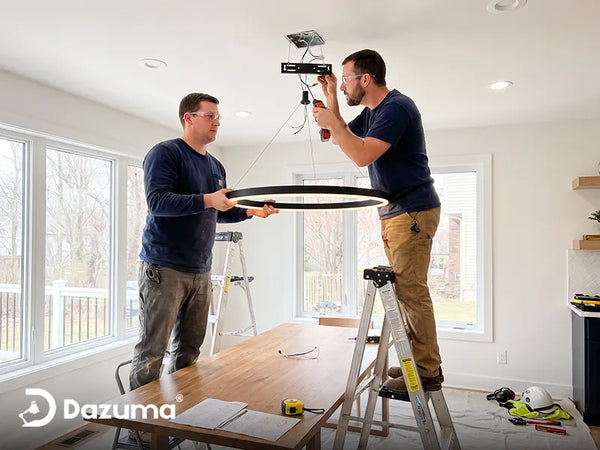
Attaching a modern ceiling light fixture.
6. The “What If” Moment: Troubleshooting
Of course, as the light stayed on, I had one of those “Wait, did I do this right?” moments. I was thinking about the wattage and whether I’d grabbed the right bulbs. Luckily, no issues at all—everything worked smoothly. But I definitely made a mental note to check bulb compatibility before I dive into my next light fixture swap.
7. Conclusion: A Small Task, Big Satisfaction
All in all, changing my ceiling light fixture turned out to be way easier than I had imagined. And the best part? I did it myself. No calling the electrician, no waiting around—just me, my tools, and a new light shining in my living room.
So, if you’ve got an old light fixture giving up on you, don’t panic. Just follow these steps, and you’ll have a brand new light in no time. Seriously, if I can do it, you can do it. And when that light flickers on, you’ll feel like a total pro.