
Who This Is For: This guide is for homeowners planning a freestanding lamp post beside a residential driveway, gate, or front walk and trying to choose a height that looks proportional, lights the route, and stays comfortable for drivers and pedestrians.
Quick Answer: Start Around 6 to 8 Feet for a Residential Lamp Post
For many residential driveways and main front walks, a total lamp post height of roughly 6 to 8 feet—from finished grade to the top of the lantern—is a practical design starting range. A post near 6 feet feels more intimate and usually suits a shorter walk, smaller front yard, or modest one-story home. A post closer to 7 or 8 feet has more presence beside a wider driveway, gate, larger facade, or deeper setback.
This is a visual and functional starting point, not a universal installation rule. The final height depends on the lantern body, pole, base, house scale, driveway width, grade, beam pattern, nearby planting, sightlines, and any local requirements. A tall post with a small lantern can look thin and commercial; a short post with a large lantern can feel top-heavy and place the brightest glass directly in a driver's eyes.

Measure the Complete Fixture, Not Just the Pole
Product descriptions may list a pole height, lantern height, or total assembled height. These are not interchangeable. For planning the visible result, measure from the finished ground surface at the installation point to the highest part of the complete fixture. Include the exposed base, post, fitter or mounting collar, lantern, and decorative cap.
Also separate visible height from buried or anchored length. A direct-burial post may extend below grade, while a surface-mounted post may attach to a concrete footing or base. The amount below ground does not contribute to the visual height, but it is essential to structural stability. Follow the specific fixture, post, footing, wiring, and local installation requirements rather than estimating burial depth from appearance.

Mock Up the Full Silhouette Before Buying
Use a painter's pole, PVC pipe, or wood strip to mark the proposed post height, then attach a cardboard outline of the lantern at the top. View it from the street, driveway, front door, and main windows. This simple test reveals scale problems that a dimension sheet cannot. Browse lamp posts with the total assembled height in mind, not the pole alone.
Lamp Post Height by Location
| Location | Practical Starting Height | Design Goal | Main Check |
|---|---|---|---|
| Short front walk or small yard | About 5.5–6.5 ft total | Welcoming, pedestrian scale | Keep bright glass above direct eye level |
| Main driveway entrance | About 6.5–8 ft total | Mark the entry and improve visibility | Vehicle clearance and sight triangle |
| Wide circular or long driveway | About 7–9 ft total | Stronger visual anchor and broader reach | Avoid a commercial streetlight effect |
| Top of an existing masonry pier | Judge complete pier-plus-lantern height | Frame a gate or driveway entrance | Lantern scale, cap size, and mounting base |
These ranges are best used for a temporary mock-up. A six-foot total fixture may be perfect on one property and disappear on another because the house sits higher, the driveway is wider, or the planting bed is deep. Always evaluate the fixture from the direction people first see it.
Beside a Front Walk: Keep the Scale Pedestrian
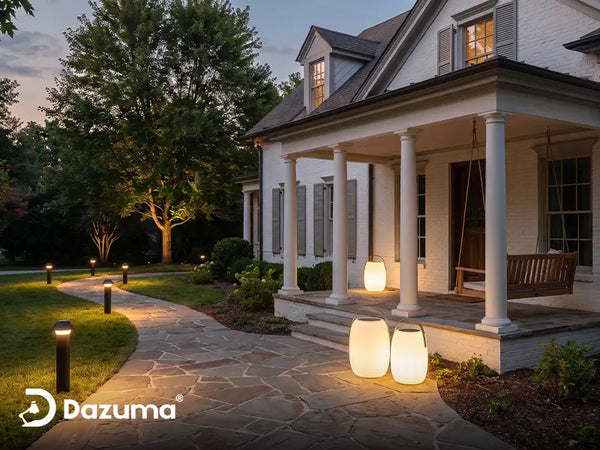
Near a front walk, the post is experienced at close range. A total height around 5.5 to 7 feet often feels comfortable because the fixture reads as part of the garden and entry sequence. Keep the lantern high enough that the brightest visible element does not glare into a pedestrian's eyes, but do not raise it so far that the light misses the pavement.
If the route already has several path lights, the lamp post does not need to provide uniform illumination along the entire walk. Let it mark a junction, gate, address, or transition to the porch while the lower fixtures guide the route.
Beside a Driveway: Increase Presence Without Creating Glare
A driveway post is viewed from farther away and against a larger paved surface, so it can usually carry more height. Around 6.5 to 8 feet is a useful first mock-up for a typical residential entrance. Taller may work for a broad circular drive or large property, but height alone does not guarantee better coverage. The lantern's optics, shielding, and output determine where the light actually lands.
Check the View from the Driver's Seat
Park at the approach and exit positions after dark. The lantern should help define the driveway edge without hiding pedestrians, signs, or oncoming traffic behind a bright source. Move the post farther from the pavement or adjust the lantern choice when direct glare dominates. The comparison Bollard vs. Post Lights: Which Is Better for Driveways? is helpful when a lower repeated fixture may suit the route better.

On a Masonry Pier: Count the Pier as Part of the Height
A pier-mounted lantern is not a freestanding post, even though it serves a similar visual role. Measure from finished grade to the top of the lantern, including the column. A four-foot masonry pier with a two-foot lantern already creates a six-foot composition. Adding a tall pole above the pier would usually be unnecessary and visually unstable.
The lantern should fit the width of the pier cap and leave enough visible margin around its base. Use pillar lights when the property already has masonry columns, gate piers, or low walls that can provide the architectural base.
Match the Lamp Post to the House and Landscape
Post height should relate to more than the person standing beside it. Compare it with the front door, eaves, porch columns, garage openings, mature shrubs, and the distance from the street. A low post can vanish behind planting. A tall post can compete with a one-story roofline or look like a small municipal streetlight.

The Lantern and Pole Must Scale Together
A useful fixture looks like one composition, not a lantern placed on an unrelated stick. As pole height increases, the lantern often needs more visual mass. A broad base or tapered pole can also make a taller fixture feel grounded. Compare the complete silhouette against the home rather than selecting the lantern and post separately by style.
Plant growth deserves attention. A post placed in front of young shrubs may look tall at installation and disappear after several seasons. Either keep planting below the lantern and beam or locate the post in a defined hardscape or low planting zone. Leave practical access for cleaning, bulb replacement, finish maintenance, and snow removal.
Height and Placement Have to Be Planned Together
A correct height in the wrong place still produces a poor result. Keep the post outside vehicle swing paths, door-opening zones, snowplow routes, mower paths, and the likely travel line of delivery vans. Check how cars turn into and out of the drive, not only how a parked car sits.
At a driveway entrance, do not let the post or surrounding planting block the view of pedestrians, cyclists, or traffic. Local rules may regulate setbacks, rights-of-way, easements, maximum fixture heights, sight triangles, and electrical work. Verify property boundaries and underground utilities before choosing the final location or digging.
Beside a walk, a small setback from the pavement helps protect the post from carts, shovels, and shoulder contact while allowing the beam to reach the surface. There is no single offset that works for every lantern; test the actual beam after dark. A wider post or outward-projecting lantern may need more clearance than a narrow, shielded design.
How to Handle a Sloped Driveway or Uneven Ground
On a slope, measuring the same distance up from the pavement at two separate posts can create a pair that looks crooked against the gate or architecture. Decide what the posts should align with: the driveway entrance, gate top, masonry piers, or broader property line. Then compare the tops and lantern centers from the main viewing direction.
Pair Alignment Is Visual, Not Merely Numerical
Two posts can have identical manufactured heights and still finish at different elevations. For a paired entrance, mock up both complete fixtures and view them from the road. Sometimes the posts need different exposed lengths or properly designed bases to make the lanterns align. Structural and electrical details must still follow the approved installation method.

A single post on a slope should appear vertical and stable, not visually lean with the grade. Create or use a suitable level mounting condition as required by the system. Avoid improvised wedges or decorative bases that can trap water or weaken anchoring.
Light Output, Glare, and Color Affect the Right Height
A clear lantern with a bright exposed bulb may require more height or stronger shielding to stay comfortable. A frosted or downward-directed lantern can sometimes sit lower because the source is less aggressive. This is why fixture height and brightness cannot be specified independently.
For a residential approach, warm white light often creates a more welcoming effect on brick, stone, planting, and wood than cool blue-white light. Consistency matters: if the porch and path are warm, a much cooler lamp post can make the entrance feel disconnected. Use enough output to reveal the route and address without turning the lawn or street into a uniformly bright field.
If the lamp post is only one layer in a larger plan, coordinate it with outdoor lighting at the porch, garage, steps, and landscape. The post should establish a destination or boundary, while lower fixtures handle detailed navigation.
Common Lamp Post Height and Placement Mistakes
- Reading pole height as total fixture height. Add the visible base, collar, lantern, and cap before judging scale.
- Choosing height before choosing the lantern. The lantern's size and source visibility change what height feels comfortable.
- Using a small lantern on a tall pole. The result can look thin, temporary, or commercial.
- Installing too close to the driveway edge. Consider mirrors, doors, turning vehicles, plows, and service access.
- Ignoring the driver's view. Bright glass can hide the very people and edges the light is meant to reveal.
- Following sloped pavement for a paired layout. Align the composition to the entrance and test it from the road.
- Expecting one post to light the entire front walk. Use lower path lighting at curves, steps, and dark gaps.
- Forgetting mature planting size. Shrubs can block the fixture, beam, and maintenance access.
Pre-Installation Checklist
- Confirm whether the listed dimension is pole height or total assembled height.
- Mock up the complete post and lantern at the proposed location.
- View it from the road, driveway, front walk, door, and major windows.
- Check vehicle turns, doors, mirrors, plows, mowers, and pedestrian clearance.
- Verify that the lantern illuminates the intended pavement or entrance area.
- Test glare from both a driver's and pedestrian's eye level.
- Coordinate the post with porch, path, gate, and landscape lighting.
- Account for grade changes, future plant growth, and maintenance access.
- Confirm property lines, utilities, local requirements, and the approved mounting method.
For a front walk that also needs multiple lower fixtures, read How Far Apart Should Path Lights Be Installed? before deciding that a taller or brighter post should cover every section of the route.
Final Advice
Start around 6 to 8 feet total height for many residential driveway and main-walk lamp posts, then refine the choice using the full lantern size, property scale, beam pattern, grade, and approach views. A smaller front walk may feel better closer to 5.5 or 6.5 feet, while a broad driveway entrance may support 7 or 8 feet.
The most reliable method is a full-size mock-up and nighttime test. The right post should mark the route, feel proportional in daylight, and provide useful light after dark without becoming the brightest object in the view. Height is successful when people notice where to go before they notice the pole itself.