
Who This Is For: This guide is written for homeowners, landscape designers, and DIY enthusiasts who want to upgrade their outdoor lighting — whether the goal is better security, more curb appeal, or simply figuring out which fixture belongs where.
Walk through any well-lit neighborhood after dark and you'll notice something: not all outdoor lights are doing the same job. Some wash an entire driveway in broad, even brightness. Others single out a beautiful oak tree or a stone pathway with a precise, dramatic beam. These two very different effects come from two very different fixtures — flood lights and spotlights.
The confusion is understandable. Both are used outdoors, both can look similar in a product listing, and both get marketed for "security" or "accent" purposes. But choosing the wrong one for the wrong application can leave you with wasted light, wasted energy, and a yard that simply doesn't look — or function — the way you imagined.
In this guide, we'll break down exactly how these two types of outdoor lights differ in beam angle, lumen output, placement strategy, and design intent — so you can make the right call for your home.
What's the Real Difference Between Flood Lights and Spotlights?
At their core, the distinction comes down to one thing: beam angle.
A flood light projects a wide beam — typically 120° or more — that spreads across a broad area evenly. Think of it like a flashlight that's been flattened into a wide fan shape. It's designed to illuminate zones, not targets. The goal is coverage.
A spotlight, by contrast, delivers a focused, narrow beam — usually between 25° and 45° — that concentrates light on a specific object or point. It's precise, directional, and intentional. It says: look here.

That single design difference cascades into differences in lumens needed, mounting height, fixture placement, and overall use case. Get that foundation right, and every other outdoor lighting decision becomes much clearer.
Understanding Beam Angles
Beam angle is measured in degrees and describes the cone of light a fixture emits. The wider the angle, the more spread — but also the more diluted the brightness over distance. The narrower the angle, the more concentrated the beam, but the smaller the illuminated footprint.
| Beam Angle | Category | Best For |
|---|---|---|
| 10° – 20° | Very Narrow Spot | Flagpoles, sculptures, tight architectural details |
| 25° – 45° | Spotlight | Trees, shrubs, wall textures, accent features |
| 60° – 90° | Wide Flood | Walkways, decks, garden beds |
| 120°+ | Flood Light | Driveways, yards, parking areas, security zones |
How Distance and Height Affect Coverage
Here's a practical formula worth bookmarking: Coverage Diameter ≈ 2 × Mounting Height × tan(Beam Angle ÷ 2). A flood light with a 120° beam mounted at 10 feet covers roughly a 34-foot diameter circle. That same height with a 30° spotlight covers just about 5 feet across. Same mounting height — dramatically different footprints. This math is why placement height matters as much as the fixture itself.
When to Choose Flood Lights Outdoors

Flood lights are the workhorses of outdoor lighting. When your goal is broad, reliable coverage — whether for safety, security, or general visibility — a flood light is almost always the right answer.
Security and Motion-Activated Coverage
For home security, you want light to appear instantly across a wide area the moment someone enters your property. A flood light's wide beam angle eliminates shadows and blind spots across an entire driveway, backyard, or side passage. Paired with a motion sensor, it becomes one of the most effective deterrents available — well-lit exterior areas are consistently shown to reduce the risk of residential break-ins.
Driveways, Parking Areas, and Garages
Large, flat surfaces need even, shadowless light. A single well-placed outdoor flood light — or two flanking a garage door — can bathe the entire area in consistent brightness, making it easy to navigate, park safely, and unload groceries at 9 PM without squinting into the dark.
Large Yards and Open Entertaining Spaces
If you're hosting a backyard barbecue, letting kids play after sunset, or simply want to feel safe stepping outside at night, flood lights deliver the ambient coverage you need. One high-output fixture mounted on an eave or pole can light a substantial backyard without requiring a complex multi-fixture installation.
Sports Courts and Active Areas
Backyard basketball courts, tennis courts, and open lawn game areas all require flood-level illumination. You need consistent brightness that reaches across the entire play surface with no dark zones. High-output flood lights in the 3,000–5,000 lumen range are the standard choice for these applications.
When to Choose Spotlights Outdoors
Spotlights are the artists of the outdoor lighting world. They don't try to light everything — they make deliberate choices about what deserves to be seen. If flood lights provide the stage, spotlights direct the performance.
Architectural Accent Lighting
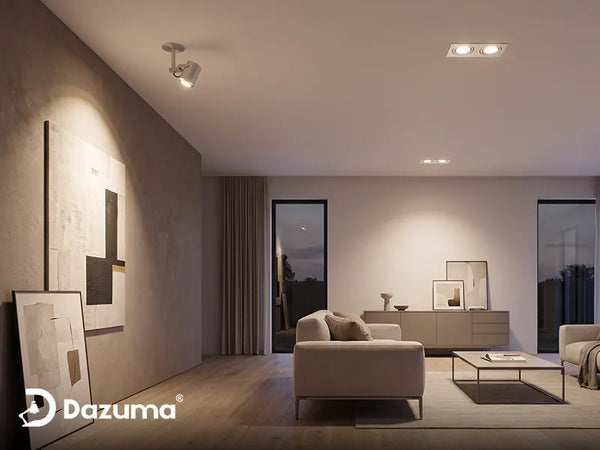
The front façade of your home is a canvas. Stone columns, brick textures, arched entryways, and decorative trim all become dramatically more beautiful when lit with a precisely aimed spotlight. Grazing a textured wall at a low angle creates shadow and depth that flood lighting would completely flatten — a technique called "wall grazing" and it's a hallmark of professional exterior design.
Tree and Landscape Uplighting
One of the most popular spotlight applications is uplighting trees and ornamental plants. A spotlight aimed upward from the base of a mature oak or Japanese maple creates a striking silhouette effect after dark, adding dimension and visual sophistication to even a modest yard. Explore our full collection of landscape lighting to find the right ground spotlight for your trees and garden beds.

Pathway and Walkway Highlights
While dedicated path lights handle long stretches, spotlights can accent the beginning and end of a walkway, highlight a garden urn or sculptural planter, or frame a decorative gate with intention. They add a layer of design that simple path lighting alone can't achieve.
Flagpoles, Water Features, and Focal Points
Any single object that deserves visual emphasis — a flagpole, a fountain, a stone statue, a decorative mailbox post — benefits from a well-aimed spotlight. The narrow beam keeps the focus exactly where you want it and minimizes light spill onto neighboring properties or into your neighbors' windows.
Flood Lights vs Spotlights: Side-by-Side Comparison

| Feature | Flood Light | Spotlight |
|---|---|---|
| Beam Angle | 120° or wider | 25° – 45° |
| Primary Purpose | Area coverage, security | Accent, focus, drama |
| Typical Lumens | 1,500 – 10,000+ | 300 – 1,500 |
| Ideal Color Temp | 4000K – 5000K (cool white) | 2700K – 3000K (warm white) |
| Best Placement | Eaves, poles, high walls | Ground stakes, low walls, recessed |
| Glare Risk | Moderate to High | Low (aimed away from eyes) |
| Motion Sensor Pairing | Very common, highly effective | Less common |
| Aesthetic Effect | Functional, utilitarian | Dramatic, curated, designed |
| Energy Use | Higher (larger area to cover) | Lower (focused output) |
Lumen Guide for Outdoor Spaces
Lumens measure the total visible light output of a fixture. Outdoors, you typically need significantly more lumens than indoors because light must travel farther and compete with ambient darkness. Use this chart as a practical starting point:
| Outdoor Area | Recommended Lumens | Best Fixture Type |
|---|---|---|
| Driveway / Parking Area | 2,000 – 5,000 lm | Flood Light |
| Backyard / Large Lawn | 3,000 – 8,000 lm | Flood Light (1–2 fixtures) |
| Tree Uplighting | 500 – 1,200 lm | Spotlight |
| Architectural Wall / Facade | 300 – 800 lm | Spotlight (grazing angle) |
| Walkway / Pathway | 100 – 300 lm | Path Light or Narrow Spotlight |
| Security / Motion Zone | 1,500 – 5,000 lm | Flood Light + Motion Sensor |
| Porch / Covered Entry | 600 – 1,200 lm | Wall Light or Spotlight |
IP Ratings: Making Sure Your Fixture Can Handle the Outdoors

Before purchasing any outdoor fixture — flood light or spotlight — check its IP (Ingress Protection) rating. This two-digit code tells you exactly how well a fixture is sealed against dust and water, which directly determines its performance and lifespan in outdoor conditions.
The format is IP[X][Y]: the first digit (X) rates dust resistance on a 0–6 scale, and the second digit (Y) rates water resistance on a 0–8 scale. Higher is always better.
| IP Rating | Protection Level | Recommended For |
|---|---|---|
| IP44 | Splash-proof from any direction | Covered porches and overhangs only |
| IP54 | Dust-limited + splash protection | Semi-sheltered exterior areas |
| IP65 | Dust-tight + water jet resistant | Most outdoor flood lights and spotlights (minimum standard) |
| IP67 | Dust-tight + immersion up to 1m / 30 min | In-ground uplights, near water features |
| IP68 | Dust-tight + continuous deep submersion | Submerged pond and pool lighting |
For the vast majority of residential flood lights and spotlights mounted on walls, eaves, or ground stakes, IP65 is the minimum you should accept. Don't be tempted by fixtures without a clearly stated IP rating — outdoor elements will degrade an unprotected housing in a single harsh season.
Can You Use Both? The Layered Outdoor Lighting Approach
Absolutely — and in fact, the most beautiful and functional outdoor lighting designs almost always use both types simultaneously. Professional landscape designers call this layered lighting: combining different fixture types for different purposes to create a rich, multi-dimensional exterior environment at night.
Think of it in three layers:
- Ambient Layer (Flood Lights): Provides the baseline brightness — safe, even coverage for driveways, yards, and open areas. The functional backbone of your outdoor plan.
- Accent Layer (Spotlights): Adds drama and intention — draws the eye to architecture, trees, and design features. Transforms a yard from "lit" to "designed."
- Task Layer (Wall Lights, Path Lights): Handles specific functional needs — steps, entry doors, gates, and seating areas where precise, localized light matters.
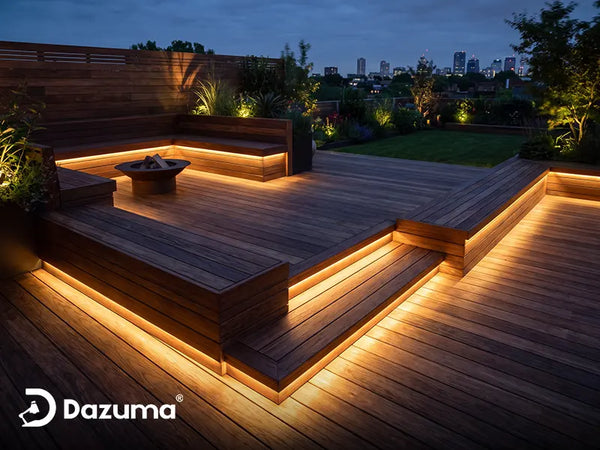
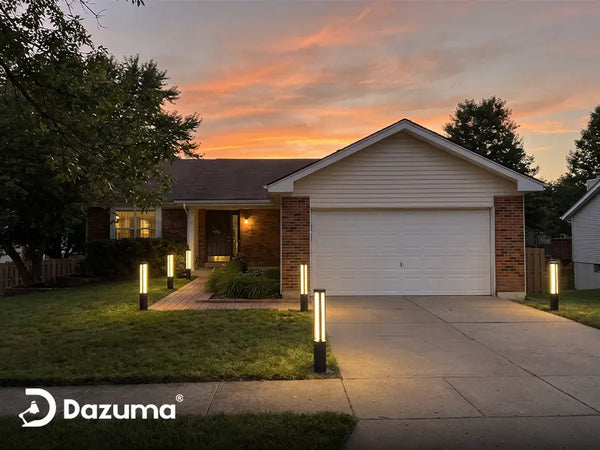
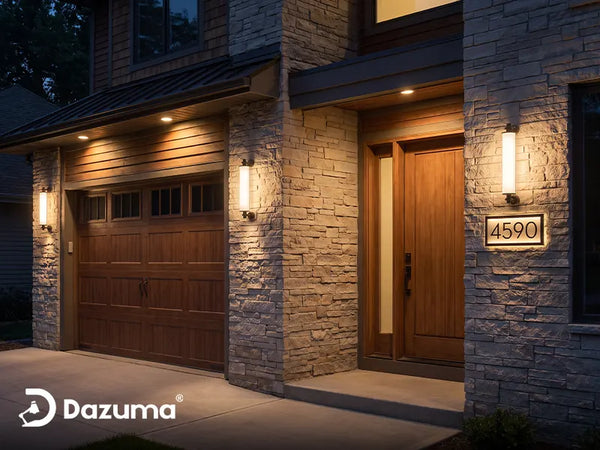
A practical example: mount a motion-activated flood light on your garage eave for security coverage, install ground spotlights to uplight the trees flanking your front door, and add a pair of outdoor wall lights at your entry to frame the door with warmth and welcome. Each fixture is doing a different job — and together, the result is dramatically more polished than any single fixture type could achieve alone.
Practical Tips for Layering Outdoor Lighting
- Use warm white (2700K–3000K) for accent spotlights to flatter natural materials, stone, brick, and landscaping.
- Use cool white (4000K–5000K) for security flood lights — it reads as brighter to the human eye and enhances camera footage clarity.
- Aim spotlights upward for trees and facades; aim them downward for paths and signage.
- Mount flood lights high and angle them away from windows to avoid glare inside your home or your neighbors' homes.
- Consider a smart lighting system that lets you dim accent spotlights for atmosphere while keeping security flood lights on automatic motion activation.
Ready to Light Up Your Outdoor Space?
Now that you understand the difference, the real work begins: choosing the right fixtures for your specific property. Whether you're building out a full exterior lighting plan from scratch or simply swapping one fixture for a better-suited option, the details matter — beam angle, lumens, IP rating, and placement all work together to determine the final result.
At Dazuma, we carry a curated selection of high-performance outdoor fixtures built for real homes and real climates. Browse our outdoor flood lights for broad, dependable security coverage, explore our outdoor spotlights for accent and landscape applications, or shop the full outdoor lighting collection to design a complete layered system from the ground up. Every fixture is rated for outdoor use and built to last through the seasons.
Great outdoor lighting doesn't happen by accident — it's a series of intentional choices. And now you have everything you need to make them with confidence.