
This guide is for homeowners planning a front walk, garden path, driveway edge, courtyard, or backyard route—and anyone who has noticed that retailers sometimes use “bollard light” and “path light” for fixtures that look surprisingly similar.
Introduction
Bollard lights and path lights can both guide people through a landscape, reveal changes in direction, and give a yard a finished nighttime appearance. The difference is not as simple as “one is tall and one is short.” In practice, bollard usually describes the fixture’s upright architectural form, while path light often describes the job the fixture performs.
That is why the categories overlap. A short post-style fixture may be sold as a bollard and used beside a walkway. A classic path light may have an upright stem that resembles a miniature bollard. The label gives you a starting point, but the decision should come from the installed height, beam control, output, mounting method, scale, and power source.

Quick Answer: Bollards Define Space; Path Lights Guide the Route
Choose bollard lights when the landscape needs visible vertical structure, broader coverage, or stronger wayfinding along a wide walkway, courtyard edge, driveway, or open lawn. Their larger scale helps them read from a distance and makes them useful at entrances, intersections, and changes in elevation.
Choose path lights for narrower residential walks, planting beds, and informal garden routes where you want smaller pools of light without turning the fixtures into dominant daytime objects. Shielded path lights are especially helpful when controlling glare near windows, seating, and property lines.
For a typical home garden, path lights are usually the quieter and easier choice. For a broad modern approach or a space that needs an architectural rhythm, bollards usually look more intentional. Neither category is automatically brighter, safer, or better; the optic and layout matter more than the name.
What Bollard Lights and Path Lights Really Mean

Form Versus Function
A bollard is recognized by its upright post-like body. A path light is recognized by its purpose: keeping a walking route legible. Some fixtures satisfy both descriptions, so compare the installed form and light distribution before relying on the category name.
Bollard lights are freestanding vertical fixtures anchored at ground or deck level. Many residential models stand roughly 18 to 36 inches high, although shorter markers and taller commercial models exist. They may distribute light around the fixture, through side openings, or downward from a shielded head. Explore Bollard Lights by looking at the luminous opening, not just the silhouette.
Path lights are usually smaller landscape fixtures placed beside a walk. A familiar version has a stake, a slender stem, and a cap that directs light down onto the paving and adjacent plants. The broader Path Lights category can also include lantern-style markers, compact posts, and integrated LED designs.
A useful rule is this: if the fixture is meant to be seen as part of the architecture, it behaves more like a bollard. If it is meant to disappear into planting while its light reveals the route, it behaves more like a traditional path light.
Bollard Lights vs. Path Lights: Side-by-Side Comparison
| Decision Factor | Bollard Lights | Path Lights |
|---|---|---|
| Visual presence | Architectural and noticeable in daylight | Lower, lighter, and easier to blend into beds |
| Typical coverage | Often broader or visible from more directions | Usually a smaller controlled pool near the ground |
| Strongest setting | Wide paths, entrances, courtyards, and driveway edges | Garden walks, planting beds, and narrow residential paths |
| Mounting | Usually anchored to a solid base, footing, or mounting plate | Often stake-mounted; some use surface bases |
| Glare risk | Higher if the source or bright lens is visible | Usually lower when a cap shields the source |
| Installation commitment | Often more permanent and alignment-sensitive | Easier to test, reposition, and stagger |
| Design role | Defines edges and establishes rhythm | Reveals the walking surface and nearby texture |
Height, Beam Spread, and Glare Matter More Than the Label
A taller fixture does not automatically illuminate farther. Useful coverage depends on where the LEDs sit, whether the source is shielded, and how the lens shapes the beam. A low path light with a wide cap can spread a generous pool across the paving. A taller bollard with narrow side slots may create a more controlled pattern and require closer spacing.
This is the most important technical distinction to carry into shopping: space fixtures by the width and uniformity of the light on the ground, not by fixture height alone. If a product page provides a photometric diagram, use it. If it does not, test one fixture at night before ordering an entire run.
Glare also changes the experience. A bright visible diffuser can feel harsh from a seated patio or a bedroom window even when the measured output is modest. Shielded path lights and cutoff bollards keep the source out of direct view. For more detail on common bollard shapes and optics, see What Are Bollard Lights? A Designer's Guide to Outdoor Lighting.
Look at the Ground, Then Look Toward the Fixture
A good nighttime test checks two views. First, confirm that the walking surface is easy to read. Then stand at the patio, front door, and nearby windows to see whether any exposed source becomes distracting.

For a small residential route where the goal is gentle guidance, a compact solar path light can be a practical first layer.
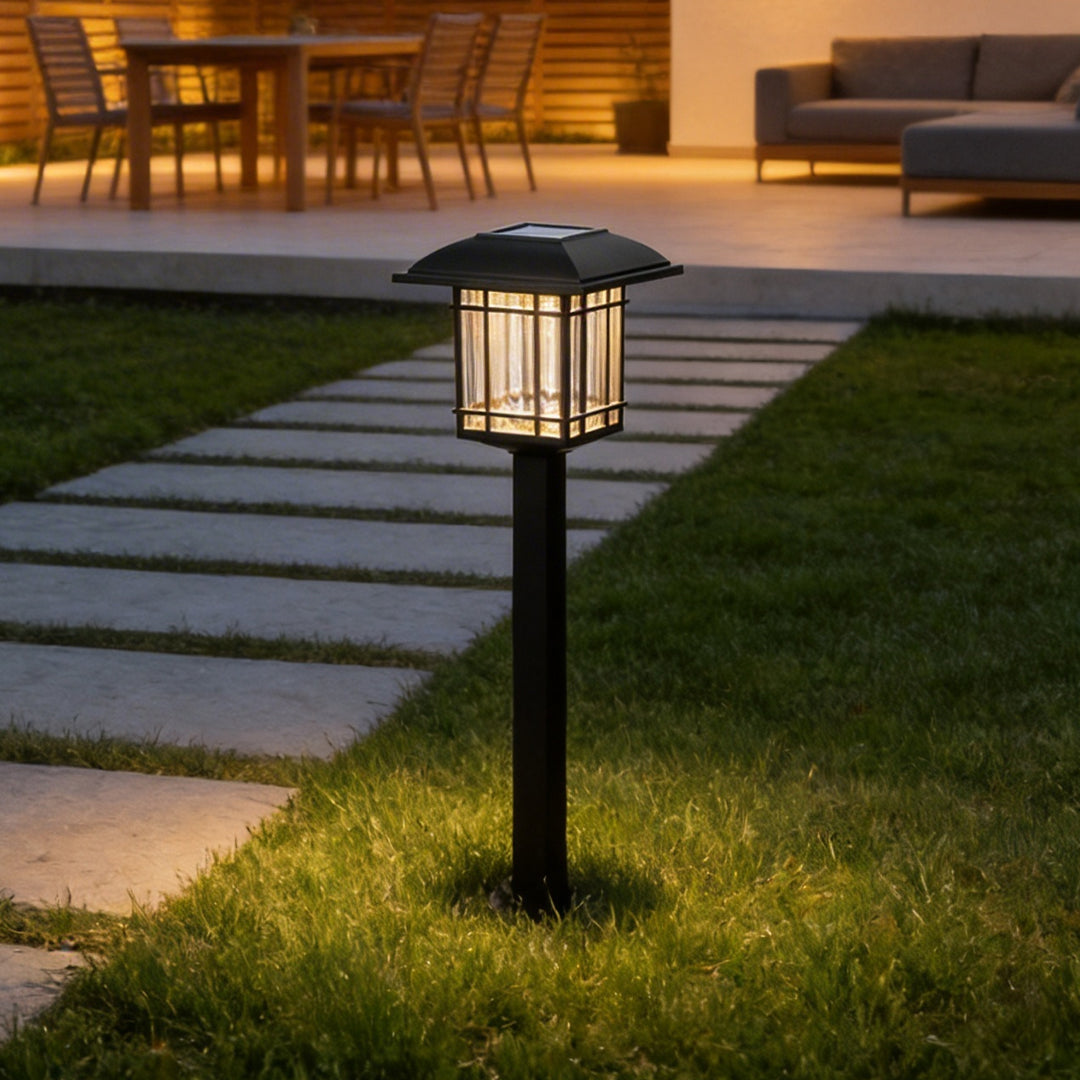
2-PCS Solar Outdoor Lawn Lights Vintage Square Waterproof Lamp
Price: $88.99
The 17.13-inch lantern-style profile gives a narrow garden walk a visible rhythm without requiring buried cable or a transformer.
- Ground-mounted ABS and PVC construction with a black finish.
- Automatic nighttime operation with no external wiring required.
- The product page lists six to ten hours after a full charge.
Solar, Low-Voltage, or Hardwired?
Power source is separate from fixture type. Both bollards and path lights can be solar, low-voltage, or line-voltage. The right choice depends on how important consistent output is, whether wiring already exists, and how much freedom you need to adjust the layout.
Solar
Solar fixtures are fast to place and easy to move. They work well for ambient guidance in sunny locations, but nighttime duration varies with panel exposure, season, weather, and battery condition. Compare Solar Path Lights when trenching is impractical or the path layout may change. Do not assume decorative solar light alone will meet a code-required or security-critical need.
Low Voltage
A low-voltage landscape system is a flexible middle ground for many homes. It provides more repeatable output than small solar units, supports timers and controls, and can power both path lights and bollards from one transformer. Cable sizing, transformer capacity, voltage drop, waterproof connections, and local requirements still need proper planning.
Hardwired Line Voltage
Line-voltage bollards are appropriate where dependable output and permanent installation matter, especially at entrances and larger paved areas. They generally require a solid mounting base, protected wiring, code-compliant connections, and professional installation. The commitment is greater, so confirm exact locations before concrete, paving, or planting is finished.
A compact hardwired marker can be useful where a tall post would interrupt views but reliable illumination is still important. This example also shows why category names need a second look: its product page classifies it as a bollard, yet its roughly four-inch height makes it visually closer to a low architectural marker than a traditional standing bollard.
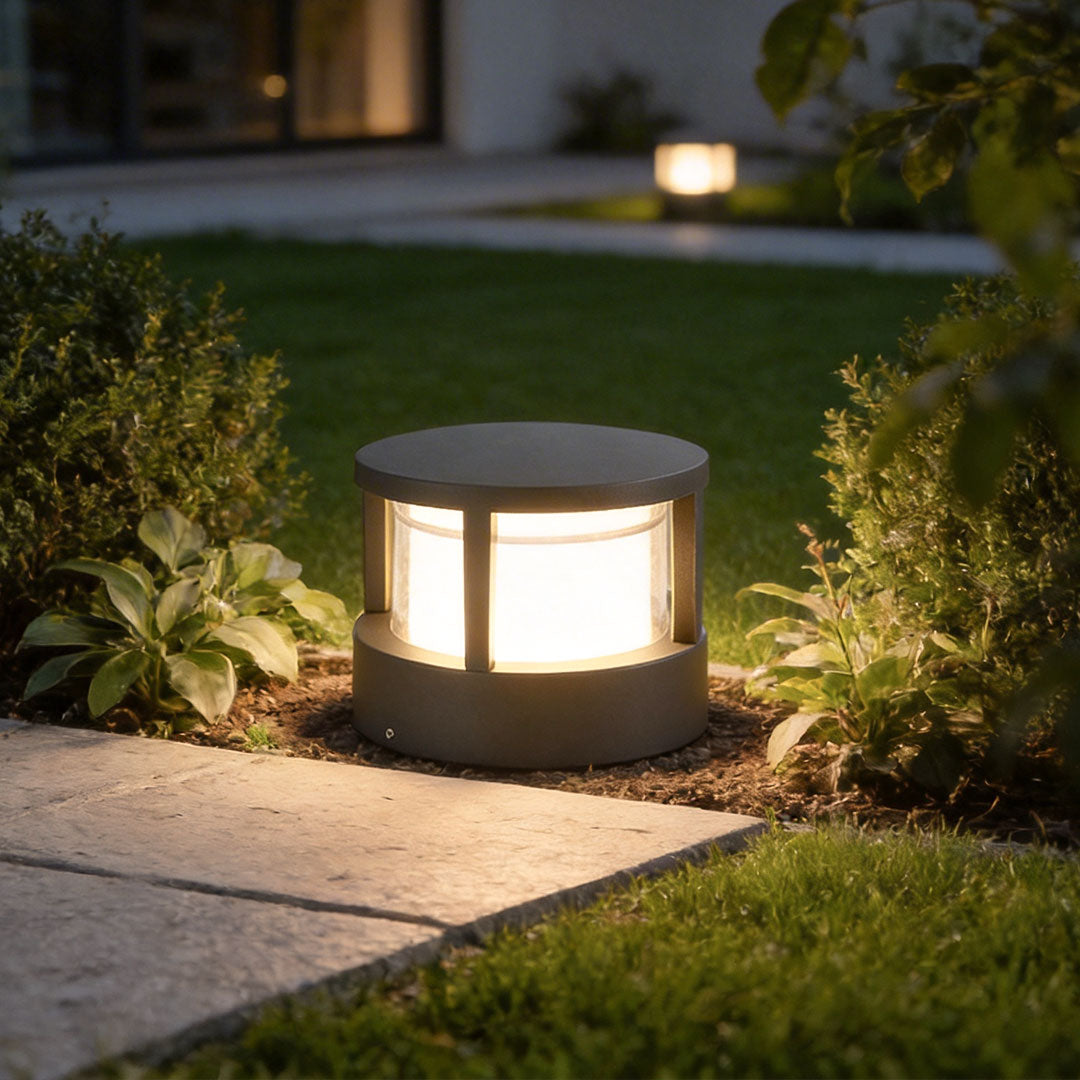
Modern Round Outdoor Post Light Double-Layered Lampshade Light
Price: From $89.99 for one light
This low-profile hardwired fixture suits modern walkways, entrance edges, and courtyards where a tall post would feel visually heavy.
- Aluminum-alloy body with a double-layered acrylic diffuser.
- Available in approximately 4.17-inch and 6.30-inch widths.
- Hardwired 110–220V installation should be handled appropriately.
How Far Apart Should Bollard and Path Lights Be?
There is no universal spacing number because beam width, lumen output, mounting height, surface color, surrounding darkness, and desired contrast all change the result. As a planning starting point—not a final rule—residential path lights are often tested around 6 to 10 feet apart, while bollards may begin around 8 to 15 feet apart. A product’s photometric data or a nighttime mock-up should make the final decision.
Avoid creating an airport-runway effect by placing path lights in perfectly matched pairs on both sides of a narrow walk. Staggering them usually feels more natural and requires fewer fixtures. Bollards, by contrast, often benefit from a more deliberate rhythm when they line a formal approach or paved courtyard.

Place Light at Decisions, Not Every Few Feet
Start at steps, curves, intersections, gates, and surface changes. Add intermediate fixtures only where the route remains unclear. This produces a calmer landscape than filling every dark gap with another light.
If you are laying out a full route, the step-by-step priorities in How to Plan Pathway Lighting? can help you mark hazards and destinations before choosing exact fixture positions.
| Landscape Situation | Better Starting Point | Layout Note |
|---|---|---|
| Narrow curved garden path | Shielded path lights | Stagger fixtures and emphasize curves |
| Wide straight front walk | Bollards or larger path lights | Use a consistent architectural rhythm |
| Driveway entrance or turn | Bollards at decision points | Keep fixtures outside vehicle clearance |
| Path beside low planting | Low path lights | Keep the source below common sightlines |
| Open courtyard edge | Architectural bollards | Coordinate spacing with paving joints and doors |
Where Each Type Works Better
Use Path Lights for Intimate Residential Routes
Path lights are usually the better fit beside mulch beds, stepping stones, cottage-style planting, and short walks from a patio to a garden gate. Their smaller scale leaves room for plants to remain the daytime focus. Models with broad caps and warm light create gentle contrast without making the yard feel commercial. For a cleaner contemporary look, compare Modern Path Lights with concealed or diffused sources.
Use Bollards for Structure and Long Sightlines
Bollards suit broad drive approaches, open courtyards, formal walkways, and entries viewed from the street. Their vertical form remains legible beyond the immediate pool of light, so fewer well-placed fixtures can establish direction. Keep them far enough from pavement edges to avoid doors, lawn equipment, bicycle handlebars, snow removal, and turning vehicles.
Mix Them When the Landscape Has More Than One Scale
A mixed layout can feel cohesive when each fixture has a specific job. Use bollards at the start of a route, at a major intersection, or beside a broad entrance. Use lower path lights between those landmarks where the route narrows or passes through planting. Match color temperature, finish family, and diffuser character so the two types look related rather than accidental.
Build a Hierarchy Instead of Repeating One Fixture Everywhere
Taller markers can announce the gate and main turn, while lower path lights quietly carry people through the garden. The change in scale helps visitors understand which route is primary.

Common Mistakes to Avoid
- Buying by category name alone. Verify the actual installed height, base, optic, output, and mounting diagram.
- Choosing the brightest fixture available. Excess output can create glare and make adjacent dark areas feel even darker.
- Lighting every foot of pavement evenly. Residential landscapes usually feel better when important transitions are emphasized and some darkness remains.
- Ignoring plant growth. A fixture that clears young groundcover today may be blocked after one growing season.
- Putting fixtures in the impact zone. Account for mower decks, snow shovels, sprinklers, car doors, delivery carts, and foot traffic.
- Mixing beam styles without a plan. A glaring 360-degree bollard beside soft shielded path lights can make the whole layout feel inconsistent.
- Skipping a nighttime mock-up. Drawings cannot fully predict reflections from pale paving, dark mulch, glass doors, and wet surfaces.
Final Buying Checklist
- Decide whether the fixture should visually define the space or quietly reveal the path.
- Measure installed height, body width, mounting base, and clearance from the pavement.
- Compare verified lumens, beam direction, diffuser opacity, and glare control.
- Choose solar, low-voltage, or hardwired power based on reliability and installation access.
- Confirm the outdoor rating and follow the listed mounting orientation.
- Mark steps, curves, intersections, gates, and surface changes before filling straight sections.
- Coordinate the fixture scale with the path width, architecture, and viewing distance.
- Test one fixture at night before committing to final spacing or a large quantity.
Final Advice: Which One Should You Choose?
Choose path lights when the route is narrow, planted, informal, or close to places where glare would be distracting. Their smaller scale and downward light usually make them the more comfortable choice for everyday residential gardens.
Choose bollard lights when the route is broad, formal, or visually connected to the architecture. Their vertical presence can define an entry, courtyard, driveway edge, or primary walk more clearly from a distance.
The best answer may also be a hierarchy: bollards at important landmarks and path lights along quieter sections. Most importantly, compare the fixture’s real height, beam pattern, output, and mounting method. The words on the category page tell you what family it belongs to; the nighttime light tells you whether it belongs in your yard.