
Who This Is For: This guide is for homeowners who love the warm, softly glowing look of an alabaster chandelier but are unsure whether it will provide enough usable light over a dining table and throughout the room.
Why This Question Matters
Alabaster chandeliers are popular because they make a dining room feel calm, polished, and warm without the sparkle of crystal or the visual sharpness of exposed bulbs. The stone appears to glow from within, and its natural-looking veining gives even a simple ring or petal-shaped fixture more depth. That softness is also what makes shoppers pause: if the shade diffuses the light, will the room feel beautifully intimate or simply too dim?
The honest answer cannot be based on the fixture’s appearance alone. A chandelier can illuminate the tabletop beautifully while leaving the perimeter of the dining room underlit. Another fixture may use more electrical power but lose more light inside thick stone panels. To judge an alabaster chandelier correctly, you need to separate three jobs: lighting the table, helping illuminate the room, and creating a visual focal point.

Quick Answer: Can an Alabaster Chandelier Be Bright Enough?
Yes, an alabaster chandelier can provide enough light for some dining rooms, but it should not be assumed. It is most likely to work as the main light in a small or medium dining room when the fixture has adequate delivered lumens, distributes light in more than one direction, and is sized correctly for the table. Pale walls and ceilings also help by reflecting light back into the space.
For a larger room, a dark interior, or a dining area used for homework, paperwork, crafts, and food preparation, the chandelier is usually better treated as the visual centerpiece of a layered plan. Recessed lights, wall lighting, or nearby lamps can fill the outer part of the room without taking away the chandelier’s soft character.
Most importantly, wattage is not a reliable substitute for brightness. Look for the fixture’s total lumen output or photometric data. If a product page lists integrated LED wattage but no lumens, you can compare size, light direction, and power range, but you cannot confirm the final brightness from the listing alone.
How Alabaster Changes the Way a Dining Room Feels
Clear glass allows you to see the lamp and often produces distinct highlights and shadows. Opaque metal sends light only through intentional openings. Translucent stone sits between those two experiences: it spreads the source across a larger glowing surface, reducing harsh points of light and softening facial shadows around the table.

Diffusion Improves Comfort but Reduces Punch
The stone’s diffusion can make the same amount of light feel gentler than it would through clear glass. That is excellent for long dinners because guests are less likely to look into a glaring point source. The tradeoff is less visual “punch” on the tabletop and less light reaching distant corners.
Stone is also variable. Natural alabaster, cloud stone, marble-like stone, resin composites, and acrylic panels can all be described with similar visual language online, but they do not transmit light identically. Thickness, color, veining, surface finish, and the distance between the LED and shade all matter. If material authenticity is important to you, read the specification rather than relying only on the product title or photographs.
This leads to a useful design distinction: soft light is not automatically low light. A large, well-engineered luminous surface can deliver substantial illumination with little glare. Conversely, a dramatic fixture with a few small glowing panels may look bright when viewed directly but add relatively little light to the whole room.
How Many Lumens Should You Plan for?
A practical starting range for general dining room illumination is about 10 to 20 lumens per square foot. Multiply the room’s floor area by that range, then adjust for finishes, ceiling height, and how the room is used. This is a planning estimate for the entire room, not a promise that every home needs the same level.
| Dining Room Size | Starting Ambient Range | What Usually Works |
|---|---|---|
| 100 sq. ft. | 1,000–2,000 lumens | One well-sized chandelier may be enough in a reflective room. |
| 150 sq. ft. | 1,500–3,000 lumens | A chandelier plus optional perimeter light offers more flexibility. |
| 200 sq. ft. | 2,000–4,000 lumens | Layered lighting is usually the safer approach. |
| 250 sq. ft. | 2,500–5,000 lumens | Plan separate ambient sources rather than asking one fixture to do everything. |
Use the lower end for relaxed meals in a room with a light ceiling, pale walls, and good daylight. Move toward the upper end when the walls are dark, the ceiling is high, or the room doubles as a workspace. Older adults may also appreciate more light and better contrast on the tabletop.
Judge the Whole Room, Not Just the Table
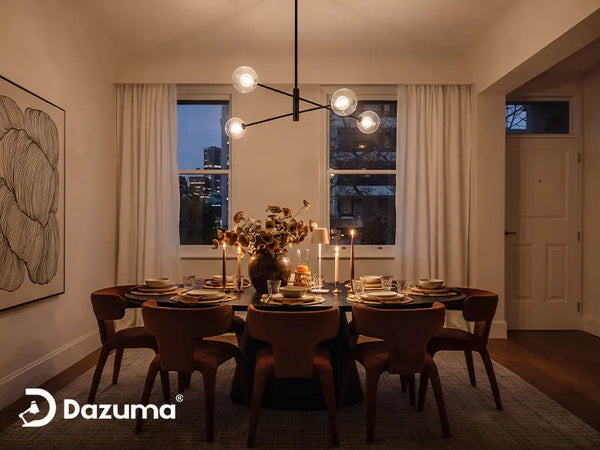
A chandelier can make plates and glassware look inviting while chair backs, artwork, and serving furniture disappear into shadow. When evaluating brightness, stand near the room’s edges and look back toward the table. Comfortable facial visibility and safe movement matter as much as the glow directly below the fixture.

Do Not Convert LED Watts Directly Into Lumens
Integrated LED fixtures can have very different efficiencies, and the shade changes how much light exits the fixture. Two 60-watt chandeliers may not produce the same delivered lumens. Ask for total fixture lumens—not only the raw output of the LED chips—because delivered output accounts more closely for losses through the diffuser.
A Broad Ring for Stronger Dining Room Presence
The following design uses an illuminated stone ring with a relatively shallow body. Its larger 31.5-inch option can visually relate to a substantial round or square dining table, while the adjustable chain helps place the glow closer to the tabletop. The product page lists two integrated LED power options but does not list lumens, so consider the wattage a specification to compare, not proof of room brightness.

Broad Ring for Round or Square Tables
Copper Modern Chandelier Luxury Creative Ceiling Light
Price: From $1,152.99
Best for a medium dining room where a wide luminous ring should feel architectural but still cast a soft, comfortable glow.
- Solid copper frame with white cloud stone shades.
- Integrated LED and three selectable color temperatures.
- Includes an adjustable hanging chain approximately 47.2 inches long.
Fixture Size and Placement Change Perceived Brightness
A small bright chandelier centered over a long table often feels weaker than its lumen output suggests because the light is concentrated in one spot. A wider fixture distributes luminous surfaces across more of the table, producing a more even impression. As a practical visual starting point, choose a fixture about one-half to two-thirds the table’s width. A linear table may be better served by an elongated chandelier than a compact round one.

Bring the Light Close Enough to Be Useful
For an 8-foot ceiling, a common starting position is 30 to 36 inches from the tabletop to the bottom of the fixture. The exact height depends on the chandelier’s depth, the occupants’ eye level, and whether it blocks conversation or views across the room.
In a taller room, do not automatically pull the fixture close to the ceiling. That can make a beautiful chandelier feel disconnected from the table and reduce useful illumination at dining level. For a more detailed installation framework, see how high a chandelier should hang over a dining table.
Also check weight and ceiling-box support before ordering. Stone and copper fixtures can be heavy. The two examples in this guide range from roughly 20 pounds to more than 50 pounds depending on size, so a qualified electrician should confirm that the electrical box and structure are suitable.
A Flexible Shape for Different Table Sizes
If your dining area has an unusually small round table or a long rectangular table, a fixture family with several shapes can make proportion easier. This design offers four round diameters plus two longer versions. The product page lists integrated LED power from 36 to 63 watts, but again provides no total lumen figure. Its sculptural petal arrangement emphasizes an enveloping glow rather than exposed-bulb sparkle.

Multiple Sizes for Tailored Coverage
Modern LED Chandelier Cloud Stone Full Copper Ceiling Light
Price: From $754.99
Best for dining rooms that need a softer sculptural centerpiece in a round or elongated configuration.
- Round sizes from 15.7 to 39.4 inches and long versions up to 47.2 inches.
- White cloud stone shades diffuse the integrated LED source.
- The smallest model is listed with warm light; other sizes support three color temperatures.
When the Chandelier Should Not Work Alone
Think of the chandelier as the dining table’s light first. If it also provides enough ambient light for the room, that is a bonus. This mindset prevents a common mistake: selecting a statement fixture for mood, then trying to make it painfully bright enough to cover every corner.
A simple layered plan can use three roles:
- Focal light: The alabaster chandelier defines the table and establishes the room’s mood.
- Ambient fill: Discreet recessed or other ceiling lights brighten circulation areas and the room perimeter.
- Accent light: Sconces, picture lights, or buffet lamps reveal artwork, architecture, and serving surfaces.
Layering Lets the Stone Stay Soft
Supplemental light means you do not have to choose an overly intense chandelier or the coolest color setting just to see across the room. Each source can do a smaller job, and the stone fixture can retain the gentle glow that made you choose it.

If this is a new idea, the three-lighting rule for layered interiors offers a useful way to plan ambient, task, and accent illumination. You can also browse broader chandelier styles to compare exposed, glass-shaded, and stone-diffused designs before deciding how much supplemental light your preferred look may need.
Color Temperature, Dimming, and Light Quality
For most dining rooms, 2700K to 3000K supports warm wood tones, skin tones, and a relaxed evening atmosphere. Both featured product pages list 3000K among their options, while selected configurations can switch to 4000K or 6000K. The higher settings may appear brighter because they look cooler and crisper, but they do not necessarily increase the fixture’s lumen output.
Color switching is also not the same as dimming. A fixture that changes among 3000K, 4000K, and 6000K may still operate at fixed brightness. If you want low light for dinner and stronger light for cleaning or homework, verify dimmer compatibility, the required control, and the permitted dimming range before purchase. Do not install an unspecified dimmer on an integrated LED fixture.
Color rendering matters at the table, too. A higher CRI generally helps food, flowers, finishes, and faces look more natural. The featured products list CRI 80. If color fidelity is a high priority, compare that specification with other modern chandeliers and ask whether higher-CRI customization is available.

Dining Room Buying Checklist
Before ordering, collect the information below. It takes a few extra minutes and is much more reliable than judging brightness from a styled photograph.
- Room area: Measure the full dining room, not only the table.
- Target lumens: Estimate a room-wide range, then adjust for dark finishes, age-related visibility needs, and multiple uses.
- Total fixture lumens: Ask for delivered lumens or photometric data when the listing provides wattage only.
- Fixture width and shape: Match a round chandelier to a round or square table and consider a linear form for a long table.
- Hanging height: Confirm the suspension can place the fixture comfortably above the tabletop.
- Controls: Verify whether color switching, brightness dimming, or both are supported.
- Material: Confirm whether the shade is natural alabaster, cloud stone, marble, composite stone, resin, glass, or acrylic.
- Weight and mounting: Have an electrician confirm ceiling support and hardwired installation requirements.
- Backup light: Decide where ambient or accent lighting will go if the chandelier is not enough by itself.
Final Advice
An alabaster chandelier can absolutely be the main light in a modest dining room, especially when it has generous luminous surface area, adequate delivered lumens, and good placement over the table. What it should not be is a blind gamble. Neither stone appearance nor LED wattage alone confirms how bright the finished room will feel.
Before ordering, decide where supplemental light would go and how each layer will be controlled. That small planning step can prevent difficult ceiling changes after a heavy fixture has already been installed.
Start with the room’s approximate lumen need, ask for fixture lumen data, and consider how far the light reaches beyond the table. If the chandelier gives you the atmosphere you want but cannot cover the room alone, keep it. Add quiet perimeter lighting and let each layer do its job. The result will usually feel more comfortable, more flexible, and more intentionally designed than one overly bright centerpiece.