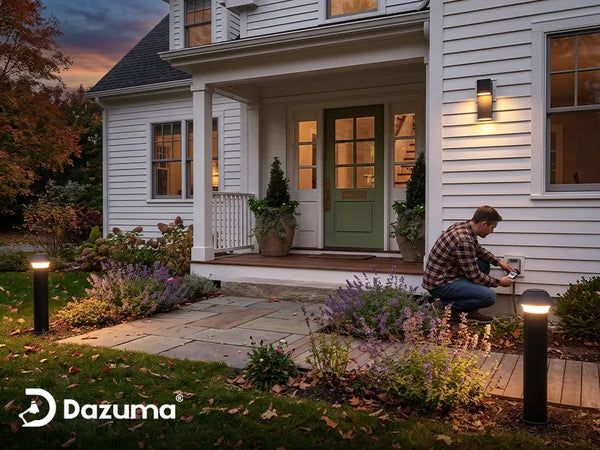

Who This Is For: This guide is for homeowners who want a yard that feels safer and more inviting after dark but are not sure where lights should go, how many they need, or how to avoid a bright, cluttered result.
Introduction
Landscape lighting usually goes wrong before a single fixture is installed. A homeowner sees a dark walkway, buys a box of lights, and spaces them evenly from the porch to the driveway. The path becomes visible, but it also looks like an airport runway. The tree near the house disappears, the patio stays uncomfortable, and one bright fixture shines through a bedroom window.
A better layout begins with the way people actually use and see the property. You need enough light to find the front door, recognize a step, carry food to the patio, and notice where the lawn meets the walkway. You may also want the house to feel welcoming from the street and the garden to have depth from the living room. Those are separate jobs, and they do not all need the same fixture.
The goal is not to light the entire yard. It is to create a clear sequence of useful, comfortable pools of light with darkness between them. That approach usually needs fewer fixtures, creates less glare, and makes the landscape look more dimensional.

Quick Answer
To design a landscape lighting layout, first walk the property in daylight and after dark. Mark hazards, destinations, important views, existing electrical access, irrigation, and places where a fixture could be damaged. Divide the yard into small zones, then give every proposed light one clear job: guidance, task light, architectural accent, planting accent, or ambient light.
Choose the lighting technique before the decorative style. Place temporary markers where fixtures might go, view them from the street and inside the home, and test actual beams at night before burying cable. Plan the transformer, cable routes, controls, and future expansion only after the fixture locations are reasonably settled. The strongest layouts are adjusted on site; they are rarely created by a spacing formula alone.
Step 1: Decide What the Lighting Must Do
Write down your priorities before browsing outdoor lighting. Put safety and daily use first. Decorative lighting should support those needs rather than distract from them.
Start With the Routes People Actually Take
Mark the walk from the driveway to the front door, the path to the side gate, the steps from the deck to the lawn, and the route from the kitchen to an outdoor dining area. Pay special attention to level changes, narrow turns, dark paving, loose gravel, and places where tree roots cross a path. A visitor should not have to search for the next safe step.
Identify Destinations and Tasks
Entries, grills, dining tables, trash enclosures, pool gates, and storage areas need different kinds of visibility. A soft wash may be enough for conversation on a patio, while a grill needs more focused task light. Do not ask low path lights to illuminate a tabletop, and do not use a powerful floodlight to solve every small task.
Choose Only a Few Visual Anchors
Select one or two features visible from each major viewpoint: a mature tree, stone wall, textured façade, sculpture, or layered planting bed. Lighting every shrub gives the eye nowhere to rest. A few well-chosen anchors create depth and make the unlit areas feel intentional.
Step 2: Sketch the Yard From Real Viewpoints
You do not need professional design software. Print an overhead property image or make a simple hand sketch showing the house, paths, driveway, deck, planting beds, large trees, steps, gates, and outdoor outlets. Add the approximate location of irrigation heads, drainage areas, lawn-mower routes, and places where snow may be piled.
Next, mark viewpoints with arrows. Include the street, front door, patio chairs, kitchen window, living room, and any bedroom that faces the yard. Landscape lighting is experienced from inside as well as outside. A spotlight hidden from the sidewalk can still be painfully visible from a sofa or reflected in a glass door.

Use Three Simple Symbols
Use circles for fixtures, arrows for beam direction, and dashed lines for possible cable routes. Number the lights by zone. This makes it much easier to notice that one area has six fixtures while another important route has none.
Step 3: Divide the Property Into Zones
Think of the yard as several small lighting projects rather than one long chain of fixtures. Typical zones include the front walk and entry, driveway edge, side passage, patio or deck, garden beds, and back lawn. A zone should group lights that serve a similar area, turn on at the same time, or share a practical cable route.
Zoning solves everyday annoyances. The front path can remain on for evening arrivals while decorative tree lights switch off later. Patio lights can be dimmed for dinner without reducing visibility at the steps. A side-yard motion light can operate independently instead of waking the whole backyard whenever an animal passes.
Separate zones also make troubleshooting easier. If one branch becomes dim or stops working, you can inspect a limited area rather than tracing a cable around the entire property. Leave room in the plan for one future bed, tree, or seating area; outdoor projects tend to grow after homeowners see the first phase at night.
Step 4: Match Each Zone With a Lighting Technique
A fixture type is not a design by itself. First decide whether light should point down, up, across a surface, or softly outward. Then choose a fixture built for that job and exposure.
| Area or Goal | Useful Technique | Good Starting Approach | Watch For |
|---|---|---|---|
| Front walk | Shielded path lighting | Stagger fixtures near turns and changes in grade | Runway-like rows and visible glare |
| Steps | Step, wall, or handrail light | Reveal tread edges and landings | Deep shadows between bright spots |
| Tree or sculpture | Uplighting or cross-lighting | Aim through the trunk or feature, away from windows | Hot spots, flat light, and skyward spill |
| Stone or brick wall | Grazing or washing | Test distance to control texture and shadow | Uneven scallops and harsh reflections |
| Patio seating | Downlight plus soft ambient light | Keep light below eye level or well shielded | A bright source in seated sightlines |
Paths Need Guidance, Not a Border of Bulbs
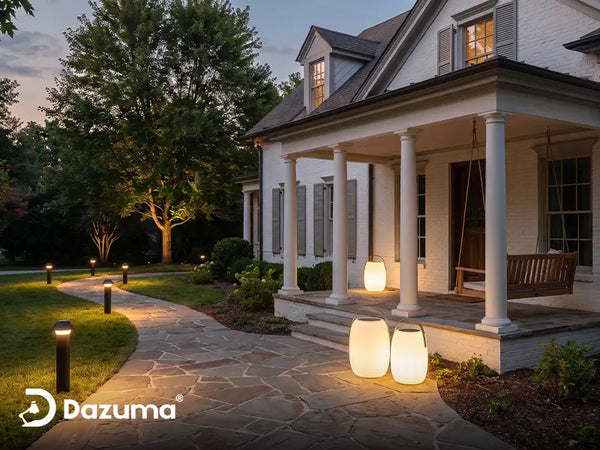
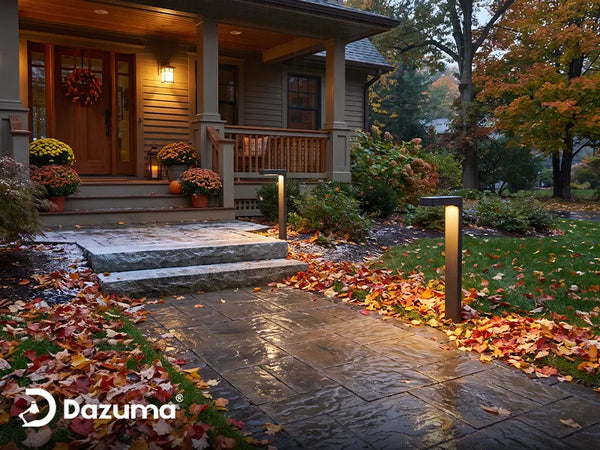
Use path lights where their beam can reveal the walking surface and edge. Stagger them when the path and planting allow, and place them near curves, transitions, and hazards rather than at perfectly equal intervals. The pools of light may overlap slightly, but the fixtures should not become the main thing you notice.
Avoid the Airport-Runway Effect
Pairs of lights directly opposite each other create a rigid corridor. A staggered layout feels more natural and can use fewer fixtures, provided the walking surface remains easy to read. Check the result from both directions because glare changes with viewpoint.

Accents Should Reveal Form
Use adjustable outdoor spotlights when you need to aim around roots, branches, or architecture. Recessed well lights can keep the fixture visually quiet where soil, drainage, roots, and maintenance access make an in-ground installation appropriate.
A single uplight can give a narrow ornamental tree clear direction. A broad or multi-trunk tree may need light from more than one angle so it does not look like a flat cutout. The detailed guide to uplighting trees and landscaping explains how placement changes the trunk, canopy, and background.
Step 5: Set Initial Positions and Spacing
Spacing charts are starting points, not final answers. Beam width, mounting height, fixture output, plant growth, surface color, and ambient street light all change the result. Two path lights with the same wattage can cover very different areas.
For a typical residential path, you might begin by marking positions roughly 6 to 10 feet apart, then move them closer at turns, steps, and dark materials or farther apart when a wide beam already covers the surface. Do not buy the full fixture count from that estimate alone. Test one or two lights first and follow the manufacturer's photometric or coverage information when available.
Keep fixtures out of mower paths and away from places where a hose, pet leash, or snow shovel will catch them. Do not bury an accessible lens under mulch or place a stake where a growing shrub will cover it within a season. Near irrigation, consider where spray lands and whether water will sit around an in-ground housing.

Aim Through the Subject
Before fixing an uplight, stand behind it and follow the beam. The tree, wall, or sculpture should intercept most of the useful light. If the beam continues toward a neighbor's window or open sky, change the angle, output, shield, or location.
Step 6: Plan Power, Wire Runs, and Controls
Confirm the power type of every fixture. Solar, low-voltage, and line-voltage products do not share one installation method. Low-voltage lighting is common for residential landscapes, but it still requires listed outdoor equipment, compatible components, weather-resistant connections, and installation that follows the manufacturer and local requirements. Line-voltage work should be handled by a qualified electrician.
For a low-voltage plan, total the rated load for each run, measure the actual cable route, and select the transformer, cable gauge, and output tap as a system. Do not measure straight across the lawn when the wire must travel around paving and roots. Long runs, higher loads, and undersized cable increase voltage drop, which can leave the farthest fixtures dim or unstable.
Shorter zone runs or a hub-style arrangement are often easier to balance than one cable looping around the property. Record each run and connection on the sketch before covering it. For gauge comparisons and voltage-drop planning, see Landscape Lighting Wire: 12/2 Vs 16/2 Vs 10/2.
Give Different Activities Different Controls
Use timers, astronomical controls, dimmers, or motion sensing only when they are compatible with the system. Entry and path lights may come on at dusk, while decorative accents can switch off earlier. Motion control is useful for occasional side-yard tasks but can be irritating beside a bedroom or wildlife route if the detection area is too broad.
Step 7: Test the Layout After Dark
Night testing is the step most likely to save money. Temporarily place fixtures or comparable test lights, run safe above-ground temporary connections as the manufacturer permits, and wait until the surroundings are fully dark. Aim and observe before trenching or drilling.
- Walk every route: Check whether feet, edges, and level changes are visible without looking directly into a lamp.
- Sit down: Patio glare often appears only at seated eye level.
- Look from indoors: Check living areas and bedrooms for exposed sources and reflections.
- View from the street: The entry should be legible, but the house should not look washed out.
- Turn fixtures off one at a time: If removing one improves the scene, that light may be unnecessary or badly aimed.
- Take photos and notes: Record locations, aiming angles, and control groups before installation.
Move the Marker, Not the Landscape
A shift of 12 to 24 inches can remove glare, reveal more bark texture, or stop a path light from disappearing behind a perennial. Keep the layout flexible until you have viewed it in darkness and from normal positions.

Common Landscape Lighting Layout Mistakes
- Starting with fixture quantity: Count jobs and zones first; the fixture count comes later.
- Lighting every plant: Darkness between accents is what creates depth.
- Using equal spacing everywhere: Hazards, beam coverage, and viewing angles matter more than symmetry.
- Aiming from the observer toward the subject: This can put the lamp directly in the observer's eyes. Aim across or through the feature when possible.
- Mixing unrelated color temperatures: Warm, neutral, and cool sources in one view can make an otherwise good layout feel accidental.
- Ignoring plant growth: A fixture clear in spring may disappear behind summer foliage.
- Planning one very long wire run: The last fixtures may suffer from voltage drop, and troubleshooting becomes harder.
- Skipping the interior view: A beautiful tree light is not successful if it shines into a bedroom.
Final Advice
A good landscape lighting layout is a map of decisions, not a row of products. Begin with movement and safety, choose a few visual anchors, divide the property into controllable zones, and give every light a specific purpose. Then test the real beams after dark.
If the first test looks uneven, do not automatically add more fixtures. Move, aim, shield, or dim what you already have. Often the most professional-looking improvement is removing one bright source so the path, planting, and architecture can work together. Keep the final sketch with transformer information, cable routes, fixture locations, and control settings; it will make future planting, repairs, and expansion far easier.