
Who This Is For: This guide is for homeowners furnishing a roofed porch, screened patio, covered deck, or outdoor living room who like the warmth of a floor lamp but are unsure about weather resistance, cords, stability, or solar charging.
Introduction
Covered patios are often lit as if they were hallways: one ceiling fixture in the center and perhaps a wall light near the door. That arrangement may make the floor visible, yet it can leave a sofa corner flat, a dining table uninviting, and everyone’s faces shadowed. An outdoor floor lamp brings light closer to where people actually sit. It can make a patio feel furnished rather than merely illuminated.
The idea is practical, but only when the lamp matches the space. A roof does not eliminate humidity or wind-driven rain. A tall lamp needs a safe footprint. A solar panel under a deep overhang may receive too little sun, while a cord stretched across a walking path creates a new problem. The useful answer is therefore conditional: outdoor floor lamps can be excellent on covered patios, but the fixture, power source, and location must be chosen as one system.

The Quick Answer: Practical for Comfort, Not Every Safety Task
Yes, outdoor floor lamps are practical for a covered patio when you want localized ambient light, decorative light, or gentle task light beside a seating area. They are especially valuable where adding a ceiling box or wall junction would be disruptive. They also let the lighting relate directly to furniture, which is why a patio can feel noticeably more intimate after a standing lamp is added.
They should not automatically become the only light on the patio. Doors, steps, grill stations, and changes in floor level benefit from fixed lighting that remains in the same place and operates predictably. Think of a floor lamp as the light that makes people want to stay, while a wall, ceiling, or step light often handles safe arrival and movement. The broader zone-planning approach in How To Light A Patio: 7 Zones You're Probably Missing can help you separate those jobs.
| Patio Need | Is a Floor Lamp Practical? | Planning Note |
|---|---|---|
| Conversation seating | Very practical | Place beside or slightly behind seating to soften faces without glare. |
| Outdoor dining ambiance | Practical as a layer | Use it near a buffet or corner, not where chairs pull back. |
| Reading chair | Depends on output | Confirm lumens and beam direction; warm glow alone may not support sustained reading. |
| Door, steps, or grill | Secondary only | Keep a fixed task or safety light for dependable visibility. |
| Narrow balcony | Often limited | Measure the base and preserve a clear walking route. |
A Covered Patio Is Still an Outdoor Environment

Judge the Exact Spot, Not Just the Roof
A deep corner against the house may stay relatively protected, while a location six feet away at the roof edge can receive wind-driven rain, sprinkler spray, and water splashing from the floor. Condensation and humid air reach both. The lamp’s outdoor suitability should match its actual exposure rather than the general label “covered patio.”
Start with the manufacturer’s location and ingress-protection information. An IP rating describes resistance to solid particles and water under particular test conditions; it does not make poor cord routing, an open connection, or an unstable installation safe. Both products featured below are listed as IP65, but you should still follow their installation instructions and keep electrical connections protected as specified.
If a lamp plugs in, use an outdoor receptacle with working GFCI protection and a suitable weather-resistant cover. Keep the cord away from door tracks, drainage channels, and chair legs. Do not make an indoor extension cord part of the permanent layout. For a hardwired or ground-mounted lamp, have the circuit and installation handled according to local requirements, especially when wiring passes through masonry or a patio slab.
The Jobs Outdoor Floor Lamps Do Especially Well
They Put Light at the Scale of Furniture
Ceiling light can flatten a seating group because it illuminates everything from above. A standing lamp beside a sectional creates contrast at eye level and makes cushions, plants, and faces feel warmer. This is less about flooding the patio with brightness and more about shaping a small zone where people naturally gather.

They can also solve an architectural problem. If a patio has sliding glass doors, stone veneer, or few solid walls, there may be no natural place for a sconce. A freestanding or ground-mounted light creates vertical interest without interrupting the facade. For coordinated planning across ceiling, wall, and portable layers, browse outdoor porch lighting by fixture type rather than asking one lamp to do everything.
What they usually do not provide is broad, uniform illumination. Neither wattage nor physical height tells you exactly how bright a lamp will feel. Shade material, LED output, beam direction, surrounding finishes, and distance from the task all matter. If a product page does not list lumens, treat the lamp first as ambient or decorative lighting. It may help with casual reading, but it should not be assumed to replace a dedicated reading light.
A Permanent Floor Lamp That Also Defines the Patio Edge
Some fixtures sold as outdoor floor lamps are closer to architectural landscape lights than movable living-room lamps. That can be a benefit when you want a clean, stable feature that stays aligned with a planter, column, or seating boundary. It also means the location should be planned before the wiring is installed.
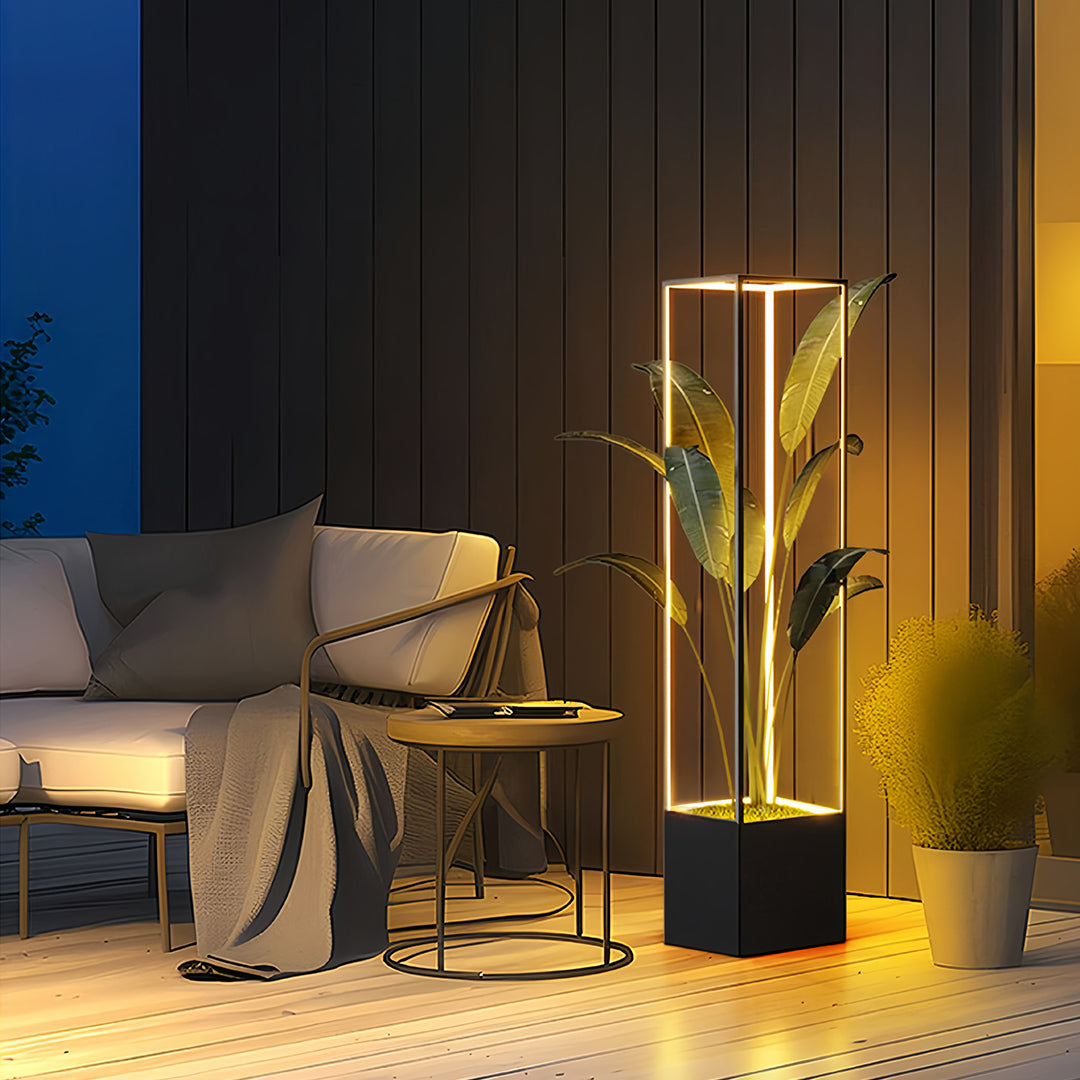
Square Floor Lamps with a Sleek Design
Current price: $446.99
The illuminated square frame and pull-up planter make this a functional boundary feature for a modern covered patio, courtyard, or garden-facing lounge.
- Stainless steel body and PC shade suit long-term exterior placement.
- Hardwired, ground-mounted construction favors a planned permanent layout.
- The integrated planter combines greenery and warm vertical accent light.
Solar, Hardwired, or Plug-In: Which Is Most Practical?
Solar power is useful when there is no nearby outlet and you want to avoid a floor cord. The tradeoff is that a roof may block the very sunlight the panel needs. A lamp at the bright outer edge of a west- or south-facing patio may charge well, while the same lamp against a shaded wall may fade early. Review Do Solar Lights Need Direct Sunlight? An Actual Guide for Shaded Homes before choosing solar for a deep porch.
Hardwired power is the most predictable for a permanent arrangement. It avoids charging anxiety and loose cords, but it is not automatically flexible. A fixture mounted to the ground should be treated as part of the architecture, and relocating it later may require electrical work. Hardwired models make the most sense when the furniture plan is settled and the lamp also marks a patio edge, planter line, or transition.
Plug-in or rechargeable power can be the easiest option for a rental or a patio that changes seasonally, provided the specific lamp is approved for outdoor use. A rechargeable lamp avoids a live cord during use; a plug-in design gives consistent output but needs disciplined routing. This article’s two products are solar and/or hardwired rather than conventional plug-in lamps, so their installation choices should not be treated as interchangeable.

Solar Needs a Charging Plan
Before buying, watch the intended location from late morning through afternoon. Trees, screens, awnings, and the roofline can reduce charging even when the patio looks bright to your eyes. If the panel is integrated into the lamp, decide whether the fixture can sit near the edge or be moved for charging without disrupting the room.
If avoiding wiring is the priority, compare the broader range of outdoor solar lights. A separate-panel design may be more practical in deep shade because the panel can sometimes be positioned in sun while the light remains under cover. Always confirm that arrangement on the actual product rather than assuming it is included.
A Softer Woven Lamp with Two Power Choices
For a relaxed patio with wood, wicker, or textured upholstery, a woven shade can feel more residential than a conventional landscape fixture. The lower height options also fit beside lounge furniture without visually dominating the room. Choose the solar version only after confirming charging conditions; choose hardwired power when dependable nightly operation matters more than future movement.
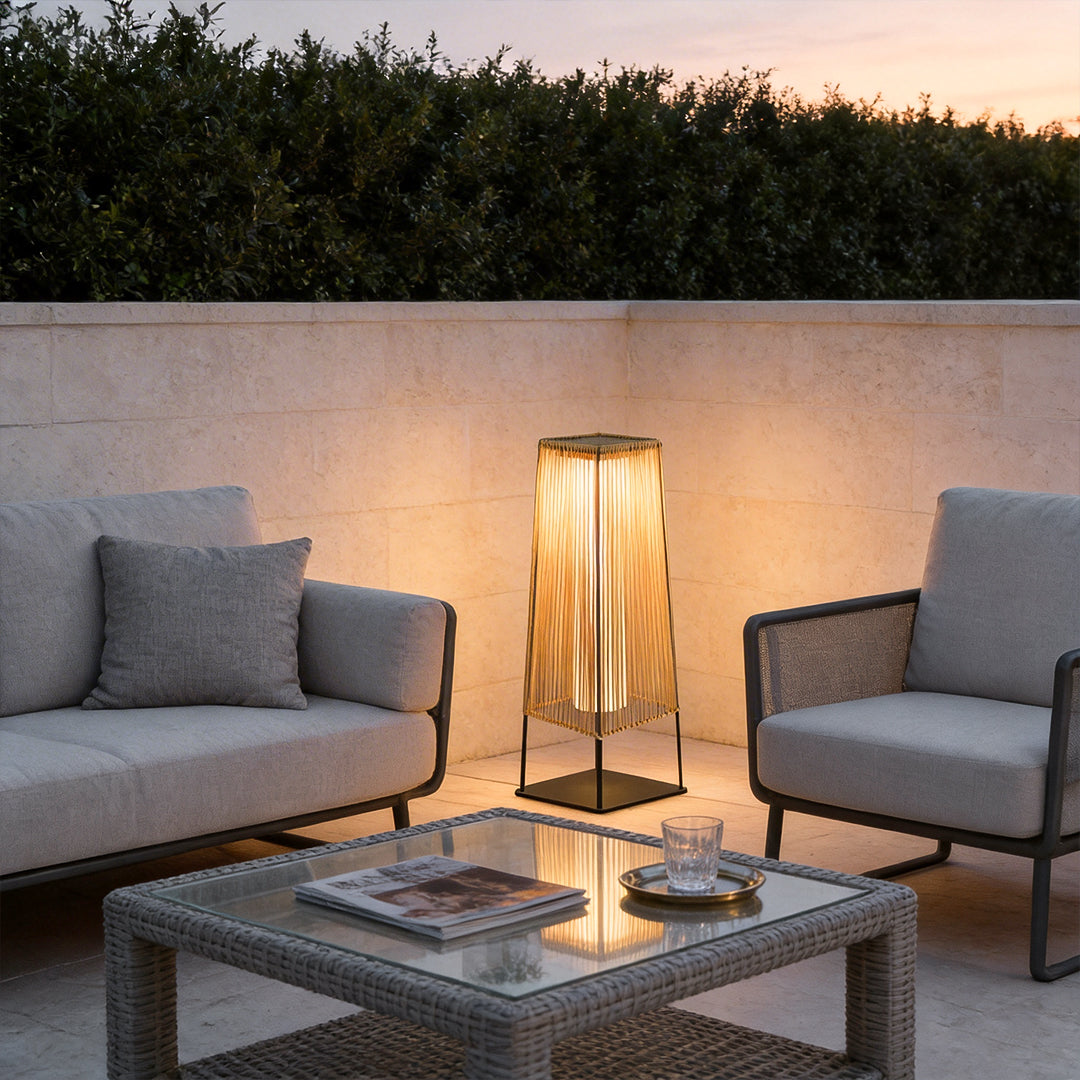
Woven Floor Lamp Rustic Rubber LED Outdoor Ground Light
Current price: $393.99
The woven wood-color shade and warm light suit a covered lounge, balcony, entrance, or garden-facing patio that needs a softer decorative presence.
- IP65 construction supports outdoor use in changing weather conditions.
- Stainless steel structure supports the suspended cylindrical light source.
- Height options range from 18.9 to 35.4 inches.
Placement, Scale, and Stability Matter as Much as Style
Protect the Walking Envelope
Place the base beyond the normal line between the door, seating, dining table, and yard. Test the arrangement with chairs pulled out, not pushed neatly under the table. A lamp that feels harmless in a staged patio can become an obstacle when guests stand up or carry food outside.

Measure the base before judging the lamp by its height. A roughly 10- to 13-inch footprint may be easy beside a deep sectional but intrusive on a narrow balcony. Leave room for cleaning around it and for water to drain rather than collecting against the base. If the lamp is ground-mounted, confirm the exact anchoring and wiring requirements before finalizing furniture or flooring.
Wind stability is another practical test. A roof reduces direct weather, but crosswinds can still move through an open patio. Weight helps, yet height, top surface area, and base width affect how a lamp behaves. Do not use furniture as an improvised anchor, and move a portable fixture to a protected location before severe weather if the manufacturer’s instructions call for it.
For light quality, 2700K to 3000K generally feels comfortable around evening seating and warm material palettes. Both featured lamps are listed at 3000K. Position the brightest part of the shade outside direct seated sightlines. A decorative glow should reveal faces and textures, not produce a small source that feels glaring against a dark yard. You can explore additional shapes in outdoor floor lamps after deciding the required height, footprint, and power method.
Three Real-Life Patio Scenarios
1. Deep, Shaded Porch with a Permanent Sofa
A hardwired lamp is usually the most dependable choice because the roof and orientation may limit solar charging. Place it just beyond the sofa arm or behind a corner seat, keeping the base out of the route to the door. Add a fixed entry or ceiling light for circulation. This combination gives the seating area warmth without relying on one bright overhead source.
2. Bright Covered Deck That Changes with the Season
A solar or rechargeable outdoor lamp can be practical when the deck edge receives several hours of useful sun. Before committing, test where shadows fall in the season when you use the patio most. Keep the lamp near furniture rather than isolated in an empty corner; otherwise, its light may decorate the perimeter without improving comfort at the seats.
3. Narrow Screened Patio or Balcony
Floor space becomes the deciding factor. A low lamp tucked into a protected corner can work, but a tall model with a broad base may make the room feel crowded. Tape the footprint on the floor, move every chair through its normal range, and open the screen door fully. If the path narrows too much, use wall, ceiling, railing, or table-level lighting instead.
Covered Patio Floor Lamp Buying Checklist
- Outdoor approval: Confirm the lamp is intended for exterior use and suitable for the exact exposure.
- Water resistance: Read the stated rating and installation instructions; a roof alone is not protection.
- Power plan: Identify the solar charging location, hardwired route, or safe outdoor receptacle before ordering.
- Lighting job: Decide whether the lamp is for ambiance, dining support, reading, or a decorative boundary.
- Output: Look for lumens and beam information when the lamp must support a task. Do not judge by watts alone.
- Footprint: Measure the base and test it with doors and chairs fully open.
- Stability: Consider weight, height, open sides, and seasonal wind at the actual patio.
- Color temperature: Warm white around 2700K to 3000K is a comfortable starting point for relaxing and dining.
- Maintenance access: Leave room to wipe the shade, clear leaves, inspect connections, and move the lamp if required.
Final Advice
Outdoor floor lamps are practical for covered patios when they are used for what they do best: creating a warm, human-scale pool of light around furniture. They become less practical when they block circulation, sit in a wet edge location without the correct approval, depend on solar charging in deep shade, or are expected to illuminate every safety-critical area.
Start with the patio zone, then choose the power source, exposure rating, footprint, and light effect. If the furniture plan is permanent, a hardwired ground-mounted lamp can feel beautifully architectural. If flexibility is more important and the patio receives reliable daylight, a solar option may be easier. Either way, preserve fixed lighting at doors and steps and let the floor lamp do the more enjoyable job: making the patio feel like a room you want to use after sunset.