
Who This Is For: This guide is for homeowners who want to improve their home's nighttime curb appeal — whether you're designing a full exterior lighting plan or simply trying to understand which lighting technique will make the biggest visual impact on your façade, landscaping, and entryway.
There's a version of your home that most of your neighbors have never seen — and neither have you. It exists only after dark, when the right lighting transforms your façade, your trees, and your landscaping from an ordinary residential exterior into something that commands a second look from the street.
The two techniques that make that transformation possible are uplighting and downlighting. They work in opposite directions — one throws light upward from the ground, one casts it downward from above — and they create distinctly different visual effects. Neither is universally better. But one may be significantly better suited to what you're trying to achieve.
In this guide, we'll break down how each technique works, what it does for curb appeal, where it belongs on a typical home's exterior, and how to combine both for a result that's greater than either could produce alone.
What Is Uplighting?

Uplighting is exactly what it sounds like: fixtures positioned at or near ground level, aimed upward to illuminate trees, architectural features, walls, and landscaping from below. The light source is hidden — buried in a garden bed, staked beside a tree base, or mounted flush with a paved surface — and the visible effect is the illuminated subject, not the fixture itself.
The defining characteristic of uplighting is drama. Because light rarely comes from below in nature — the sun rises and sets on the horizon, never from the ground — uplighting creates an effect the eye immediately reads as deliberate and theatrical. Shadows travel upward. Textures are exaggerated. Trees become sculptural silhouettes. Stone walls develop a richness and depth that disappears in flat daylight. Uplighting doesn't try to mimic natural light — it creates something distinctly different, and that contrast is precisely the source of its visual power.
What Is Downlighting?

Downlighting places fixtures at height — on eaves, rooflines, tree branches, or wall-mounted positions — aimed downward to cast light over a surface below. It's the direction light naturally falls: from sun to ground, from ceiling to floor. Because it mirrors this natural hierarchy, well-executed downlighting reads as organic and comfortable rather than theatrical.
The defining characteristic of downlighting is naturalness. Light falling from above produces the shadows and gradients we're wired to read as normal. A downlit porch looks like a welcoming space. A downlit garden path looks safe and navigable. A downlit lawn looks like a moonlit clearing — especially when warm-white LED sources are used at the right lumen level.
One specialized form of downlighting worth knowing: moonlighting, where fixtures are mounted high in tree canopies and aimed downward, casting dappled light through leaves onto the ground. The effect is among the most beautiful in all of residential landscape lighting — and it's achieved entirely through strategic downlighting from a hidden source.
How Each Technique Affects Curb Appeal
The Visual Impact of Uplighting on Curb Appeal
Uplighting creates the most immediately striking curb appeal effect of any exterior lighting technique. A mature tree uplighted from the base against a dark sky becomes a focal point that's visible from the end of the block. A stone façade grazed with uplighting from ground-mounted spots gains depth and texture that makes a home look like it belongs in an architectural magazine.
The contrast between lit subject and dark surroundings is high with uplighting — and high contrast is what catches the eye from the street. If your goal is to make your home memorable and visually distinctive after dark, uplighting delivers that impact more efficiently than any other single technique.
The tradeoff: uplighting is unforgiving of imprecision. Poorly aimed uplight creates glare that blinds rather than flatters. Over-lit trees look garish. Uplight aimed too steeply on a wall can bleach the surface instead of revealing it. The technique rewards careful placement and restraint.
The Visual Impact of Downlighting on Curb Appeal
Downlighting builds curb appeal through warmth and livability. A home with well-designed downlighting on its porch, entryway, and front path reads as welcoming, inhabited, and cared for — exactly the impression that improves how a property is perceived both aesthetically and in terms of perceived value.
Downlighting also solves practical problems that directly affect curb appeal: a dark front path looks uninviting; a lit one looks inviting. A dark front door is hard to find; a downlit one is easy to approach. In this sense, downlighting earns curb appeal by making a home function well after dark — and a home that functions well at night is one that looks good from the street.
Uplighting vs Downlighting: Side-by-Side Comparison
| Feature | Uplighting | Downlighting |
|---|---|---|
| Light Direction | Ground level → upward | Elevated → downward |
| Visual Mood | Dramatic, theatrical, bold | Natural, warm, welcoming |
| Best For | Trees, façades, architectural features | Paths, porches, seating areas, entries |
| Shadow Direction | Shadows fall upward — creates depth | Shadows fall downward — reads as natural |
| Fixture Visibility | Hidden — fixture buried or staked low | Visible — sconce, lantern, or eave mount |
| Glare Risk | Higher — aimed toward eye level | Lower — aimed away from eyes |
| Typical Color Temp | 2700K – 3000K (warm white) | 2700K – 3000K (warm white) |
| Curb Appeal Style | High visual impact, statement-making | Polished, livable, refined |
| DIY Friendliness | High — low-voltage ground stakes | Moderate — wall mounting or eave work |
Best Spots for Uplighting on Your Home's Exterior
Trees and Large Ornamental Plants
Uplighting a mature tree is one of the highest-return moves in residential landscape design. A single well-aimed spotlight at the base of an oak, maple, or ornamental pear creates a focal point that's visible from the street and transforms the entire feel of a front yard after dark. The key: aim slightly off-center rather than straight up, use warm white (2700K–3000K), and keep the lumen level modest — 500 to 800 lumens is typically sufficient for trees under 30 feet. Our outdoor spotlights include ground-stake models purpose-built for tree uplighting in a range of beam angles.
Architectural Façade Features
Stone columns, brick chimneys, decorative gables, and textured exterior walls all benefit dramatically from uplighting. The technique is called wall grazing when the light source is positioned close to the wall surface at a steep angle — the resulting shadows reveal every ridge, joint, and texture in the material. The same brick wall that looks flat in daylight becomes visually rich and dimensional when grazed with a low-angle uplight after dark.

Entryway Columns and Pillars
Flanking your front door columns or entry pillars with uplights creates a symmetrical, formal effect that elevates curb appeal immediately. The upward light on architectural columns draws the eye directly to the entry — which is exactly where you want it focused when someone approaches your home for the first time.
Flagpoles and Vertical Focal Points
Any single vertical element on the property — a flagpole, a tall ornamental grass clump, a sculptural garden element — benefits from a precisely aimed uplight. The narrow beam keeps the focus intentional and prevents light spill that would dilute the effect.
Best Spots for Downlighting on Your Home's Exterior

Front Porch and Entry Area
The front entry is where downlighting earns its keep most clearly. Wall-mounted sconces flanking the front door provide the classic downlit welcome that every well-designed exterior needs. Overhead fixtures mounted on the porch ceiling extend that warmth across the full entry area, illuminating the door, the threshold, and the steps below. Choose warm white (2700K) at 600–1,000 lumens per fixture for an inviting, residential quality of light. Browse our outdoor wall lights for a full range of sconce styles designed to complement both traditional and modern home exteriors.
Pathways and Front Walkways
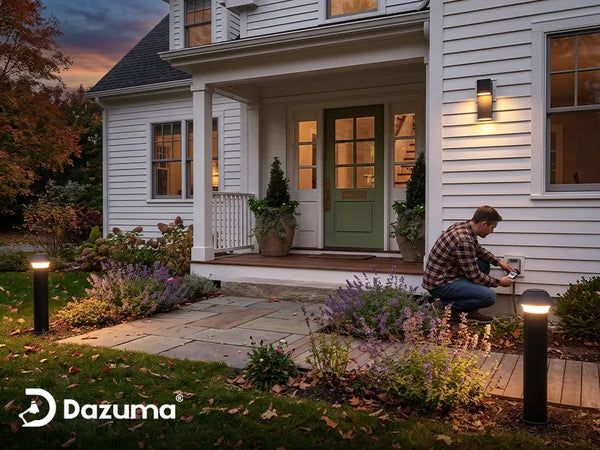
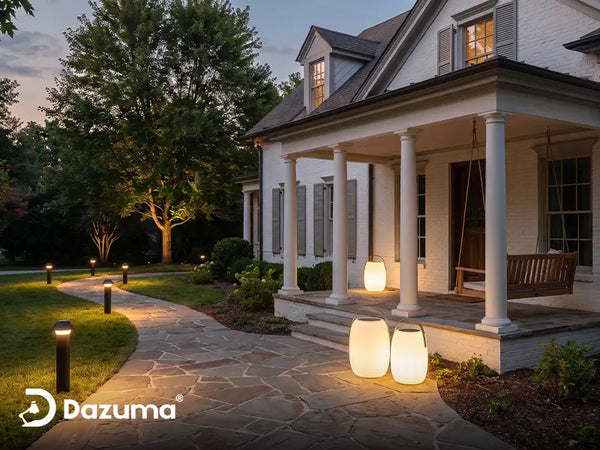
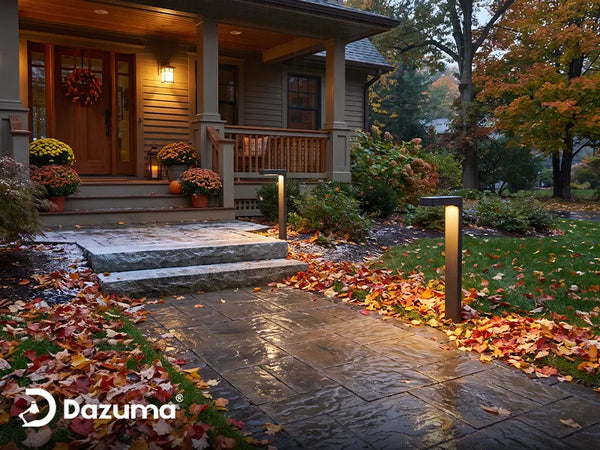
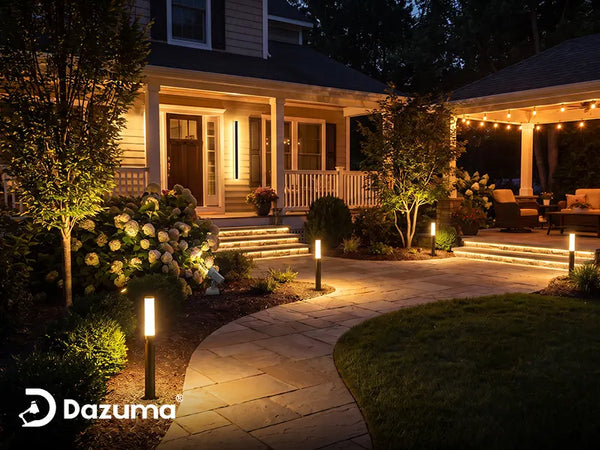
Downlighting a front walkway — either with low path lights or with wall-mounted fixtures aimed at the path from the side — creates the visual guide from street to door that makes a home feel complete at night. The goal isn't brightness; it's continuity. A well-lit path reads as safe and welcoming from the sidewalk in a way that even the most dramatic façade uplighting cannot replicate on its own.
Garage Facades and Wide Horizontal Surfaces
Eave-mounted downlights or soffit fixtures are ideal for illuminating the broad horizontal surfaces of a garage apron, front driveway, or wide paved courtyard. Their height advantage means fewer fixtures cover more area, and because the light source is above eye level, glare is minimized for both drivers and approaching visitors.
Choosing the Right Fixtures: Lumens and Color Temperature
| Application | Technique | Recommended Lumens | Color Temp |
|---|---|---|---|
| Tree uplighting (under 25 ft) | Uplight | 400 – 800 lm | 2700K |
| Tree uplighting (25–50 ft) | Uplight | 800 – 1,500 lm | 2700K – 3000K |
| Wall grazing (stone / brick) | Uplight (narrow beam) | 300 – 700 lm | 2700K |
| Front door / entry sconces | Downlight | 600 – 1,000 lm | 2700K |
| Porch ceiling / soffit | Downlight | 500 – 800 lm | 2700K |
| Front walkway path lights | Downlight | 100 – 250 lm | 2700K – 3000K |
| Moonlighting (tree canopy) | Downlight (high mount) | 200 – 600 lm | 2700K |
Layering Both for Maximum Curb Appeal

The most compelling residential exteriors after dark don't choose between uplighting and downlighting — they use both, intentionally, to serve different purposes within the same composition.
Think of it as a three-part system:
- Uplighting for drama and focal points — trees, architectural features, columns, and textured surfaces that deserve visual emphasis from below.
- Downlighting for function and welcome — porches, pathways, entries, and horizontal surfaces that need reliable, comfortable illumination from above.
- Balance between the two — neither technique should dominate to the point where it overwhelms the other. The best exterior lighting designs feel cohesive, as though the light is simply revealing the home as it was meant to be seen.
A practical starting point for most homes: install wall sconces flanking the front door as your downlight anchor, add one to two ground spotlights aimed at your most significant tree or architectural feature as your uplight focal points, and connect them with path lighting that guides the eye from street to entry. That three-layer foundation creates more curb appeal than most homes currently achieve — and it's achievable in a single weekend installation project.
For a full collection of fixtures designed to work together in a layered system, browse our landscape lighting range, which includes coordinated spotlights, path lights, and wall fixtures in matching finishes and styles.
Ready to Transform Your Home's Curb Appeal After Dark?
Uplighting brings drama and distinction. Downlighting brings warmth and function. Used together with intention, they create the kind of exterior that makes people slow down when they drive past at night.
At Dazuma, we carry a curated selection of outdoor fixtures built for both techniques — from precision ground spotlights for tree and façade uplighting to elegant wall sconces and soffit fixtures for architectural downlighting. Explore our complete outdoor lighting collection and start building the exterior lighting plan your home deserves.
The best version of your home's curb appeal is already there. The right lighting just reveals it.