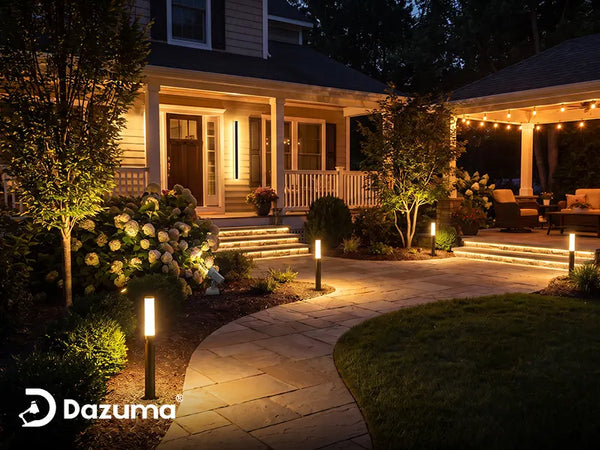

This guide is for homeowners who like the simplicity of solar pathway lighting but have a front walk, side yard, or garden path that receives sun for only part of the day.
Introduction
Solar path lights are appealing because they require no trenching, transformer, or electrician. Push them into the soil, let them charge, and the walkway gets a soft glow after dark. The uncertainty begins when the path runs beneath a maple tree, beside a north-facing fence, or under an eave. The yard may look bright during the day, but “bright” is not the same as receiving enough solar energy.
The honest answer is that solar path lights can work in partial shade, but their brightness and operating time will usually be less predictable than in full sun. The result depends on what creates the shade, how many hours the solar panel receives direct light, the size of the panel and battery, and how much energy the lamp uses at night. A lamp that works well beneath moving summer leaves may struggle in dense evergreen shade or during a cloudy winter week.

Do Solar Path Lights Work Well in Partial Shade?
Yes—if “partial shade” still gives the panel several hours of direct sun and you only need decorative wayfinding light. Expect shorter runtime, lower late-night brightness, and more variation after cloudy days. If the panel gets no direct sun because it stays beneath a roof overhang, dense canopy, or tall north-facing wall, a conventional all-solar path light is unlikely to be dependable.
The intended job matters just as much as the sun. A soft marker that helps define the edge of a garden bed can tolerate an early shutoff. A light relied upon at steps, a grade change, or a dark entry should not depend on uncertain daily charging. Use wired, low-voltage, or separately rechargeable lighting for those safety-critical locations.
If you are still comparing fixture types, start with the more focused Solar Path Lights category, then compare it with the broader Path Lights selection when the site may need a wired alternative.
Not All Partial Shade Is the Same
Before buying lights, identify what the solar panel—not the surrounding lawn—will see between midmorning and late afternoon. U.S. Department of Energy guidance on photovoltaic energy yield identifies shade as one of the outside factors that reduces the energy actually harvested by solar panels. That same basic principle applies to the small panel on a path light: less usable light during the day means less stored energy for the night.

Moving or Dappled Tree Shade
This is the most promising shaded condition. Sun patches move across the panel as branches sway and the sun travels. If the panel gets a solid midday or afternoon window, the light may perform well enough for decorative path marking.
Bright Open Shade
A path beside a light-colored wall may look bright because it receives reflected sky light, yet the panel may never see the sun directly. It can still collect some energy, but charging is slower and full-night operation is less likely. This is where product claims based on a “full charge” can be misunderstood: the published runtime begins after the battery is full, not after any ordinary shaded day.
Roof, Fence, or North-Side Shade
Fixed architectural shade is more difficult because it does not move much during the charging window. If a roofline blocks the sun all day, moving the lamp a foot or two may not solve the problem. A separate solar panel, USB charging option, or low-voltage cable is usually more realistic.
Dense Evergreen Shade
Evergreens can block sunlight year-round, including when the winter sun sits lower in the sky. A solar fixture may glow briefly after a bright day but should not be treated as reliable. In this location, choose solar only if occasional accent light is acceptable.
| What the Panel Receives | Likely Result | Best Planning Response |
|---|---|---|
| About 6 or more hours of clear direct sun | Best chance of reaching the product's full-charge runtime | Normal solar placement |
| About 3–5 hours of direct sun plus open sky | Often usable for decorative markers, with shorter or variable runtime | Test the exact spot for three nights |
| About 1–2 hours of direct sun | Inconsistent brightness and early shutoff are likely | Move the panel or choose rechargeable/wired lighting |
| No direct sun beneath dense or fixed shade | Poor choice for dependable path lighting | Use low voltage, a remote panel, or USB backup |
These time ranges are practical screening points, not performance guarantees. Panel size, battery condition, latitude, season, weather, and nightly power use all change the result.
Use a Three-Day Sun Test Before Installing the Whole Set
A phone compass or sun-tracking app can help, but a simple observation test is often enough. Pick the exact spot where the panel will sit and check it at 9 a.m., noon, 3 p.m., and 5 p.m. Take a photo each time. Do this on a mostly clear day, then repeat after the lights are installed.
Record Three Things Each Night
- How bright the light appears during the first hour after dusk.
- Whether it is still operating at your normal bedtime.
- Whether all lights in the set behave similarly.
If the shaded fixture fades much earlier than a matching light placed in full sun, the location—not necessarily the product—is the limiting factor. The existing guide on whether solar lights need direct sunlight in shaded homes offers more background for borderline sites.

Install one or two lights first rather than opening and placing a large set along the entire path. Give a new light one or two clear days to charge with the switch on as directed by the product. Then judge performance over three nights. This prevents a common mistake: assuming the whole yard is unsuitable because one test light was placed beneath the densest branch.
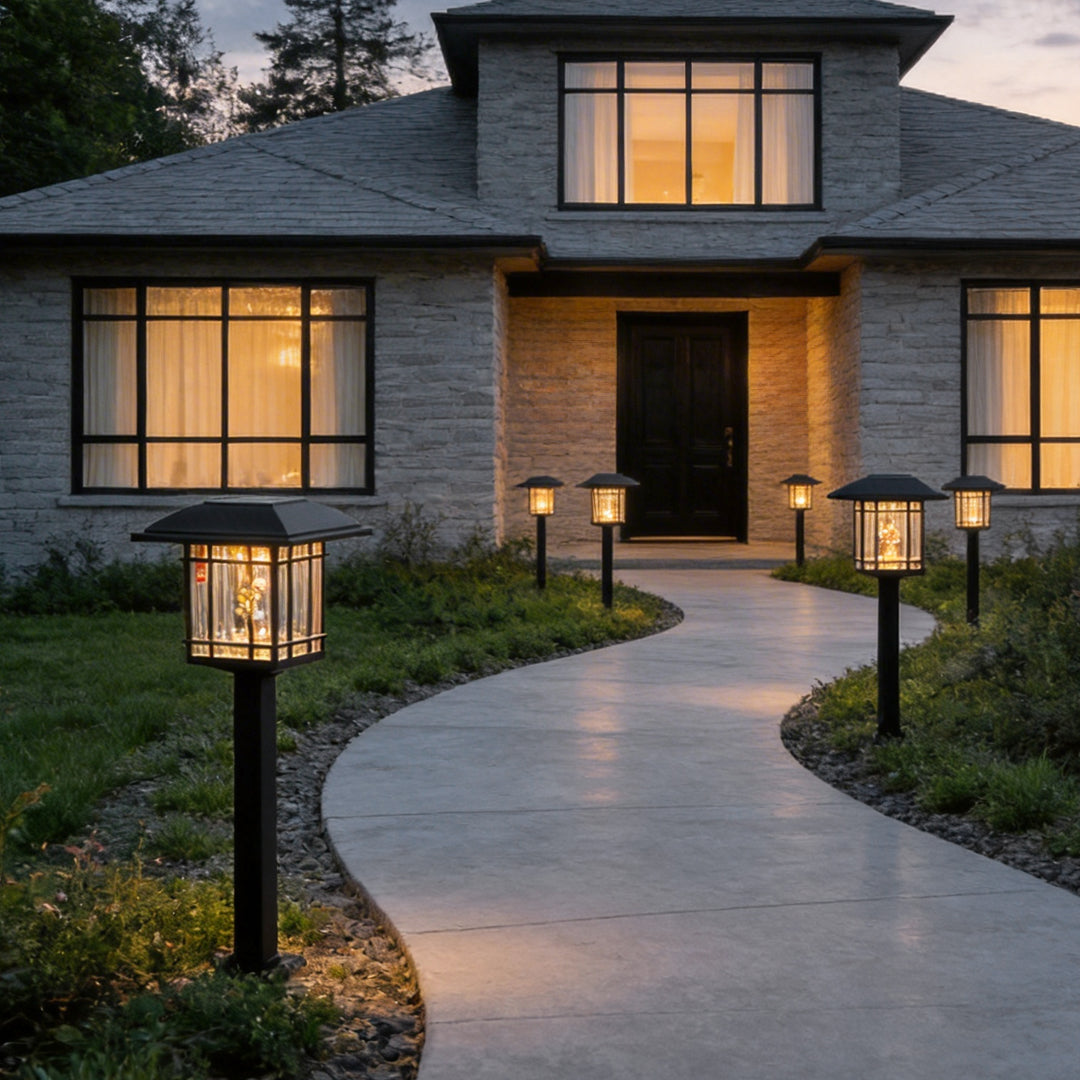
2-Piece Vintage Solar Outdoor Lawn Lights
Price: $88.99
This pair suits paths with moving tree shade or a dependable afternoon sun window. Its warm output is intended for gentle visual guidance, not high-output safety lighting.
- The top solar panel charges without wiring and switches on automatically at night.
- Black square housings create a classic lantern-like path rhythm.
- Runtime depends on the day's sunlight, so shaded placement should be tested.
How to Improve Solar Path Light Performance in Shade
Move the Panel Into Sun, Even If the Light Stays Near the Path
With an all-in-one fixture, the panel and light move together. Try shifting the stake toward the sunny edge of the bed and aiming the light back toward the walkway. A change of 18–24 inches can move the panel beyond a fence shadow or low branch while keeping the visual effect nearly the same.

Trim Only What the Garden Can Spare
Remove leaves or small shoots directly over the panel, but do not damage a mature tree just to support a small path light. If the lighting plan fights the landscape, change the lighting technology. A remote-panel fixture or low-voltage path light is a better long-term answer than repeated aggressive pruning.
Use Fewer Lights, Placed More Intentionally
Closely spaced dim solar lights do not necessarily improve navigation; they can create visual clutter while each unit competes for the few sunny spots. Place fixtures near turns, bed edges, and changes in direction. Staggering rather than creating two rigid rows often produces a calmer residential look.
Design the Path to Fail Gracefully
In a mixed-sun yard, do not distribute the best charging locations evenly just for symmetry. Give the sunniest spots to the fixtures that mark the most important decisions: the start of the walk, a turn, the edge of a step, and the approach to the door. Use the more heavily shaded fixtures as secondary rhythm between those points. If they fade earlier, the route still makes visual sense.
A typical example is a front walk that receives afternoon sun near the driveway but passes beneath a tree near the porch. Put one fully charged marker at the driveway entrance and another where the path changes direction. Let the tree-shaded section use softer decorative lights, while a dependable porch or low-voltage step light handles the final approach. This layered plan feels intentional at dusk and remains safer late at night.
Clean the Panel, Not Just the Lens
Pollen, dust, irrigation residue, and wet leaves reduce the light reaching an already shaded panel. Wipe the panel with a soft damp cloth and keep surrounding foliage from lying across it. If charging still fails after a sunny day, use the troubleshooting steps in why solar lights may not be charging before replacing the entire set.
Use Backup Charging for the Hardest Locations
A USB-chargeable light can be useful where the path receives inconsistent sun but running cable is impractical. Treat USB as a deliberate maintenance step: charge the unit before a gathering, after several gray days, or when seasonal shade increases. It does not make the shaded solar panel collect more energy.

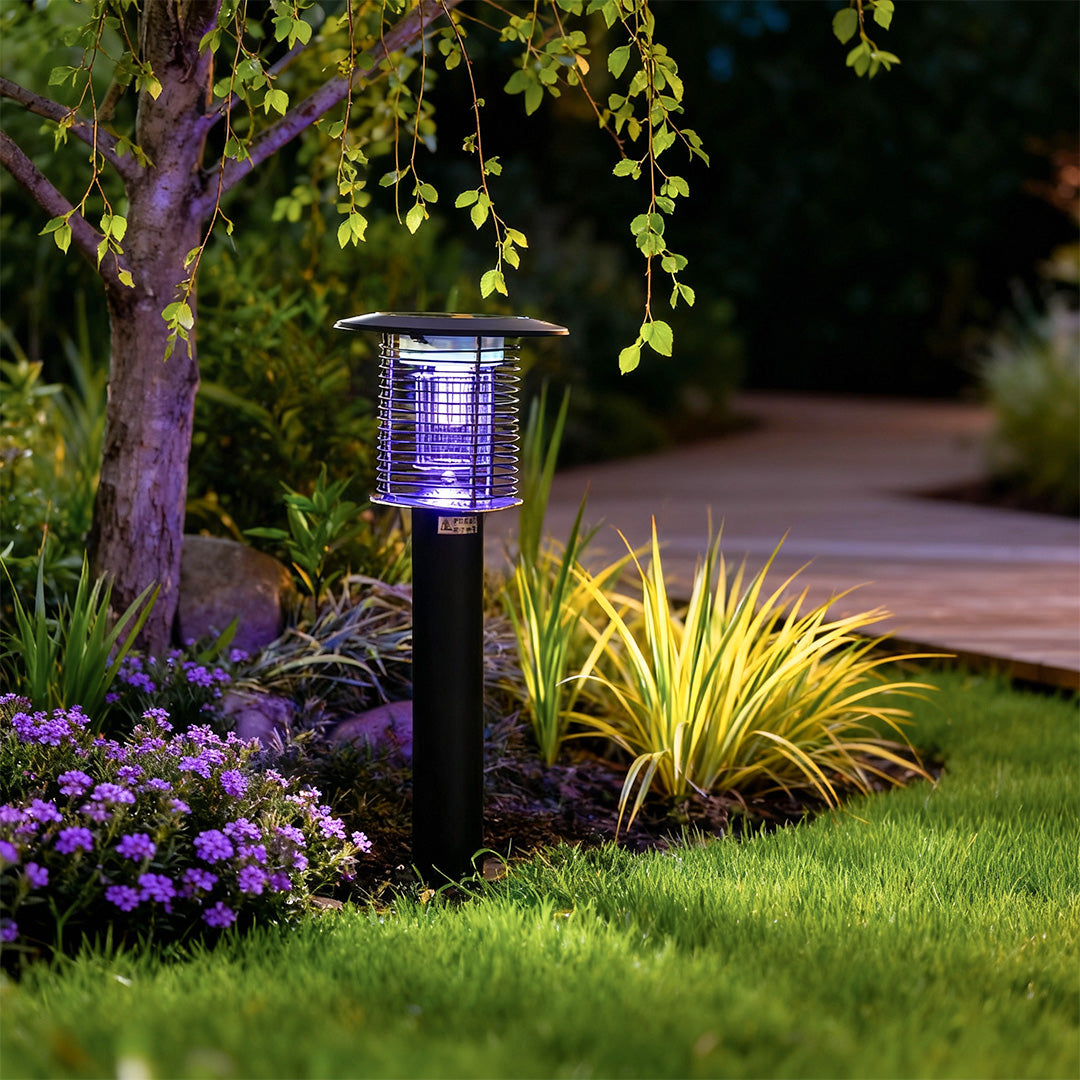
Solar and USB Garden Light With Bug Zapper
Price: $100.99
The Ground Insert or Lawn style can sit near a shaded path where both white light and an insect-attracting UV function are desired. USB backup makes cloudy-week maintenance more practical.
- White LED light and ultraviolet insect-attracting light share one fixture.
- Ground, lawn, portable, wall, and post configurations fit different sites.
- The product page does not publish runtime, so test it before relying on late-night light.
This second option is not a conventional path marker alone. Its additional UV function also uses stored energy, and the page does not state a working-time range. Place it along the outer edge of a path or garden rather than making it the only light at steps. If you use the insect-attracting mode, keep it away from the center of a seating area so it does not draw flying insects toward guests.
Expect the Same Location to Behave Differently by Season
A site that works in June can disappoint in November. The sun sits lower, days are shorter, deciduous branches cast different shadows, and evergreen screening becomes more influential. Cold weather can also reduce battery performance. Judge the installation by the darkest season in which you actually need the path.

Plan for the Night You Care About Most
If the lights are mainly for summer dinners, partial shade may be perfectly acceptable because the days are long. If they must guide guests during dark winter evenings, test after the leaves fall and the sun angle changes. For more styles that may include different charging and mounting arrangements, browse Outdoor Solar Lights.
Common Mistakes in Partially Shaded Yards
Judging Shade at Only One Time of Day
A panel in sun at 10 a.m. may be shaded for the rest of the charging window. Observe the whole day, especially midday through afternoon when sunlight is typically strongest.
Reading “6–10 Hours” as a Nightly Promise
For the first product above, 6–10 hours is the stated working time after a full charge, and the page explicitly says it depends on sunlight duration. Partial shade may never fill the battery on a given day. Treat runtime as a best-case range, not a fixed schedule.
Assuming a Bigger Battery Solves Shade
A larger battery stores more energy, but it still needs enough incoming energy to recharge. Battery capacity, panel output, and nightly consumption must work together. A large undercharged battery can still produce a short night.
Using Decorative Solar Lights as Safety Lighting
Low-output path lights help reveal edges and create rhythm; they may not fully illuminate steps, uneven paving, or obstacles. Add a dependable source at hazards. Solar can remain the decorative layer while wired lighting handles safety.
Ignoring Water and Soil Conditions
Even a product described as waterproof should not sit in a low spot where irrigation or rain pools around the housing. Neither product page supplies a specific IP rating. Install stakes in firm, well-drained soil and avoid sprinkler jets aimed directly at the panel or seams.
Final Advice
Solar path lights can work well in partial shade when the panels still receive a meaningful window of direct sun and the goal is soft decorative guidance. Moving tree shade is usually more workable than a permanent roof or fence shadow. The most reliable decision is to test one light in the exact location for several clear and cloudy nights.
Choose the vintage 2-piece path light when you have a usable sun window and want a warm, classic marker. Consider the solar-and-USB garden light when backup charging is worth the extra maintenance and its insect-attracting feature suits the area. For deep shade, winter-critical paths, steps, and entries, use low-voltage or another dependable power source. A good lighting plan respects the landscape, but it also respects the limits of the available sunlight.