
Who This Is For: This guide is written for homeowners, DIY enthusiasts, and property managers who want smarter, more efficient outdoor lighting — whether your priority is home security, energy savings, curb appeal, or all three.
Choosing between motion sensor and timer outdoor lights is one of those decisions that sounds simple until you're standing in the lighting aisle or scrolling through product pages at midnight. Both systems automate your exterior lighting — but they do it in fundamentally different ways, with different strengths, weaknesses, and genuinely different use cases.
The honest answer isn't "one is better than the other." It's that each excels in specific scenarios. A motion sensor is a reactive tool — it responds to what's happening right now. A timer is a proactive tool — it works on a predetermined schedule regardless of activity. Understanding that distinction will make every other decision much clearer.
How Motion Sensor Outdoor Lights Work
Most residential motion sensor lights use Passive Infrared (PIR) technology. The sensor doesn't emit anything — instead, it detects changes in infrared radiation (heat) within its detection zone. When a warm-bodied object like a person, animal, or vehicle moves through the field of view, the sensor registers the temperature differential and triggers the light instantly.

Detection Range and Sensitivity Settings
Most outdoor motion sensor lights offer adjustable controls that directly affect real-world performance:
- Range (Distance): Typically 15–70 feet. Wider coverage suits driveways and large yards; tighter ranges reduce false triggers near busy streets.
- Sensitivity: Adjusts the heat differential required to activate. High sensitivity in warm climates can increase false activations from heat-radiating surfaces.
- Time Delay (Duration): How long the light stays on after motion stops — usually adjustable from 30 seconds to 15 minutes.
- LUX Control: A daylight sensor that prevents activation during daytime hours, saving energy even when motion is present.
Beyond PIR: Microwave and Dual-Tech Sensors
Some premium fixtures use microwave sensors — which emit radar pulses to detect motion through walls and around corners — or dual-technology sensors that combine PIR and microwave to dramatically reduce false triggers. For most residential applications, a well-adjusted PIR sensor performs excellently at a fraction of the cost.
How Timer Outdoor Lights Work
Timer-based outdoor lights operate on a fixed schedule you program in advance. They switch on and off at specific times — no movement required, no sensor needed. Think of it as a dependable clock that runs your exterior lighting on autopilot, night after night.

Mechanical vs. Digital Timers
Mechanical timers use physical pins or rotating dials to set on/off windows. They're simple and inexpensive — but they can't account for seasonal shifts in sunset time, drifting up to 30 minutes off during winter months without manual adjustment.
Digital timers allow precise multi-cycle scheduling and often include astronomical clock features that automatically sync on/off times to local sunrise and sunset data year-round — no manual adjustment needed across seasons.
Smart Timers and App Control
Modern smart timers integrate with Google Home, Amazon Alexa, and Apple HomeKit. You can update schedules remotely, set vacation modes, or sync your exterior lighting with real-time sunset data from your GPS location. For homeowners who want scheduling with remote override capability, a smart timer is an excellent upgrade.
Motion Sensor Outdoor Lights: Pros and Cons
| ✅ Pros | ❌ Cons |
|---|---|
| Strongest security deterrent — sudden bright light startles intruders | Can be triggered by animals, blowing branches, or passing traffic |
| Only runs when needed — maximum energy efficiency | Doesn't provide consistent ambient or decorative illumination |
| Ideal for low-traffic zones: side yards, garages, back entries | Requires calibration to minimize nuisance activations |
| Works year-round without any seasonal reprogramming | Repeated short cycles can feel jarring for frequent visitors |
| Lower operating cost over time due to on-demand activation | Not suitable for continuously lit decorative or landscape applications |
Timer Outdoor Lights: Pros and Cons
| ✅ Pros | ❌ Cons |
|---|---|
| Consistent, predictable lighting that enhances curb appeal all evening | Runs on schedule even when no one is home — wastes energy |
| Perfect for landscape, architectural, and decorative fixtures | Requires seasonal adjustments with non-astronomical timers |
| Zero false triggers — completely unaffected by animals or wind | Weaker active deterrent — lights on whether anyone's present or not |
| Simulates occupancy effectively for security during travel | Doesn't respond to real-time activity or unexpected events |
| Ideal for patios, front doors, and entertaining spaces | Smart models have a steeper setup and programming learning curve |
Head-to-Head Comparison
| Feature | Motion Sensor | Timer |
|---|---|---|
| Activation Method | Triggered by movement | Fixed on/off schedule |
| Energy Efficiency | ⭐⭐⭐⭐⭐ Excellent | ⭐⭐⭐ Moderate |
| Security Deterrence | ⭐⭐⭐⭐⭐ Best | ⭐⭐⭐ Occupancy simulation |
| Curb Appeal | ⭐⭐ On-demand only | ⭐⭐⭐⭐⭐ Consistent all night |
| False Activation Risk | Moderate | None |
| Seasonal Adjustment | Not required | Required (unless astronomical) |
| Best Use Case | Driveways, entries, side yards | Patios, landscapes, facades |
When to Choose Motion Sensor Outdoor Lights
Motion sensors earn their keep in specific high-value scenarios. If security is your primary concern, a motion-activated outdoor wall light is one of the most cost-effective deterrents available. Studies consistently show that well-lit exteriors reduce property crime risk — and the sudden activation of a bright light is far more startling to an intruder than a fixture that was already on.
Motion sensors are the right choice when:
- Security is your top priority over aesthetics
- The location is low-traffic — side gates, back entries, detached garages
- You're securing a rental or vacation home that sits empty for extended periods
- You want immediate notification of unexpected nighttime activity
- The fixture will be paired with a security camera system
- You want to minimize electricity usage without sacrificing safety

When to Choose Timer Outdoor Lights
Timer lighting is the right call when consistency and visual impact take priority over reactivity. If you've invested in landscape lighting, architectural uplighting, or decorative wall fixtures, you want those lights performing on cue every single evening — not waiting for someone to walk past.
Timers make the most sense when:
- You're lighting a patio, pergola, or entertainment area where ambience matters all night
- The fixture is purely decorative — a lantern post, a wall sconce, or a facade accent light
- You travel frequently and need lights to simulate occupancy on a consistent schedule
- Your pathway lights or landscape spotlights should remain on throughout evening hours
- Your HOA or neighborhood aesthetic requires consistent nighttime illumination

Energy Savings Breakdown: Which Actually Costs Less?
The energy cost difference between motion sensor and timer lighting can be substantial over the course of a year. Here's a practical comparison based on a standard 20W LED outdoor wall light at the U.S. average electricity rate of $0.16/kWh:
| Scenario | Daily Runtime | Annual kWh | Est. Annual Cost |
|---|---|---|---|
| Timer — Dusk to Dawn (~10 hrs) | 10 hours | 73 kWh | ~$11.68 |
| Timer — Evening Only (~5 hrs) | 5 hours | 36.5 kWh | ~$5.84 |
| Motion Sensor — Busy Entry (~2 hrs total) | ~2 hours | 14.6 kWh | ~$2.34 |
| Motion Sensor — Low-Traffic Area (~20 min total) | ~20 minutes | 2.4 kWh | ~$0.38 |
The math is clear: for low-traffic security zones, a motion sensor can cost 30× less per year than a dusk-to-dawn timer running the same fixture. Even for busier areas, motion sensors typically cut operating costs by 60–80% compared to continuous timer schedules. Over a 5-year fixture lifespan, those savings add up meaningfully — especially across multiple fixtures.
The Hybrid Approach: Why Choose When You Can Have Both?

The most effective outdoor lighting plans combine both systems strategically. Professional landscape designers consistently recommend a layered approach: timers for ambient and decorative zones, motion sensors for security-critical areas.
A practical hybrid layout for a typical home:
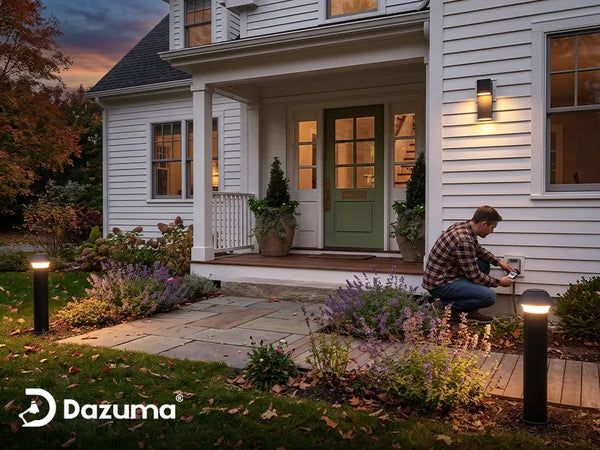
- Front door and porch: Timer — on every evening for curb appeal and welcoming guests
- Driveway and garage: Motion sensor — activates when you pull in, deters approach from strangers
- Side yard and back gate: Motion sensor — low-traffic zone, maximum security value
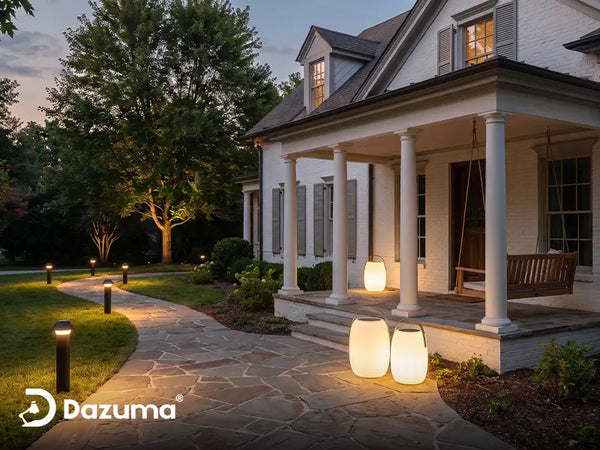
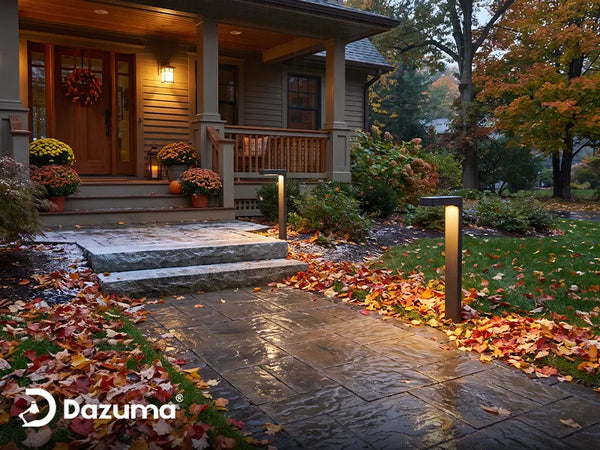
- Landscape and pathway: Timer or solar outdoor lighting — consistent ambient glow all evening
- Deck or patio: Timer or smart dimmer — atmosphere on demand during entertaining hours

Pro Installation Tips for Both Systems

Motion Sensor Installation Best Practices
- Mount at 8–10 feet: This height balances detection range with ground-level coverage. Too low and range shrinks; too high and the sensor may miss low-movement targets.
- Angle slightly downward: PIR sensors detect horizontal movement most effectively. A slight downward tilt maximizes sensitivity to approaching figures.
- Avoid heat sources nearby: HVAC vents, grills, and south-facing walls that absorb solar heat can cause false triggers in warm months.
- Test before finalizing: Walk the detection zone yourself before securing wiring to confirm coverage and eliminate blind spots.
Timer Installation Best Practices
- Choose an astronomical timer for zero-maintenance scheduling: It auto-adjusts to your location's sunrise/sunset times every day of the year.
- Set a buffer: Program lights to turn on 15–20 minutes before official sunset rather than exactly at sunset, so your home is never briefly dark during the transition.
- Pair with a photocell: A built-in or add-on dusk-to-dawn sensor used alongside a timer ensures lights never run during daylight hours — even if your schedule drifts.
- Use waterproof-rated outdoor timers: Any timer installed in an exterior junction box or exposed location must carry a minimum IP44 rating — IP65 for fully exposed installations.
Whether you're upgrading a single outdoor wall sconce or redesigning your entire exterior lighting plan, pairing the right control system with the right fixture makes the difference between lighting that merely works and lighting that genuinely performs.
Which One Should You Choose?
Here's the simplest framework: if the location needs security coverage and energy efficiency, choose a motion sensor. If it needs consistent ambience and visual presence, choose a timer. If the location needs both — which describes most front entries and driveways — the hybrid approach delivers the best result.
The good news is that modern motion sensor outdoor wall lights and smart-timer-compatible fixtures are available at virtually every price point. The investment in the right control system pays back through energy savings, better security outcomes, and a home exterior that looks intentionally designed — because it is.
Ready to upgrade your outdoor lighting? Browse our full range of outdoor wall lights, explore our solar outdoor lighting collection for timer-free energy savings, or shop path and landscape lights to complete your exterior lighting plan from the ground up.