
This guide is for homeowners whose solar post cap lights look perfect on the fence during the day but turn dim by bedtime—or who are still deciding whether a shaded deck, tree-lined yard, or covered gate gets enough sun to make solar lighting worthwhile.
How Much Direct Sun Do Solar Post Cap Lights Really Need?
Aim for 6 to 8 hours of unobstructed direct sunlight on the solar panel if you want dependable evening performance. Some efficient lights can reach a useful charge in about 5 to 6 hours, and many will still glow after a day of bright overcast or partial sun. But “the light turned on” is not the same as “the battery reached a full charge.”
Four to six hours of strong sun may be enough for decorative light through dinner in summer. Less than four hours, broken into short patches by tree branches or roof shadows, often produces unpredictable runtime. Full-day shade may let a light flicker on briefly, but it is a poor location if you expect steady illumination every night.
The product's panel size, battery capacity, LED power, lighting mode, panel cleanliness, battery age, temperature, and night length all affect the result. That is why two solar caps on the same fence can behave differently: one receives direct afternoon sun, while the next sits under a branch shadow during the most productive hours.

Direct Sunlight, Partial Sun, and Bright Shade
Solar cells can produce electricity under diffuse daylight, so a solar post cap light does not need a perfectly blue sky to charge at all. The problem is output. Direct sun delivers much more usable energy than bright shade, and even partial shading reduces what a small panel can collect. A post cap has far less panel area than a rooftop system, so it has less room to make up for a weak location.
| Daily Exposure | Likely Real-World Result | Best Expectation |
|---|---|---|
| 6–8+ hours of direct sun | Best chance of reaching a full charge | Reliable decorative lighting through much of the night |
| 4–6 hours of direct sun | Often workable, especially in summer | Good evening light, with shorter winter runtime |
| 2–4 hours plus bright daylight | Partial charging and frequent variation | Accent light for a few hours, not all-night performance |
| Bright shade all day | May charge slowly but rarely to full capacity | Inconsistent glow; consider a remote-panel or wired option |
| Deep shade under roof or dense canopy | Poor charging | Solar is usually the wrong power method for that post |
These ranges are planning guidance, not guaranteed runtimes. If the light uses a brighter mode or a higher-powered LED, it spends stored energy faster. If you only need a soft boundary glow from sunset until 10 p.m., a four-hour location may be acceptable. If you expect the light to guide an early-morning dog walk, hold out for a stronger solar location.
Homeowners comparing different formats can browse both general post cap lights and dedicated solar post cap lights. The important distinction is not simply “solar or not.” It is whether the panel can see enough sky from the exact post where the fixture will live.
The Three-Day Sun Test That Prevents a Bad Installation
Do not judge a location at noon and assume it stays sunny. Check it three times—around 9 a.m., noon, and 3 p.m.—on at least one clear day. Take a phone photo from above each proposed post cap. Then repeat on a second or third day if trees, nearby buildings, or a neighbor's fence create moving shadows.
Count only the periods when the panel area would be substantially exposed. A thin railing shadow that crosses one corner is different from a chimney shadow covering the whole top for two hours. Pay special attention between late morning and midafternoon, when the sun is generally stronger. A post that gets weak early-morning light and one hour of late sun may technically receive “sun,” but not enough useful solar energy.

Test the Worst Post, Not the Best One
On a row of eight fence posts, the sunniest cap can make the project look successful during a quick test. Install one sample on the shadiest important post first. Fully charge it according to the product instructions, then leave it in place for several normal day-and-night cycles. If its runtime meets your real need, the brighter locations should be easier.
For an open deck railing or fence that can provide roughly the listed 5- to 7-hour charging window, a compact cap with a modest LED load can be a practical fit. The first option below is sized for a smaller post top and offers two color temperatures, so the sun test should be done in the lighting mode you expect to use.
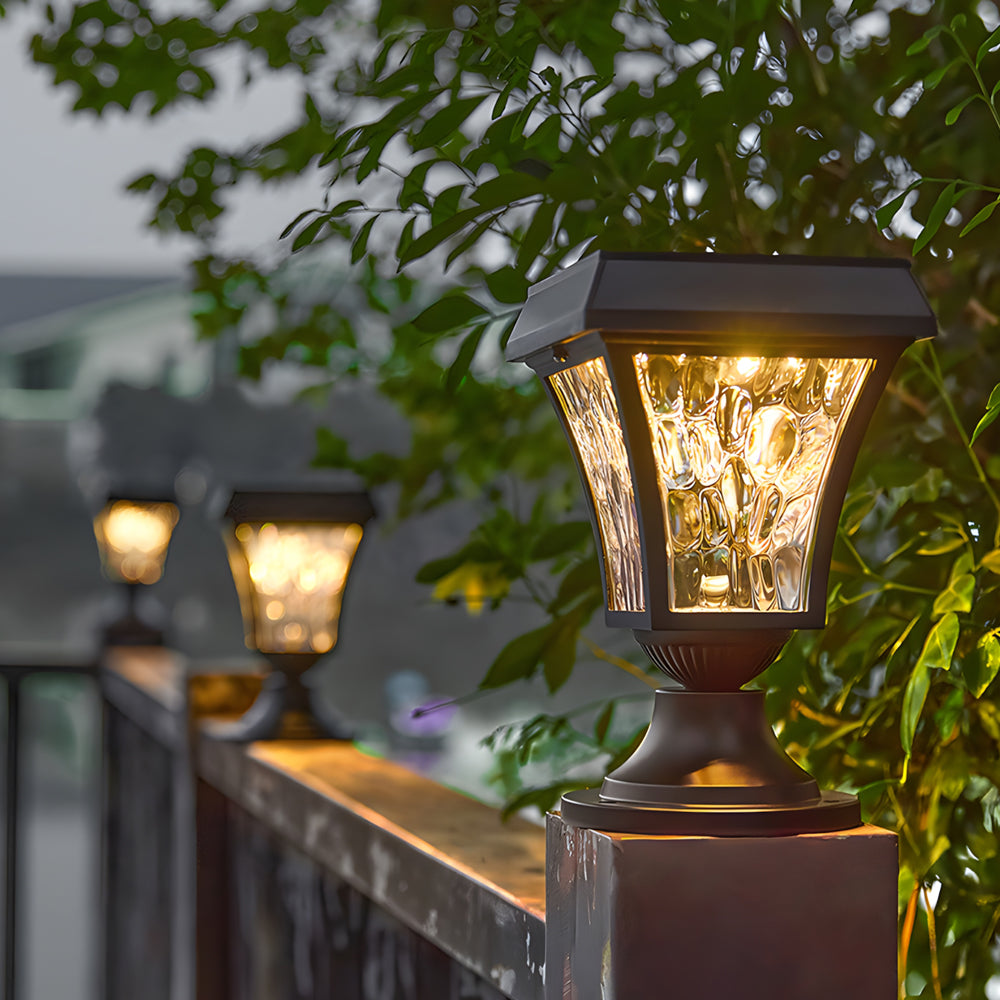
For sunny deck and fence posts
LED Solar Fence Post Cap Lights Waterproof Cast Lanterns Light
Price shown: $92.99
Best for railings, garden fences, and courtyard posts where the top panel can receive a mostly open 5- to 7-hour charging window.
- The monocrystalline panel sits directly on top for open-sky charging.
- Rippled PC panels spread decorative light in multiple directions.
- Single and multi-piece sets support consistent railing layouts.
Why a Good Summer Location Can Fail in Winter
Sun hours are not fixed for the life of the installation. In winter, days are shorter and the sun travels lower across the sky. A neighboring roof, evergreen hedge, or fence that caused little trouble in July may cover the panel for much of December. Colder batteries may also deliver less usable capacity, while longer nights ask the light to run for more hours.
Deciduous trees can work in either direction. Leaves cast heavy summer shade, but bare winter branches may let more light through. Unfortunately, the lower winter sun can introduce new shadows from houses and garages. When possible, check the proposed post from the sun's lower seasonal direction rather than relying only on a midsummer observation.
Cloudy days are not automatically zero-charge days. A good panel can collect diffuse light, but the charge is usually smaller. Several overcast days in a row create a cumulative deficit: the lamp spends more energy each night than it replaces during the day. Expect the light to dim sooner, shorten its runtime, or skip a night while the battery recovers. This is normal behavior, not immediate proof that the fixture is defective.
Set your expectation around the season when you need the light most. If the deck is mainly used for summer dinners, strong warm-weather performance may be enough. If the caps mark icy steps or a gate used before dawn, test during shorter days and plan a wired backup for safety-critical areas. Solar accent lighting should support visibility, not be the only protection at a hazardous level change.
For a deeper explanation of shaded sites, see whether solar lights need direct sunlight. The same physics applies to post caps, but their small built-in panels make careful placement especially important.
Why Solar Post Cap Lights Turn Off Too Early
Insufficient sun is common, but it is not the only cause. Work through the simple checks before assuming the battery has failed.
- Remove the protective film. A clear shipping film left on the panel can look nearly invisible while reducing charging.
- Turn the fixture on. Many solar lights must be switched to an active mode before the panel can charge and the dusk sensor can operate correctly.
- Clean the panel. Pollen, dust, bird residue, and mineral spotting reduce the light reaching the cells. Use the care method in the product instructions.
- Check nearby nighttime light. A porch sconce, streetlight, or bright window can fool a dusk-to-dawn sensor into thinking it is still daytime.
- Give a new light a full charge. Do not evaluate it after unpacking at 5 p.m. Let it charge in strong sun for the recommended period before the first runtime test.
- Compare neighboring units. If only one lamp is weak in the same exposure, swap its position with a working unit. The result helps separate a location problem from a fixture problem.
- Consider battery age. Rechargeable batteries lose capacity over time. If runtime gradually declined across seasons despite good sun and a clean panel, battery condition may be the cause.
The troubleshooting sequence matters. Replacing a battery will not fix a panel shaded by the deck roof, and moving the light will not fix a switch left in the off position. For additional checks, use this guide to fix solar lights that are not charging.
Run the Swap Test
Move the weak light to the sunniest post and the strong light to the problem post for two or three days. If the weakness follows the location, shade is the likely culprit. If it follows the fixture, inspect its panel, switch, sensor, connections, and battery according to the manual. This simple experiment is more useful than guessing from one cloudy night.

A larger battery provides more storage, but it cannot store energy the panel never collected. The second fixture below uses a 4000mAh battery and lists a 5- to 6-hour runtime. Its larger 9.25-inch footprint suits broad gate or courtyard pillars, where the top should remain open to the sky rather than tucked below a wall cap or tree canopy.
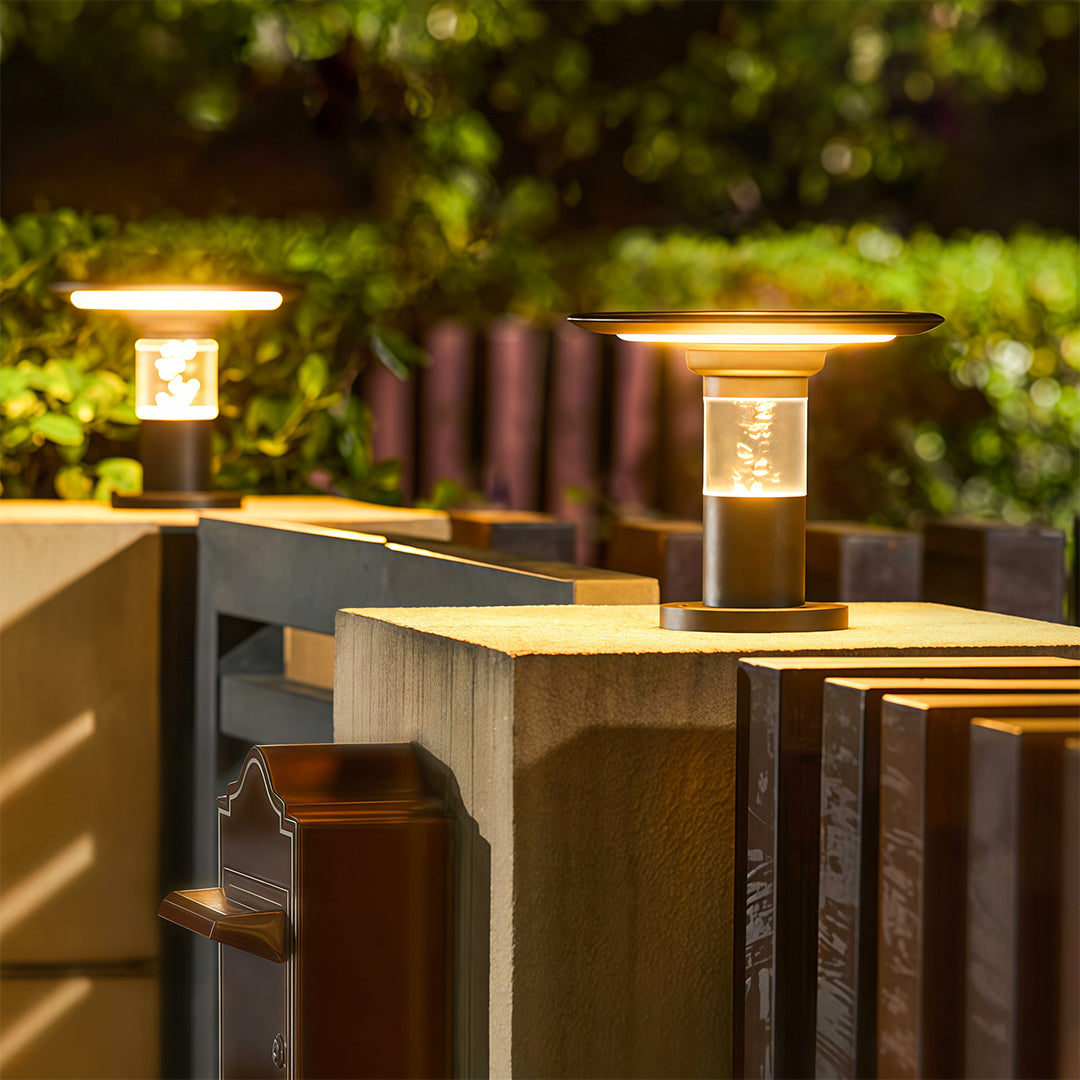
For broad gate and courtyard pillars
Solar Post Cap Light Outdoor Waterproof Aluminum Light
Price shown: $162.99
Best for a larger column top with open solar exposure and a homeowner who wants remote-controlled warm or cool light for the first part of the night.
- The integrated 5W LED supports two color-temperature modes.
- Black die-cast aluminum pairs with a white PMMA shade.
- The page lists approximately five to six hours of runtime.
Better Placement on Decks, Fences, and Gate Pillars
Deck Railings
A south- or west-exposed open railing often performs well in the Northern Hemisphere, but the deck roof is the usual trap. A panel can sit in bright ambient daylight while remaining in roof shade all afternoon. Also check the shadow of balusters, umbrellas, pergola slats, and a folded awning. If only the outer railing receives strong sun, use solar there and another lighting method under the covered section rather than accepting a mismatched row of dim caps.
Fence Lines
Fence posts can receive very different exposure over a short distance. Trees on the south side, the house, and even the fence itself can shade individual tops. You do not have to put a light on every post. Lighting corners, gates, stairs, and changes in direction often looks more intentional and prevents a dotted “runway” effect. It also lets you skip the worst shaded positions.
Gate and Masonry Pillars
Large pillars invite larger fixtures, but verify the top dimensions before ordering. The cap must sit securely without blocking drainage or leaving fasteners near an edge. A metal gate, stone coping, or decorative overhang can cast a hard shadow onto the panel. If the pillar is under a porte cochere or deep eave, wired lighting is usually more dependable than trying to make a built-in solar panel work without sun.
For other locations where independent solar fixtures make sense, browse outdoor solar lights. A remote-panel design can be especially useful when the lamp must stay in shade but a cable can reach a sunnier spot.
What to Check Before Buying Solar Post Cap Lights
- Actual post-top dimensions: Measure the width, depth, and any sloped cap—not just the nominal lumber size.
- Listed charge and runtime: Treat the runtime as a result under favorable charging conditions, not a promise for every winter day.
- Panel location: Top-mounted panels need open sky; side panels need the correct solar orientation.
- Battery capacity and serviceability: Capacity affects storage, while replaceability affects long-term maintenance.
- Brightness or operating modes: Higher output and cool-white modes may feel brighter but can use stored energy faster.
- Dusk sensor location: Make sure nearby house lights will not keep the fixture from switching on.
- Outdoor protection: Match the product's stated ingress protection and installation instructions to rain, sprinklers, and snow exposure.
- Seasonal shade: Imagine mature leaves, a lower winter sun, holiday decorations, and future landscaping.
- Your required end time: Decorative dinner lighting is a much easier target than dependable predawn illumination.
Final Advice
Give solar post cap lights 6 to 8 hours of direct sun when you can. Treat 4 to 6 hours as a workable but site-dependent range, and expect unreliable performance below that—especially in winter or after consecutive cloudy days. Before buying a full set, test one fixture on the shadiest important post, watch it through several normal weather cycles, and decide whether its actual end time fits your routine.
The goal is not to prove that a shaded post can collect some energy. It is to create a deck, fence, or entrance that still feels gently lit when you are actually outside using it. Choosing the right location first will improve performance more than buying a larger battery to compensate for a panel that never sees the sun.