
Who This Is For: This guide is written for homeowners upgrading their outdoor lighting, DIYers planning a new install from scratch, and anyone who's stood in a lighting aisle wondering what "800 lumens" actually means in the real world. If you've ever bought a fixture only to find it too dim — or blindingly bright — this is for you.
Choosing outdoor lighting shouldn't feel like guesswork — but for most homeowners, it does. You browse a product page, see "1600 lumens," and have absolutely no idea whether that's enough to light a front porch or whether it'll wash out the entire neighborhood. The short answer: lumens tell you how much light a fixture produces, and getting the number right for your specific outdoor space makes the difference between a yard that feels safe and welcoming versus one that's either dark and uninviting or harsh and glaring.
This guide cuts through the confusion. You'll find specific lumen ranges for every major outdoor area — front entries, driveways, patios, walkways, and security zones — plus a simple formula to calculate exactly what your yard needs. Whether you're replacing a single porch sconce or planning a full landscape lighting project, you'll leave with the numbers and the confidence to get it right.
What Are Lumens?

A lumen (lm) is the standard unit for measuring the total amount of visible light emitted by a source. Think of it like this: watts measure how much electricity a bulb consumes; lumens measure how much light it actually produces. With the widespread shift to LED technology, watts are essentially useless as a brightness indicator — a 10-watt LED can produce the same light as an old 60-watt incandescent. Lumens are the only number that actually matters.
Outdoors, you generally need more lumens than indoors for the same perceived brightness. Why? The open environment absorbs and disperses light far more aggressively than enclosed walls and ceilings do. Light that would illuminate a room beautifully gets swallowed up by sky, grass, and distance outside. That's why an indoor table lamp at 800 lumens feels comfortable but an outdoor wall sconce at 800 lumens might leave your front path feeling underlit.
Understanding this principle is the first step to making smart lighting decisions. Now let's put real numbers to it.
Outdoor Lumen Chart by Area
Use this reference table as your go-to starting point. These ranges reflect best practices from professional landscape lighting design and are appropriate for typical residential applications in the US.
| Outdoor Area | Recommended Lumens | Fixture Type | Notes |
|---|---|---|---|
| Front Entry / Porch | 600–1,200 lm | Wall sconces (pair) | One sconce per side of door; layer with overhead if possible |
| Driveway / Garage | 1,500–3,000 lm | Wall-mount, post light | Mount at 8–10 ft height; use linear fixtures for even coverage |
| Patio / Deck | 1,200–2,500 lm total | Wall sconces, string lights | Layer multiple sources; avoid single bright fixture |
| Walkway / Path | 100–300 lm per fixture | Path lights | Space fixtures 6–8 ft apart along the path |
| Garden Accent / Uplighting | 50–300 lm | Spotlights, ground stakes | Scale to plant size; 50 lm for small shrubs, 300 lm for trees |
| Security / Flood Zone | 2,000–8,000 lm | Flood lights, area lights | Pair with motion sensor for maximum deterrence |
| Wide Backyard / Open Area | 4,000–8,000 lm total | Multiple fixtures or area light | Distribute with multiple fixtures vs. one concentrated source |
Keep this table bookmarked — you'll come back to it as you work through each zone of your property.
Front Entry and Porch Lighting
Your front entry sets the tone for your entire home. It's the first impression guests see and the transition zone your family uses every single day after dark. Getting the lighting right here is both a practical and aesthetic decision.
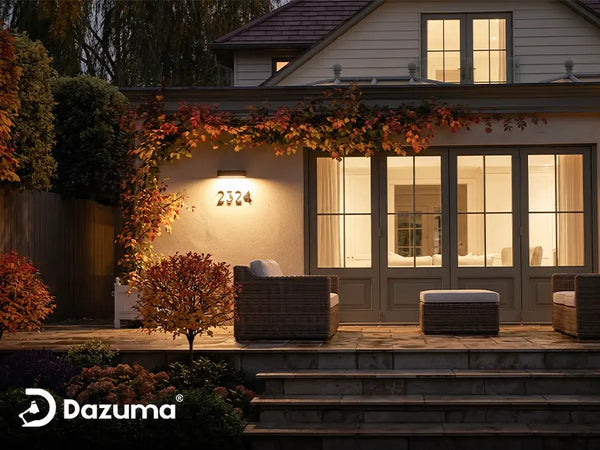
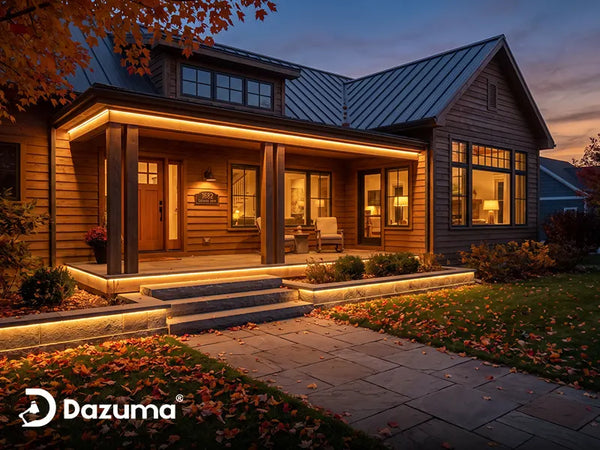
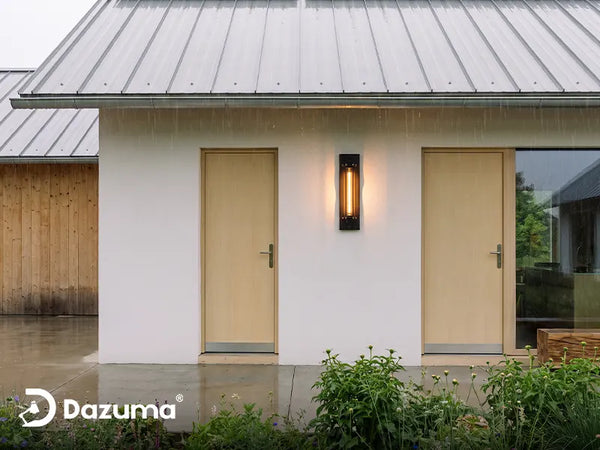
For most residential front porches, you're targeting 600 to 1,200 lumens total. The most effective approach is to flank your front door with a pair of wall sconces — one on each side — rather than relying on a single overhead fixture. Two sconces at 400–600 lumens each gives you balanced, shadow-free illumination that works for both curb appeal and functional visibility.
The height matters too. Mount entry sconces at eye level — roughly 5.5 to 6 feet above the finished floor — to avoid glare. If your porch has a covered ceiling, a flush mount or lantern above the door can supplement the sconces for a layered, inviting look.
For covered porches with defined ceiling areas, consider adding a ceiling fan with integrated light or a pendant that adds another 400–600 lumens of ambient fill. This creates a welcoming pool of warm light that extends the living space outdoors.

✦ Featured Product
This dual-head arc sconce throws light both upward and downward for a balanced, layered effect. A modern statement piece for front entries, patios, and garage walls. Waterproof construction stands up to rain, humidity, and temperature swings.

Driveway and Garage Lighting
Driveways are long, wide, and open — which means they demand more lumens than most homeowners expect. Poor driveway lighting is a safety hazard: it makes it difficult to see pedestrians, pets, or obstacles when pulling in at night.

Target 1,500 to 3,000 lumens per fixture for driveways and garage areas. Wall-mounted fixtures work exceptionally well here — they keep the light source elevated (aim for 8 to 10 feet above grade) and direct it where you actually need it: down onto the pavement and across the approach. Linear wall fixtures are particularly effective for garage walls because their elongated form distributes light evenly over a wider horizontal span, eliminating the dark spots you'd get from a traditional point-source fixture.
For a standard two-car garage, two well-placed linear sconces flanking the garage doors — each producing 1,500–2,000 lumens — will cover the entire garage face and most of the adjacent driveway area. Pair these with outdoor wall lighting along any fence lines or retaining walls to eliminate shadowed approach zones.
✦ Featured Product

Black Long LED Linear Outdoor Wall Light
A razor-thin aluminum linear sconce built for architectural drama. PMMA diffuser spreads light evenly across walls and entryways. Multiple lengths available — choose the size that fits your space. Weatherproof and built to last.
Patio and Backyard Lighting
Patio and backyard spaces are where outdoor living actually happens — dining al fresco, entertaining friends, relaxing on summer nights. Unlike security lighting, the goal here isn't maximum brightness. It's atmosphere.

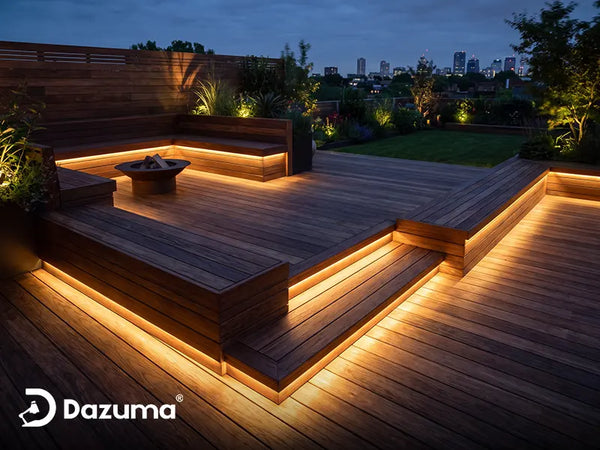
For a typical residential patio, target 1,200 to 2,500 lumens of total ambient light. The key word is "total" — the best patio lighting comes from multiple layered sources rather than a single bright overhead fixture. A combination approach works best: wall sconces mounted on the house or perimeter walls provide directional fill light, while overhead string lights or a pergola pendant add a warmer, diffused ambient glow.
Think of your patio in lighting zones. The dining area might benefit from a slightly brighter overhead source (800–1,200 lm) to make it easy to see food and faces. The lounge or seating area can be softer and more ambient (400–800 lm total). Transition zones between zones should blend naturally.
Avoid placing a single floodlight or high-lumen fixture directly overhead. This creates harsh downward shadows that flatten faces and make the space feel institutional rather than intimate. Spread the lumens around. For patio outdoor wall lighting, aim for sconces that cast light both upward and downward to create dimensional, layered illumination.
Path and Garden Lighting
Path and garden lighting serves double duty: it's functional (keeping guests from tripping at night) and decorative (enhancing your landscaping after dark). The good news is that these fixtures use far fewer lumens than you might expect.
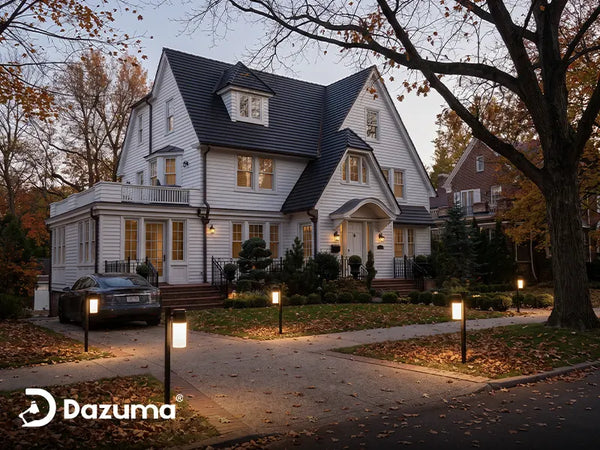
For path lights, the sweet spot is 100 to 300 lumens per fixture. This might sound low, but path lights work in aggregate — their purpose is to define the edges of a walkway, not flood the entire area with light. Space them 6 to 8 feet apart along both sides of the path in a staggered or straight-line pattern. At that spacing, 100–150 lm fixtures create a gentle, inviting line of light that guides movement without creating glare at eye level.
For garden accents and uplighting, scale your lumen output to the size of the plant or feature:
- Small shrubs and ground cover: 50–100 lm — subtle wash of light at the base
- Medium shrubs and ornamental grasses: 100–200 lm — directional spotlight from ground level
- Mature trees (uplighting): 200–300 lm minimum — use adjustable outdoor spotlights aimed upward into the canopy
- Architectural features (columns, stone walls): 150–400 lm depending on scale
The goal with garden lighting is drama through contrast — illuminated focal points pop against the dark background. Resist the temptation to light everything uniformly; selective highlighting looks far more professional than a yard bathed in flat, even light.
Security and Flood Lighting
Security lighting is the one outdoor application where more lumens are almost always better. The visual deterrence effect of bright lighting is well-documented, and sudden, intense light from a motion-triggered fixture is one of the most effective passive security measures available to homeowners.
For dedicated security and perimeter outdoor flood lights, target 2,000 to 8,000 lumens per fixture. Wide driveways, back yards, side alleys, and any large open areas you want to monitor should be covered by fixtures in this range. A standard residential security flood at 3,000–5,000 lumens paired with a motion sensor will illuminate a typical 20×30 ft zone clearly enough to identify a person from across the yard.
When positioning security lights, aim them to cover approach zones — the paths an intruder would logically take. Mounting height of 9 to 12 feet keeps the fixture above easy reach and broadens the coverage footprint. Angle the fixture slightly downward (30–45 degrees from horizontal) to maximize useful illumination on the ground plane while minimizing light pollution and neighbor spillover.
Don't forget side yards and back gates — these are often the most overlooked and most vulnerable zones. A 2,000–3,500 lm wall pack or flood on a motion sensor covers most residential side-yard applications.

Color Temperature and Perceived Brightness
Lumens measure quantity of light. Color temperature shapes the quality — and it has a significant effect on how bright a space feels even at identical lumen levels.
| Color Temperature | Appearance | Best For | Perceived Brightness |
|---|---|---|---|
| 2700K | Warm white (incandescent-like) | Porch, patio, garden accents | Lower perceived brightness — cozy, inviting |
| 3000K | Soft white (slight warmth) | Entries, pathways, architectural accent | Balanced — warm enough for ambiance, clear enough for visibility |
| 4000K | Cool white (neutral) | Driveways, work areas, step lighting | Higher perceived brightness — crisp, commercial feel |
| 5000K | Daylight (blue-white) | Security flood lights, parking areas | Highest perceived brightness — stark, utilitarian |
The practical takeaway: if you want your porch or patio to feel warm and welcoming, choose fixtures in the 2700K–3000K range. These emit a golden-toned light that's flattering to people and plants alike. For driveways and security zones where visibility is the priority, step up to 4000K–5000K — the bluer spectrum triggers higher perceived alertness and makes detail recognition easier at distance.
A common design choice in professional residential lighting: use 2700–3000K for all decorative and social spaces, then reserve 4000–5000K strictly for functional security zones. The contrast between the two makes security zones feel distinctly brighter and more purposeful without over-lighting the rest of your property.
How to Calculate Total Lumens for Your Yard
The lumen chart gives you zone-by-zone targets, but if you want to be precise — especially for larger properties or complex lighting layouts — there's a simple formula used by professional lighting designers:
Formula: Coverage Area (sq ft) × Foot-candles Needed = Lumen Target
The foot-candle (fc) is a unit of illuminance — essentially, how many lumens hit each square foot of surface. Here are the standard foot-candle targets for outdoor residential spaces:
- Walkways and paths: 1–2 foot-candles
- Patio and entertaining areas: 3–5 foot-candles
- Garage and driveway: 5–10 foot-candles
- Security zones: 10–20 foot-candles
Example calculation: You have a 15×20 ft patio (300 sq ft) that you want lit to a comfortable entertaining level (4 foot-candles).
300 sq ft × 4 fc = 1,200 lumens total
That means two wall sconces at 600 lumens each, or three smaller fixtures at 400 lumens each, would cover your space perfectly — which aligns exactly with the 1,200–2,500 lm range in the chart above.
Keep in mind that this formula assumes relatively direct, efficient light delivery. Fixtures mounted very high, angled awkwardly, or equipped with frosted/opaque diffusers will have lower effective lumen output at the surface. When in doubt, round up by 15–20% to account for real-world losses.
For complex projects — multi-zone landscapes, properties with significant grade changes, or architectural lighting — consider sketching a simple overhead plan of your yard with zones labeled. Calculate each zone separately, then sum the total fixture count. This approach prevents both over-lit zones that feel harsh and under-lit dead zones that undermine the overall effect. Browse our full landscape lighting collection to find fixtures for every zone.
Final Thoughts on Outdoor Lighting
Getting outdoor lumen levels right isn't complicated once you break your property into zones and match each zone to its purpose. Warm, lower-lumen sources for social and decorative spaces; bright, higher-lumen fixtures for driveways and security zones; gentle path lights to guide movement safely. Layer your light sources, choose the right color temperature for each application, and use the foot-candle formula when precision matters.
The fixtures you choose matter as much as the numbers. Well-designed outdoor fixtures direct light where it belongs — onto the surfaces you want illuminated — rather than scattering it into the sky. Invest in quality weatherproof construction, choose the right color temperature for the mood you want, and let the numbers guide you rather than guessing at the store.
Ready to Light Up Your Outdoor Space?
Shop Dazuma's curated selection of weatherproof outdoor fixtures — from architectural wall sconces to security floods. Every fixture is built for the elements and designed to perform.
Shop Outdoor Wall Lighting Explore Landscape Lighting