
Who This Is For: This guide is for homeowners planning a bathroom remodel or a simple vanity update who want useful mirror light without harsh glare, awkward shadows, or a fixture that looks too small for the wall. It is also for anyone who has stood under a bright ceiling light and wondered why shaving, makeup, or skincare still feels difficult.
Introduction: Bright Is Not the Same as Flattering
A bathroom can have plenty of light and still be frustrating at the mirror. The usual culprit is direction. One ceiling fixture sends light toward the top of your head, leaving shadows under the eyes, nose, and chin. A small bar centered high above a wide mirror brightens the wall but not both sides of your face. A bare or overly cool LED may make the room feel clinical even when the tile and vanity are beautiful.
The best bathroom vanity lighting solves the routine first. It lets you see skin tone, facial hair, makeup color, and small details without leaning toward the mirror. It also supports the room after the grooming task is finished: comfortable light for washing hands at night, enough illumination for cleaning, and a fixture that belongs with the mirror, faucet, and cabinet.

Quick Answer: What Makes Vanity Lighting Work?
For most bathrooms, begin with light at face level or slightly above it, a diffused source that is wider than a tiny decorative sconce, and a color temperature around 3000K to 4000K. Side lighting is often the most flattering because it reaches both sides of the face. An above-mirror bar is usually the easiest solution when wiring, wall width, or mirror shape leaves no room at the sides.
Do not choose from lumens alone. Check the fixture’s physical length, where the light-emitting surface sits, whether it can aim toward the face, its color rendering, color temperature, glare control, and suitability for the bathroom location. If the product page does not state a damp-location rating, dimmer compatibility, or CRI, ask before ordering rather than assuming.
Above the Mirror or Beside It?
Side Lighting: Best for Reducing Facial Shadows
Two vertical sconces or pendants placed on either side of the mirror send light across the face from left and right. That makes them a strong choice for makeup, shaving, contact lenses, and skincare. Side lighting also works beautifully with round, arched, or tall mirrors because it frames the shape instead of visually pressing down on it.
The challenge is space. A narrow vanity may not leave enough wall between the mirror and a side wall, medicine cabinet, towel ring, or shower glass. The fixtures can also appear crowded if the mirror already fills most of the wall. In that case, choose slim wall sconces, reduce the mirror width, or move to an above-mirror solution.
Above-Mirror Lighting: Best When Wall Space Is Tight
A linear vanity bar above the mirror is practical for apartments, small bathrooms, medicine cabinets, and wide mirrors with little side clearance. A longer, diffused fixture spreads light more evenly than a compact three-bulb cluster. If the light direction is adjustable, angle it toward the person—not straight down onto the counter and not directly into the mirror.
Above-mirror lighting can still create under-eye shadows, especially when mounted very high. Balance it with soft ceiling light or another ambient layer rather than trying to make the vanity bar overpower the whole room. The broader idea is covered in this guide to layered lighting and the three-lighting rule.
| Layout | Best For | Main Risk | Practical Fix |
|---|---|---|---|
| Two side sconces | Detailed grooming and tall mirrors | Crowded wall edges | Use slim fixtures and measure open doors and glass |
| One bar above | Limited side space and wide mirrors | Shadows below facial features | Keep it close enough to the mirror and aim light forward |
| Side sconces plus ceiling light | Primary bathrooms and shared routines | Too much light at once | Use separate switching or compatible dimming |
| Integrated mirror plus room light | Minimal spaces and shallow walls | Flat, overly frontal appearance | Add soft ambient light from above or behind |

Test the Shadow Pattern Before Installation
Hold two portable lamps near the sides of the mirror, then compare the result with a lamp held above it. The experiment is imperfect, but it quickly shows whether your face benefits more from side fill or a broad top source. Take the photo from normal standing position, not inches from the mirror.
How High Should Bathroom Vanity Lights Be?
Measurements are starting points, not laws. For side sconces, place the center of the luminous area near eye level—often around 60 to 66 inches above the finished floor. If the adults using the bathroom differ greatly in height, aim between their eye levels and use a vertically diffused fixture so the light serves both people.
For a bar above the mirror, a common starting point is roughly 75 to 80 inches from the floor to the center of the light. Another practical check is the gap above the mirror: around 3 to 6 inches often looks connected without crowding the frame. Tall mirrors, vessel sinks, unusually high ceilings, or existing electrical boxes can change those numbers.
Before drilling, mark the entire fixture—not just the junction box—with painter’s tape. Open the medicine cabinet, shower door, and nearby cabinet doors. Stand at the sink and check whether you see the LEDs directly or as a harsh reflection. An adjustable fixture can rescue an imperfect box location, but it cannot fix a light that physically collides with the mirror.
A Long Adjustable Bar for Wide Mirrors
When the electrical box is already above a broad single mirror, a long adjustable bar can spread light more effectively than a small centered fixture. The following model is almost 40 inches long, so it is best treated as a deliberate choice for a wide vanity rather than a universal fit for every powder room.
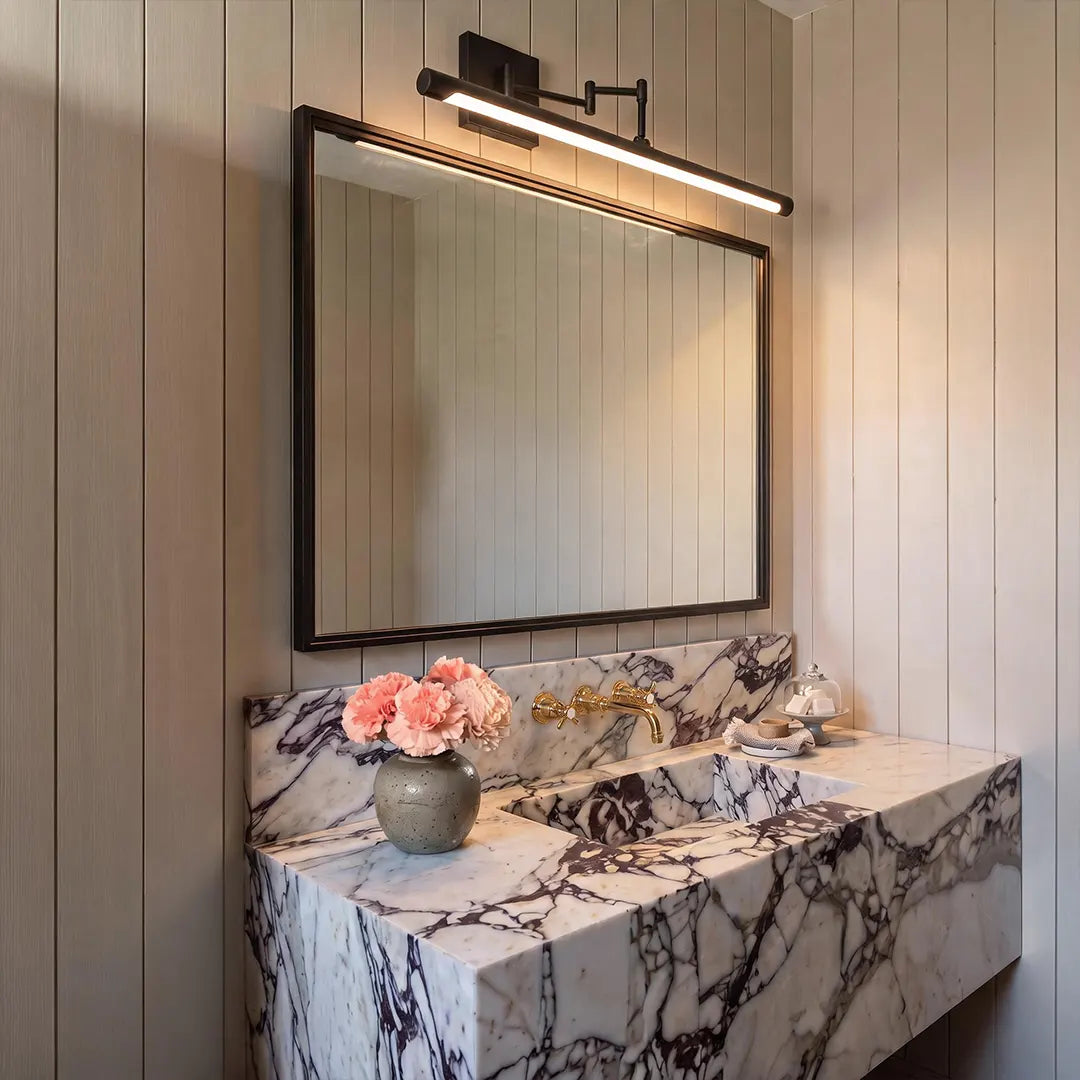
For Wide Modern Mirrors
Black Bar Vanity Light Metal Swing Arm Bathroom Light
Price: $211.99
Best for a wide single vanity or compact double vanity where a long fixture and adjustable swing arms can direct light toward the mirror user.
- Adjustable arms help refine the beam after the fixture is mounted.
- Available in black or white with several light-color configurations.
- Integrated LED, iron construction, and a diffusing PC shade create a clean linear profile.
How Bright Should Bathroom Vanity Lighting Be?
Start with the whole bathroom, not one product number. As a planning range, many bathrooms need roughly 25 to 40 lumens per square foot from all layers combined, with useful task light concentrated at the vanity. Dark tile, charcoal paint, deep shades, and high ceilings absorb more light; pale walls and a large mirror reflect more.
A single vanity may feel comfortable with roughly 1,200 to 2,000 useful lumens around the mirror, while a wide double vanity may need more or two fixtures. These are planning ranges, not promises. Distribution matters: 1,400 diffused lumens directed toward the face may work better than a higher-output ceiling light behind you.
Color Rendering Matters More Than Many Shoppers Expect
CRI describes how accurately a light reveals color compared with a reference source. For makeup, hair color, clothing, and skin tone, look for a published CRI of 90 or higher when possible. Do not assume every integrated LED meets that level. If CRI is missing from the product page, request it before treating the fixture as precision grooming light.
Choose Color Temperature by Routine
- 2700K–3000K: Warm, relaxed, and flattering for evening use, guest baths, and warm materials.
- 3500K–4000K: Clearer and more neutral for grooming without feeling as blue as very cool white.
- 5000K–6000K: Crisp and high-energy, but it can make a small bathroom feel clinical and may exaggerate contrast.
If you want both morning clarity and evening comfort, a selectable-color fixture can be useful. Confirm whether “three-step” means color selection, brightness dimming, or both. Those features are often confused on shopping pages. A wall switch that changes color temperature is not automatically a brightness dimmer.
Match Vanity Light Size to the Mirror
For a horizontal bar above the mirror, begin around 70% to 90% of the mirror width and keep the fixture within the mirror edges in most layouts. A slightly shorter light usually looks intentional; a very short bar creates a bright center and dim edges. A light wider than the mirror can work on a broad wall, but it often looks top-heavy and may conflict with side cabinets.
For a double vanity, decide whether the users have separate mirrors or one continuous mirror. Two mirrors usually look cleaner with one fixture above each. One long mirror can use a continuous bar, paired bars, or side fixtures at the outer edges plus an ambient ceiling layer. The useful guide to choosing a linear vanity light offers more examples of how length changes the wall composition.
Measure Three Things Before Shopping
Write down mirror width, open wall width, and the center of the electrical box. Then note any medicine-cabinet projection. The wall can fit a fixture on paper while the light still sits too close to the cabinet door or too far forward from the mirror.

A Shorter Gold Bar for Warm Finishes
A compact or medium-width mirror does not need a 40-inch bar. A shorter linear fixture can keep more breathing room around the mirror and support warmer finishes. This option comes in three lengths, making it easier to relate the light to the mirror instead of forcing one scale into every bathroom.
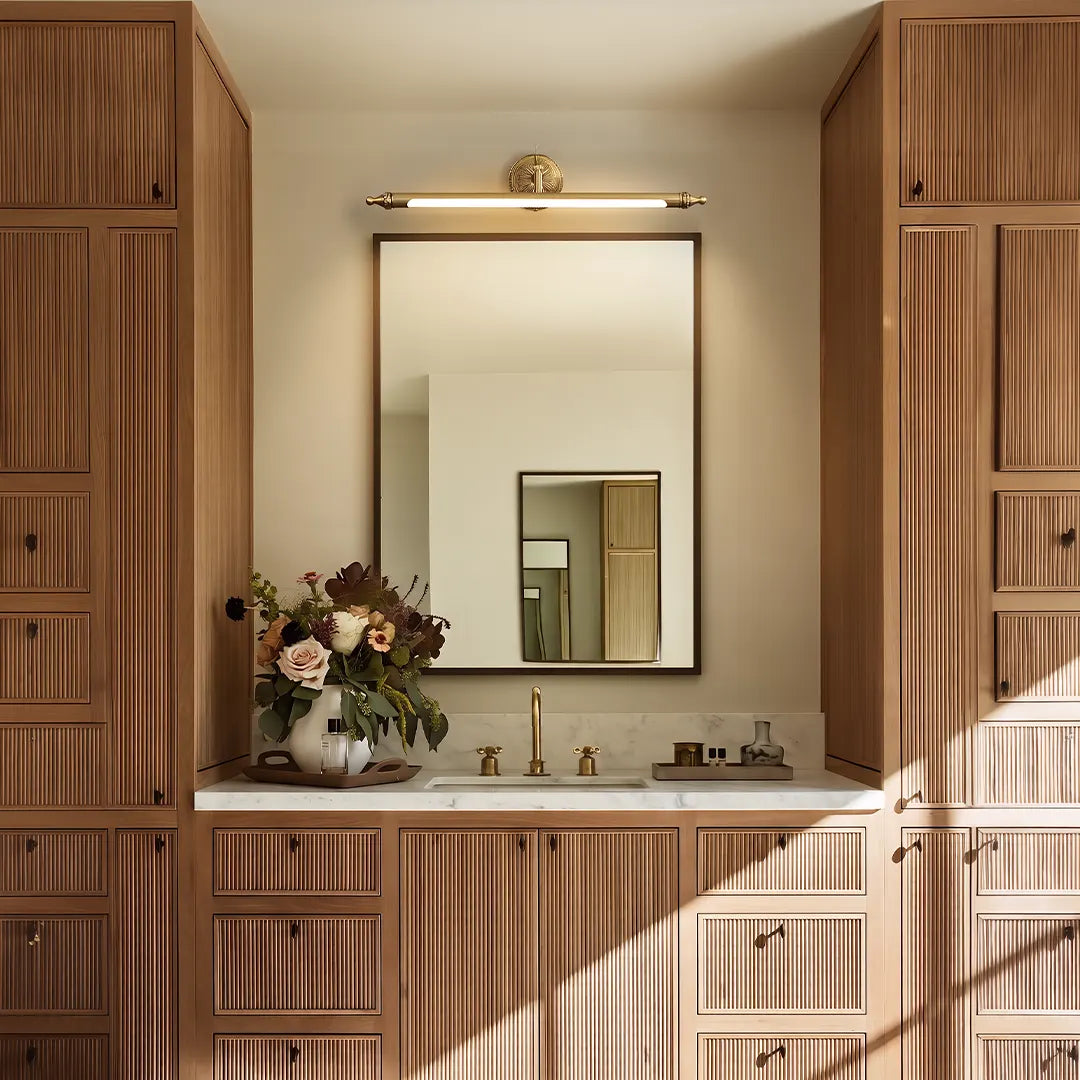
For Warm Transitional Vanities
Brushed Gold Vanity Light Bar European-Style Linear Copper Light
Price: $273.99
Best for small-to-medium mirrors, warm wood cabinets, marble, cream tile, and bathrooms where adjustable light direction helps refine the mirror illumination.
- Three fixture lengths help match different mirror widths.
- Fixed color options and a selectable-color version support different routines.
- A PC diffuser and adjustable downward direction soften and aim the integrated LED light.
Choose a Style That Supports the Vanity
Bathroom finishes do not need to match perfectly. A black vanity light can repeat a black mirror frame while the faucet remains brushed nickel. A gold light can warm up white tile even if the cabinet hardware is matte black. The room feels intentional when a finish appears at least twice or when the contrast is clearly deliberate.
Use black wall sconces for graphic definition against pale tile, white paint, or marble. Consider gold wall sconces when the room needs warmth around wood, cream, green, or stone. Avoid adding a third strong metal finish unless another element—such as a framed mirror—visually connects them.
Shape matters too. A thin linear bar works with rectangular mirrors and quiet modern rooms. Rounded shades soften angular tile. Vertical side lights emphasize height. If the bathroom is small, choose one clear shape and let the mirror remain the main visual surface.
Bathroom Vanity Lighting Buying Checklist
- Define the task. Decide whether the light is for quick handwashing, daily grooming, detailed makeup, or a shared morning routine.
- Measure the mirror and open wall. Record the electrical-box center and cabinet projection.
- Choose the layout. Use side light for facial balance or an above-mirror bar when side clearance is limited.
- Check actual lumens. Wattage is energy use, not brightness.
- Ask for CRI. Favor 90+ for color-sensitive grooming when the specification is available.
- Confirm color temperature. Decide whether you want warm, neutral, cool, or selectable light.
- Verify dimming details. Confirm driver and wall-control compatibility; color switching and brightness dimming are different features.
- Confirm bathroom suitability. Match the fixture’s damp or wet-location rating to its exact position and follow local electrical code.
- Mock up the size. Tape the full fixture outline above or beside the mirror and inspect it from the doorway.
- Use a qualified electrician. Hardwired bathroom lighting combines electricity, grounded boxes, and moisture, so installation is not the place to improvise.

Choose in This Order: Placement, Light, Then Finish
The prettiest fixture can still disappoint if it sends light onto the counter instead of the face. Solve the placement, beam direction, and brightness first. Then use the curated bathroom vanity lighting collection to compare styles that fit the completed plan.
Final Advice
The right vanity light should make the morning easier, not just make the mirror wall prettier. Begin at the face: decide where the light must come from to reduce shadows. Then measure the mirror, choose a useful length, confirm lumens and color quality, and verify that the fixture is suitable for its bathroom location.
If you are uncertain between two sizes, tape both outlines on the wall and live with them for a day. Check the view from the doorway, the reflected view in the mirror, and the clearance around cabinet doors. That small test prevents the most common expensive mistake: installing a beautiful light that is aimed at the wrong place.