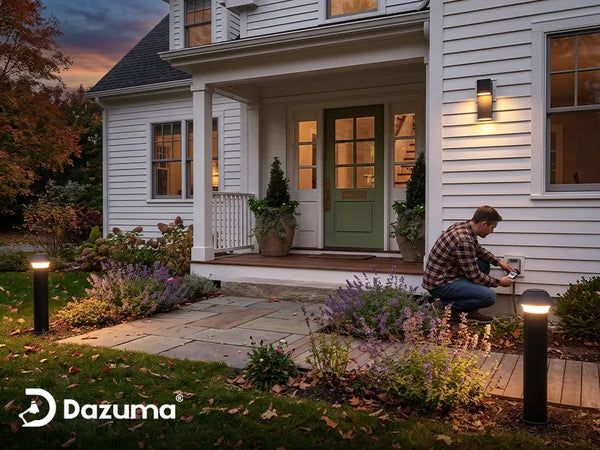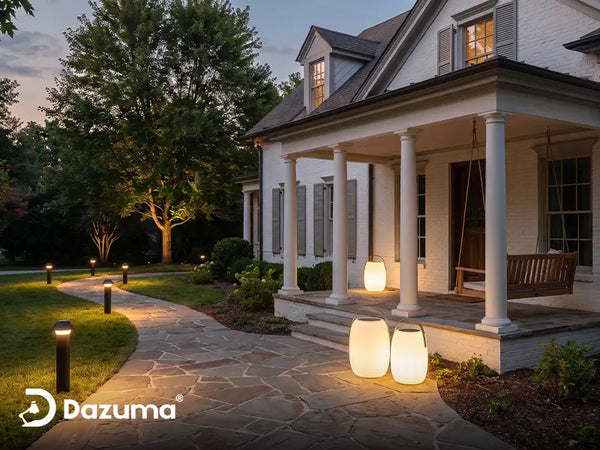

Who This Is For: This guide is for homeowners planning a driveway lighting upgrade — whether you're starting from scratch, replacing aging fixtures, or trying to decide which style makes more sense for your property's layout and curb appeal.
You're planning your driveway lighting and you've narrowed it down to two strong contenders: bollard lights and post lights. Both look great in product photos. Both are sold as "driveway lighting." Both come in styles that could complement your home. So how do you actually choose?
The answer isn't just about aesthetics — it's about function. Bollard lights and post lights distribute light differently, sit at different heights, create different visual effects, and suit different driveway types and home styles. Choose the right one, and your driveway looks intentional and well-lit at night. Choose the wrong one, and you'll have either too little light where you need it, too much glare where you don't, or a fixture that looks visually out of scale with your property.
This guide lays out the practical difference between bollard lights and post lights for driveway applications — so you can make the call with clarity.
What Are Bollard Lights?

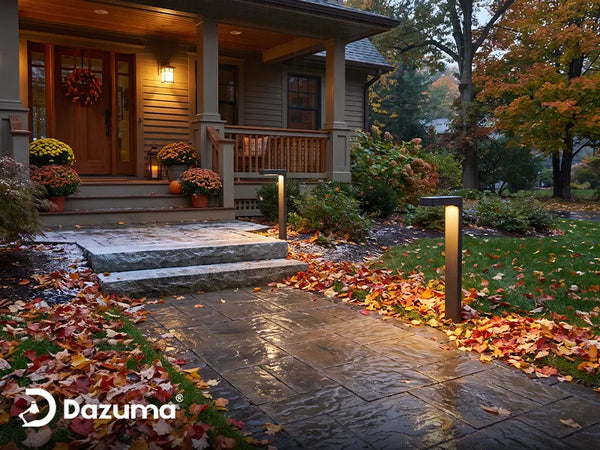
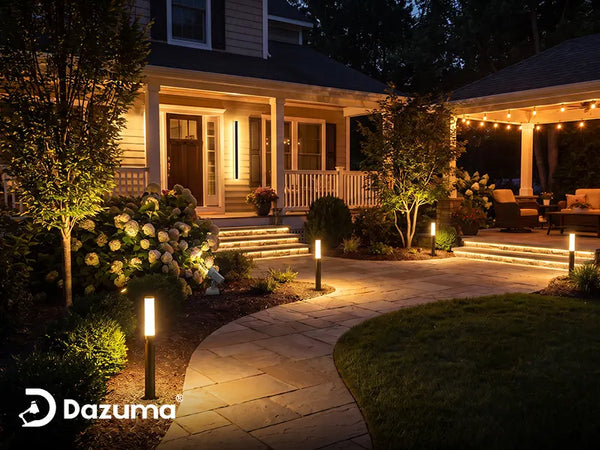
Bollard lights are short, sturdy, cylindrical or rectangular fixtures mounted directly in the ground, typically standing between 24 and 48 inches tall. They're designed to sit low in the landscape, casting light outward and downward in a wide, diffused pattern that hugs the ground plane.
Originally used in commercial and municipal settings — parking lots, pedestrian pathways, park entrances — bollard lights have become a popular choice in residential landscape design over the past decade, particularly in modern and contemporary home styles. Their clean, architectural silhouette integrates naturally into garden beds, lawn edges, and paved surfaces without dominating the visual landscape the way a taller fixture can.
Because of their low mounting height, bollard lights are excellent at edge definition — marking the boundaries of a driveway, path, or planting bed with a consistent line of soft, low-level light. They don't try to flood an area from above; instead, they illuminate at knee height and below, creating a layered, ambient glow rather than overhead brightness.
What Are Post Lights?

Post lights are taller, more architectural fixtures — a lantern-style or decorative head mounted on a vertical post, typically standing between 5 and 8 feet tall. They're among the most recognizable forms of outdoor residential lighting, with roots going back to gas-lamp street lighting in American neighborhoods.
Where bollard lights blend into the landscape, post lights make a deliberate statement. A well-chosen post light at the entrance of a driveway communicates arrival — it frames the approach to a home, signals the boundary of a property, and adds architectural presence to the streetscape. In traditional, craftsman, colonial, or farmhouse-style homes, a post light at the driveway entrance is practically a design standard.
The height advantage of post lights translates directly into coverage: a fixture mounted at 6 feet throws light over a much wider radius than a bollard at 3 feet. A single post light can illuminate a meaningful stretch of driveway, an entire front walkway, or the full width of a garage apron. For long or wide driveways, that coverage efficiency matters.
Bollard Lights vs Post Lights: Side-by-Side Comparison
| Feature | Bollard Light | Post Light |
|---|---|---|
| Typical Height | 24 – 48 inches | 5 – 8 feet |
| Light Distribution | Low, wide, diffused glow | Broad overhead coverage |
| Primary Function | Edge definition, ambient accent | Wide-area coverage, entrance statement |
| Visual Impact | Low-profile, landscape-integrated | Tall, architectural, prominent |
| Best Home Styles | Modern, contemporary, minimalist | Traditional, craftsman, colonial, farmhouse |
| Fixtures Needed | More (spaced 6–10 ft apart) | Fewer (1–2 at entrance or spaced wider) |
| Glare Risk | Low — light stays near ground level | Moderate — can cause glare if over-bright |
| Typical Lumens | 400 – 1,200 lm per fixture | 800 – 2,500 lm per fixture |
| Installation | Ground stake or concrete footing | Anchor plate or concrete base required |
| Wiring Options | Low-voltage, solar, or hardwired | Typically hardwired (120V) |
What Driveway Lighting Actually Needs to Do
Before choosing a fixture type, it helps to be clear about what you're actually asking your driveway lighting to accomplish. Most driveways need to do three things at night — and understanding which matters most for your situation will point you toward the right fixture.
Safety and Edge Visibility
The primary job of driveway lighting is to let drivers and pedestrians navigate safely after dark. This means clearly defining the edges of the driveway so you know where the pavement ends and the lawn begins — especially when reversing, parking, or pulling in after dark. It also means providing enough ambient brightness that you can see obstacles, people, or pets in the path of a moving vehicle.
Curb Appeal and Architectural Presence
Driveway lighting is one of the most visible exterior design elements on a property after dark. Done well, it frames the home, guides the eye toward the entrance, and communicates a sense of care and quality. Done poorly — wrong scale, wrong style, wrong placement — it looks like an afterthought.
Light Distribution and Coverage
A long, wide driveway has very different coverage requirements than a short city driveway. The number of fixtures needed, the spacing, and the mounting height all depend on how much area needs to be lit and how evenly the light needs to be distributed.
When Bollard Lights Are the Better Choice for Driveways
Bollard lights earn their place on driveways where precise edge definition matters more than wide-area coverage — and where the design intent is clean, modern, and landscape-integrated.
Modern and Contemporary Homes
If your home has clean lines, a flat or low-pitched roof, large windows, and minimal ornamentation, a traditional post lantern is going to look visually mismatched. Bollard lights — especially in matte black, brushed aluminum, or dark bronze — complement modern architecture naturally. Their linear, low-profile form reads as intentional and designed rather than decorative.
Narrow or Curved Driveways
Bollard lights excel at tracing the contours of a curved or narrow driveway, where their low, directional light keeps the edge visible without creating glare for the driver. A line of bollards along the inside of a curve acts almost like runway lighting — guiding the vehicle through the turn with visual precision. Browse our full range of bollard lights to find styles that work for both straight and curved driveway layouts.
Landscape Integration
When your driveway is bordered by garden beds, low hedges, or planting areas, bollard lights integrate seamlessly into the planting scheme in a way that taller post lights cannot. They feel like part of the landscape design rather than a separate lighting installation.

When Post Lights Are the Better Choice for Driveways
Post lights come into their own when your driveway needs a strong visual anchor, broad light coverage, or an entrance feature that matches the character of a traditional home.
Traditional and Classic Architecture
For craftsman, colonial, Victorian, or farmhouse-style homes, a post light at the driveway entrance is essentially a design expectation. The proportions, materials, and lantern forms of traditional post lights are designed to complement these architectural styles — and they do it better than any bollard could. Scale matters here: a 6-foot post light with a substantial lantern head reads correctly against a two-story traditional home in a way that a 30-inch bollard simply does not.
Long Driveways That Need Coverage Efficiency
On a driveway that runs 50, 75, or 100 feet from street to garage, lighting the full length with bollards alone would require a significant number of fixtures and a substantial low-voltage wiring run. A pair of post lights — one at the street entrance, one near the garage — can cover the same driveway with just two fixtures, thanks to their height-to-coverage advantage. For coverage efficiency on longer driveways, post lights win. Explore our post lights collection for classic and transitional styles suited to both long driveways and formal entrance designs.
Entrance Statement and Property Framing
Two matching post lights flanking the entrance to a driveway create one of the most universally effective curb appeal moves in residential exterior design. They frame the arrival experience, signal the transition from public street to private property, and add a sense of symmetry and permanence that low-profile bollards can't replicate.
Height and Lumen Guide for Driveway Lighting
| Driveway Type | Recommended Fixture | Ideal Height | Lumens per Fixture |
|---|---|---|---|
| Short city driveway (<30 ft) | Post Light (entrance pair) | 5 – 6 ft | 800 – 1,200 lm |
| Medium driveway (30–60 ft) | Post Lights or Bollards + Post | Bollards: 24–36 in / Posts: 6 ft | Bollards: 500–800 lm / Posts: 1,200–2,000 lm |
| Long driveway (60+ ft) | Post Lights (spaced 20–30 ft) | 6 – 8 ft | 1,500 – 2,500 lm |
| Curved or narrow driveway | Bollard Lights (inside of curve) | 24 – 42 in | 400 – 800 lm |
| Formal / estate entrance | Post Lights (flanking gate or entry) | 7 – 8 ft | 2,000 – 2,500 lm |
Can You Use Both Together?

Absolutely — and for many driveways, especially medium to longer ones, using both types together produces the best overall result. The approach mirrors the layered lighting philosophy used throughout good exterior design.
A typical combined approach:
- Post lights at the street entrance — frame the driveway opening, create the arrival moment, provide wide light coverage at the transition from street to property.
- Bollard lights along the driveway edges — define the lane boundaries continuously, provide consistent low-level ambient light, and guide the driver through any turns or narrowing sections.
- Post light near the garage or turnaround area — provides a second high-mounted coverage anchor at the terminus of the driveway.
This combination gives you the coverage efficiency of post lights and the edge precision of bollards, without requiring an excessive number of either. It also creates a richer, more layered nighttime appearance than either fixture type could produce alone. For landscape-integrated driveway designs, pairing bollards with border planting is a particularly effective combination — browse our landscape lighting collection for coordinated bollard and path light options that work together seamlessly.
Installation Considerations

Wiring: Low-Voltage vs Line Voltage
Bollard lights most commonly run on 12V low-voltage systems — the same landscape lighting infrastructure used for path lights and garden spotlights. Low-voltage wiring is relatively DIY-friendly, requires no conduit in most jurisdictions, and can be powered by a single transformer near the house. Solar-powered bollards are also increasingly practical for driveways with good sun exposure.
Post lights typically require 120V line voltage, which means a hardwired connection run through conduit to a dedicated outdoor circuit. This is a job for a licensed electrician in most jurisdictions — the installation is more involved and more permanent, but it also provides more reliable power output and supports higher-lumen fixtures.
Spacing Guidelines
For bollard lights along a driveway edge, a spacing of 6 to 10 feet between fixtures typically provides continuous edge visibility without overlap or gaps. For post lights used as standalone coverage fixtures, 20 to 30 feet of spacing is standard, with closer spacing on darker or more complex driveway layouts.
Foundation and Anchoring
Both fixture types require a stable base. Bollard lights in garden beds can often use manufacturer-supplied ground stakes, while bollards set in pavement or high-wind areas should be set in a small concrete footing. Post lights universally require a concrete anchor base — typically a pre-cast anchor or a poured footing — to keep a 6–8 foot fixture stable in wind. Skipping the proper foundation is the most common DIY installation mistake, and one that leads to tilting, leaning fixtures within the first year.
Find Your Driveway Lighting Match at Dazuma
Whether you're drawn to the clean, low-profile look of bollard lights or the classic statement of a well-placed post light, the right choice comes down to your driveway's specific layout, your home's architectural style, and what you need the lighting to actually do at night.
Both fixture types are represented in our outdoor lighting lineup — explore our curated outdoor lighting collection to compare styles, finishes, and IP ratings side by side. Every fixture is built for outdoor use, rated for real weather, and designed to look as good in three years as it does on the day it's installed.
Your driveway is the first thing visitors see — and the last thing you see before you close the garage door at night. It deserves lighting that does the job right.