
When planning a landscape illumination project, homeowners are immediately faced with a critical technological choice that will impact their property for decades: Halogen vs LED Outdoor Lights. For many years, halogen bulbs were the undisputed gold standard in the architectural lighting industry. They produced a beautifully warm, familiar glow and boasted excellent color rendering. However, the rapid advancement of solid-state Light Emitting Diode (LED) technology has completely upended the exterior design market. Today, clients frequently ask me if the higher upfront price tag of integrated LED fixtures is genuinely justified.
To answer the question of "Which saves more money?", we must look far beyond the initial checkout cart. The true cost of an Outdoor Lighting system is a complex equation involving daily energy consumption, ongoing maintenance labor, hardware replacement cycles, and underlying electrical infrastructure. As a professional landscape lighting designer, I have audited hundreds of residential properties to calculate these exact metrics. Let us dive deep into the designer mathematics and reveal the true financial reality of illuminating your estate.

Cost Factor 1: The Energy Consumption Formula
The most immediate and noticeable financial difference between halogen and LED technology is electrical efficiency. Halogen bulbs operate via thermal combustion; they pass electricity through a tungsten filament until it gets so incredibly hot that it glows. In fact, nearly 90% of the energy consumed by a halogen bulb is wasted as pure heat, with only 10% converting into visible light.
Conversely, LEDs generate light through quantum physics, passing electrons through a semiconductor. They run incredibly cool, converting almost all their electrical draw directly into high-lumen output.
To put this into perspective, a traditional halogen landscape spotlight requires 50 watts of electricity to properly illuminate a tree. An integrated LED fixture from our Outdoor Spotlights collection can produce the exact same brightness using only 7 watts. If you install a modest residential system consisting of exactly 20 lights running consistently for 6 hours every single night, a halogen system will consume roughly 2,190 kilowatt-hours (kWh) per year. The identical LED system will consume just 306 kWh. At the national average of $0.15 per kWh, LEDs save you nearly $300 a year on your utility bill alone.

Cost Factor 2: Lifespan And The Annoyance Of Replacement
The financial drain of a halogen system extends well beyond the monthly electricity bill; the recurring maintenance costs are staggering. A premium, high-quality traditional halogen bulb is typically rated for approximately 2,000 to a maximum of 4,000 hours of operational life. If your landscape lights run 6 hours a night, you will be replacing every single halogen bulb in your yard every 12 to 18 months.
Modern LED diodes, however, boast an astonishing lifespan of 40,000 to 50,000 hours. Under that exact same 6-hour daily usage schedule, a premium LED fixture will easily last for 18 to 22 years before experiencing any noticeable lumen degradation. When you factor in the retail cost of purchasing replacement halogen bulbs year after year—not to mention the physical labor, frustration, and ladder-climbing required to change burned-out Outdoor Wall Lighting fixtures on your second story—the upfront premium of an LED system pays for itself within the first three years of ownership.
Cost Factor 3: The Hidden Transformer And Wiring Savings
Here is the ultimate industry secret that most homeowners fail to consider: LED technology drastically reduces your initial installation infrastructure costs. In low-voltage landscape lighting, every fixture must connect to a central transformer that converts your home's 120V power down to a safe 12V current.
Because halogen lights draw massive amounts of wattage, a 20-light halogen system requires a massive, incredibly expensive 1200-watt transformer. Furthermore, pushing that much power requires you to purchase thick, expensive 10-gauge or 8-gauge copper wire to prevent "voltage drop" at the end of the line.
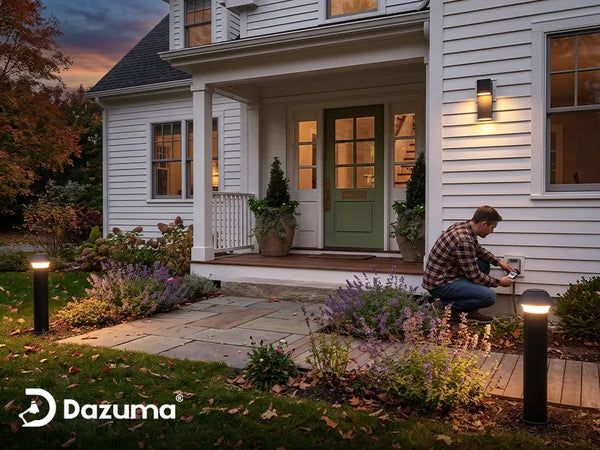
Because an identical 20-light LED system only draws a total of 140 watts, you can safely power the entire yard using a much smaller, highly affordable 300-watt transformer. You can also utilize standard, thinner 12-gauge wire, which is cheaper to buy and significantly easier to bury in the dirt. This infrastructural savings often completely offsets the higher cost of the LED Path Lights themselves during the initial purchase.
Professional Data: 10-Year Cost Of Ownership Comparison
To visually demonstrate the irrefutable financial superiority of LED technology, we have calculated the estimated 10-year total cost of ownership for a standard 20-fixture residential landscape installation. This mathematical breakdown includes hardware, electricity, and replacement materials:
| Financial Metric (10-Year Span) | Traditional Halogen System (50W) | Modern LED System (7W) |
|---|---|---|
| Estimated Total Energy Cost | $2,850.00 | $395.00 |
| Transformer & Wiring Cost | High (Large transformer, thick wire) | Low (Small transformer, standard wire) |
| Bulb Replacements Needed | 150 - 200 Bulbs | 0 Bulbs (Integrated System) |
| Estimated Maintenance Material Cost | $1,200.00+ | $0.00 |
| 10-Year Operational Expense | $4,050.00+ | $395.00 |

Upgrade Your Estate Wisely
The verdict is absolute: while halogen fixtures may look cheaper on the hardware store shelf, they are an incredibly expensive financial trap in the long run. By choosing modern, high-efficiency LED illumination, you guarantee a brilliantly lit property with virtually zero maintenance and drastically reduced energy bills. Ready to make the smart investment?
Shop Professional LED Flood Lights