
Who This Is For: This guide is for homeowners planning a front entry update who want outdoor wall lights to look balanced beside the door, illuminate the lock and steps, and avoid shining directly into visitors’ eyes.
Why Door-Side Wall Lights Often Look “Almost Right”
Outdoor wall lights can be electrically correct and still feel wrong. Too high, and the lock and visitor’s face stay shadowed. Too low, and the light may glare, look undersized, or become vulnerable to bumps and weather splash.
Many diagrams give one number without explaining whether it refers to the fixture top, junction-box center, or bottom edge. The best placement balances door height, light-source center, fixture length, and the visitor’s approach—not one universal number.

Quick Answer: How High Should Outdoor Wall Lights Be?
For most standard front doors, start with the fixture or junction-box center about 66 to 72 inches above the finished porch floor, slightly above the average visitor’s direct line of sight.
Treat that range as a starting point. A small lantern may fit it closely, while a 48-inch linear sconce may need adjustment so its top clears the trim and its bottom stays above the main handle area. Traditional fixtures are often roughly one-quarter to one-third the door height; long architectural lights should relate to the full vertical opening.
Why Mounting Height Matters More Than It Seems
You Need Light at the Lock, Not Only Above the Door
A common complaint is, “The porch is bright, but I still cannot see the keyhole.” The fixture may be high or directing light upward while the hand-level task area stays dark. Test whether the lock, handle, threshold, and nearest step remain readable when someone stands in front of the door.
The Brightest Part Should Not Hit the Eyes
A clear lantern with exposed bulbs behaves differently from an indirect up-and-down light. Bare bulbs at eye level can cause squinting, while shielded or backlit fixtures reduce discomfort. Judge height together with light direction; the guide on how to avoid glare from outdoor wall lights explains why brightness alone does not determine comfort.
The Light Should Make the Door Feel Taller, Not Shorter
During the day, the fixture becomes part of the architecture. Leave breathing room above and below it so the light relates naturally to the door panels, handle, sidelights, and house numbers.

Test the Entry From a Visitor’s Position
Stand where someone waits after ringing the bell. Check whether the light reaches the face and lock while remaining outside the strongest direct viewing angle.
How to Measure Outdoor Wall Light Height Correctly
Measure From the Finished Walking Surface
Measure from the porch floor, landing, or step where the visitor actually stands—not from the soil, driveway slope, or unfinished subfloor. If the entrance has multiple levels, use the main landing directly in front of the door.
Mark the Centerline First
Mark possible centerlines at 66, 69, and 72 inches, then tape the fixture’s full outline. This reveals whether a long light crowds the trim or extends too close to the ground.
Check the Actual Light Source Location
The junction box may be centered while the LEDs are not. Evaluate glare from the brightest visible section, not only the mounting plate.
View the Mockup From Four Places
- From the sidewalk or driveway, to judge curb appeal.
- From the main approach path, to check glare.
- From directly in front of the door, to check the lock and visitor’s face.
- From inside through any glass panel, to check reflections.
The broader guide to wall-mounted lighting placement, height, and coverage can help when the same project includes garage, patio, or side-yard fixtures.
Mock Up the Full Fixture, Not Just the Junction Box
A center mark can look reasonable while the actual fixture extends too high or too low. Use tape or cardboard to show the complete silhouette before electrical work begins.

Should One Light and Two Lights Be Mounted Differently?
One Light Beside the Door
A single fixture is usually most useful on the latch side, where it lights the handle, lock, doorbell, and visitor. Leave clearance for casing, storm-door swing, house numbers, and the camera view. Give it enough visual presence without pushing it unusually high.
Matching Lights on Both Sides
With a pair, align both centerlines precisely because the door creates a strong reference. Two moderate lights often produce better facial lighting and fewer hard shadows than one very bright fixture.
What if One Side Has a Sidelight or Narrow Wall?
Do not force symmetry into a narrow wall strip. One well-placed latch-side light plus an overhead porch fixture may look and function better than a cramped pair.
Adjust the Height for Fixture Size and Shape
| Fixture Type | Starting Center Height | What to Check |
|---|---|---|
| Compact Shielded Sconce | About 66–72 inches | Does the downward light reach the handle and landing? |
| Clear Lantern | Often near the upper part of the range | Is the exposed bulb above the direct eye line? |
| Up-and-Down Light | About 66–72 inches, then test beams | Do the beams avoid trim, soffits, and visitor glare? |
| 24- to 40-Inch Linear Light | Center near 66–72 inches as a mockup | Does the bottom stay clear of the handle and the top clear the header? |
| Very Long Architectural Light | Determined by full fixture length | Use the door proportions and wall height instead of a fixed centerline alone |
When comparing styles, start with Outdoor Wall Lighting, then narrow the choice by beam direction, weather exposure, and available wall width. For contemporary entrances, Modern Outdoor Wall Lighting includes compact geometric fixtures and taller architectural forms.

How Different Entrances Change the Mounting Height
Standard 80-Inch Front Door
For a typical 6-foot-8-inch door, a fixture center around 66–72 inches usually creates a comfortable relationship with the handle and upper door panels. Confirm the fixture top does not crowd a low porch ceiling or decorative trim.
Eight-Foot-Tall Door
Tall doors can support larger or longer wall lights, but do not automatically raise the fixture to the top third of the door. The entry still needs comfortable light at human height. A taller fixture often solves the scale problem better than mounting a small fixture unusually high.
Door With a Transom
Treat the door and transom as one architectural composition, but keep the useful light near the door opening. Wall lights should not be raised beside the transom so far that the handle and landing remain dark.
Covered Porch
A deep overhang reduces direct rain but can make the ceiling and upper wall darker. Up-and-down fixtures can add architectural glow, while a porch ceiling light can fill the center. Covered does not mean dry, so the fixture must still be rated for the actual damp or wet exposure.
Exposed Entry
Wind-driven rain, snow, irrigation, and roof runoff make weather rating and installation quality especially important. Use a wet-location-appropriate fixture, exterior-rated box, proper gaskets, and manufacturer-approved sealing. Do not seal drainage or weep openings that are designed to release moisture.
Entry With a Video Doorbell
A very bright wall light placed close to a camera can overexpose faces or create reflections at night. Mock up both devices together. The doorbell needs a clear approach view, while the fixture should illuminate the visitor without shining directly into the lens.
A Compact Up-and-Down Light for a Covered Entry
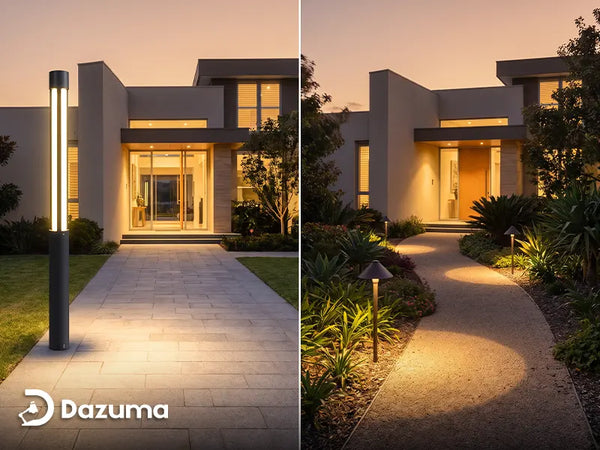
A smaller up-and-down fixture can work beside a standard door when you want the wall itself to glow without a bulky lantern projecting into the walkway. Because the light is directed along the wall, the nighttime test should focus on whether enough illumination reaches the lock and landing.
The Up & Down Wall Lights collection is useful for comparing beam shapes and fixture heights before choosing the mounting position.

Up Down Lighting Wall Lights Modern Curved LED Waterproof Light
Price: $91.99
This compact curved fixture creates upward and downward wall illumination and is available in several sizes. Its IP54 rating makes it better suited to a semi-outdoor entry with shelter, such as a covered doorway or porch beneath an eave.
- Integrated LED with upward and downward light direction.
- Aluminum body with glass shade and several finish options.
- Selected variants include a motion-sensing option.
How to Position a Long Linear Light Beside the Door
Long wall lights create a strong vertical line, so their top and bottom edges matter more than the junction-box center. Leave breathing room below the porch ceiling and above the landing, then relate the body to a glass panel, vertical handle, or door-panel division.
A 24-inch fixture may fit the normal 66–72-inch center range. A 48- or 60-inch fixture may need adjustment to clear the handle and header. Keep a deliberate gap from sidelights, casing, and nearby corners.

Use the Door’s Vertical Lines
A long fixture looks intentional when its edges relate to the door panels, handle, or sidelights. Random placement is more noticeable with a linear sconce than with a compact lantern.
A Long Linear Light for a Tall Modern Entrance
For an eight-foot door or wide minimalist facade, a long linear fixture provides scale that a small lantern cannot and visually connects the tall doorway to the surrounding wall.
Compare different vertical proportions in the Black Outdoor Wall Lights collection before committing to the electrical-box height.
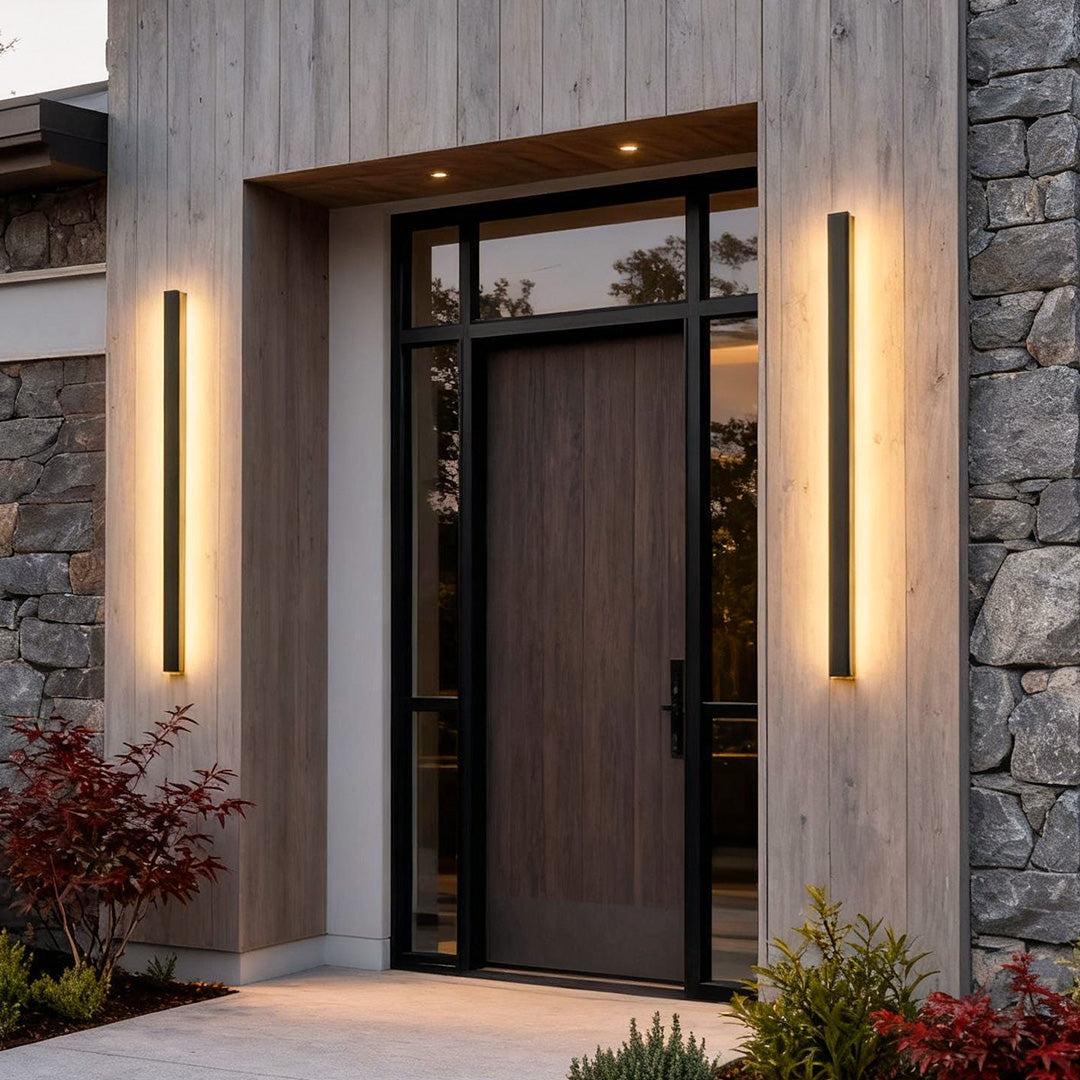
Outdoor Strip Wall Light Black Linear LED Integrated Light
Price: $232.99
This narrow vertical light is available in multiple lengths, making it useful for tall modern doors and larger wall sections. Its IP65 rating provides stronger weather protection for outdoor entrances with greater rain and snow exposure.
- Black iron body with a white PMMA shade.
- Warm white, white, three-step dimming, and RGB variants are listed.
- Long size range supports different door heights and facade proportions.
Common Outdoor Wall Light Mounting Mistakes
Measuring to the Top of the Fixture
Most height guidance refers to the center of the fixture or junction box. Using the top edge can place the actual light source much too low.
Mounting Both Sides From Separate Measurements
Small floor or trim irregularities can produce a visibly uneven pair. Establish one level reference line across the doorway.
Choosing the Junction-Box Location Before the Fixture
This is especially risky with long linear lights. Select the general fixture dimensions early so framing, wiring, and mounting support can be planned around the real product.
Ignoring the Storm Door and Trim
Check door swing, casing width, decorative shutters, and future holiday decorations. A projecting fixture can interfere even when the electrical box appears clear.
Using an IP54 Fixture in a Fully Exposed Location
IP54 provides limited protection and may be appropriate for a sheltered semi-outdoor area, but it should not automatically be treated like a more weather-resistant IP65 fixture. Follow the product instructions and local electrical requirements.
Forgetting the Camera and House Numbers
Bright light can wash out a video doorbell image, while a tall fixture can physically compete with vertical address numbers. Plan all wall-mounted entry elements together.
Skipping a Nighttime Test
Daytime symmetry does not reveal glare, shadows, reflections, or whether the lock is readable. Temporarily power or simulate the fixture before finalizing multiple mounting points whenever practical.
Entry Wall Light Checklist Before Installation
- Measure from the finished porch floor or landing.
- Mark a starting centerline between 66 and 72 inches.
- Mock up the fixture’s full height and width.
- Check the door handle, lock, trim, storm-door swing, and house numbers.
- View the location from the walkway, doorstep, street, and inside the house.
- Confirm the brightest light source will not sit directly in the visitor’s eye line.
- Check video-doorbell exposure and field of view.
- Match the fixture’s weather rating to the actual rain and snow exposure.
- Use exterior-rated boxes, connectors, and mounting hardware.
- Have a qualified electrician perform or review permanent hardwired installation.
Final Advice: Start at 66–72 Inches, Then Design Around the Door
For most entrances, a fixture center about 66–72 inches above the finished floor is a dependable starting point. Adjust for fixture length, door height, light direction, visitor eye line, and exposure.
Compact lights can often follow that range closely. Long linear fixtures need a full-size mockup because their top and bottom affect the composition as much as the center. The final result should make the lock visible, light visitors comfortably, preserve the camera view, and keep the door as the focal point.