
Who This Is For: This guide is for homeowners choosing an outdoor wall sconce for a front door, garage, porch, patio, or exterior passage—and anyone worried that the fixture will look undersized, overwhelm the architecture, or interfere with the door.
Introduction
An outdoor wall sconce often looks much smaller in your hand than it does on a product page—and much smaller again once it is mounted beside a full-height door. That scale shift is why homeowners commonly buy a fixture that is technically functional but visually disappears from the street.
The right size is not one universal number. It depends on whether you are using one light or a pair, the height and width of the door or garage opening, the amount of wall available, the sconce’s projection, and the fixture’s visual weight. A 24-inch lantern with a wide frame can feel larger than a 40-inch linear LED bar that is only two inches wide. Good sizing therefore combines a proportion rule with a real measurement of the installation area.

The Quick Answer: Start With One-Third or One-Quarter of the Door Height
For a traditional lantern-style fixture beside a standard entry door, use these proportions as a starting point:
- One sconce: choose a fixture roughly one-third the height of the door.
- Two matching sconces: each fixture can be closer to one-quarter the door height.
- Garage-door sconces: start around one-quarter the height of the garage opening, then adjust for wall space and viewing distance.
For an 80-inch front door, those rules suggest about 20 inches for each light in a pair or roughly 24–27 inches for one more prominent fixture. These are visual guidelines, not electrical codes. If your entry includes a transom, broad sidelights, heavy stonework, or a two-story wall, the larger architectural composition may support a bigger sconce.
| Location | Useful Starting Size | What Changes the Choice |
|---|---|---|
| Single front-door sconce | About 1/3 of door height | Sidelights, transom, viewing distance |
| Pair beside a front door | About 1/4 of door height each | Trim width, symmetry, handle clearance |
| Beside a garage door | About 1/4 of opening height | Wall pier width and driveway view |
| Covered porch or patio | Scale to the wall and furniture zone | Ceiling light, seating, and sheltered exposure |
Use the Door as Your Starting Scale—Then Look at Visual Mass

Measure Height First
Door height is a stable reference because it remains visible from the curb and from the porch. Measure the door slab, divide by four for a pair or by three for a single fixture, and use the result to create a shopping range—not an exact requirement.
Next, evaluate visual mass. This means how much space the fixture appears to occupy, not merely the number listed under “height.” Thick frames, opaque shades, wide backplates, and dark finishes read as visually heavier. Open lanterns, clear glass, and narrow LED bars read lighter. A slim 30-inch bar may be quieter than a solid 18-inch box sconce.
Width is a helpful secondary check. For many front entries, a sconce width around 15–25 percent of the door slab width feels balanced. On a 36-inch door, that gives a rough range of 5.5–9 inches. However, a sculptural or very deep fixture can appear larger than its face width suggests, so never buy from width alone.
If you are still comparing fixture families, browse Outdoor Wall Lighting with your target height, width, and projection already written down. Filtering by style first and measuring later is the usual path to an expensive scale mismatch.
Measure the Actual Wall Zone, Not Just the Door
The electrical box tells you where the fixture connects, but it does not tell you how much fixture the wall can support. Photograph the wall straight on and record the clear rectangle around the box.
- Measure from door casing to the nearest corner, column, window, or downspout.
- Measure from the porch floor to the soffit or ceiling.
- Mark the electrical-box center and its distance from the trim.
- Check the backplate dimensions. It must cover the box and sit flat on the wall surface.
- Check the fixture’s full projection. Include curved arms, glass, and decorative caps.
A good practical target is to preserve visible wall around the fixture rather than filling every available inch. For a conventional sconce, leaving at least several inches of breathing room above, below, and beside the fixture keeps it from colliding visually with trim. With an outward-swinging screen or storm door, open the door fully and measure the swept path before choosing a deep light.
Use a Paper or Cardboard Template
Cut a rectangle to the listed fixture dimensions and tape it to the wall. View it from the sidewalk, driveway, and inside the approach path. Add a folded side piece to represent projection if the sconce is deep.

This low-tech test is more reliable than holding a tape measure vertically against the siding. A template reveals whether a fixture feels cramped beside the casing, too high under the soffit, or too small when viewed from the driveway.
Choose the Sconce Size for the Installation Location
Front Door: Size for Arrival and Facial Visibility
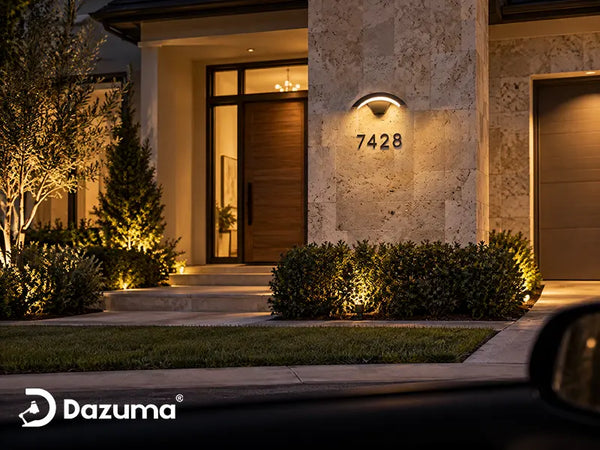
At the main entry, the sconce is part of the home’s first impression and should help visitors see the handle, threshold, house number, and face of the person answering the door. A pair creates symmetry, so each fixture can be slightly smaller than a single sconce. If there is only one junction box, a larger fixture can carry more visual weight without needing to be extremely bright.
Mounting height and fixture size must be considered together. A common starting point is to place the center of the light source around 60–66 inches above the finished floor, then adjust so the top does not crowd the header and the light does not shine directly into eye level. For more detailed placement planning, see Wall-Mounted Lighting: Placement, Height, and Coverage.
Garage: Go Larger Than You Expect

Garage fixtures are viewed from farther away and compete with a large door surface. Small sconces can disappear even when their lumen output is adequate. Start with the garage-opening height, then confirm that the fixture leaves enough width on the side wall or center pier.
On a narrow pier between two doors, width and projection may limit you more than height. A tall, slim sconce can provide presence without extending into the door trim. If the garage is a major part of the front elevation, this guide to outdoor sconces for garage doors offers additional style and placement context.
Covered Porch or Patio: Coordinate With the Whole Lighting Layer
A covered space may already have a ceiling fixture, recessed lights, or a pendant. In that setting, the wall sconce does not need to light the entire patio by itself. Scale it to the wall bay and nearby furniture, and decide whether it should be a quiet navigation light or a visible decorative feature. The Outdoor Porch Lighting collection can help you compare wall-mounted options with other fixture types used in the same zone.

Up Down Lighting Wall Lights Modern Curved LED Waterproof Light
Price: $115.99 for the selected set of two
This compact, curved design is available in four fixture heights, making it easier to match a sheltered entry, porch bay, or balcony wall without overwhelming narrow trim.
- Aluminum body with a glass shade and up-and-down light.
- Four finish combinations coordinate with modern exterior palettes.
- IP54 protection is best matched to a sheltered or semi-outdoor wall.
How to Size Tall Linear Outdoor Wall Sconces
Tall linear fixtures are the main exception to the one-third-of-the-door rule. Because they are narrow and often emit light along a slim line, they can extend farther vertically without feeling oversized. Instead of judging height alone, evaluate three things:
- Fixture-to-wall ratio: the bar should feel intentional within the full wall bay, with clear space at both ends.
- Fixture-to-door relationship: align the light with a meaningful architectural line, such as the door panel, handle zone, or top of the glazing.
- Light pattern: a very long luminous line becomes an architectural feature, while a shorter bar behaves more like a conventional sconce.
A 40- or 48-inch linear wall light can work beside a tall modern door even though it exceeds the traditional formula, especially when its face is only a few inches wide. Longer versions are better reserved for broad façade walls, tall entry volumes, large patio doors, or repeated installations where the vertical rhythm is part of the design.


Outdoor Strip Wall Light Black Linear LED Integrated Light
Price: $232.99 for the selected 24-inch configuration
Seven length options let this slim black fixture scale from a residential doorway to a tall contemporary façade. Its narrow profile keeps the visual weight lighter than a wide lantern of similar height.
- Iron body, white PMMA shade, and black finish.
- Warm white, white, three-step dimming, and RGB options are listed.
- IP65 protection suits more exposed exterior applications.
When comparing Modern Outdoor Wall Lighting, note whether dimensions are listed as height, length, depth, or projection. Product drawings sometimes rotate the fixture, so the largest number is not always the installed vertical dimension. Confirm the orientation shown in the installation image.
Projection and Clearance Can Rule Out an Otherwise Perfect Size
A sconce can look proportional from the front and still be wrong from the side. Projection affects walking clearance, door operation, glare, and how easily the fixture catches rain or debris. Check these conditions before ordering:
- Will a storm or screen door strike the fixture when fully open?
- Does the sconce extend into a narrow passage or shoulder-height walking path?
- Can the backplate sit flat across lap siding, stone, or brick?
- Is there enough clearance to remove glass or access service parts?
- Will a camera, house number, gutter, or downspout interrupt the light pattern?
Up-and-down fixtures also need clean wall above and below the apertures. A soffit very close to the top can cut off the beam, while a deep trim ledge below can create a harsh bright patch. Browse Up & Down Wall Lights only after measuring the uninterrupted wall surface available for both beams.
Do a Side-View Check
Stand where people approach the door and look across the wall, not only straight at it. A deep sconce can feel bulky in a narrow porch even when its front elevation looks balanced.
Size, Brightness, and Weather Rating Are Separate Decisions
Do not buy a larger fixture solely because you need more light. Integrated LEDs, optics, shade materials, and beam direction can make a small sconce perform differently from a large lantern. Compare verified lumen output when available, then consider glare and distribution. A bright exposed source at eye level may be less comfortable than a shielded fixture that sends light toward the wall and threshold.
Color temperature also changes perception. Warm light around 2700K–3000K tends to soften stone, brick, and wood, while cooler light can make edges and contrast appear sharper. It does not physically change the fixture size, but it can make a high-output sconce feel more visually dominant at night.
Finally, match the weather rating to exposure. A covered wall under a deep roof is different from an uncovered garage face receiving wind-driven rain. IP54 indicates protection against limited dust ingress and splashing water, while IP65 provides stronger dust and water-jet protection. Follow the product’s installation guidance, local electrical requirements, and an electrician’s advice for the actual location.
Common Outdoor Wall Sconce Sizing Mistakes
Choosing From the Product Photo Alone
Lifestyle images can use tall doors, wide camera lenses, or cropped walls that change perceived scale. Read the dimension drawing and recreate the outline on your own wall.
Measuring Only the Fixture Height
Width, depth, backplate size, opacity, and finish all affect visual mass. Compare the complete silhouette, especially if the sconce has an arm or projecting shade.
Using the Same Size Everywhere
The porch, side door, garage, and patio do not have the same viewing distance or architectural scale. A consistent family can use different sizes while maintaining a coordinated exterior.
Ignoring the Pair Effect
Two fixtures create more combined presence than one. If you place a large sconce on both sides of a narrow door, the entry can feel squeezed even when each fixture fits its individual wall section.
Letting the Fixture Crowd the Trim
A light that nearly touches the casing looks accidental. Allow visible separation and verify that the backplate, not just the fixture body, fits the mounting surface.
Final Buying Checklist
- Door, garage opening, or wall-bay height measured
- Fixture target range calculated from the architectural reference
- Clear wall width and height around the junction box confirmed
- Backplate dimensions checked against the wall surface
- Full projection checked from the side
- Storm door, trim, walkway, gutter, and camera clearances confirmed
- Paper template viewed from the curb and approach path
- Light output and glare evaluated separately from fixture size
- Weather rating matched to covered, semi-exposed, or exposed placement
- Installation requirements reviewed with a qualified electrician
Final Advice
For a standard front door, one-third of the door height for a single sconce and one-quarter for each light in a pair are dependable starting points. But the best final choice is the fixture that also fits the wall zone, clears the door and walking path, and has the right visual mass for the architecture.
If two sizes both fit, the slightly larger option often looks more resolved from the street—provided it preserves breathing room around the trim. Tall linear sconces deserve their own test: judge their narrow profile, beam pattern, and alignment rather than rejecting them because they exceed a traditional lantern ratio. Measure, make a template, and view the shape from where people will actually see it. That five-minute check is the most reliable way to avoid an undersized outdoor wall sconce.